
Ring-necked Pheasant


Ring-necked Pheasant (Phasianus colchicus): Complete Identification, Habitat Guide & Sound Library
Quick Answer: How to Attract & Identify the Ring-necked Pheasant
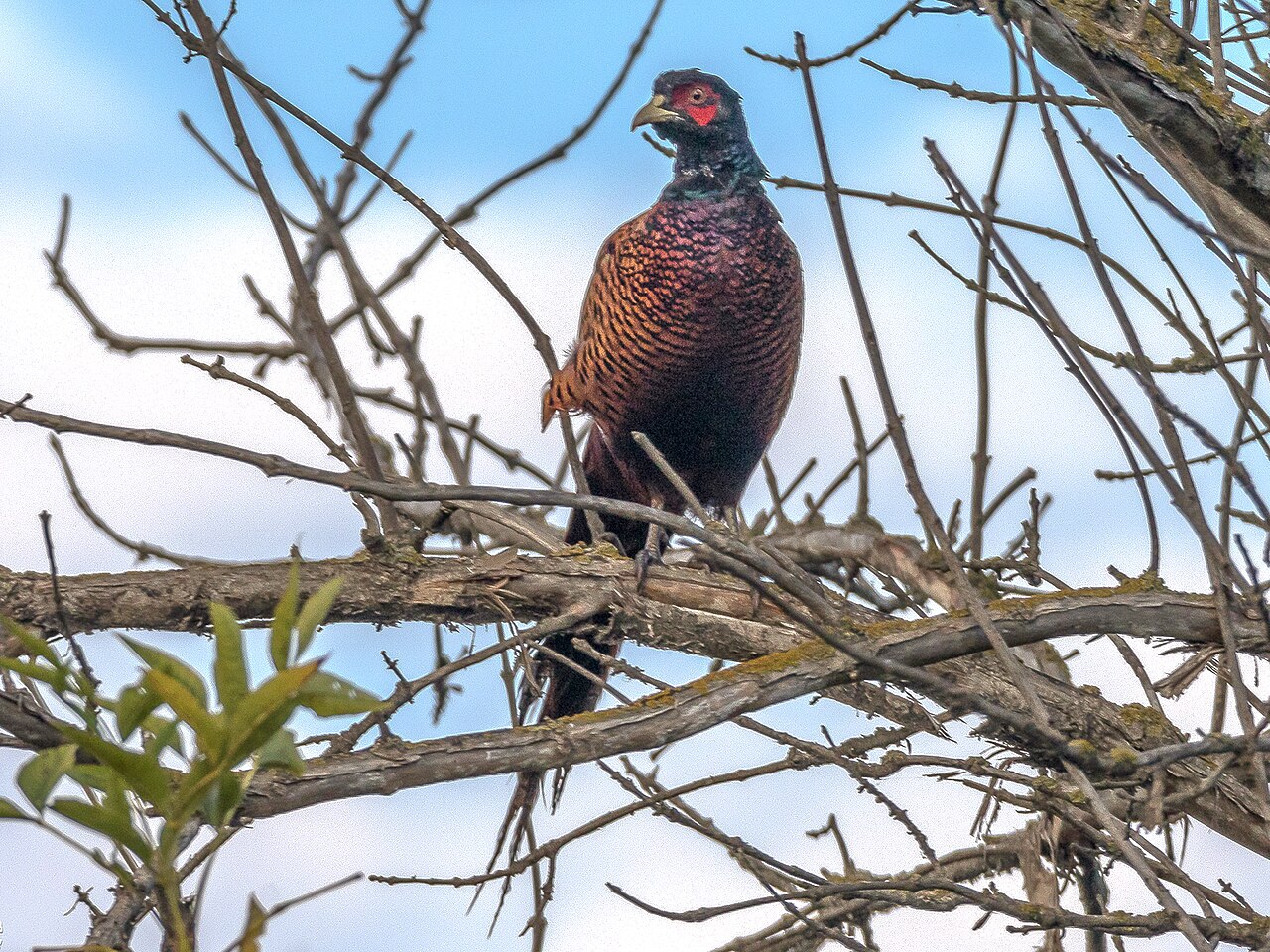
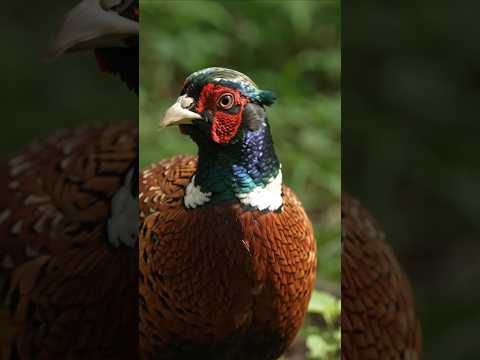
The Ring-necked Pheasant (Phasianus colchicus) is the gilded gamebird of American farmland — an Asian import, established since the 1800s, and the state bird of South Dakota. The rooster wears an iridescent green head, red face wattles, a white neck ring, and a yard-long tail; the hen is mottled buff-brown camouflage. Its voice is a loud, grating double-squawk crow followed by a whirr of wings. Rural properties support them with standing grass cover, un-mowed field margins, winter shelterbelts, and spilled grain. They share the field edge with the Northern Bobwhite and the Wild Turkey.
Species Physical Profile & Morphometrics
The Ring-necked Pheasant belongs to the pheasant and grouse family (Phasianidae) — an introduced Asian species now naturalized across the northern United States, strongest in the grain-and-grass country of the Midwest and Great Plains.
The identification formula: long tail + chicken-like shape + (rooster) iridescent green head and white ring. No other yard bird matches the rooster’s colors; the hen is a large, long-tailed, buff-brown ground bird, much bigger and longer-tailed than a grouse. The grating crow and explosive flush confirm it.
Essential Morphometric Field Marks:
- Body Length & Mass: Roosters reach 30 to 36 inches (76–91 cm) with the tail accounting for half of that; hens run 20 to 25 inches. Weight runs roughly 1.8 to 3.3 pounds (0.8–1.5 kg), roosters heavier.
- Wingspan: Wings are broad and rounded, built for the explosive vertical flush and a short fast flight — not for distance.
- Bill Structure & Color: A short, stout, horn-colored bill for picking grain, seeds, and insects off the ground.
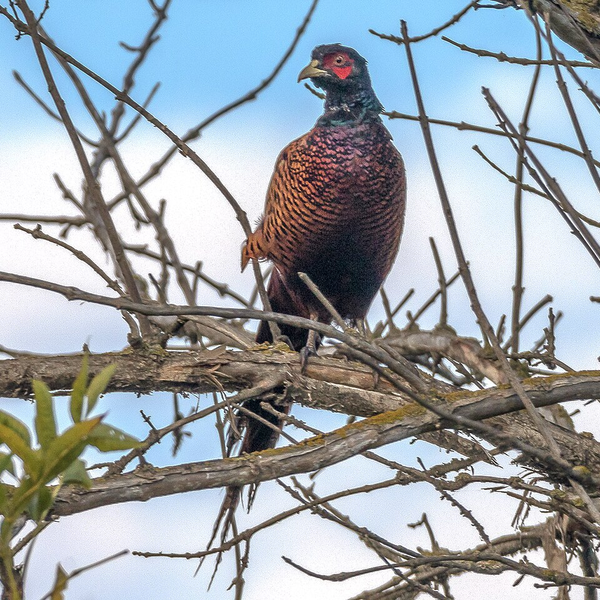
- Color Pattern: The rooster is copper and chestnut with an iridescent green head, red facial wattles, and usually a white neck ring; the hen is mottled buff-brown overall with a long pointed tail.
- Male vs. Female: The most extreme difference among backyard birds — the rooster is a jewel, the hen is a shadow: only the male has the green head, red wattles, and white ring.
The gilded rooster: green head flashing, red wattles blazing, crowing from a hay bale at dawn and dragging his yard-long tail through the stubble like a banner.
The invisible hen — mottled buff and brown, half the rooster’s size — she freezes flat at your feet rather than flush, then leads her striped chicks down the field margin like a string of bumblebees.
Ring-necked Pheasant Vocalization Guide (3 Field Recordings)
The rooster’s crow is a loud, grating, double-squawk — korrk-KOK — almost always followed by a rapid whirring of wings; at the flush he bursts out with a burst of excited cackling. All recordings below are real field audio via Wikimedia Commons — no simulations. For a deeper library, browse xeno-canto: Ring-necked Pheasant.
1. The Crowing Rooster
2. The Flush Cackle
3. The Contented Cluck
Habitat, Range & the Grain-and-Grass Country
The Ring-necked Pheasant lives in agricultural country with permanent grass cover: grain fields with weedy margins, hay meadows, cattail sloughs, shelterbelts, and ditch banks. It needs grass for nesting, dense cover for winter survival, and grain for food — farmland that provides all three holds pheasants; clean, wall-to-wall cropland does not.

The Heartland’s Imported Jewel
Established from Asia beginning in the 1880s, the species now holds year-round across the northern half of the Lower 48 — strongest from the Dakotas and Minnesota through Iowa, Nebraska, and Kansas, with populations west to the Pacific and east to the Atlantic seaboard.
For rural landowners: a property with standing winter grass, a shelterbelt, and un-tilled corners can hold pheasants year-round. The birds you crow-count in May are the same birds that will ride out January in your cattails.
Backyard Behavioral Patterns & Social Dynamics
The Ring-necked Pheasant is a ground-living farmland bird whose year runs on grass, grain, and cover. Four behaviors explain most of what you will observe:
🌅 The Dawn Crower
In spring, roosters crow from prominence at first light — hay bales, fence posts, ditch banks — wing-whirring after each crow to claim a breeding territory.
❄️ The Winter Bunch
In winter pheasants bunch into flocks in heavy cover — cattail sloughs and shelterbelts — feeding out to grain fields morning and evening on predictable paths.
🧊 The Freeze Defense
A pheasant’s first escape is to freeze and trust camouflage — birds hold until nearly stepped on, which is why the flush is so startlingly close and loud.
🌾 The Edge Feeder
They feed along edges, never far from cover — grain stubble beside grass, road margins beside cattails — a pattern that tells you exactly where to look.
Problem: “Pheasants Used to Live Here. How Do I Bring Them Back?”
The three most common Ring-necked Pheasant puzzles all have proven answers:
First, the disappearing flock: pheasant numbers track permanent grass cover — if field margins were tilled, hay mowed early, or sloughs drained, the birds left with the cover. Restore grass strips and idle corners, and pheasants find them within a season or two. Second, the winter wipeout: blizzard winters kill birds caught without heavy thermal cover — cattail sloughs, dense shelterbelts, and standing corn are survival habitat, not luxuries. Third, the hen you never see: nesting hens sit tight and invisible through May and June — delay mowing hay until mid-July, the single most effective thing a landowner can do for pheasant recruitment.
Method 1: Restore the Cover — Grass, Shelter & Food
Design for a ground bird that winters hard:
-
Leave Grass Standing
Un-mowed field margins, ditch banks, and idle corners are nesting and escape cover — the foundation everything else builds on.
-
Plant a Shelterbelt
A dense row of conifers or shrubs on the windward side gives winter thermal cover that decides whether birds survive January.
-
Provide Waste Grain Access
In deep snow, standing corn strips or scattered grain near cover carry flocks through the hardest weeks.
-
Delay the Hay Mowing
Mow after mid-July — early mowing destroys nests and kills sitting hens; late mowing saves a generation every year.
Method 2: Watch & Support — Observation Without Pressure
Enjoy the flock without stressing it:
-
Watch the Dawn Feed Run
In winter, birds move cover-to-field at first light on fixed routes — glass the field edge from a distance rather than walking the cover.
-
Listen for the Spring Crow
Crowing counts at dawn in April and May tell you how many roosters hold your land — the traditional pheasant census.
-
Keep Cats & Loose Dogs Home
Ground nests cannot survive free-roaming pets — restraint during May and June protects the year’s hatch.
-
Drive Field Edges Slowly
Winter flocks flush across roads at dusk — slow down beside cattails and standing corn, for the birds’ sake and your radiator’s.
Tool Solution: Recommended Hardware for Ring-necked Pheasant
Equipment matched to a farmland ground bird:
Permanent Grass Strip
An un-mowed margin of dense grass along field and fence — nesting cover in spring, escape cover all year.
- • Width: 20 ft or more
- • Mowing: Never in spring
- • Bonus: Bobwhites & meadowlarks
Shelterbelt & Standing Corn
A dense tree-and-shrub row plus a strip of unharvested corn near cover — the combination that carries flocks through blizzard weeks.
- • Rows: 2–3 dense rows
- • Food: Standing corn
- • Placement: Windward side
Dawn Field-Edge Watch
Binoculars, a thermos, and a parked position beside a winter feeding run — the reliable way to watch pheasants without flushing them.
- • Timing: First light
- • Distance: Stay back
- • Listen: Crowing in spring
Frequently Asked Questions
- Species Profile: The Ring-necked Pheasant (Phasianus colchicus) is a large introduced gamebird (Phasianidae), band code RNEP — roosters up to 36 inches with tail, 1.8–3.3 pounds.
- ID in One Look: Rooster: green head, red wattles, white ring, yard-long tail. Hen: mottled buff-brown, long pointed tail.
- The Sound: A grating korrk-KOK crow with a wing-whir; real field recordings above.
- Range & Habit: Year-round resident of northern farmland; grass cover in spring, dense cover plus grain in winter.
- Landowner Formula: Standing grass margins, shelterbelts, late hay mowing, and winter grain near cover.
- The State Bird: An Asian import so beloved in the Midwest that South Dakota made it the state bird.
Bird Watching Log
Species: Ring-necked Pheasant (Phasianus colchicus)
| Ring-necked Pheasant (Rooster or Hen: R / H — Crowing Heard: Yes / No — Flushed: Yes / No — Cover Type: ___ — Date & Time: ___) | |