
Acorn Woodpecker


Acorn Woodpecker (Melanerpes formicivorus): Complete Identification, Feeder Guide & Call Library
Quick Answer: How to Attract & Identify the Acorn Woodpecker
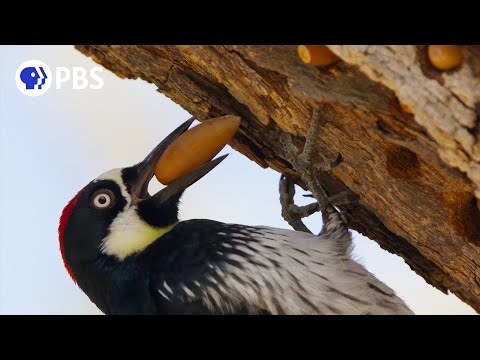
The Acorn Woodpecker (Melanerpes formicivorus) is the clown-faced keeper of the granary tree — a western oak-country woodpecker that lives in family colonies and hammers thousands of acorns into storage holes drilled in dead trees, poles, and (to some owners’ dismay) wooden siding. Pale-eyed, black-backed, white-faced, and red-crowned, it chatters its famous waka-waka-waka across California and the Southwest oaks. At feeders it takes suet, peanuts, and sunflower hearts with gusto. It shares the oak woods with the California Scrub-Jay and the Oak Titmouse.
Species Physical Profile & Morphometrics
The Acorn Woodpecker belongs to the woodpecker family (Picidae) — but it abandoned the lone-forager lifestyle for communal living: colonies of related adults share granary trees, nest cavities, and even broods, with multiple breeders and helper offspring at a single nest. It is the most social woodpecker in North America.
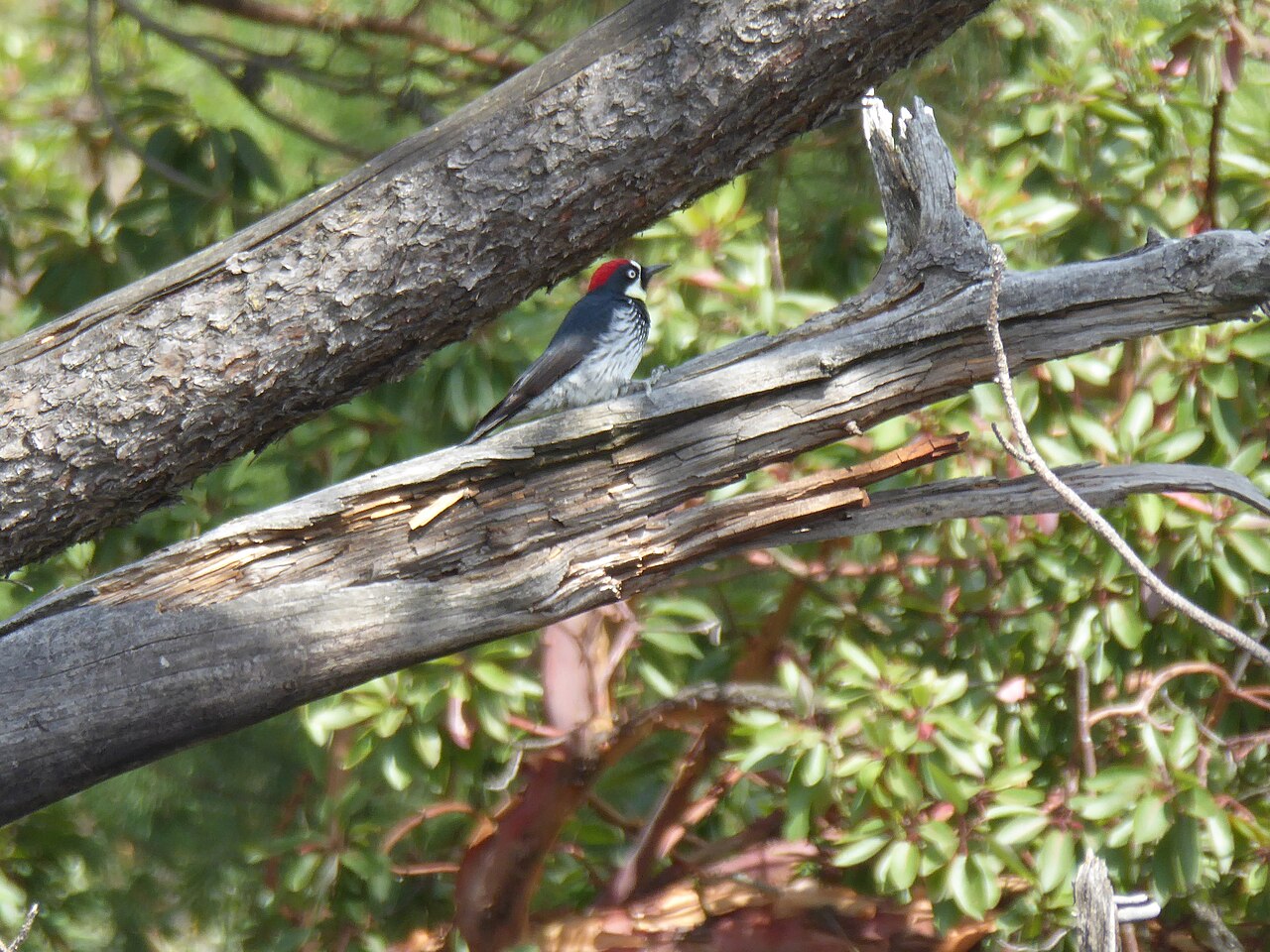
The identification formula: black back, white rump and wing patches, white face with black border, pale staring eye, and red crown — the clown face. In flight the white rump and wing patches flash boldly. Within its range nothing is truly similar; the red crown and white face separate it from Nuttall’s and Ladder-backed Woodpeckers at a glance.
Essential Morphometric Field Marks:
- Body Length & Mass: 7.5 to 9.1 inches (19–23 cm) and 2.3 to 3.2 ounces (65–90 grams) — a mid-sized woodpecker, robin-weight but woodpecker-shaped.
- Wingspan: 13.8 to 16.9 inches (35–43 cm); flight is bounding and showy, the big white wing patches and white rump flashing with every dip — plus flycatcher-style sallies after insects.
- Bill Structure & Color: A straight, chisel-tipped dark bill — equal parts drill (granary holes), hammer (acorn seating), and probe (bark insects).
- Color Pattern: Glossy black back and bib, white rump, white wing patches, whitish belly; the face is a white mask outlined in black with striking pale eyes and a red crown — solid red on the male, black-band-interrupted on the female.
- Male vs. Female: Look at the crown: the male’s red cap runs unbroken from the forehead back; the female has a black band between the white forehead and red crown. Colonies contain both, often several breeding pairs at once.
The full red cap: red from bill to nape without interruption — and often the colony’s busiest granary custodian, tapping, testing, and re-seating loose acorns as the storage holes shrink through the dry season.
The black-banded crown — a black strip separates her white forehead from the red cap. Colony females share nests in cooperative groups, several sisters laying in one cavity while the whole clan helps raise the chicks.
Acorn Woodpecker Vocalization Guide (3 Field Recordings)
The Acorn Woodpecker’s trademark is the laughing waka-waka-waka — a loud, woody, rising rattle given by colony members at the slightest provocation — plus drumming on hollow limbs and a rich vocabulary of contact calls. All recordings below are real field audio via Wikimedia Commons — no simulations. For a deeper library, browse xeno-canto: Acorn Woodpecker.
1. The Waka-Waka
2. The Drum Roll
3. The Colony Chatter
Habitat, Range & the Oak Belt
The Acorn Woodpecker lives where oaks live: oak and pine-oak woodland, canyon live-oak forest, parks, and oak-shaded neighborhoods from coastal California through the Southwest to Texas’s Edwards Plateau (a separate population), plus Mexico to Colombia. It needs acorns to store and dead wood to store them in — granary trees are carved from snags, poles, and sometimes buildings.

Where the Oaks Are, the Colonies Are
The range hugs the oak belt of the Pacific slope and Southwest — California’s foothills and coast ranges, southern Arizona and New Mexico’s oak canyons, the Edwards Plateau of Texas, and south through the Mexican highlands. Everywhere it is resident; the colony and its granary endure for decades.
For backyard birders: a yard with mature oaks in this range is a granary waiting to happen. Colonies readily adopt neighborhoods, storing acorns in dead limbs, fence posts, telephone poles — and occasionally cedar siding, which calls for the management notes below rather than eviction.
Backyard Behavioral Patterns & Social Dynamics
The Acorn Woodpecker turned hoarding into civilization — a woodpecker with a pantry, a commune, and a work ethic. Four behaviors explain most of what you will observe:
🌰 The Granary Tree
The colony’s masterwork: thousands of acorns — up to 50,000 — hammered into individually drilled holes in a dead tree or pole, defended and rearranged for years. As holes dry and loosen, workers re-seat every acorn snugly. Some granaries serve generations.
👨👩👧👦 The Commune
Colonies of up to a dozen or more related adults share granaries, cavities, and chicks — several females may lay in one nest, and grown offspring stay home as helpers before dispersing. It is the most cooperative household in American birding.
🪰 The Flycatching Woodpecker
In summer, watch the sallies: a woodpecker launches from a bare branch, loops through the air after a flying insect, and returns — plus sap sipping from shallow drilled wells, a woodpecker living three lives at once.
😂 The Laugh Track
The colony narrates itself: waka-waka calls volley across the trees at every arrival, departure, and squirrel. Once you know the laugh, oak woodland never sounds silent again.
Problem: “Acorn Woodpeckers Are Storing Acorns in My Siding. What Should I Do?”
The three most common Acorn Woodpecker conflicts all have proven answers:
First, the siding granary: wood siding reads as a dead tree to a hoarding woodpecker — offer a better granary nearby (a standing dead snag or a mounted post drilled with starter holes), hang reflective tape or lightweight netting on the hot wall during the fall storing rush, and patch holes promptly so the pattern doesn’t reward itself. Second, the drumming at dawn: spring drumming on gutters and vents is advertising, not feeding — pad or damp the resonant spot and provide a hollow branch nearby; the season passes in weeks. Third, the worry about the tree: a true granary is carved into dead wood, and the colony’s holes don’t kill living oaks — a granary snag is a wildlife heirloom worth keeping if safety allows. Remember the law and the logic alike: these are protected native birds, and a managed colony is a daily nature documentary.
Method 1: Set the Table — Suet, Peanuts & the Right Wood
Design for a communal, hoarding woodpecker:
-
Hang Suet Where the Colony Works
Suet cakes on or near the granary tree are taken immediately — a high-energy staple the whole colony shares, and the fastest way to bring waka-waka to your yard.
-
Offer Peanuts & Sunflower Hearts
Whole peanuts in the shell and sunflower hearts on a platform or in a cage feeder suit the hoarding instinct — watch birds shuttle peanuts away to wedge into cracks like honorary acorns.
-
Provide a Dead Snag or Granary Post
The ultimate welcome: a standing dead limb or a post pre-drilled with a grid of one-inch holes — a starter granary that a colony can adopt, sparing your siding entirely.
-
Keep Water at Trunk Level
A birdbath near the oaks gets daily colony traffic; woodpeckers drink on the wing between granary chores and prefer baths with an approach branch.
Method 2: Build the Habitat — Oaks, Snags & Patience
Feed the acorn, and the colony comes:
-
Protect Mature Oaks
The colony’s economy runs on acorns: several oak species in a neighborhood spread the crop across years (oaks alternate heavy mast years) — keep every oak you safely can.
-
Leave the Snag
A standing dead tree in the oak grove is granary gold — if it’s safely away from the roof, leave it; if it must come down, leave a 15-foot stub for the pantry.
-
Redirect From Siding Politely
Where siding is targeted: reflective tape, temporary netting during the storing season, and a superior granary post ten feet away — redirect, never harm; they’re protected and they’re also your best insect patrol.
-
Let the Colony Settle In
Colonies occupy territories for decades — once a clan adopts your oaks, you inherit generations of granary-keeping, insect-hawking, and daily laughter.
Tool Solution: Recommended Hardware for Acorn Woodpecker
Equipment matched to a communal hoarding woodpecker:
Suet Cage on the Oak
A suet cage mounted on or beside the granary tree — the colony’s favorite handout and the quickest way to daily close views.
- • Food: Suet cakes
- • Mount: Trunk or limb
- • Bonus: Titmice & nuthatches join
Peanut & Sunflower Platform
Whole peanuts and sunflower hearts — wedge-able, stash-able, and beloved; expect shuttle traffic from feeder to granary.
- • Food: Peanuts in shell
- • Style: Platform / hopper
- • Show: Caching behavior daily
Pre-Drilled Granary Post
A sturdy post drilled with a grid of storage holes near the oaks — the humane answer to siding storage and a fascinating pantry to watch fill.
- • Build: 1-in holes, grid pattern
- • Placement: Near oaks, off the house
- • Result: Colony-adopted pantry
Frequently Asked Questions
- Species Profile: The Acorn Woodpecker (Melanerpes formicivorus) is a 7.5–9.1 inch, 2.3–3.2 ounce woodpecker (Picidae), band code ACWO — the communal granary keeper of western oaks.
- ID in One Look: Clown face — white mask, black border, pale staring eyes, red crown — over a black back with white rump and wing patches.
- The Sound: The laughing waka-waka-waka volleyed around the colony, plus drumming and granary chatter; real field recordings above.
- Range & Habit: Resident in oak country from California through the Southwest (plus a Texas population and south to Colombia); colonies hold territories for decades.
- Feeder Formula: Suet on the trunk, peanuts and sunflower hearts on a platform, water near the oaks, and a pre-drilled granary post to spare your siding.
- The Pantry: Granary trees of up to 50,000 individually stored acorns, tended by a commune that shares nests, chicks, and the daily laugh track.
Bird Watching Log
Species: Acorn Woodpecker (Melanerpes formicivorus)
| Acorn Woodpecker (Red Crown: Solid / Black-Banded — Granary Seen: Yes / No — Waka-Waka Heard: Yes / No — Colony Size: ___ — Storing Acorns: Yes / No) | |