
Ladder-backed Woodpecker


Ladder-backed Woodpecker (Dryobates scalaris): Complete Identification, Feeder Guide & Call Library
Quick Answer: How to Attract & Identify Ladder-backed Woodpeckers
The Ladder-backed Woodpecker (Dryobates scalaris) is the small woodpecker of southwestern desert scrub — Downy-sized, with the whole back and wings barred black-and-white like a ladder, a striped black-and-white face, and a buffy, dark-spotted breast. The male wears a red crown from forehead to nape; the female’s crown is black. It gleans insects from mesquite, agave stalks, and cacti rather than drilling deep. To attract it: hang a suet cage in shrubby shade, offer nut pieces and sunflower chips, and keep native brush and a water dish. Listen for the sharp “peek” call and a descending whinny. It is a year-round resident, sharing desert yards with the Gila Woodpecker and the Northern (Gilded) Flicker.
Species Physical Profile & Morphometrics
The Ladder-backed Woodpecker is a small member of the woodpecker family (Picidae), the desert Southwest’s counterpart to the eastern Downy Woodpecker and a close cousin of California’s Nuttall’s. Its build matches a gleaner’s lifestyle: a straight, pointed bill for picking insects off bark, stiff tail feathers for bracing, and zygodactyl feet for hitching up everything from twigs to cactus spines.
The identification formula: ladder-barred back + striped face + spotted buffy flanks + (male) a full red crown — on a shrub, agave, or cactus in dry country.
Essential Morphometric Field Marks:
- Body Length & Mass: about 6.3 to 7.1 inches (16–18 cm) and 0.7 to 1.7 ounces (21–48 grams) — in the same small class as a Downy, far slighter than a Hairy Woodpecker.
- Wingspan: about 13 inches (33 cm); flight is the typical bounding woodpecker dip-and-rise between shrubs.
- Bill Structure & Color: A dark, straight, sharply pointed bill, slightly longer than a Downy’s — built for gleaning and probing pods, not deep chiseling.
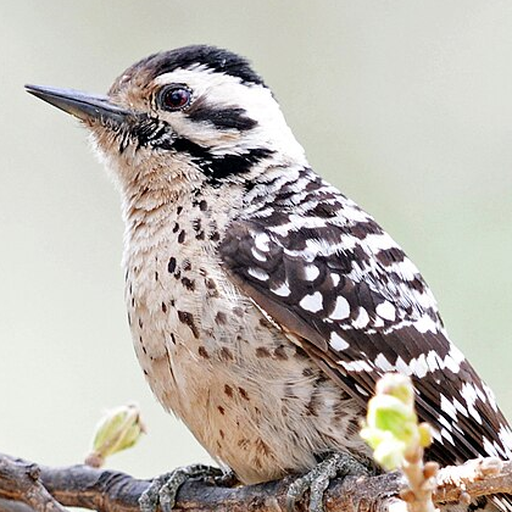
- Color Pattern: Back and wings barred black-and-white in horizontal rungs (the “ladder”), face white with bold black stripes, underparts buffy with dark spots on the flanks, and white outer tail feathers barred black.
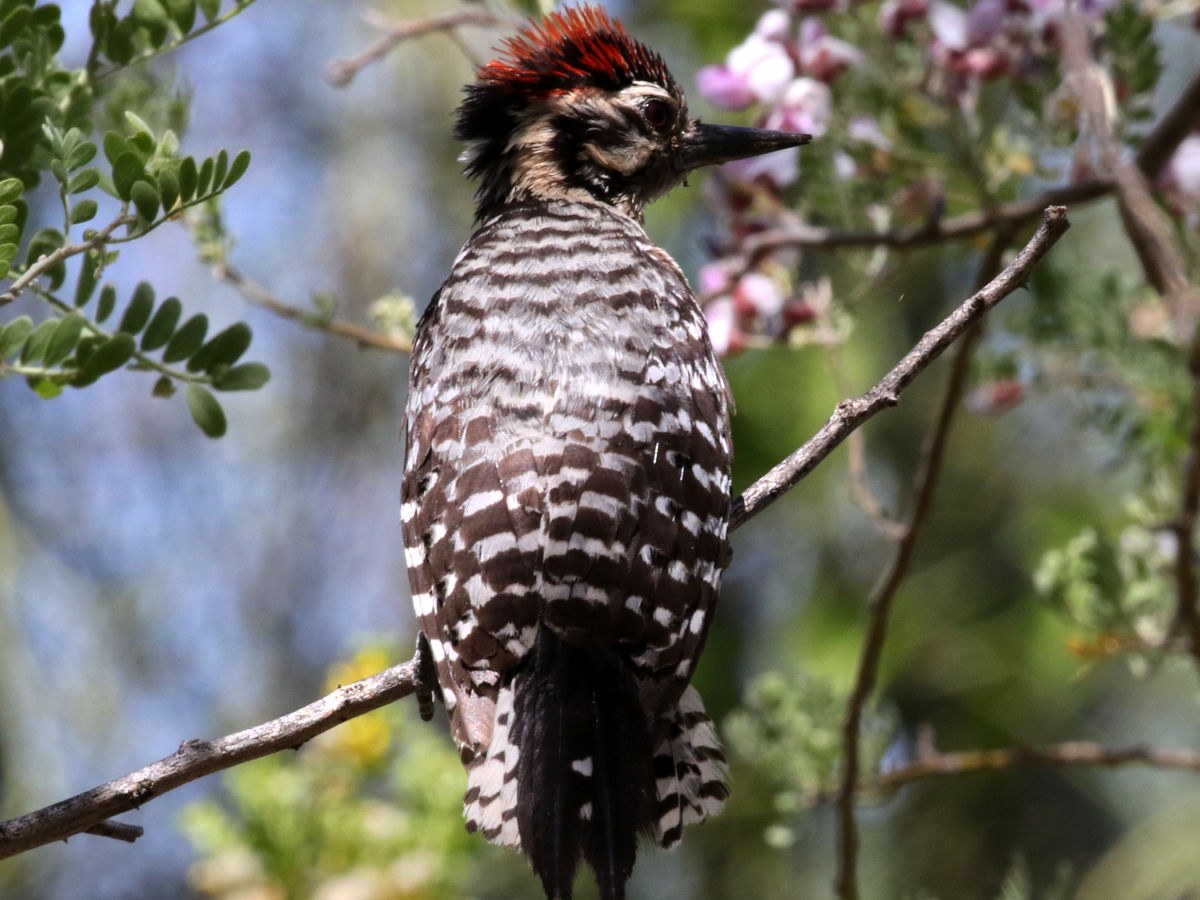
- Male vs. Female: The male’s crown is red from forehead to nape; the female’s crown is black-and-white striped with no red at all — the easiest sexing mark of any southwestern woodpecker.
Red from forehead to nape: the male’s entire crown is crimson, wrapping around toward the sides of the neck. He does the bulk of the spring drumming — short, rapid rolls on dead agave stalks, mesquite snags, and cactus ribs.
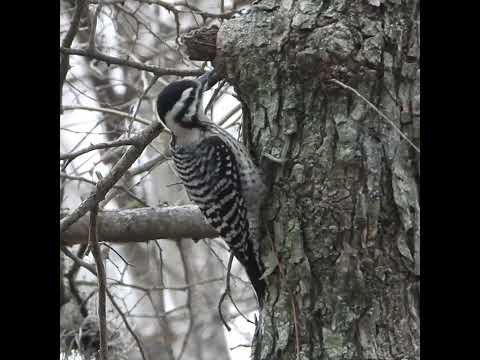
Black crown, same ladder: the female wears a black-and-white striped crown with no red, over the identical barred back and striped face. She shares excavation and feeding duties and visits suet just as readily.
Ladder-backed Woodpecker Vocalization Guide (3 Clearly Labeled Simulations)
A small woodpecker with a sharp voice: the everyday note is a clipped “peek” or “pik”, and excitement brings a descending whinny — a rattling series that drops in pitch like a tiny Downy. Drumming comes in short, rapid rolls on resonant dead wood. No freely licensed field recording of this species is currently archived on Wikimedia Commons, so all three cards below are clearly labeled acoustic simulations built to published descriptions; for real wild audio, browse xeno-canto: Ladder-backed Woodpecker.
1. Call Simulation — The Sharp Peek
2. Call Simulation — The Descending Whinny
3. Drum Simulation — The Short Rapid Roll
Habitat, Range & the Thorn-Scrub Belt
The Ladder-backed Woodpecker belongs to the arid brushlands of the Southwest — mesquite bosques, thorn scrub, desert washes, pinyon edges, cactus flats, and the native-plant corners of southwestern suburbs, where it is the default small woodpecker.

California Deserts to Texas — and South
The U.S. range runs from southeastern California and southern Nevada across Arizona, New Mexico, and Texas to southwest Oklahoma, with outposts into southern Utah and Colorado — then continues through Mexico into Central America. It is a permanent resident; pairs hold brushy territories in every season, and wanderers rarely leave the arid lowlands.
In Texas it is the small woodpecker of the brush country and the Trans-Pecos, replaced east of the Hill Country by the Downy — the two overlap where woodlands meet the desert edge.
Backyard Behavioral Patterns & Social Dynamics
The Ladder-backed Woodpecker works small and close. Four behaviors explain most backyard encounters:
🌿 The Twig Gleaner
Unlike heavy chiselers, this species picks insects off the surface of small branches, mesquite twigs, and cactus skin — beetle larvae, ants, caterpillars, and scale — rarely excavating deep. Watch it hitch nimbly along perches too thin for bigger woodpeckers.
🌵 The Cactus & Agave Specialist
Thorns are no obstacle: it clings to cactus pads, yucca seed pods, and hollow agave stalks, probing for insects — and it nests in cavities chiseled into trees, large cacti, or thick agave and yucca stems.
🥜 The Suet Regular
A dependable feeder bird in southwestern yards: suet is the top draw, with nut pieces and sunflower chips close behind. It prefers a cage hung in shrubby cover or shade, darting in and out rather than lingering exposed.
🤝 The Quiet Neighbor
Pairs stay together year-round and share yards peacefully with Gila Woodpeckers and flickers — partitioning the habitat by size: the Gila takes the saguaro trunk, the Ladder-backed works the twigs and pods the big birds ignore.
Problem: “My Downy Woodpecker Looks Wrong — Its Back Is All Stripes. What Is It?”
The three most common Ladder-backed puzzles all resolve quickly:
First, the “striped Downy” confusion: a Downy Woodpecker has a clean white stripe down a black back; if the whole back is barred like a ladder and the flanks are buffy and spotted, you have a Ladder-backed — the expected small woodpecker of desert yards. Second, “it never comes to my open feeder”: this species is cover-loving — move the suet cage beside a shrub or into afternoon shade and visits usually begin within days. Third, “is it a Nuttall’s?”: along the California desert edge the two meet; Nuttall’s carries barring up onto the crown and a blacker face, while the Ladder-backed male’s red crown reaches the forehead and the face stripes are cleaner. Range settles most cases — Nuttall’s is the coastal California bird, Ladder-backed the interior desert one.
Method 1: Set the Table — Suet & Nut Stations
Design for a small, cover-loving gleaner:
-
Hang Suet in Shrubby Shade
Suet is the number-one attractant — hang a standard cage beside a shrub, against a trunk, or under a ramada. In desert summer, shade keeps the cake from melting and keeps the bird visiting at midday.
-
Offer Nut Pieces and Chips
Crushed peanuts and sunflower chips in a small hopper or on a platform suit a gleaning bill — no deep drilling required. Keep portions small and fresh in the heat.
-
Keep Water Close to Cover
A shallow bath within a quick dart of brush completes the station — in dry country, water can outdraw food, and the Ladder-backed drinks and bathes like any backyard bird.
-
Leave the Pods and Stalks
Spent yucca and agave stalks are foraging posts and drumming stages — leaving a few standing through winter gives the bird both a pantry and a perch.
Method 2: Build the Habitat — Native Brush & Shade
Feed the habitat, and the Ladder-backs follow:
-
Plant Native Thorn-Scrub Trees
Mesquite, acacia, desert willow, and palo verde grow the twiggy, insect-rich surface this species was built to work — a single native shrub cluster can anchor a pair’s foraging route.
-
Keep a Brushy Corner
The Ladder-backed feeds close to cover. An unmanicured corner — native shrubs, a pile of pruned branches, standing stalks — is worth more than any feeder placed in the open.
-
Leave Dead Limbs for Nesting
Pairs chisel nest cavities into soft dead wood, large cacti, and agave stalks. Where safe, leave a dead limb or snag standing through spring — it may become next season’s nest tree.
-
Skip the Sprays
Surface-gleaned insects are the whole menu — an unsprayed shrub is a stocked pantry. Scale insects and beetle larvae that prompt spraying elsewhere are exactly what this bird eats.
Tool Solution: Recommended Hardware for Ladder-backed Woodpeckers
Equipment matched to a small, shade-seeking desert gleaner:
Suet Cage in Cover
A standard single suet cage hung beside a shrub or on a shaded trunk — the station a Ladder-backed trusts, sized so larger birds can’t easily monopolize it.
- • Food: Insect-blend or peanut suet cakes
- • Style: Standard cage, cover-adjacent
- • Placement: Shade in hot months
Hopper or Platform with Nut Pieces
A small hopper or drained platform stocked with crushed peanuts and sunflower chips — gleanable fare for a bird that picks rather than chisels, shared with verdins and towhees.
- • Food: Crushed peanuts, sunflower chips
- • Style: Small hopper or covered platform
- • Placement: Beside brushy cover
Shallow Bird Bath
A shallow basin near shrub cover, refreshed daily — in the desert Southwest, water is the strongest year-round attractant, drawing the Ladder-backed along with the whole yard guild.
- • Depth: 1–2 in, gently sloped
- • Summer: Refresh daily; shade slows algae
- • Placement: A quick dart from brush
Frequently Asked Questions
- Species Profile: The Ladder-backed Woodpecker (Dryobates scalaris) is a 6.3–7.1 inch, 21–48 gram woodpecker (Picidae) of southwestern desert scrub — ladder-barred back, striped face, spotted buffy flanks.
- ID in One Look: The whole back is barred like a ladder (a Downy’s has a clean white stripe); males wear a red crown from forehead to nape, females a black crown.
- A Permanent Resident: No migration — pairs hold brushy territories year-round from the California deserts to Texas and deep into Mexico.
- The Sound: A sharp, clipped “peek,” a descending Downy-like whinny, and short rapid drums on agave stalks and dead wood.
- Feeder Formula: A suet cage in shrubby shade, nut pieces and sunflower chips, shallow water near cover, and standing yucca or agave stalks.
- The Surface Gleaner: It picks insects off twigs, pods, and cactus skin rather than drilling deep — an unsprayed native shrub is its pantry.
Bird Watching Log
Species: Ladder-backed Woodpecker (Dryobates scalaris)
| Ladder-backed Woodpecker (Male Red Crown: Yes / No — At Suet: Yes / No — On Cactus / Pods: Yes / No — Drumming Heard: Yes / No) | |