
Red-shouldered Hawk


Red-shouldered Hawk (Buteo lineatus): Complete Identification, Habitat Guide & Sound Library
Quick Answer: How to Attract & Identify the Red-shouldered Hawk
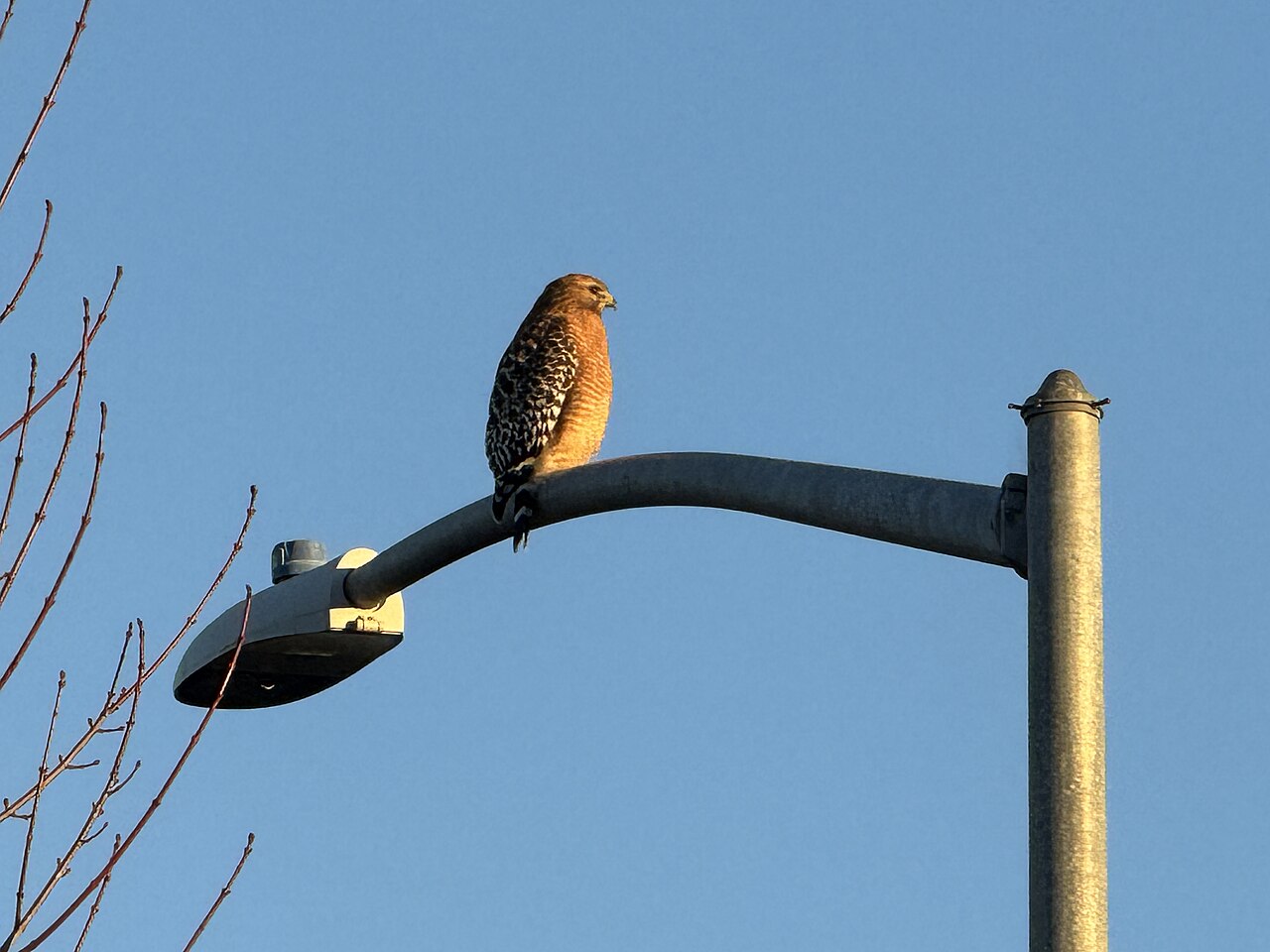
The Red-shouldered Hawk (Buteo lineatus) is the noisy raptor of eastern woodlands and leafy suburbs — a medium buteo with a barred rufous breast, black-and-white checkered wings, and a narrowly banded tail. Its piercing kee-aah, kee-aah whistle is one of the most imitated sounds in the forest (Blue Jays copy it constantly). It hunts from low perches over streams and clearings. Wooded yards see them hunting frogs and rodents at woodland edges — and occasionally stooping at feeder birds. They share the canopy with the Red-tailed Hawk and the Cooper’s Hawk.
Species Physical Profile & Morphometrics
The Red-shouldered Hawk belongs to the hawk and eagle family (Accipitridae) and the genus Buteo — the soaring hawks. It is a year-round resident of eastern deciduous forests from Minnesota to the Gulf, with a separate population along the Pacific coast from Oregon through California.
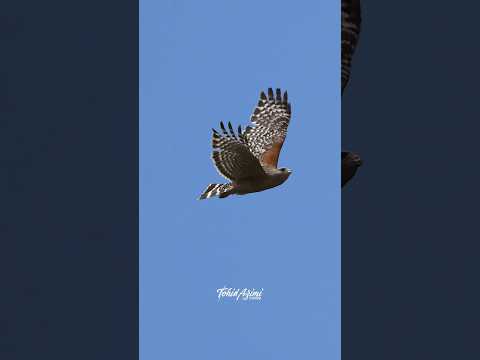
The identification formula: barred rufous breast + black-and-white checkered wings + banded tail. A Red-tailed Hawk is bulkier with a plain or belly-banded breast and (in adults) a brick-red tail; the Red-shoulder is slimmer, warmer-colored, and far more vocal. The translucent crescent at the base of the primaries — a pale comma near each wingtip — clinches the ID in flight.
Essential Morphometric Field Marks:
- Body Length & Mass: 16.9 to 24.0 inches (43–61 cm) and 17.1 to 27.3 ounces (486–774 grams) — a slim, medium buteo, noticeably smaller than a Red-tailed Hawk.
- Wingspan: 37.0 to 43.7 inches (94–111 cm) — broad, rounded wings held in a slight dihedral when soaring; in a flap-and-glide through the woods it looks quick and compact.
- Bill Structure & Color: A dark hooked bill with a yellow cere and bright yellow legs and feet — tools for frogs, snakes, crayfish, and small mammals.
- Color Pattern: Rufous-barred breast and rusty shoulder patches, bold black-and-white checkering on the wings, and a dark tail with narrow white bands; Florida birds are paler-headed.
- Male vs. Female: Sexes share the same striking pattern; the female is simply larger — up to a third heavier — a common arrangement among hawks.
The vocal watchman: slim and rust-breasted, perched at mid-height over the creek, whistling kee-aah at every crow that crosses the territory — and chasing it halfway across the woodlot.
The larger partner — same checkered plumage in a bigger frame — she builds the stick nest high in a crotch of a tall hardwood and broods the downy chicks while the male brings frogs to the rim.
Red-shouldered Hawk Vocalization Guide (2 Field Recordings)
The Red-shouldered Hawk is one of the loudest woodland birds in America: a piercing, repeated kee-aah, kee-aah, kee-aah that carries for half a mile — Blue Jays imitate it so well that hearing the call proves nothing until you see the caller. All recordings below are real field audio via Wikimedia Commons — no simulations. For a deeper library, browse xeno-canto: Red-shouldered Hawk.
1. The Kee-aah Whistle
2. The Sky Duet
3. The Rapid Alarm
Habitat, Range & the Bottomland Woods
The Red-shouldered Hawk lives in mature deciduous woodland, especially bottomland forest, swamp edges, and stream corridors — and increasingly in leafy suburbs with tall trees. It hunts from low perches over wet ground, where frogs, snakes, crayfish, mice, and large insects are caught in short, dropping strikes.

The Voice of the Eastern Woodlot
The range splits in two: the East from Minnesota and New England to the Gulf Coast, and the Pacific slope from Oregon through California into Baja. Most birds are permanent residents; only the northernmost breeders drift south in hard winters.
For backyard birders: if your neighborhood has tall mature trees and a creek or wet ground nearby, a pair may already own your block. They adapt well to suburbs — their whistled kee-aah over the rooftops is the surest sign.
Backyard Behavioral Patterns & Social Dynamics
The Red-shouldered Hawk is a loud, perch-hunting woodland buteo that has learned to love suburbia. Four behaviors explain most of what you will observe:
🪑 The Perch Hunter
It hunts still-hunting style — sitting quietly on a low limb, fence, or pole over wet ground, then dropping straight down onto frogs, snakes, mice, and crayfish.
📣 The Loudmouth
Pairs call loudly and often, all year — the kee-aah whistle marks territory, keeps mates in contact, and is the soundtrack of the eastern woodlot.
🐍 The Wet-Ground Menu
Unlike open-country hawks, it specializes in wet-ground prey — frogs, snakes, crayfish, and insects — plus chipmunks and mice taken along stream edges.
🏙️ The Suburban Adapter
In leafy suburbs it nests in backyard trees and hunts the green edges — many eastern birders see more Red-shoulders from the kitchen window than on any hike.
Problem: “A Hawk Keeps Hunting Around My Feeders. What Should I Do?”
The three most common Red-shouldered Hawk puzzles all have proven answers:
First, the feeder visitor: a hawk taking a bird at your feeder is natural predation, and Red-shoulders mostly want frogs and rodents, not finches — if songbirds are being pressured, simply take feeders down for one to two weeks; the hawk will move on and the songbirds return the day you re-hang them. Second, the jay trick: if you keep hearing the call but never see a hawk, suspect a Blue Jay — jays imitate the kee-aah perfectly; the hawk’s own call has a wilder, more falling quality. Third, the which-buteo question: check the wings and tail — checkered black-and-white wings with narrow tail bands say Red-shouldered; a plain-backed bird with a belly band and brick-red tail is a Red-tailed Hawk.
Method 1: Watch Smart — Perches, Calls & Timing
See more of the hawk you already have:
-
Scan Mid-Level Perches
Look at mid-height limbs over wet ground, fences, and quiet streetlights — Red-shoulders hunt low, not from the treetops like Red-tails.
-
Learn the Real Call
Memorize the true kee-aah from the recordings above — once you know it, you will find the bird by ear long before you see it.
-
Watch at First Light
Early morning is prime hunting time over damp ground — the first hour after sunrise is when perch sites are occupied.
-
Follow the Mobbing
A swirl of scolding crows and jays usually marks a perched hawk — let the local birds point you to it.
Method 2: Keep the Woods — Habitat & Coexistence
A hawk-friendly yard is simply a healthy yard:
-
Keep Mature Trees Standing
Tall hardwoods and an unbroken canopy edge are the nest sites — a wooded lot is the whole attraction strategy.
-
Protect the Wet Corner
A creek margin, rain garden, or damp low spot supports the frogs and crayfish that make up most of this hawk’s diet.
-
Pause Feeders If Pressured
If a hawk camps on your feeder area, rest the feeders for a week or two — the songbirds will return; the hawk will redistribute.
-
Skip Rodenticide
As with owls, poisoned rodents poison hawks — use enclosed traps and let the raptors do the open-ground patrol.
Tool Solution: Recommended Hardware for Red-shouldered Hawk
Equipment matched to a woodland perch-hunter:
Kitchen-Window Perch Watch
A comfortable chair and binoculars aimed at mid-level limbs over your wettest ground — where this hawk actually hunts.
- • Height: Mid-canopy limbs
- • Timing: Early morning
- • Clue: Mobbing jays & crows
Mature Hardwood Stand
Standing tall trees with a stream or damp margin — the nest and hunt territory that keeps a pair on your block for years.
- • Trees: Tall hardwoods
- • Feature: Wet ground
- • Bonus: Barred Owls too
Seasonal Feeder Rotation
Resting feeders briefly when a hawk sets up nearby — the simple, proven reset that protects songbirds without harming the hunter.
- • Pause: 1–2 weeks
- • Then: Re-hang normally
- • Rule: No poison, ever
Frequently Asked Questions
- Species Profile: The Red-shouldered Hawk (Buteo lineatus) is a 16.9–24.0 inch, 17.1–27.3 ounce buteo (Accipitridae), band code RSHA — the vocal sentinel of eastern and Pacific woodlands.
- ID in One Look: Barred rufous breast, checkered black-and-white wings, narrowly banded tail, pale wing crescents in flight.
- The Sound: A piercing repeated kee-aah whistle — learn it apart from the Blue Jay’s imitation; real field recordings above.
- Range & Habit: Year-round resident of eastern bottomland woods and the Pacific slope; hunts frogs and rodents from low perches.
- Yard Strategy: Mature trees plus wet ground hold a pair; pause feeders briefly if songbirds are pressured.
- The Coexistence Note: A hunting hawk means a healthy food web — protect the woods and skip the rodenticide.
Bird Watching Log
Species: Red-shouldered Hawk (Buteo lineatus)
| Red-shouldered Hawk (Perched or Soaring: Perched / Soaring — Calling: Yes / No — Prey Seen: ___ — Jays Mobbing: Yes / No — Date & Time: ___) | |