
Western Meadowlark


Western Meadowlark (Sturnella neglecta): Complete Identification, Feeding Guide & Song Library
Quick Answer: How to Attract & Identify the Western Meadowlark
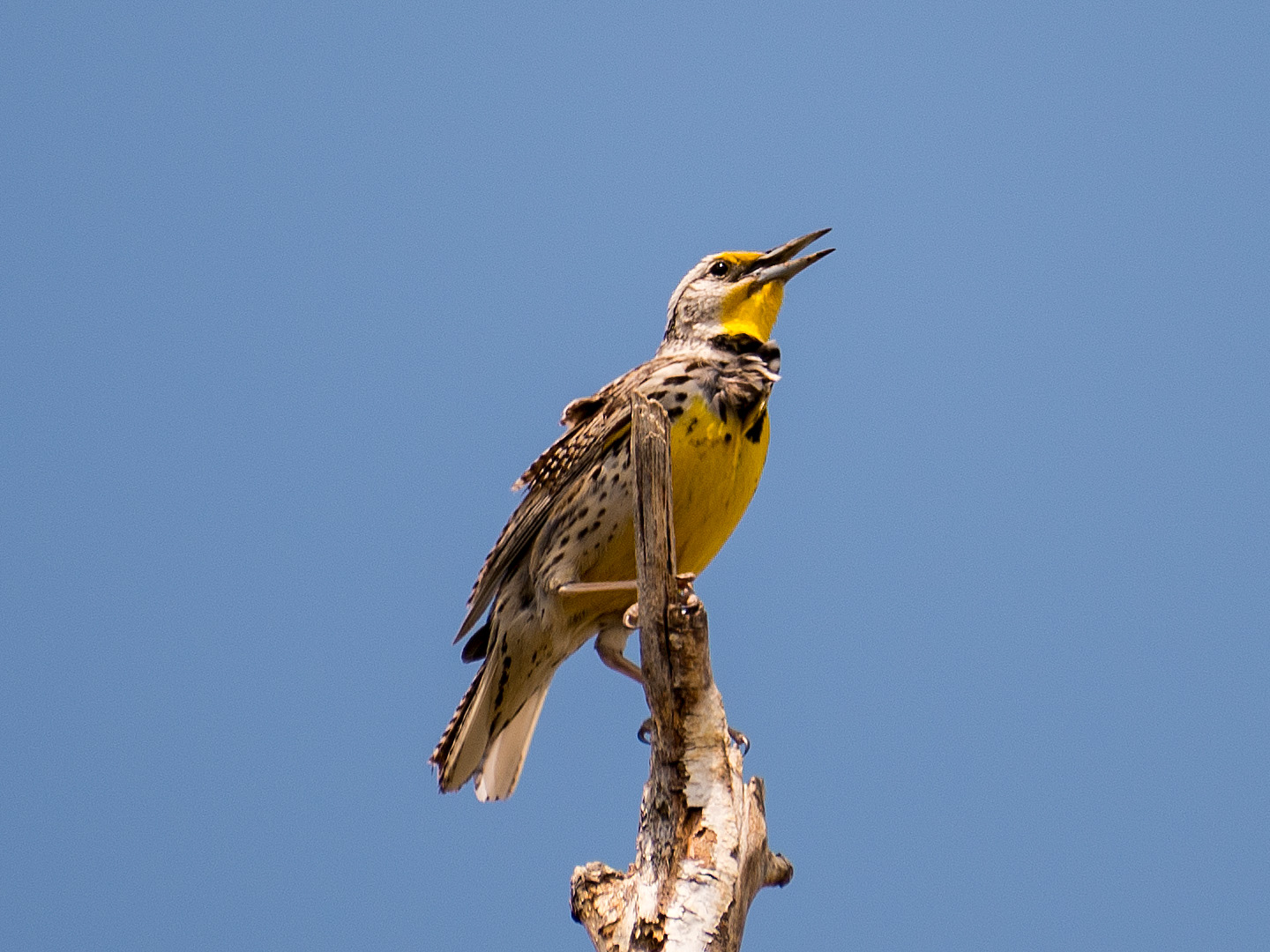
The Western Meadowlark (Sturnella neglecta) — state bird of Kansas, Montana, Nebraska, North Dakota, Oregon, and Wyoming — is the golden-breasted voice of western grasslands, a robin-sized ground bird with a bold black V on a bright yellow chest and one of the most beautiful songs in North America: a rich, flute-like cascade of gurgling whistles. It walks (never hops) through open grass, flashing white outer tail feathers when it flushes. Though a bird of prairies and pastures rather than city lots, it visits rural and semi-rural backyards with open ground, where cracked corn, millet, and sunflower hearts on a low platform plus a ground-level birdbath can make your yard part of its territory. It shares the open-country feeder scene with the Red-winged Blackbird and the House Finch.
Species Physical Profile & Morphometrics
The Western Meadowlark belongs to the blackbird family (Icteridae) — despite its thrush-like look and lark-like name, it is a close cousin of orioles, grackles, and cowbirds. It is a stocky, ground-dwelling songbird built for life in open grass: strong legs for walking, a long dagger bill for probing soil, and a cryptic streaked back that disappears against dry grass the moment it crouches.
The identification formula: bright yellow underparts + bold black V bib + streaked brown back + white outer tail feathers. The great lookalike is the Eastern Meadowlark, essentially identical at a glance — the Western usually shows yellow reaching up into the cheek (malar) area, a paler, less rufous back, and above all a completely different voice: fluted and gurgling rather than a clear whistle. Where their ranges meet on the Great Plains, song is the decisive mark.
Essential Morphometric Field Marks:
- Body Length & Mass: 8.7 to 10.2 inches (22–26 cm) and 3.2 to 5.4 ounces (90–147 grams) — robin-sized but chunkier, with a short tail and a long, straight bill.
- Wingspan: About 16.1 inches (41 cm); flight is a distinctive stiff, shallow flutter alternating with short glides, low over the grass, with white outer tail feathers flashing at every wingbeat pause.
- Bill Structure & Color: A long, straight, sharply pointed pinkish-horn bill — a soil probe and grass-parting tool. Meadowlarks practice “gaping”: they thrust the closed bill into turf and pry it open to expose hidden insects.
- Color Pattern: Brilliant yellow from throat to belly, crossed on the upper chest by a glossy black V-shaped bib; upperparts intricately streaked in brown, buff, and black; the crown shows a pale central stripe; outer tail feathers are largely white, obvious in flight.
- Male vs. Female: Sexes look nearly alike — the male averages larger with a slightly brighter yellow and a crisper black bib, while the female is a touch duller and smaller. Behavior is the better clue: the singing bird on the fence post is the male.
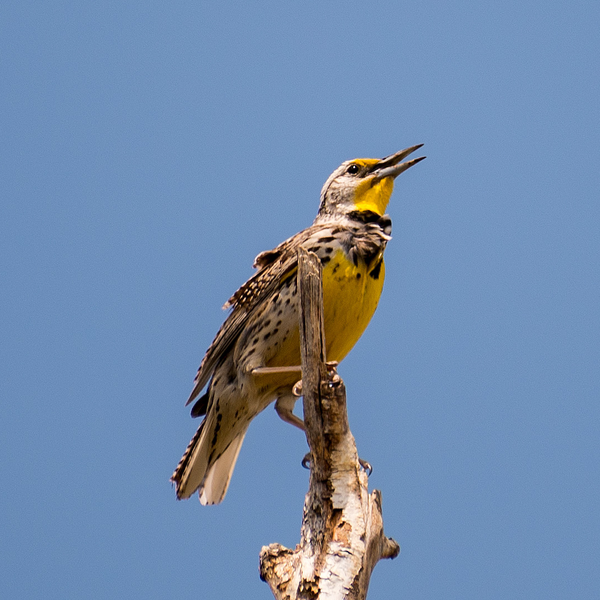
The golden soloist: blazing yellow underparts with a deep black V, a boldly striped crown, and in spring an unstoppable voice — he sings hundreds of times a day from fence posts, utility wires, and shrub tops, defending a grassland territory that may support two females at once.
Same pattern, quieter palette — a slightly duller yellow breast and finer black bib, with the same streaked camouflage above. She alone builds the nest: a grass-woven cup on the ground, usually roofed with a dome of woven grass and hidden in a tuft, where she raises the brood while the male sings overhead.
Western Meadowlark Vocalization Guide (3 Field Recordings)
The Western Meadowlark’s song is one of the signature sounds of the American West — a rich, flute-like series of gurgling, cascading whistles, more melodic and complex than the Eastern Meadowlark’s simple see-you see-yeer. Males also give sharp chuck notes and a dry rattle. All recordings below are real field audio, shared via Wikimedia Commons — no simulations. For a deeper library, browse xeno-canto: Western Meadowlark.
1. The Fluted Song
2. Song Phrases at Dawn
3. Calls and Song in Open Country
Habitat, Range & the Open Grassland
The Western Meadowlark is a bird of wide open spaces: native prairie, pasture, hayfields, rangeland, weedy roadsides, golf courses, and the grassy edges of rural and semi-rural properties. It needs two things — open ground to walk and forage, and elevated perches to sing from. A big country lawn, horse pasture edge, or acreage with native grasses is prime backyard meadowlark territory.

The Voice of the Western Two-Thirds
The Western Meadowlark blankets the western two-thirds of North America, from the Great Lakes region west to the Pacific and from central Canada deep into Mexico. In the northern Great Plains and across the Intermountain West it is one of the most abundant and conspicuous breeding birds in open country.
For backyard birders the map reads simply: if you live in the West or on the Plains with open ground around you, the meadowlark is your neighbor — and in winter, northern birds shift south into Texas, the Southwest, and Mexico, swelling numbers in mild-country yards. It is the official state bird of six states: Kansas, Montana, Nebraska, North Dakota, Oregon, and Wyoming.
Backyard Behavioral Patterns & Social Dynamics
The Western Meadowlark lives its life at grass level but sings from the sky’s edge — a ground bird with a showman’s instincts. Four behaviors explain most of what you will observe:
🎵 The Fence-Post Soloist
From March through summer, males sing from the highest available perch — a fence post, wire, or shrub top — hundreds of song bouts a day. Each male owns a repertoire of varied flute-like phrases, and neighbors counter-sing in long duels. A singing meadowlark on your fence line means your land is inside his territory.
🚶 The Walker, Not the Hopper
Meadowlarks walk through grass with a deliberate, almost mechanical stride, never hopping like a robin. Watch one cross a short-grass lawn: head down, bill ready, pausing upright to scan — a posture unique among backyard birds.
⛏️ The Gaping Bill
The meadowlark’s signature feeding move is gaping: it inserts its closed bill into soil, turf, or dung, then pries the bill open to expose beetle grubs, caterpillars, and seeds other birds can’t reach. You can sometimes hear the turf tear.
🪹 The Hidden Dome Nest
The female nests on the ground, weaving a grass cup and often roofing it with a dome that has a side entrance, tucked into a dense grass tuft. The nest is so well hidden that people usually find it only when the female explodes up from underfoot — mow rural meadows late, and check before you cut.
Problem: “Meadowlarks Sing on the Far Fence Line but Never Visit My Yard. What Should I Do?”
The three most common Western Meadowlark frustrations all have proven answers:
First, the standoff distance: meadowlarks are wary, open-country birds — put food where they already feel safe, along fence lines and pasture edges near their singing perches, not beside the patio. Once a bird learns a quiet feeding corner, it will work closer to the house over the season. Second, the short-grass problem: closely shaved lawn offers no insects and no cover — leave one section of the yard unmowed, letting grass go to seed; a meadow strip beats any feeder for meadowlarks. Third, the disappearing act in summer: adults get quiet and skulky in late summer as they molt — keep water available year-round; a ground-level birdbath with gently dripping water draws them even when they’re silent. Patience is the whole game with this species: reward the bird’s own habits rather than asking it to change them.
Method 1: Set the Table — Ground Feeding the Open-Country Way
Design for a walking, ground-probing grassland bird:
-
Scatter Cracked Corn & Millet on Open Ground
Cracked corn, white millet, and hulled sunflower scattered on short grass or bare ground matches the meadowlark’s natural stride-and-probe feeding style. Choose a quiet, open spot with a clear sightline — these birds distrust feeding in cover they can’t see out of.
-
Use a Low Platform Feeder
A low platform or tray feeder set on or near the ground keeps grain clean and visible from a distance. In winter, meadowlarks visit platforms regularly, especially in the morning after cold nights when natural seeds are locked under frost.
-
Offer Mealworms in Spring
In the breeding season, live or dried mealworms on a shallow tray answer the meadowlark’s huge appetite for insects — grasshoppers, beetles, and caterpillars make up the bulk of its summer diet, and a reliable protein source can hold a pair near the yard.
-
Serve Water at Ground Level
A shallow birdbath at or near ground level in the open is visited daily, especially in dry western summers. Moving water — a dripper or small fountain — advertises itself by sound across the prairie.
Method 2: Build the Habitat — Grass, Space & Song Posts
Feed the habitat, and the meadowlark does the rest:
-
Leave a Meadow Strip Unmowed
The single most powerful move: let a strip or corner of your property grow into meadow — native bunchgrasses and weeds allowed to seed. It produces the insects and grass seed meadowlarks actually eat, and the dense base they need for nesting.
-
Keep Sightlines Open
Meadowlarks shun tight, shrubby feeding spots — the opposite of most songbirds. Feed in the open, away from ambush cover, and keep cats indoors; a ground-feeding prairie bird is a cat’s easiest target.
-
Provide Singing Perches
A fence line, a few posts, or a solitary shrub in an open area gives a male the stage he needs. Properties with prominent perches hold territorial males longer into the season — and that means song at dawn, every day, all spring.
-
Delay Mowing Until August
Ground nests with domed grass roofs are invisible and vulnerable. If you have meadow or pasture, mow after the nesting season (late July–August) and leave fields idle in early summer — the difference between a fledged brood and a destroyed nest is often one mowing.
Tool Solution: Recommended Hardware for Western Meadowlark
Equipment matched to a ground-feeding, open-country songbird:
Low Platform or Ground Tray
A wide, low platform set in the open with cracked corn and millet — visible from afar, easy for a walking bird to approach, and equally useful to doves and sparrows.
- • Seed: Cracked corn, millet, sunflower hearts
- • Style: Low platform / ground tray
- • Placement: Open ground, clear sightlines
Mealworm Tray
A shallow dish of live or dried mealworms in spring and summer — the closest match to the grasshoppers and beetles that dominate the meadowlark’s breeding-season diet.
- • Food: Live or dried mealworms
- • Season: Spring–summer
- • Bonus: Bluebirds & robins join in
Ground-Level Bath with Dripper
A shallow ground-level bath — heated in winter — serving open-country birds that won’t approach a raised pedestal bath beside a wall. The dripper’s sound carries across open ground.
- • Depth: 1–2 in, gently sloped
- • Winter: Thermostatic heater
- • Placement: Open, near feeding area
Frequently Asked Questions
- Species Profile: The Western Meadowlark (Sturnella neglecta) is a stocky 8.7–10.2 inch, 3.2–5.4 ounce grassland songbird (Icteridae), band code WEME — state bird of six western and plains states.
- ID in One Look: Brilliant yellow underparts with a bold black V bib, streaked brown back, and white outer tail feathers flashed in a flutter-and-glide flight.
- The Sound: A rich, flute-like cascade of gurgling whistles — far more melodic than the Eastern Meadowlark’s simple see-you see-yeer; three real field recordings above.
- Range & Habit: The western two-thirds of North America in open grassland; a partial migrant, with northern birds wintering south while western birds stay put.
- Feeder Formula: Cracked corn, millet, and sunflower hearts on a low platform in the open, mealworms in spring, and ground-level water — fed along fence lines, not beside the house.
- The Meadow Rule: Leave grass unmowed, keep sightlines open, delay haying until August, and keep cats indoors — habitat beats feeders for this species.
Bird Watching Log
Species: Western Meadowlark (Sturnella neglecta)
| Western Meadowlark (Black V Bib Seen: Yes / No — Singing Heard: Yes / No — Perch Type: Fence / Wire / Shrub — Walking Ground Forager: Yes / No) | |