
American Robin vs Western Meadowlark



American Robin vs Western Meadowlark (Turdus migratorius vs Sturnella neglecta): The Complete Backyard Identification Guide
Quick Answer: The Fastest Way to Tell Them Apart
The lawn thrush and the prairie blackbird. Three rules:
- Breast pattern: plain brick-orange = robin; bright yellow with a bold black V = Western Meadowlark.
- Back and tail: plain gray-brown back and plain tail = robin; heavily streaked back and white outer tail feathers flashing on takeoff = meadowlark.
- Voice: long caroled phrases = robin; a rich, flutelike, gurgling melody rolling over the grass = Western Meadowlark.
At-a-Glance Comparison Table
Robin vs meadowlark, side by side. KEY rows separate fastest.
| Feature | American Robin | Western Meadowlark |
|---|---|---|
| Scientific Name | Turdus migratorius | Sturnella neglecta |
| Length | 7.9–11 in (20–28 cm) | 9.5 in (24 cm) |
| Wingspan | 12.2–15.8 in (31–40 cm) | 14–16 in (36–41 cm) |
| Weight | 2.7–3.0 oz (77–85 g) | 3.1–4.1 oz (88–116 g) |
| Overall Shape | Upright thrush with a longish tail | Stocky grassland bird with a short tail and long bill |
| Male Plumage KEY | Gray back, brick-red breast, dark head with white eye arcs, yellow bill | Brown-streaked back, brilliant yellow underparts with a bold black V; yellow reaches the cheek; white outer tail feathers (sexes alike) |
| Female Plumage | Like the male but paler, with a duller head and breast | Like the male, slightly duller |
| Bill Shape | Straight, slender yellow bill | Long, straight, sharply pointed, pinkish |
| Tail | Medium dark tail with white corners | Short, with flashing white outer feathers |
| Core Range KEY | Nearly all of North America; lawns, parks and woods | West of the Great Lakes — prairies, pastures, meadows and sage flats |
| Migration | Northern birds migrate; southern birds resident; flocks roam in winter | Partial migrant; southern and valley birds resident |
| Feeder Presence KEY | Not a seed eater — visits for soaked raisins, mealworms and birdbaths | Rarely uses feeders; may pick scattered seed on open rural ground |
| Favorite Foods | Earthworms, insects, berries and fruit | Insects (grasshoppers, beetles), grass and weed seeds |
| Song KEY | Cheerful rising-falling phrases: “cheerily, cheer-up, cheerio” | A rich, flutelike, gurgling melody — longer and more complex than the Eastern’s |
| Flight Call | Sharp “tut-tut-tut” alarms and a thin “seep” | A low “chupp” and a dry rattle |
| Population Trend | Abundant; the default lawn bird of America | Declining but still the voice of western prairies; state bird of six states |
Male Field Marks, Side by Side
American Robin — Male
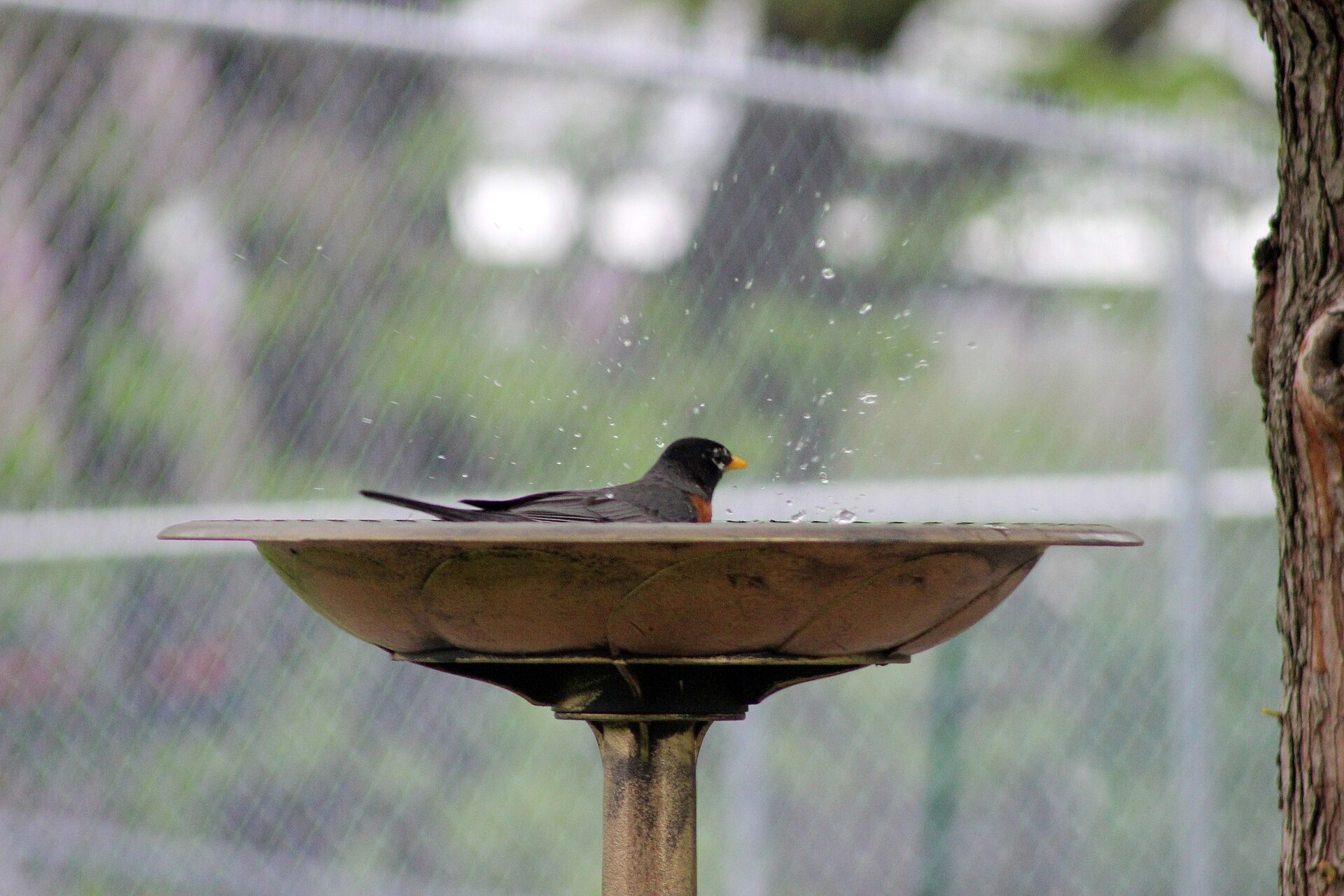
- Brick-red breast on a gray-backed, dark-headed thrush.
- White eye arcs and yellow bill.
- Runs, stops, and cocks its head on lawns.
Western Meadowlark — Male
- Yellow breast with black V; yellow washes onto the cheek.
- Streaked brown back, white outer tail feathers.
- The flutelike gurgle rolling over the prairie gives it away.
Female & Juvenile Marks, Side by Side
American Robin — Female
- Paler version of the male.
- Same upright lawn-hunting posture.
- White corners flash on the tail in flight.
Western Meadowlark — Female
- Like the male but duller.
- Walks through grass, probing soil with the long bill.
- Domed grass nest hidden on the ground.
Part-by-Part Anatomy Breakdown
Same size class, completely different pattern:
| Body Part | American Robin | Western Meadowlark |
|---|---|---|
| Breast | Plain brick-orange | Brilliant yellow with a bold black V bib |
| Back | Plain gray-brown | Brown, heavily streaked and barred |
| Tail | Medium, plain | Short; white outer feathers flash in flight |
| Bill | Short, yellow | Long, straight, pinkish spike |
| Gait | Runs and stops upright on lawns | Walks deliberately through grass, probing soil |
| Flight | Strong and level | Stiff, quail-like bursts low over the grass |
| Habitat | Lawns, parks, gardens | Prairie, pasture, hayfields, sage flats |
Song & Call Comparison
American Robin
Song: cheerful phrases — cheerily, cheer-up, cheerio — among the first voices of dawn.
Calls: sharp tut-tut-tut alarms at dusk roost time.
Western Meadowlark
Song: a rich, flutelike, gurgling melody — longer and more bubbling than the Eastern Meadowlark’s simple whistle.
Calls: a low chupp and a dry rattle.
Range & Seasonal Presence
The American Robin breeds and winters across nearly the whole US — as at home in western towns as anywhere.
The Western Meadowlark lives west of the Great Lakes in prairies, pastures and sage flats — the state bird of six western states. Rural yards adjoining real grassland may host one; tight suburbs rarely do.
Feeder Behavior & Favorite Foods
- American Robin: soaked raisins, fruit, mealworms and a ground bath.
- Western Meadowlark: rarely uses feeders; may pick insects and scattered seed from open rural ground in late winter.
- Habitat over feeders: for meadowlarks, an unmown grassy corner beats any seed offering.
- Ground caution: both feed at ground level — a cat-safe yard matters for both species.
Temperament & Flock Behavior
American Robins work lawns in the open, tame and conspicuous.
Western Meadowlarks sing exposed from fence posts but flush early into the grass, bursting away with white tail flashes.
6-Step Backyard ID Checklist
- Breast. Plain orange = robin; yellow with black V = meadowlark.
- Back. Plain = robin; heavily streaked = meadowlark.
- Tail. Plain = robin; white outer flashes = meadowlark.
- Bill. Short yellow = robin; long pinkish spike = meadowlark.
- Habitat. Lawn = robin; prairie and pasture = meadowlark.
- Song. Caroling = robin; flutelike gurgling melody = meadowlark.
Frequently Asked Questions
- Breast: Plain orange = robin; yellow + black V = meadowlark.
- Back: Plain = robin; streaked = meadowlark.
- Tail: Plain = robin; white flashes = meadowlark.
- Habitat: Lawn = robin; prairie = meadowlark.
- Song: Caroling = robin; flutelike gurgle = meadowlark.
- Family: Thrush vs blackbird — look-alikes by convergence only.