
American Robin




American Robin (Turdus migratorius): Complete Identification, Feeding Guide & Song Library
Quick Answer: How to Attract & Identify American Robins
The American Robin (Turdus migratorius) is the big orange-breasted thrush of lawns, parks, and suburbs across nearly all of North America — gray-brown above, brick-red below, yellow bill, and the rolling “cheerily-cheer-up” dawn song. To attract one: skip the seed feeder entirely — serve soaked raisins, chopped apple, or mealworms on the ground or a low platform, keep a shallow birdbath filled, and leave part of the lawn pesticide-free so the earthworms stay. It shares the lawn with the Eastern Bluebird and the Song Sparrow.
Species Physical Profile & Morphometrics
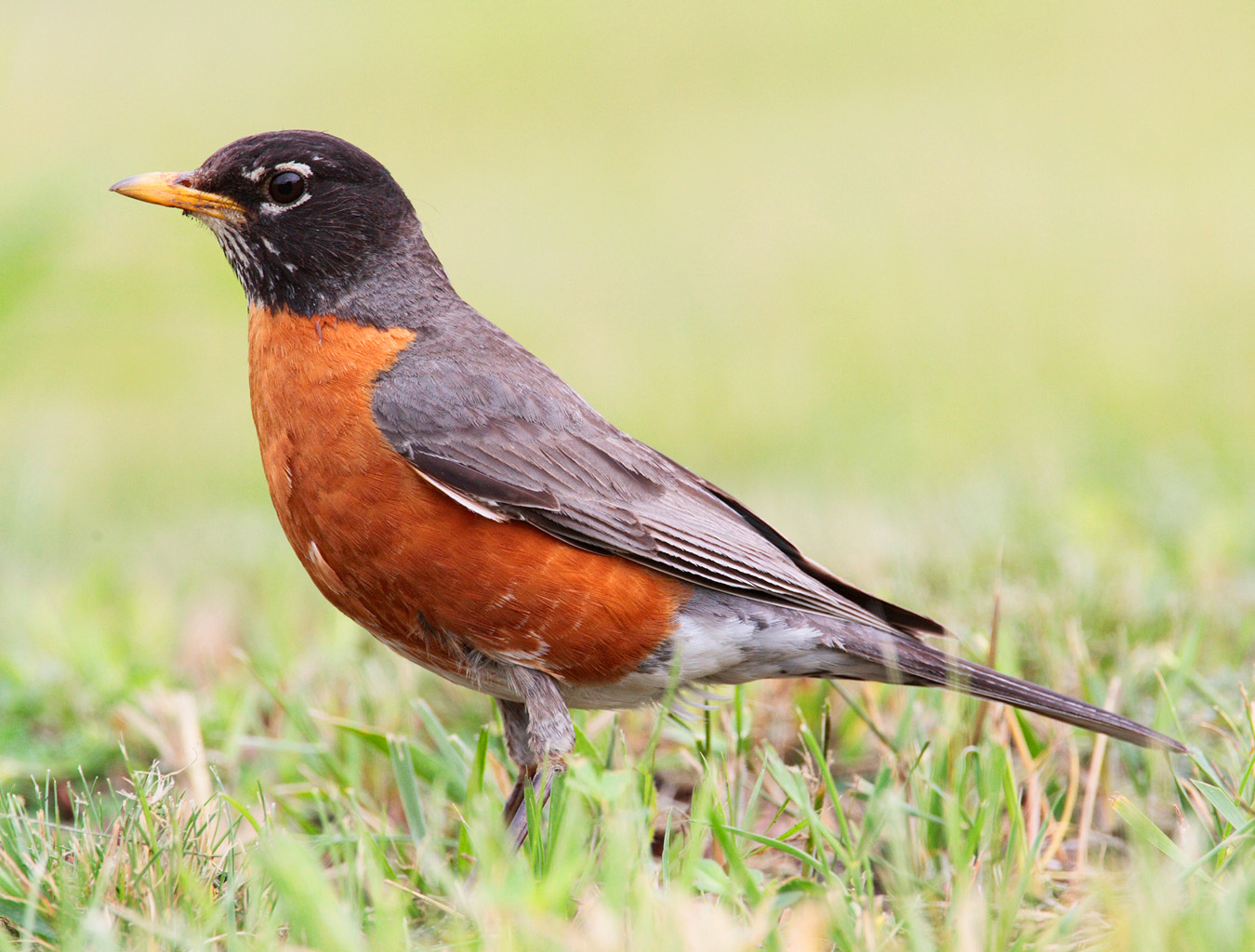
The American Robin is the largest, most familiar member of the thrush family (Turdidae) in North America — a plump, long-legged, upright bird that owns the suburban lawn. The pattern is unmistakable: dark gray-brown above, warm orange-red below, with a dark head, a yellow bill, and white arcs framing the eye.
The identification formula: orange breast + yellow bill + upright lawn stance + white eye arcs. Nothing else this common matches it. Juveniles confuse people in July — they wear a speckled, spotted breast like other young thrushes. Out west, the Varied Thrush is the deeper-orange cousin with a black chest band.
Essential Morphometric Field Marks:
- Body Length & Mass: about 7.9 to 11 inches (20–28 cm) and 2.7 to 3.0 ounces (77–85 grams) — the standard by which every other lawn bird is measured.
- Wingspan: about 12.2 to 15.8 inches (31–40 cm); flight is quick and direct with bursts of wingbeats, white flashing at the tail corners.
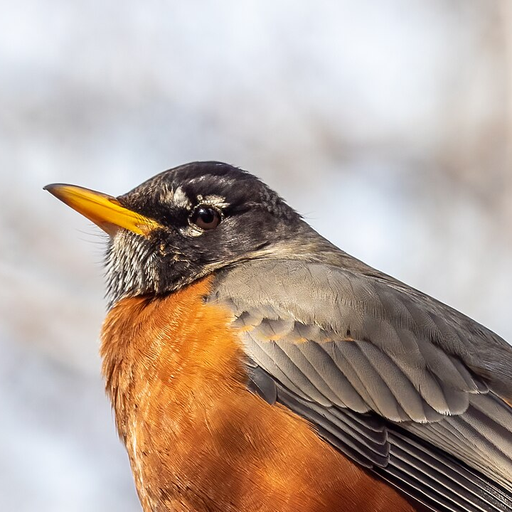
- Bill Structure & Color: A slender yellow bill, slightly decurved — a worm-grasper, not a seed-cracker; the yellow is brightest on breeding males.
- Color Pattern: Gray-brown back, orange-red breast, dark head with white eye arcs, white streaked throat, and white under the tail. Juveniles are spotted and speckled below.
- Male vs. Female: The male is the richer copy — head nearly black, breast a deep brick-red. The female is paler gray above and softer orange below, with a grayer head; both share the same pattern.
The black-headed singer: darker head, deeper red breast, and the territory’s voice — he delivers the rolling dawn carol from the highest snag and is the one dive-bombing his reflection in your window in April.
The mud-cup architect: paler gray and orange, and she alone builds the nest — a grass cup reinforced with wet mud gathered beakful by beakful — and incubates the famous 3–5 sky-blue eggs for about two weeks.
American Robin Vocalization Guide (4 Field Recordings)
The robin is the voice of the North American dawn: a cheerful, rolling carol remembered as “cheerily, cheer-up, cheerio,” plus sharp alarm “tut-tut-tut” notes and soft contact calls. All four recordings below are real field audio hosted on Wikimedia Commons — three by Jonathon Jongsma (mirrored from xeno-canto) and one from the Yellowstone sound library — no simulations. For a deeper library, browse xeno-canto: American Robin.
1. The Morning Carol
2. The Sidewalk Calls
3. The Winter Fruit Flock
4. The Yellowstone Dawn
Habitat, Range & the Human Landscape
The American Robin owns the American lawn — but its range is far broader: city parks, farms, orchards, open woodland, mountain meadows, and the edges of the northern tundra. The common thread is short open ground for worm hunting plus trees or shrubs for nesting — a combination the suburbs supply perfectly.

From Alaska to Mexico, Lawn to Tundra
One of the continent’s widest-ranging songbirds: breeding from Alaska and northern Canada to the Mexican highlands, and present year-round across most of the Lower 48. Northern birds retreat in hard winters, but huge numbers simply switch to fruit and overwinter out of sight in berry-rich woods.
Backyards score best with an open lawn, a filled birdbath, and fruit-bearing shrubs. Robins ignore tube feeders entirely — think ground, water, and worms, not seed.
Backyard Behavioral Patterns & Social Dynamics
The American Robin is the most watched bird in North America — and four behaviors explain nearly everything it does in your yard:
🪱 The Run-and-Pause Hunt
The classic routine — a few quick steps, a frozen upright pause, head cocked, then a strike — is hunting by sight, not sound: experiments show robins key on the sight of worm casts and movement at the burrow mouth, which is why a freshly watered or rain-soaked lawn fills with robins within minutes.
🌅 The Dawn Chorus Leader
Robins are among the very first birds to sing each day, often caroling an hour before sunrise and again at dusk. The male sings from the highest exposed perch on the territory — in spring, your rooftop antenna or the tallest maple will do.
🫐 The Winter Fruit Switch
When frost locks the soil, robins abandon the lawn and switch almost entirely to fruit, roaming in flocks that can strip a crabapple tree in days. The “first robin of spring” at your window in February is usually a flock member that overwintered nearby all along.
🪺 The Blue-Egg Nester
The female builds a grass cup reinforced with wet mud on a tree branch, ledge, gutter, or porch light, and lays the famous robin’s-egg blue eggs. Two broods are routine and three are common — and the male takes over feeding the fledglings while she starts the next nest.
Problem: “A Robin Keeps Attacking My Window, and the Flock Stripped My Berry Bushes. Can I Fix That?”
The three most common American Robin complaints all have workable answers:
First, the window war: a spring male fights his own reflection for days — the fix is to kill the reflection from the outside with soap streaks, tempera paint, an external screen, or a hanging towel for a week or two until the territory settles; decals on the inside do nothing. Second, the stripped berry bushes: winter flocks are voracious but move on — net the one shrub you care about and plant the rest for the birds, because a flock stripping your crabapples is a free nature show that lasts a week at most. Third, the porch nest: robins love ledges, gutters, and light fixtures — if the spot is tolerable, enjoy it (the family is gone in about five weeks from the first egg); if not, block the ledge before nest building starts in March, never after eggs are laid.
Method 1: Feed the Ground, Not the Feeder
Design for a big ground-foraging thrush that ignores seed:
-
Soaked Raisins Are the Secret Weapon
Raisins soaked in warm water until plump are the classic robin bait — soft, sweet, and exactly the size a thrush swallows whole. Chopped apple, currants, and berries work too. A small handful on the same patch of lawn each morning builds the habit fast.
-
Mealworms for the Breeding Season
Live or dried mealworms in a shallow dish are robin gold when nestlings arrive — watch an adult cram a bill-full and fly straight to the nest. Serve a measured portion twice a day so the dish empties and stays clean.
-
Serve at Ground Level
A robin will rarely climb onto a hanging feeder. A swept patch of lawn, a ground tray, or a low platform matches the walk-and-peck style this species was built for — and keep it away from dense shrubs where cats can hide.
-
Let the Lawn Do the Catering
The best robin food is free: an untreated lawn full of earthworms. Skip pesticides, water a corner in dry spells, and the robins will patrol it daily — that run-and-pause hunt on your own grass is the whole point of having them.
Method 2: Water, Mud & Fruit Trees
With robins, habitat features outperform any feeder:
-
Keep a Shallow Birdbath Full
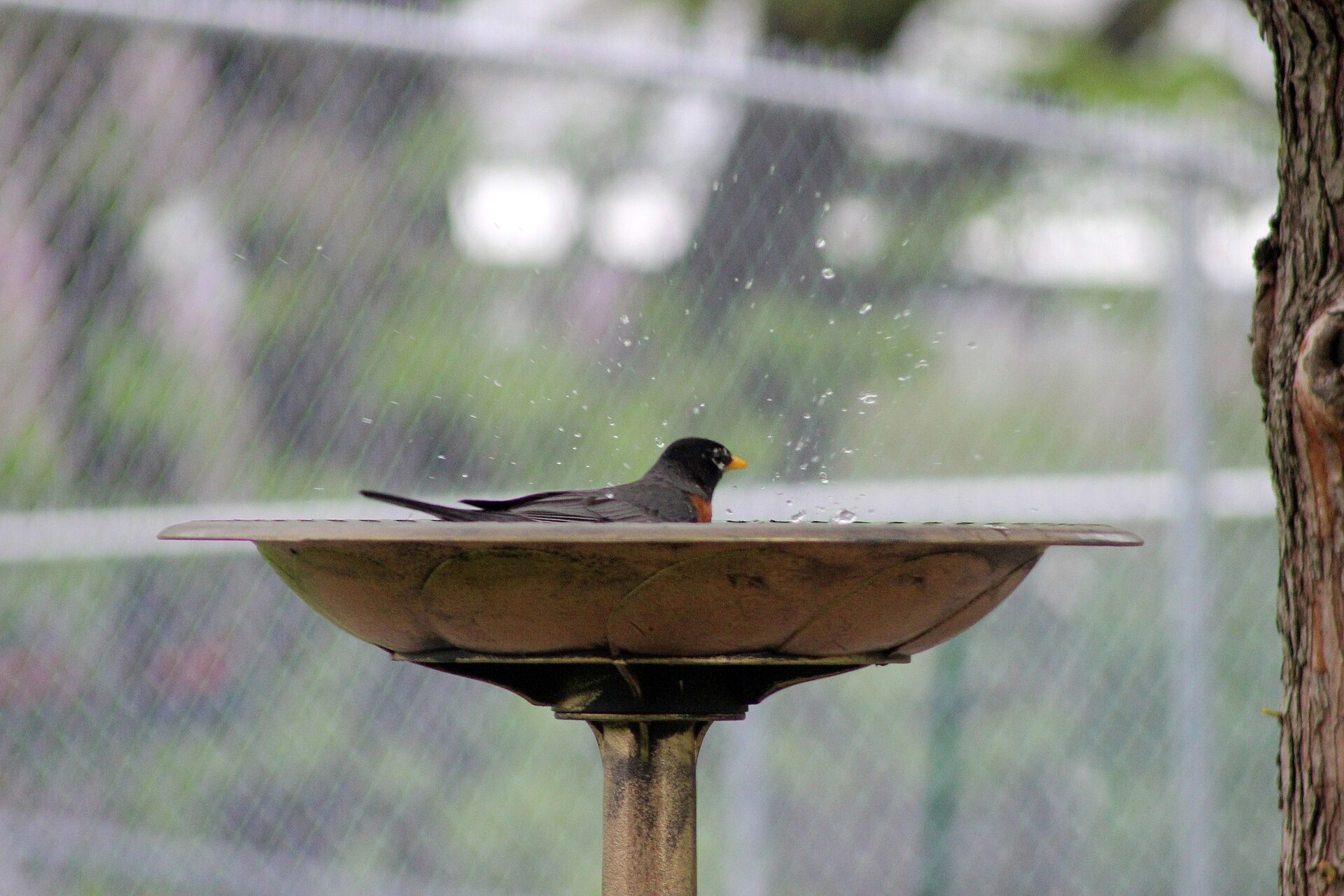
Robins are daily, enthusiastic bathers — they wade in and splash with the whole body. A shallow bath (1–2 inches deep at the edge) on open ground is used in every season, and a heated bath in winter draws birds from the whole block.
-
Leave a Mud Puddle in Spring
Nesting females need wet mud for the nest cup. A bare damp patch or a deliberately kept puddle in March and April will be visited beakful after beakful — one of the most charming sights of the season.
-
Plant the Winter Pantry
Crabapple, dogwood, serviceberry, sumac, and juniper hold fruit into the cold months and turn your yard into a winter robin stop. One good crabapple can feed a flock for a week.
-
Offer a Nesting Ledge
Robins nest on branches, gutters, and ledges, not in boxes — but a simple shelf mounted under an eave, out of reach of cats and in shade, is adopted readily. Place it near the mud source and watch the whole cycle from your window.
Tool Solution: Recommended Hardware for American Robins
Equipment matched to a ground-feeding, bath-loving thrush:
Ground Tray / Low Platform
A ground-level tray or low rigid platform for soaked raisins, chopped fruit, and mealworms — the only serving style a lawn-foraging robin uses confidently, with drainage and a daily hose-down.
- • Food: Soaked raisins, apple, mealworms, suet crumbles
- • Style: Ground tray, drain holes, open sightlines
- • Placement: Open lawn edge, away from cat cover
Shallow Heated Bird Bath
A shallow bath with a gentle slope and a winter heater — robins drink and bathe daily year-round, and ice-free water in January pulls in the whole overwintering flock.
- • Depth: 1–2 in at the edge
- • Extras: Thermostat-controlled heater
- • Placement: Open ground with clear views
Robin Nesting Shelf
An open-sided nesting shelf mounted under an eave or on a sheltered wall — robins adopt shelves readily, and a well-placed one gives you the mud-cup building and blue eggs at eye level.
- • Style: Open front, roofed shelf
- • Mount: 6–12 ft, shaded, cat-proof
- • Extra: Keep a mud source nearby
Frequently Asked Questions
- Species Profile: The American Robin (Turdus migratorius) is an 8–11 inch, 77–85 gram thrush (Turdidae) of lawns and suburbs across nearly all of North America — orange breast, yellow bill, white eye arcs, band code AMRO.
- ID in One Look: Orange-red breast + yellow bill + upright stance on a lawn; juveniles are speckled, and the male’s head is nearly black.
- More Homebody Than Legend: Many robins overwinter in the North, switching from worms to fruit in roaming flocks — the “first robin of spring” often never left.
- The Sound: A rolling “cheerily-cheer-up” carol that leads the dawn chorus, plus sharp “tut-tut” alarms — four real field recordings above, from a Minnesota morning to a Yellowstone dawn.
- Feeder Formula: No seed — soaked raisins, chopped apple, or mealworms on a ground tray, plus a shallow birdbath and an untreated, worm-rich lawn.
- The Blue Eggs: The female builds a mud-reinforced cup and lays 3–5 sky-blue eggs, raising two or three broods a season — a nesting shelf under your eave brings the whole cycle to eye level.
Bird Watching Log
Species: American Robin (Turdus migratorius)
| American Robin (Flock Size: ___ — Worm Caught: Yes / No — Bathing: Yes / No — Singing: Yes / No) | |