
Wood Thrush
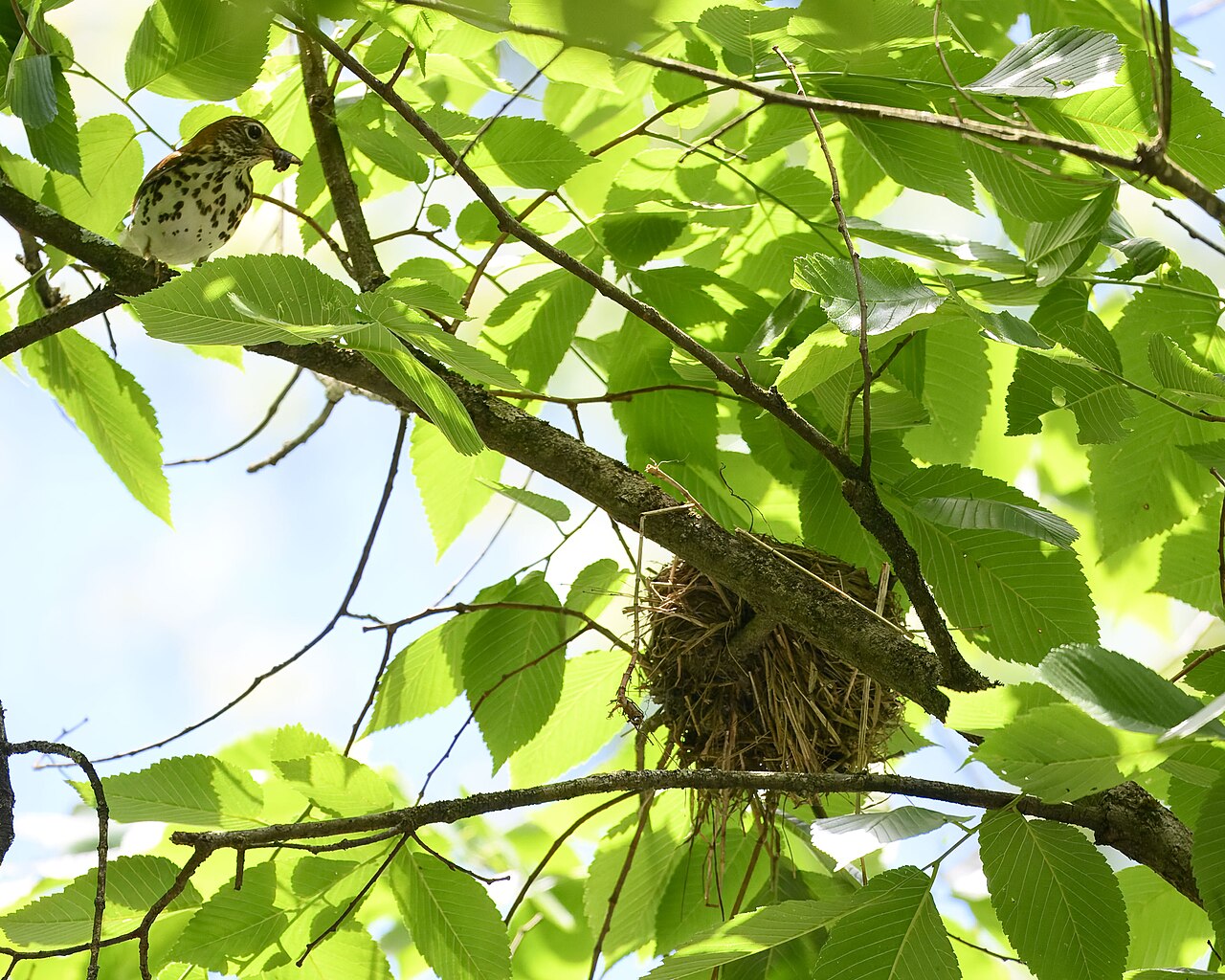


Wood Thrush (Hylocichla mustelina): Complete Identification, Habitat Guide & Sound Library
Quick Answer: How to Attract & Identify the Wood Thrush
The Wood Thrush (Hylocichla mustelina) is the flute-voiced singer of eastern forests — a rusty cap over a brown back, bold round black spots on white underparts, and a song of liquid ee-oh-lay phrases with trilled endings that defines summer dusk in the woods. It forages in moist leaf litter and winters in Central America. Shady yards attract them with mature trees, dense understory, deep leaf litter, and zero insecticide. They share the woods with the Hermit Thrush and the American Robin.
Species Physical Profile & Morphometrics
The Wood Thrush belongs to the thrush family (Turdidae) and is the signature songster of eastern deciduous forest — breeding from the Great Plains to the Atlantic, wintering in Central America.
The identification formula: rusty cap + bold round spots + upright posture in deep woods. The Hermit Thrush has a rusty tail it raises slowly; the Brown Thrasher is longer-tailed, streaked (not spotted), and rufous all over. The fluted ee-oh-lay settles it.
Essential Morphometric Field Marks:
- Body Length & Mass: 7.5 to 8.3 inches (19–21 cm) and 1.4 to 1.8 ounces (40–50 grams) — the largest of the eastern spotted thrushes.
- Wingspan: 11.8 to 13.4 inches (30–34 cm); flight is quick and direct through the understory, usually low and short.
- Bill Structure & Color: A straight, slim dark bill — the thrush standard, built for leaf-tossing and worm-pulling.
- Color Pattern: Rusty crown fading to olive-brown back, white breast with bold round black spots, white eye ring, pinkish legs.
- Male vs. Female: The sexes look alike — he sings the flute phrases; she builds the mud-lined cup and incubates.
The dusk flutist: perched mid-canopy at last light, pouring ee-oh-lay phrases through the woods until dark.
Identical in plumage — she molds the nest cup with mud like a robin and incubates low in a sapling fork.
Wood Thrush Vocalization Guide (3 Field Recordings)
The Wood Thrush’s song is a series of fluted ee-oh-lay phrases, each ending in a complex trill — among the most beautiful songs in North America. All recordings below are real field audio via Wikimedia Commons — no simulations. For a deeper library, browse xeno-canto: Wood Thrush.
1. The Ee-Oh-Lay
2. The Dusk Concert
3. The Pit-Pit Alarm
Habitat, Range & the Eastern Woods
The Wood Thrush lives in mature deciduous and mixed forest with moist soil and dense understory — and increasingly in shady suburban woodlots and large wooded parks, where it can thrive if the understory stays intact.

The Voice of the Deciduous Forest
Breeding range spans the eastern half of the country from the plains edge to the Atlantic; in fall the population migrates to southern Mexico and Central America, where deforestation is squeezing the wintering grounds.
For backyard birders: yards adjoining mature woods with dense understory and deep leaf litter can host a singing male all summer — a dusk concert from your own deck.
Backyard Behavioral Patterns & Social Dynamics
The Wood Thrush is a litter-foraging flutist of the forest interior. Four behaviors explain most of what you will observe:
🎶 The Dusk Flute
It sings most intensely at dawn and dusk — ee-oh-lay phrases carrying through the woods when the light is low.
🍂 The Leaf Tosser
It forages by tossing leaf litter aside — beetles, caterpillars, worms, and salamanders from the moist floor.
🪺 The Mud-Lined Cup
The nest is a robin-style cup with a mud layer, placed low in a sapling or shrub fork in shady woods.
🌎 The Tropics Commute
It winters in Central American forest — the song in your June woods was tuned in Costa Rica.
Problem: “How Do I Bring a Wood Thrush to My Yard? What Should I Do?”
The three most common Wood Thrush puzzles all have proven answers:
First, the heard-not-seen bird: Wood Thrushes sing from mid-canopy shade and forage on the ground — scan the forest floor for a spotted, upright bird tossing leaves, not the treetops. Second, the missing singer: yards without contiguous woods and understory rarely hold them — the fix is structural: keep understory shrubs, connect to neighboring woods, and let leaf litter accumulate. Third, the cowbird problem: in fragmented woods, cowbirds parasitize thrush nests heavily — large connected forest patches resist it; supporting local forest conservation is the real solution.
Method 1: Set the Table — Shade, Understory & Deep Litter
Design for a forest-floor thrush:
-
Keep the Understory
Dense native shrubs under mature trees — the nesting zone and shelter a thrush territory requires.
-
Let Leaves Lie
Deep, undisturbed leaf litter — the beetle-and-worm pantry; raking the woods bare starves them.
-
Skip Insecticide & Slug Bait
Ground-foragers eat what lives in the litter — poisoned prey poisons the bird.
-
Keep Cats Indoors
Ground nests and fledglings are cat prey — an indoor cat policy is thrush conservation.
Method 2: Build the Habitat — Moist Soil & Listening Hours
Keep the woods damp and the evenings quiet, and the flute returns each May:
-
Protect Moist Areas
Seeps, ravines, and low spots — moist soil holds the earthworms and salamanders thrushes love.
-
Add a Shaded Water Feature
A dripper or bath under the trees — forest birds bathe where cover is close.
-
Reduce Window Risk
Screens or markers on big windows near woods — thrushes strike glass during dawn song flights.
-
Listen at Dusk
The last hour of light is concert time — the finest free performance in eastern birding.
Tool Solution: Recommended Hardware for Wood Thrush
Equipment matched to a forest-floor flutist:
Layered Native Understory
Spicebush, viburnum, and azalea under mature trees — the structure that turns a shady yard into thrush territory.
- • Plants: Native understory
- • Rule: No spring pruning
- • Bonus: Warblers & tanagers too
Permanent Leaf Litter
Un-raked leaves under the trees — the living soil that feeds a Wood Thrush family.
- • Rule: Never rake woods
- • Bonus: Fireflies & salamanders
- • Cost: Zero
Shaded Dripper or Bath
Moving water placed under tree cover — where forest thrushes actually dare to drink and bathe.
- • Placement: Under canopy
- • Feature: Moving water
- • Bonus: Ovenbirds & grosbeaks
Frequently Asked Questions
- Species Profile: The Wood Thrush (Hylocichla mustelina) is a 7.5–8.3 inch, 1.4–1.8 ounce thrush (Turdidae), band code WOTH — the flute of the eastern forest.
- ID in One Look: Rusty cap, bold round spots, upright on the forest floor.
- The Sound: Fluted ee-oh-lay phrases at dawn and dusk; real field recordings above.
- Range & Habit: Eastern deciduous woods; winters in Central America; nests low in shady saplings.
- Feeder Formula: Understory, litter, moisture, and quiet — feeders do not apply.
- The Litter Rule: Deep unraked leaves under trees are the pantry — tidiness starves thrushes.
Bird Watching Log
Species: Wood Thrush (Hylocichla mustelina)
| Wood Thrush (Rusty Cap Seen: Yes / No — Bold Spots Seen: Yes / No — Ee-Oh-Lay Heard: Yes / No — Litter Foraging Watched: Yes / No — Date & Time: ___) | |