
American Kestrel vs Sharp-shinned Hawk


American Kestrel vs Sharp-shinned Hawk (Falco sparverius vs Accipiter striatus): The Complete Backyard Identification Guide
Quick Answer: The Fastest Way to Tell Them Apart
The two small raptors most likely in a backyard — built for completely different hunts. Three rules:
- Shape in the air: long, sickle-pointed wings = kestrel (a falcon); short, rounded wings with a long narrow rudder tail = Sharp-shinned Hawk (an accipiter).
- Hunting style: hovering in place over open grass or perched on a wire = kestrel; a explosive low ambush through the yard at feeder height = Sharp-shinned Hawk.
- Plumage: rufous back and tail with two bold black face stripes = kestrel; blue-gray back with fine orange barring below and a long barred tail = Sharp-shinned Hawk.
At-a-Glance Comparison Table
Falcon vs accipiter, side by side. KEY rows separate fastest.
| Feature | American Kestrel | Sharp-shinned Hawk |
|---|---|---|
| Scientific Name | Falco sparverius | Accipiter striatus |
| Length KEY | 8.7–9.8 in (22–25 cm) | 9.4–13.4 in (24–34 cm) |
| Wingspan | 20–24 in (51–61 cm) | 16.9–22.1 in (43–56 cm) |
| Weight | 2.8–5.8 oz (80–165 g) | 3.1–7.7 oz (87–218 g) |
| Overall Shape KEY | Robin-sized falcon with long pointed wings | Small accipiter: short rounded wings, long narrow tail |
| Male Plumage KEY | Blue-gray wings, rufous back and tail with a black terminal band, double black mustache marks | Blue-gray above, red-barred breast, yellow-orange eyes; notably smaller than the female |
| Female Plumage | Rufous wings and back barred with black; same double mustache face pattern | Same pattern as the male but up to a third larger |
| Bill Shape | Small hooked falcon bill | Small hooked bill |
| Tail | Long rufous tail, often fanned while hovering | Long, narrow, squared-off tail tip |
| Core Range KEY | Open country across all of the Americas; grasslands, farms, roadsides | Breeds in northern and mountain forests; winters across the US |
| Migration | Northern birds migrate south; southern ones resident | Short- to long-distance migrant; winter visitor to most yards |
| Feeder Presence | Never a seed feeder bird — but hunts sparrows around yards; nest boxes attract pairs | Hunts the feeder itself — ambushes sparrows, finches and doves |
| Favorite Foods | Grasshoppers, crickets, mice, small birds | Small songbirds, almost exclusively |
| Song | A shrill rapid “killy-killy-killy” | A rapid, high “kik-kik-kik” in alarm |
| Flight Call | The same shrill killy series in alarm | Shrill repeated kik notes |
| Population Trend | Declining in parts of the East; nest-box programs help | Stable; the classic winter feeder-hawk |
Male Field Marks, Side by Side
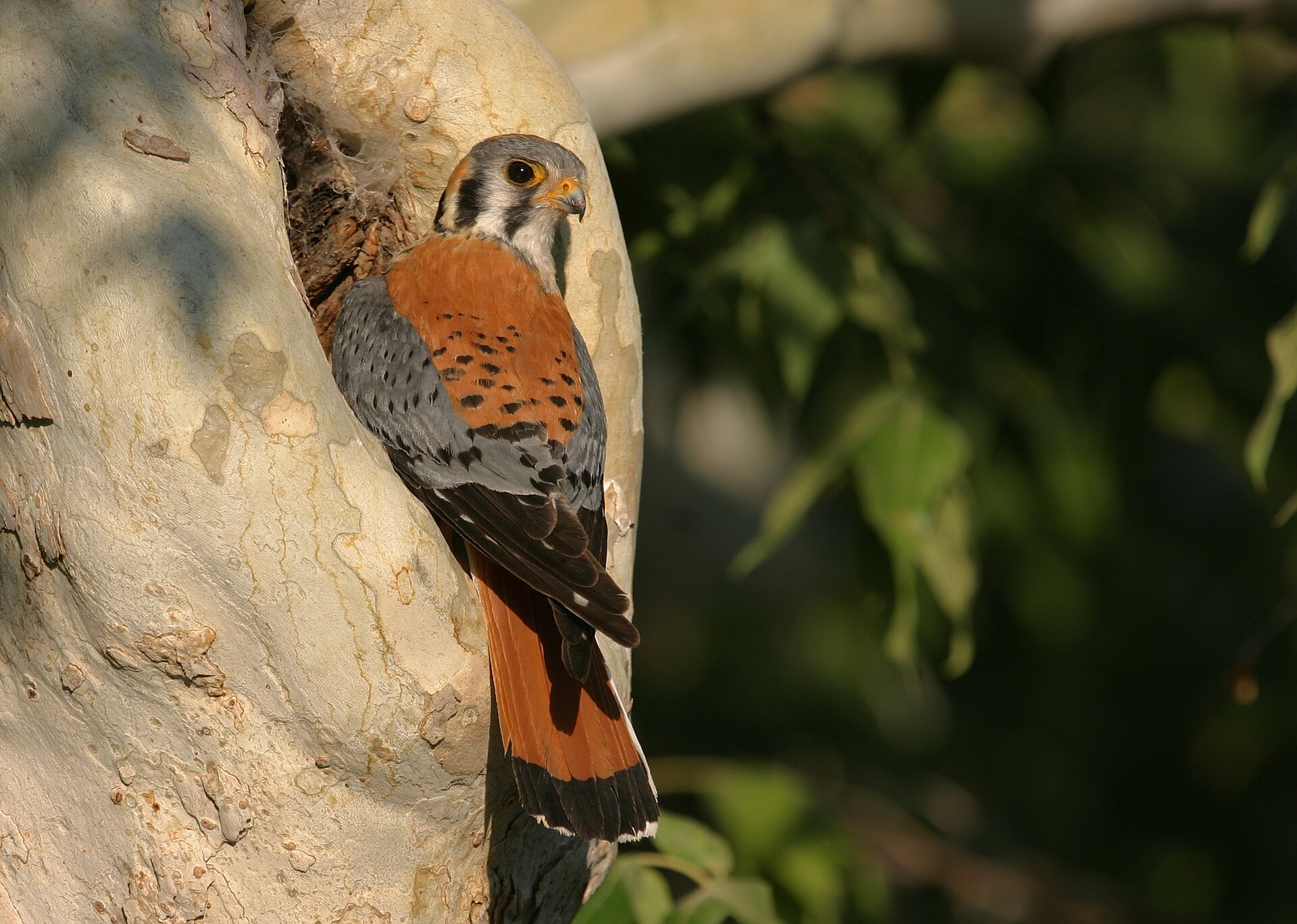
American Kestrel — Male
- Blue-gray wings + rufous back = male kestrel.
- Double black mustache marks on a white face.
- Hovers over grass, then drops on prey.
Sharp-shinned Hawk — Male
- Blue-gray back, red-barred breast, capped look.
- Short rounded wings + long squared tail = accipiter silhouette.
- The size of a jay; females approach crow size.
Female & Juvenile Marks, Side by Side
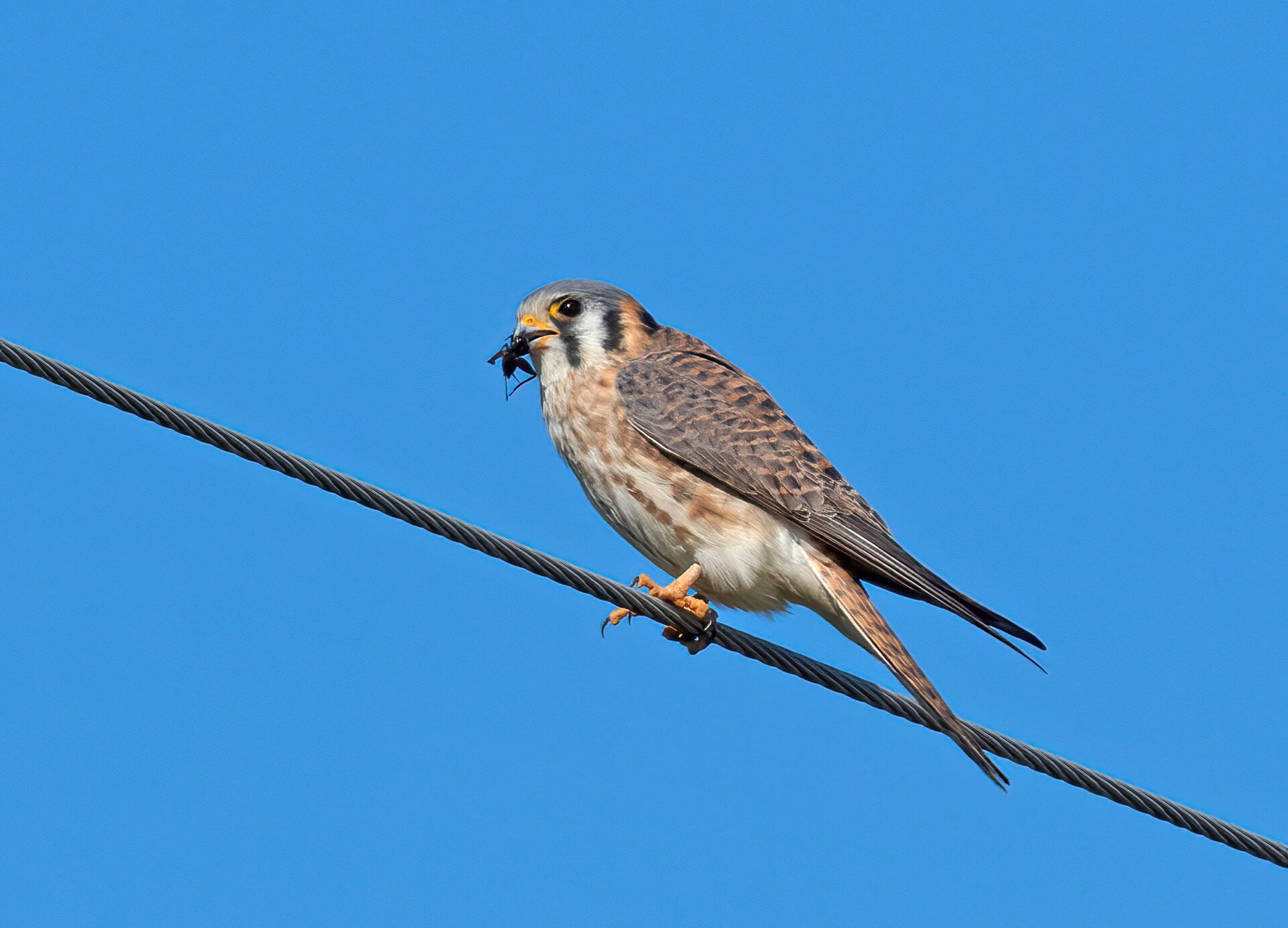
American Kestrel — Female
- Rufous barred wings and back.
- Same mustached face; slightly larger than the male.
- Perches on wires scanning for insects.
Sharp-shinned Hawk — Female
- Same plumage as the male, much larger.
- Yellow-to-orange eyes (red in older birds).
- Streaky brown juveniles hunt feeders too.
Part-by-Part Anatomy Breakdown
The two raptor body plans, part by part:
| Body Part | American Kestrel | Sharp-shinned Hawk |
|---|---|---|
| Wings | Long, pointed, built for speed and hovering | Short, rounded, built for dodging through trees |
| Tail | Rufous with a broad black tip | Very long, narrow, barred, square-tipped |
| Back (M) | Rufous with black barring; blue-gray wings | Blue-gray, same tone as the head |
| Breast (M) | Pale with scattered black spots | Fine orange-rufous horizontal barring |
| Face | Two bold black vertical stripes on white | Hooded blue-gray with a red-orange eye |
| Size | 9–12 in; sexes nearly the same size | 9–13 in; females much larger than males |
| Hunting Posture | Hovers or watches from high wires | Sits hidden in cover, then attacks low and fast |
Song & Call Comparison
American Kestrel
Voice: a shrill rapid killy-killy-killy.
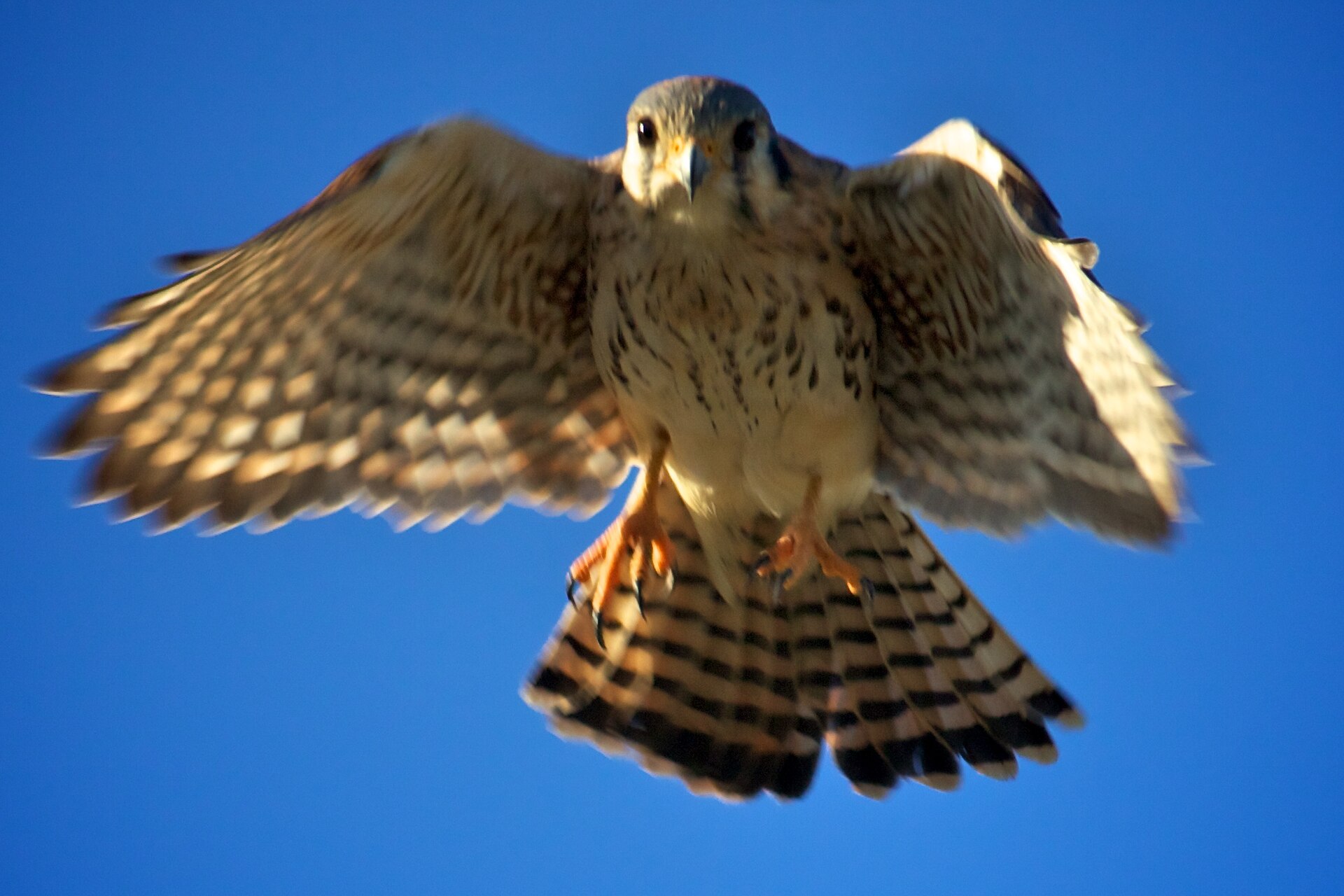
Behavior: wind-hovers in place — a falcon signature.
Sharp-shinned Hawk
Voice: rapid high kik-kik-kik alarms near the nest or a kill.
Behavior: ambush dives from cover onto feeder birds.
Range & Seasonal Presence
The American Kestrel — North America’s smallest falcon — hunts open country across the whole continent: fields, roadsides, desert edges and parks. Northern birds migrate; much of the US hosts kestrels year-round.
The Sharp-shinned Hawk breeds in northern and mountain forests and migrates south in fall, when it becomes the small-hawk regular of backyards across the US — because backyard feeders concentrate exactly what it eats.
Feeder Behavior & Favorite Foods
- American Kestrel: ignores seed feeders — it hunts mice, voles, grasshoppers and small birds in open ground, so you will see it on the wires and poles overlooking your lawn, not in the feeding station.
- Sharp-shinned Hawk: the feeder hawk — it learns your yard’s flight paths and blasts through cover to snatch sparrows, finches and doves mid-flight. Feeder activity often pauses for days after a successful raid.
- Living with them: a Sharpie’s visit is a sign your feeder ecosystem is healthy; if predation feels heavy, take feeders down for a week and the hawk moves on.
- Nest boxes: kestrels accept backyard nest boxes on poles in open habitat — one of the few raptors you can genuinely host.
Temperament & Flock Behavior
American Kestrels are conspicuous and confiding — they perch on wires and signs, bob their tails, and hover in place with fanned tails while scanning for prey.
Sharp-shinned Hawks are secretive between attacks — still, upright, and hidden inside cover — then suddenly the fastest thing in the yard, twisting through branches at full speed.
6-Step Backyard ID Checklist
- Wing shape. Long pointed wings = kestrel; short rounded wings = Sharp-shinned.
- Tail length. Moderate rufous tail = kestrel; extremely long barred rudder = Sharp-shinned.
- Hunting behavior. Hovering over open grass = kestrel; ambush through the feeder = Sharp-shinned.
- Back color. Rufous barred back = kestrel; blue-gray back = Sharp-shinned.
- Face. Two black face stripes = kestrel; hooded gray with red eye = Sharp-shinned.
- Call. Shrill repeated “killy-killy-killy” = kestrel; sharp rapid “kik-kik-kik” = Sharp-shinned.
Frequently Asked Questions
- Family: Kestrel = falcon; Sharp-shinned = accipiter hawk.
- Wings: Long and pointed (kestrel) vs short and rounded (Sharpie).
- Hunt: Hovering over grass (kestrel) vs feeder ambush (Sharpie).
- Plumage: Rufous with face stripes (kestrel) vs blue-gray with orange barring (Sharpie).
- Tail: Rufous with black tip vs long barred rudder.
- Backyard Role: Kestrel patrols wires; Sharpie empties the feeder for a day.