
Red-winged Blackbird


Red-winged Blackbird (Agelaius phoeniceus): Complete Identification, Feeder Guide & Song Library
Quick Answer: How to Attract & Identify Red-winged Blackbirds
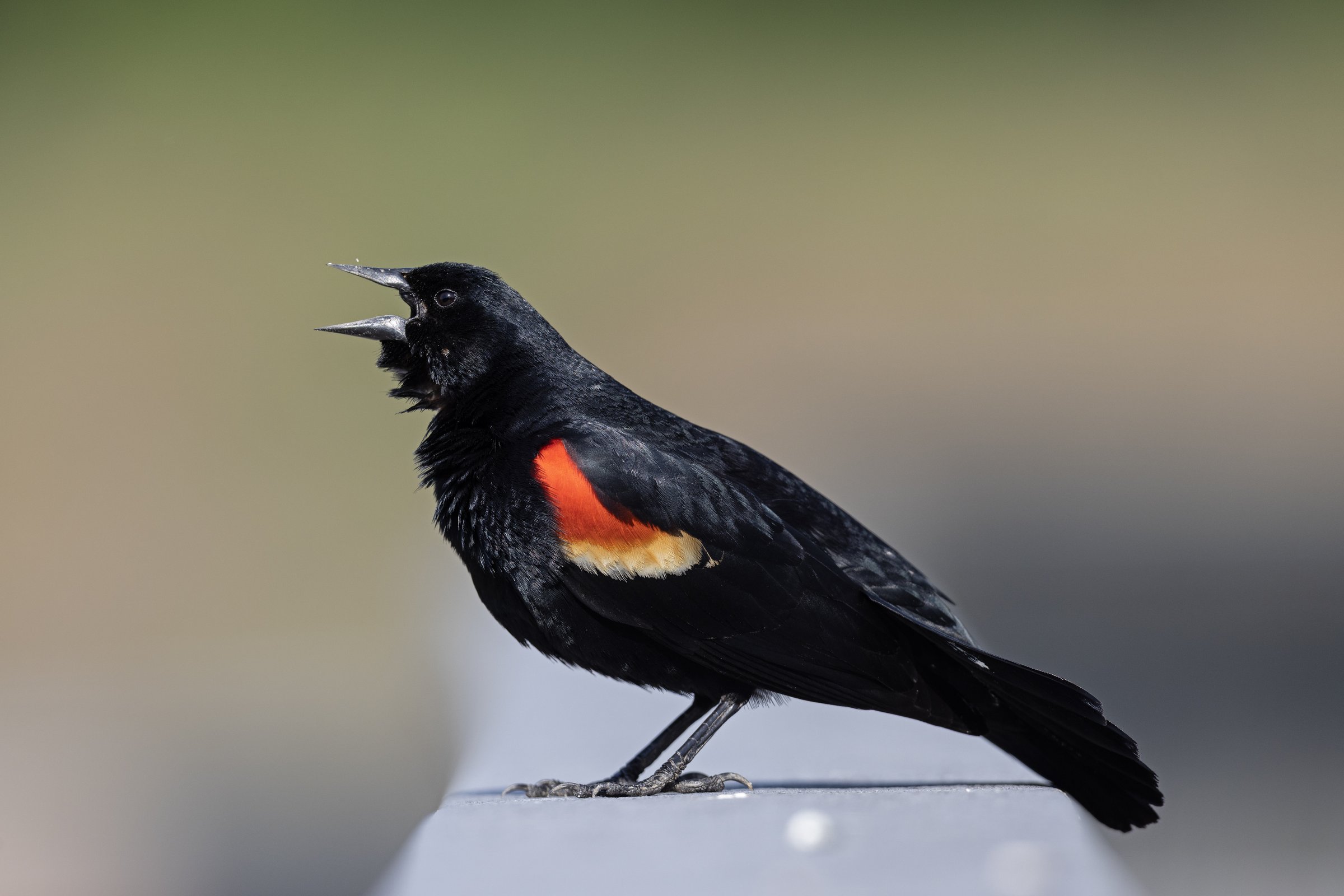
The Red-winged Blackbird (Agelaius phoeniceus) is the glossy black marsh bird with scarlet shoulder patches — one of the most abundant and familiar birds in North America. The male flashes his red-and-yellow epaulets as he sings his gurgling conk-la-ree from a cattail; the female is a streaky brown, sparrow-like bird with a pale eyebrow. Most of the U.S. holds them year-round, and northern birds pour south in winter flocks. Attract them with black oil sunflower seeds, cracked corn, and suet on tray or platform feeders — especially in late winter — and expect the Common Grackle and the Brown-headed Cowbird to arrive with the same flock.
Species Physical Profile & Morphometrics
The Red-winged Blackbird belongs to the New World blackbird family (Icteridae) and is among the most abundant native birds on the continent, with winter roosts numbering in the millions. It shares its marshes and feeders with the Common Grackle and the Brown-headed Cowbird — and on the Pacific slope its close cousin, the Tricolored Blackbird, shows a deeper red shoulder with a crisp white (not yellow) border.
The identification formula: stocky black bird + scarlet shoulder patch edged in yellow + conk-la-ree anywhere near water. No other common black bird carries the red epaulet. The female fools beginners every spring: she is streaked brown all over, sparrow-like but larger, with a pale eyebrow and a sharp, pointed bill — look for her near singing males.
Essential Morphometric Field Marks:
- Body Length & Mass: 6.7 to 9.1 inches (17–23 cm) and 1.1 to 2.7 ounces (32–77 grams) — stocky and robin-sized, with males notably larger than females.
- Wingspan: 12.2 to 15.8 inches (31–40 cm); flight is direct and strong, with huge flocks wheeling over winter fields like smoke.
- Bill Structure & Color: A long, sharply pointed conical bill, blackish in the male and gray-brown in the female — equally good at cracking seeds and snatching dragonflies.
- Color Pattern: The male is glossy black with a scarlet-red epaulet edged in pale yellow-buff on each shoulder, flared in display and tucked away when feeding. The female is heavily streaked brown with a pale eyebrow stripe and often a pinkish wash on the throat.
- Male vs. Female: Few common birds differ more: the male’s black-and-scarlet advertises from every cattail, while the female’s streaky brown hides her on the nest below. Young males look like dark, smudgy females with an orange-tinted shoulder that deepens to red by their second spring.
The scarlet sentinel: jet black with living coals on his shoulders. He arrives on the marsh weeks before the females, spends dawn shouting conk-la-ree from the tallest cattail, and dive-bombs anything — crow, dog, or birder — that strays near his patch of reeds.
The hidden weaver — streaked brown like an oversize sparrow, she slips through the marsh stems almost invisible. She alone builds the woven cup lashed to cattails or shrubs, incubates the blue-green speckled eggs, and does most of the feeding while the male stands guard.
Red-winged Blackbird Vocalization Guide (3 Field Recordings)
The Red-winged Blackbird’s signature is the gurgling, metallic conk-la-ree! — the anthem of American marshes — backed by sharp chack calls and scolding chatters. All three recordings below are real field audio, shared under commercial-use licenses via Wikimedia Commons — no simulations. For a deeper library, browse xeno-canto: Red-winged Blackbird.
1. The Conk-la-ree
2. The Marsh Chorus
3. The Alarm and the Chatter
Habitat, Range & the Marsh Life
The Red-winged Blackbird is a bird of wet places: cattail marshes, wet meadows, roadside ditches, pond edges, and flooded fields. But it spills far beyond the marsh — breeding territories crowd into hayfields and parks, and winter flocks roam croplands, feedlots, and backyard feeders wherever seed is on offer.

Coast to Coast, All Year
Few birds cover more of the map: Red-winged Blackbirds breed from Alaska and Canada to Central America and live year-round across most of the United States and Mexico. Northern breeders migrate south in fall, gathering into mixed winter flocks with grackles, cowbirds, and starlings that can number in the thousands.
For backyard birders, the feeder calendar peaks in late winter and early spring, when snow covers weed seeds and hungry flocks descend on tray feeders; traffic fades in summer as birds spread into the marshes to nest, then rebuilds as flocks reassemble in fall.
Backyard Behavioral Patterns & Social Dynamics
The Red-winged Blackbird lives at full volume — singing, flashing, flocking, and defending. Four behaviors explain most of what you will observe:
🚩 The Epaulet Display
The red shoulder patch is a signal flag: a male singing on territory flares both epaulets wide and leans into his conk-la-ree, and rivals size each other up by the size and brightness of the red. When he drops to a feeder among other birds, he tucks the scarlet away and looks plain black.
🌾 The Winter Flock
Outside the breeding season these birds are intensely social — flocks of hundreds or thousands wheel over cornfields and roost together at night, often mixed with grackles, cowbirds, and starlings. A backyard station in flock country may host a swirling crowd that empties the tray by noon.
🛡 The Marsh Guard
Nesting males are famously fearless: they dive-bomb crows, herons, dogs, and people that approach the nest marsh, striking hats and helmets on occasion. One male may guard the nests of a dozen females within his territory — the harem system that makes a spring cattail patch so loud.
🥣 The Ground-and-Tray Feeder
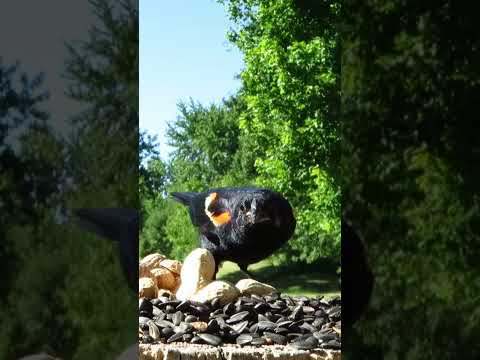
At the station they feed like little pheasants — tray feeders, platform feeders, and spilled seed on the ground suit them best, though they cling to suet cages and tube feeders when motivated. Cracked corn, sunflower, and millet are the reliable draws, especially when snow buries natural seeds.
Problem: “A Hundred Blackbirds Descended on My Feeders and Emptied Them in a Day. What Should I Do?”
The three most common Red-winged Blackbird worries all have proven answers:
First, the emptied station: winter flocks eat like locusts, and open trays invite the whole crowd — serve sunflower and safflower in tube feeders with small perches and weight-sensitive mechanisms, and put only a modest scoop on the tray so the flock moves on while songbirds still eat. Second, the dive-bombing: a male guarding a marsh nest will swoop at anything near the cattails — give the nest patch a wide berth in May and June, walk a different route for a few weeks, and know the attacks stop the moment the season ends. Third, the spring takeover: a dominant male may shoulder chickadees and finches aside — spread feeders apart and keep one small, cage-enclosed station reserved for the little birds. Manage the flock rather than fight it, and the conk-la-ree chorus becomes the best free concert of late winter.
Method 1: Set the Table — Seeds, Suet & Tray Feeders
Design for a ground-feeding flock bird with a seed eater’s bill:
-
Offer Black Oil Sunflower and Cracked Corn
Black oil sunflower, cracked corn, and white millet are the proven draws, served on a tray or platform feeder where a stocky blackbird can stand comfortably. Mixed seed scattered beneath the feeder catches the ground-feeding birds that never perch at all.
-
Hang Suet in a Sturdy Cage
Suet cakes in a wire cage attract Red-winged Blackbirds in cold snaps, when insect-eating instinct meets frozen ground. Choose a cage with wide openings or a tail-prop design so a robin-sized bird can cling and feed.
-
Feed More in Late Winter
Timing follows the flocks: traffic peaks in late winter and early spring, when natural seeds are buried or exhausted and migrant males are arriving. Top up trays in the morning during snow cover, and scale back in summer when the birds disperse to the marshes.
-
Reserve a Small-Bird Station
A flock can monopolize a feeder — keep one tube or cage-enclosed feeder with short perches for chickadees, finches, and nuthatches, placed apart from the big trays. Everyone eats, and the smaller songbirds never have to compete with the crowd.
Method 2: Build the Habitat — Water, Cattails & Winter Cover
Feed the season, not just the week:
-
Add or Keep a Water Feature
Red-winged Blackbirds live where land meets water: a pond edge, marshy corner, rain garden, or even a reliable birdbath makes a yard feel like marsh country. A dripper keeps the water moving and audible to flocks overhead.
-
Let Grasses and Cattails Stand
Cattails, sedges, and native grasses left standing through winter are seed source, cover, and potential nest scaffolding in one. Resist the fall cleanup along the wet corner — the stalks feed birds long after the flowers fade.
-
Plant Seed-Bearing Natives
Native sunflowers, coneflowers, and switchgrass turn the garden into a natural feeder from late summer through winter. Blackbirds harvest the standing seed heads directly, taking pressure off the store-bought supply.
-
Give the Marsh Buffer Space in June
If you are lucky enough to host a nest, give the wet corner a wide berth while chicks are in the nest — the male’s dive-bombing is pure parental defense and ends when the young fledge. Mow and trim that corner after midsummer, not before.
Tool Solution: Recommended Hardware for Red-winged Blackbirds
Equipment matched to a stocky, ground-and-tray feeding flock bird:
Platform / Tray Feeder
A roomy tray or platform feeder — hung or pole-mounted — where stocky blackbirds can stand and feed on sunflower, cracked corn, and millet, with drainage to keep seed dry in wet weather.
- • Food: Sunflower, corn, millet
- • Style: Open tray, drained
- • Placement: Open, near cover
Caged Tube Feeder
A tube feeder wrapped in a wire cage or fitted with a weight-sensitive perch — keeps sunflower flowing to chickadees and finches while the blackbird flock works the open tray instead.
- • Food: Sunflower, safflower
- • Style: Cage or weight-sensitive
- • Bonus: Excludes starlings too
Heated Birdbath
A heated shallow bath keeps open water available through freezing weather — a genuine magnet for winter blackbird flocks when every marsh edge is iced over.
- • Depth: 1–2 in, gently sloped
- • Feature: Thermostat-controlled
- • Placement: Open sightlines
Frequently Asked Questions
- Species Profile: The Red-winged Blackbird (Agelaius phoeniceus) is a 6.7–9.1 inch, 1.1–2.7 ounce songbird (Icteridae), band code RWBL — one of the most abundant native birds in North America.
- ID in One Look: The male is glossy black with a scarlet epaulet edged in yellow; the female is a heavily streaked brown bird with a pale eyebrow; young males show an orange-tinted shoulder before turning red.
- The Sound: The gurgling, metallic conk-la-ree! of the marsh, plus sharp chack calls and scolding chatters; three real field recordings above.
- Range & Habit: Breeds from Alaska and Canada to Central America, resident across most of the U.S. — northern birds winter in huge mixed flocks; nests in cattail marshes, feeds out into fields and yards.
- Feeder Formula: Black oil sunflower, cracked corn, millet, and suet on tray or platform feeders — traffic peaks in late winter; keep one caged tube feeder reserved for small songbirds.
- The Season: Males return to the marshes in February and March; expect the biggest backyard crowds whenever snow covers natural seeds, and give nesting marshes a wide berth in June.

Bird Watching Log
Species: Red-winged Blackbird (Agelaius phoeniceus)
| Red-winged Blackbird (Red Epaulets Seen: Yes / No — Conk-la-ree Heard: Yes / No — Feeder Taken: Yes / No — Flock Size: Small / Large) | |