
Cooper’s Hawk


Cooper’s Hawk (Accipiter cooperii): Complete Identification, Feeder Coexistence & Call Library
Quick Answer: Identifying & Living with a Cooper’s Hawk
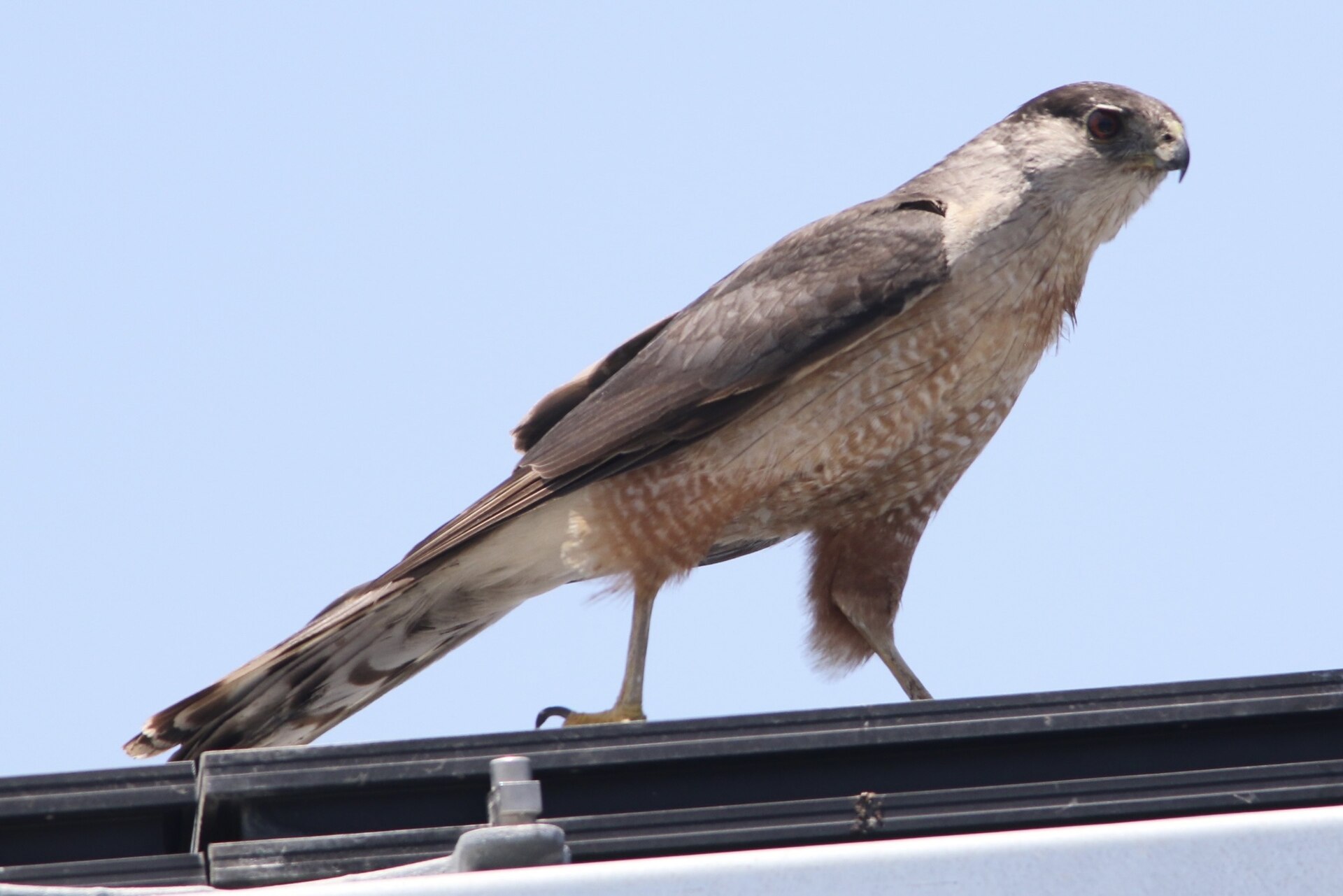
The Cooper’s Hawk (Accipiter cooperii) is the crow-sized accipiter that has become the classic backyard predator of North America — adults are blue-gray above with a rufous-barred breast, a dark cap, red eyes, and a long rounded tail; juveniles are brown with streaked underparts and yellow eyes. It hunts medium-sized birds at feeders, bursting from cover on short rounded wings. You cannot (and legally may not) deter it by harm — instead pause feeders for a week or two, add escape cover within ten feet, and protect windows. The top confusion species is the smaller Sharp-shinned Hawk: check tail shape (rounded vs. square) and the capped vs. hooded head pattern.
Species Physical Profile & Morphometrics
The Cooper’s Hawk belongs to the hawk and eagle family (Accipitridae) and shows the classic accipiter build: short, rounded wings and a long, rudder-like tail — a design for pursuit through trees, not soaring over fields.
The identification formula: crow-sized + dark cap with pale nape + finely barred rufous breast + long rounded tail with wide white tip + flap-flap-glide flight. Juveniles trade the rufous barring for brown streaks and the red eye for yellow.
Essential Morphometric Field Marks:
- Body Length & Mass: 14.6 to 17.7 inches (37–47 cm) and 7.8 to 24.0 ounces (220–680 grams) — roughly crow-sized, with females averaging a third larger than males and sometimes weighing nearly twice as much.
- Wingspan: 24.4 to 35.4 inches (62–90 cm); wings are short and rounded, and flight alternates a few stiff flaps with a glide — never the constant flapping of a falcon or the soaring of a buteo.
- Bill & Feet: A hooked blue-gray bill and long yellow legs and toes — the legs proportionally thicker than a Sharp-shinned Hawk’s pencil-thin legs.
- Color Pattern: Adults: steely blue-gray above, warm rufous barring below, dark cap contrasting with a pale nape, red-orange eyes, and a long tail rounded at the tip with a broad white band. Juveniles: brown above, white below with coarse brown streaks, yellow eyes.
- Age & Sex Differences: Eye color shifts from yellow to orange to deep red with age; males average darker-backed and deeper red-eyed. The white tail tip wears away by the bird’s second year.
The smaller half: males run near the bottom of the size range — little bigger than a jay-and-a-half — and show the crispest blue-gray back, the finest rufous barring, and often the deepest red eye. In a perched pair, the male is the noticeably compact bird.
The bigger half — females can approach small-crow bulk and dominate the pair. Juveniles of both sexes are the brown, streaky, yellow-eyed birds that so often appear at winter feeders; they molt into adult plumage over their first full year.
Cooper’s Hawk Vocalization Guide (3 Field Recordings)
The signature sound is a loud, harsh, accelerating cak-cak-cak series, backed by single alarm kik notes. All three recordings below are real field audio, shared under free licenses via Wikimedia Commons — no simulations. For a deeper library, browse xeno-canto: Cooper’s Hawk.
1. The Cak Series
2. Alarm and Agitation
3. Calls in Suburbia
Habitat, Range & the Backyard Life
Once a bird of deep forest, the Cooper’s Hawk has adapted completely to wooded suburbs, city parks, and backyard feeder lines — it is now one of the most widespread raptors on the continent, found year-round across most of the United States.

The Suburban Success Story
The species breeds across southern Canada and the entire Lower 48 wherever there are trees to nest in — and that now explicitly includes neighborhoods. Feeders concentrate prey, mature street trees provide nest sites, and the hawks have followed.
Northern birds withdraw in winter while southern birds are resident, so most of the country has Cooper’s Hawks in every month of the year. A winter feeder watch is the single most likely place an American will meet this hawk.
Backyard Behavioral Patterns & Social Dynamics
Four behaviors define what you will actually see when a Cooper’s Hawk adopts your yard:
🎯 The Feeder Ambush
The hawk learns the yard’s rhythm and watches from a concealed perch — inside a spruce, behind the fence line — then bursts in low and fast when feeder traffic peaks. Songbirds exploding in every direction is usually your first notice that the hawk was ever there.
🌳 The Thread-the-Needle Flyer
Those short wings and that long tail let a Cooper’s Hawk chase prey through dense branches at full speed, rolling sideways through gaps that seem impossible. Chases routinely end at windows — for both hunter and hunted — which is why window protection matters.
🪶 The Flap-Flap-Glide
Learn the flight signature: a few stiff, quick wingbeats followed by a short glide, repeating. It reads completely different from a falcon’s rowing flight or a Red-tailed Hawk’s soaring, and it identifies the bird crossing your yard at a glance.
🛁 The Surprising Bather
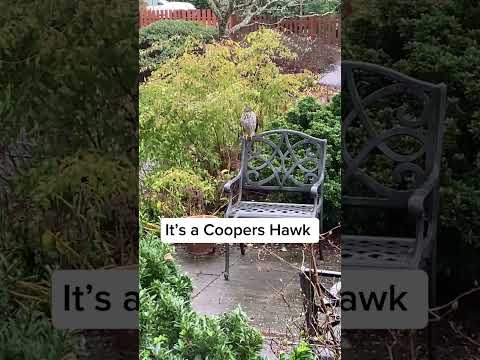
A settled yard hawk often starts bathing and drinking at a birdbath, standing belly-deep and fanning that long tail — sometimes monopolizing the bath for half an hour. It is one of the great backyard sights, and it means the hawk considers your yard home territory.
Problem: “A Hawk Has Discovered My Feeders and Is Picking Off My Songbirds — What Can I Do?”
First, take it as a compliment — a Cooper’s Hawk only moves in where the birding is good. Then manage it the smart, legal way:
Understand what is happening: the hawk is not targeting your pets or your family; it has found a reliable concentration of dove-sized prey, which is exactly what millions of years of evolution built it to hunt. Because Cooper’s Hawks are protected by the Migratory Bird Treaty Act, trapping, harming, or harassing one is a federal offense — and unnecessary, because the humane fixes work. The proven playbook: take feeders down for one to two weeks so the prey flock disperses and the hawk’s stakeout stops paying; when you rehang them, place feeders within ten feet of dense shrub cover or a brush pile so ambushed birds reach safety in one dart; add caged feeders that small birds can enter but hawks cannot; and put collision decals on nearby windows, since feeder chases cause deadly window strikes for both parties. Expect the hawk to return periodically — many yards settle into a rhythm where the hawk visits, misses a few times, and moves along. A yard that supports the whole food web, hawk included, is a healthy one.
Method 1: Protecting Songbirds at Your Feeders
You cannot stop a hawk from hunting, but you can tilt the odds for the prey:
-
Pause Feeders When a Hawk Settles In
If a bird is making daily kills, remove all feeders for one to two weeks. The concentrated prey disperses, the hawk’s hunting success collapses, and it relocates. Songbirds resume normal foraging within a day and return when feeders come back.
-
Put Escape Cover Within Ten Feet
Dense shrubs, a brush pile, or a thicket of native evergreens right beside the feeding station is the single most effective protection — small birds need to reach cover in under two seconds. A feeder hung in the middle of an open lawn is an all-you-can-eat buffet for an accipiter.
-
Use Caged Feeders for Small Birds
Wire-mesh caged tube feeders let chickadees, finches, and titmice feed inside a shell that blocks a hawk’s approach. Big, visible birds like doves still feed exposed — and doves are the hawk’s main prey — so accept that some predation continues.
-
Protect Your Windows
Feeder chases end in window strikes more often than in captures. Decals, tape grids, or external screens on windows near feeders save songbirds fleeing a hawk — and save the hawk itself, which strikes glass at full pursuit speed. Markings must be on the outside surface to work.
Method 2: Watching & Enjoying Your Resident Hawk
Once you accept the hawk as part of the yard, it becomes one of the best birds on your list:
-
Learn the Daily Pattern
A resident Cooper’s Hawk is a creature of habit — scan fence posts, dead snags, and the bath mid-morning and late afternoon, and watch for the songbirds’ sudden silence, which announces the hawk before you see it.
-
Listen for the Spring Cak Series
From March through May, a loud cak-cak-cak echoing from a woodlot edge often means a nest nearby. Cooper’s Hawks now nest in suburban parks and big street trees; give the tree a wide berth and enjoy the show from a distance.
-
Watch from Indoors
These hawks tolerate people far better through glass: keep binoculars at the window and photograph from inside. A hawk at the bath — tail fanned, wings drooped — is a frame-worthy sight that disappears the moment the door opens.
-
Skip the Rodenticides
Cooper’s Hawks also take chipmunks and young squirrels, and rodent-eating raptors are poisoned by anticoagulant baits moving up the food chain. Choose traps over poisons — your yard’s hawks and owls are doing rodent control for free.
Tool Solution: Recommended Hardware for a Hawk-Visited Yard
Equipment that protects songbirds while letting you enjoy the hawk:
Caged Tube Feeder
A tube feeder inside a rigid wire cage with roughly 1.5-inch openings — chickadees, finches, and titmice slip through to feed while a hawk’s approach is blocked entirely. Hang it near dense shrubs for a double layer of safety.
- • Food: Sunflower hearts, mixed seed
- • Style: Tube inside wire cage
- • Placement: Within 10 ft of cover
Window Collision Decals
Exterior-surface decals or tape grids spaced two inches apart — the standard fix for chase-related window strikes. They protect fleeing songbirds and the pursuing hawk alike, and pay for themselves the first impact they prevent.
- • Type: Exterior decals or tape
- • Spacing: 2 in grid pattern
- • Targets: Windows facing feeders
Ground-Level Birdbath
A sturdy, shallow ground or pedestal bath is where a resident Cooper’s Hawk will drink and bathe — often standing in it for twenty minutes at a time. Place it in the open where the hawk feels secure, away from ambush cover aimed at the feeders.
- • Depth: 1–2 in, gently sloped
- • Base: Weighted, tip-proof
- • Placement: Open sightlines
Frequently Asked Questions
- Species Profile: The Cooper’s Hawk (Accipiter cooperii) is a 14.6–17.7 inch, 7.8–24-ounce raptor (Accipitridae), band code COHA — the crow-sized accipiter that hunts songbirds at American feeders; females run about a third larger than males.
- ID in One Look: Adults are blue-gray with a rufous-barred breast, a dark cap over a pale nape, red eyes, and a long rounded tail with a broad white tip; juveniles are brown and streaky with yellow eyes. Flight is a stiff flap-flap-glide.
- The Sound: A loud, harsh, accelerating cak-cak-cak series near the nest in spring; winter feeder hunters are usually silent — three real field recordings above.
- Range & Habit: Year-round across most of the U.S., nesting in wooded neighborhoods and hunting bird concentrations — the suburban raptor success story.
- Coexistence Formula: Pause feeders one to two weeks if a hawk settles in, keep escape cover within ten feet, use caged feeders for small birds, and decal the windows facing your feeding station.
- The Reframe: A Cooper’s Hawk at your feeder means your yard supports a complete food web — protected by federal law, doing rodent control for free, and one of the most thrilling birds you will ever watch from your kitchen window.

Bird Watching Log
Species: Cooper’s Hawk (Accipiter cooperii)
| Cooper’s Hawk (Rounded Tail Seen: Yes / No — Eye Color: Red / Yellow — Feeder Stakeout: Yes / No — Cak Call Heard: Yes / No) | |