
Sharp-shinned Hawk


Sharp-shinned Hawk (Accipiter striatus): Complete Identification, Feeder Coexistence & Call Library
Quick Answer: Identifying & Living with a Sharp-shinned Hawk
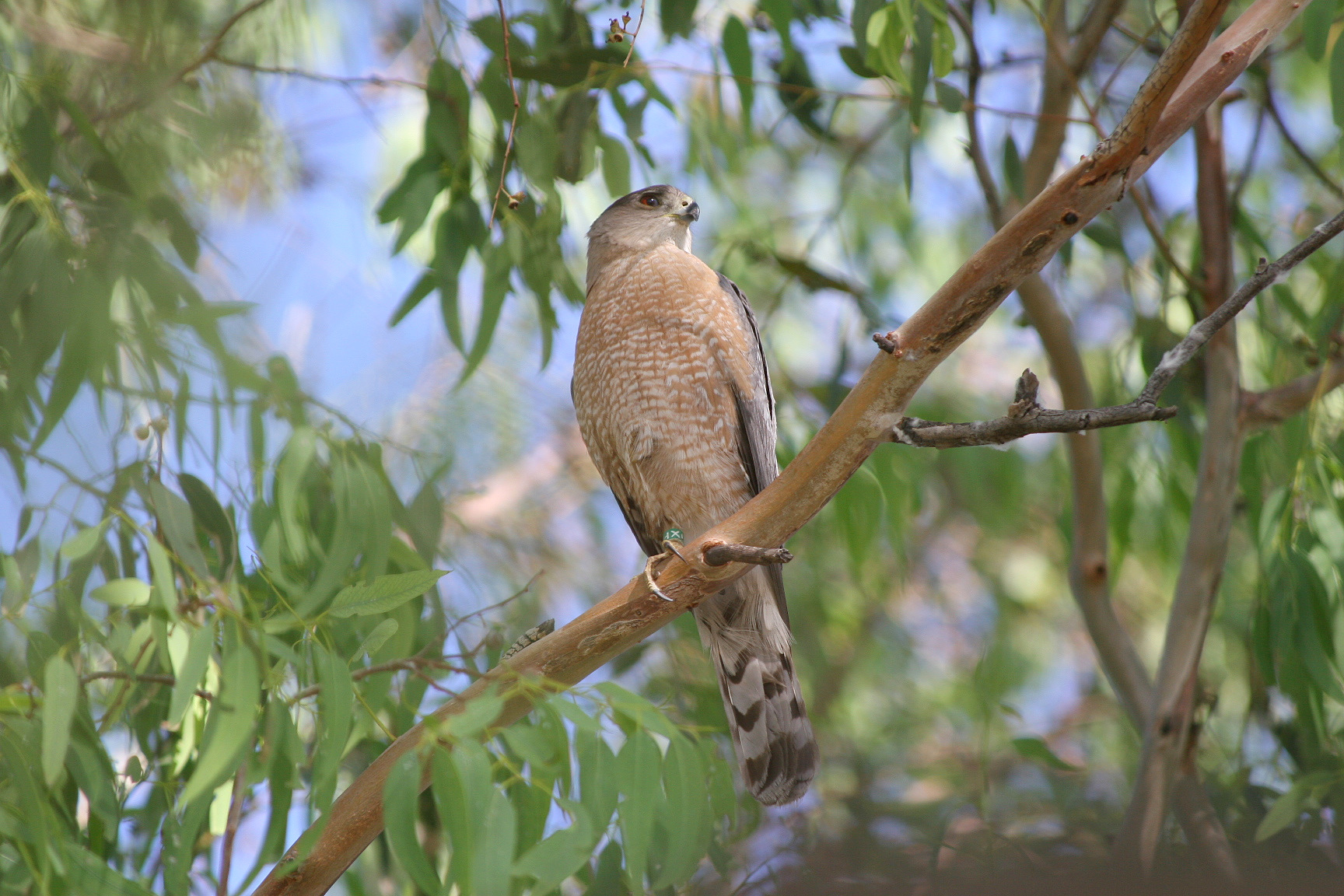
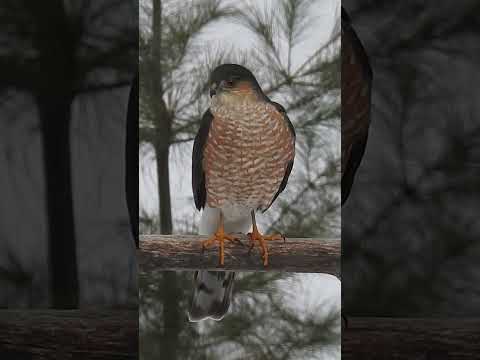
The Sharp-shinned Hawk (Accipiter striatus) is the smallest hawk in the United States — males are barely bigger than a Blue Jay — and the little accipiter that stakes out winter bird feeders. Adults are blue-gray above with orange-barred underparts, a hooded head, red eyes, pencil-thin legs, and a square-cut tail; juveniles are brown with coarse streaks and yellow eyes. It hunts sparrow-sized songbirds in twisting chases through cover. If one adopts your feeder station, pause feeding for one to two weeks, keep escape cover within ten feet, and decal nearby windows — harming it is illegal under the Migratory Bird Treaty Act. The classic confusion species is the larger Cooper’s Hawk: check tail shape (square vs. rounded) and head profile (hooded vs. capped).
Species Physical Profile & Morphometrics
The Sharp-shinned Hawk belongs to the hawk and eagle family (Accipitridae) and shares the accipiter body plan — short rounded wings and a long steering tail — shrunk down to songbird-chasing scale. Males are remarkably small, and females can weigh more than twice as much.
The identification formula: jay-sized + hooded head with tiny bill + orange-barred breast + pencil-thin legs + square tail tip + quick, snappy wingbeats. Most yard identifications come down to separating this bird from its big cousin, the Cooper’s Hawk.
Essential Morphometric Field Marks:
- Body Length & Mass: 9.4 to 13.4 inches (24–34 cm) and 3.1 to 7.7 ounces (87–218 grams) — males average jay-sized; females run up to nearly robin-and-a-half bulk and approach small male Cooper’s Hawks.
- Wingspan: 16.9 to 22.1 inches (43–56 cm); flight is quick and buoyant with snappy, shallow wingbeats, choppier than the steadier flap-flap-glide of a Cooper’s.
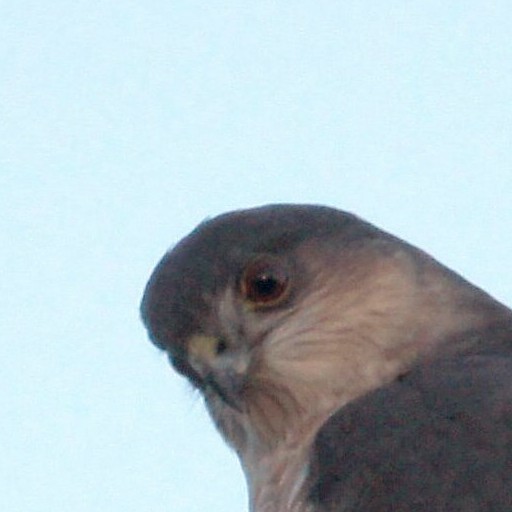
- Bill, Legs & Head: A tiny hooked bill, long pencil-thin yellow legs, and a small rounded head that barely projects past the wings in flight — the opposite of the Cooper’s big, forward-thrusting head.
- Color Pattern: Adults: blue-gray above, dense orange-rufous barring below, red-orange eyes, and a hooded look — the dark crown flows straight into the back with no pale nape. The tail ends in a square or slightly notched tip with a narrow pale band. Juveniles: brown above, creamy below with coarse reddish streaks, yellow eyes.
- Age & Sex Differences: Eye color deepens from yellow to red over the first two years; the sexes share plumage but differ strikingly in size, with females up to twice a male’s weight.
The tiny terror: males sit at the bottom of the size scale — barely longer than a Blue Jay and lighter than many doves — with the brightest orange barring and the deepest red eye. A “dove-sized hawk” at the feeder that looks compact and small-headed is usually a male Sharp-shin.
The lookalike zone — big females overlap small male Cooper’s Hawks in size, which is when tail shape (square, not rounded) and the hooded head decide the ID. Juveniles are the brown, streaked, yellow-eyed birds that make up most first-winter feeder visitors.
Sharp-shinned Hawk Vocalization Guide (3 Field Recordings)
The voice is a high, thin, rapid kik-kik-kik series — higher and faster than the Cooper’s Hawk’s deeper cak-cak-cak. All three recordings below are real field audio shared under free licenses — no simulations. For a deeper library, browse xeno-canto: Sharp-shinned Hawk.
1. The Kik Series
2. Agitated Calls
3. Field Calls
Habitat, Range & the Backyard Life
The Sharp-shinned Hawk breeds in dense coniferous and mixed forests across Alaska, Canada, the northern states, and mountain ranges — but for backyard birders it is above all a winter bird, pouring south each fall to hunt feeders and thickets across the entire Lower 48 and into Central America.

The Snowbird Hawk
Fall migration brings enormous movements along ridges and lakeshores — hawkwatches count thousands in a day — and those birds then scatter through every kind of wooded and suburban habitat for the winter. Your yard is exactly the habitat: feeders concentrate sparrows and finches, and the hawks follow them.
Most winter visitors are juveniles on their first hunt season, which is why the feeder stakeout can look clumsy and persistent. By April the winter birds slip back north, and your yard returns to songbird rule until October.
Backyard Behavioral Patterns & Social Dynamics
Four behaviors cover most of what a yard Sharp-shin will show you:
🎯 The Feeder Stakeout
The bird sits motionless inside dense cover near the feeding station — a spruce interior, a vine tangle — sometimes for an hour, waiting for traffic to resume. Then one low, horizontal burst decides everything in about three seconds.
💨 The Burst-and-Twist Chase
Hunts are won by surprise and agility: short, explosive pursuits that twist through shrubbery at songbird speed. Most chases fail — experienced feeder birds escape far more often than not — which is why the hawk returns hungry to try again.
❄️ The Winter Guest
In the northern two-thirds of the country this is overwhelmingly a cold-season bird. The same individual may adopt your yard for weeks, appearing at the same times each day — many people only ever see Sharp-shins between the first cold snap and the last frost.
🤫 The Silent Hunter
Away from the nest this species almost never calls — your alarm system is the songbirds themselves. A sudden total silence, every finch frozen or gone, is the surest sign that a little gray hawk is sitting somewhere in your yard.
Problem: “A Tiny Hawk Is Terrorizing My Feeders — Chasing My Chickadees and Finches Every Day. What Is It and What Can I Do?”
That is a Sharp-shinned Hawk doing what it was built to do — and the fix is management, not warfare:
The identification is the easy half: a jay-to-dove-sized hawk with short rounded wings, a small head, and a square-tipped tail is this species (a bigger, big-headed, round-tailed bird is a Cooper’s Hawk). What you are watching is a specialist that takes over 90 percent of its diet as small birds, and your feeder is the densest patch of prey in the neighborhood. The legal reality: like all native hawks it is protected by the Migratory Bird Treaty Act — no trapping, no harming. The working strategy: pull the feeders for one to two weeks and the hawk’s hunting grounds dry up; meanwhile add or improve dense escape cover within ten feet of the station, hang caged feeders for the smallest birds, and decal the windows facing the feeding area, since panic chases cause deadly strikes. Remember the arithmetic, too: most ambushes fail, and a hawk that catches one finch every few days is not emptying your yard — it is pruning it, the same way it has pruned songbird flocks for millennia.
Method 1: Protecting Songbirds at Your Feeders
You cannot remove the predator legally — but you can make the yard a harder hunt:
-
Pause Feeding During a Stakeout
When a hawk hunts your station daily, take all feeders down for one to two weeks. The prey flock disperses to natural foods, the hawk’s success rate crashes, and it relocates. Resume feeding after the pause; most yards see the hawk only occasionally thereafter.
-
Anchor Feeders Next to Cover
Hang or pole-mount feeders within ten feet of dense shrubs, evergreens, or a brush pile — never in the middle of open lawn. A chickadee that can reach a thicket in one second survives; one with fifty feet of open air does not.
-
Cage the Small-Bird Feeders
Wire-caged tube feeders create a physical shell that a hawk cannot penetrate, giving finches, chickadees, and titmice a protected dining room. This does nothing for doves on the ground — but doves are mostly hunted by the larger Cooper’s Hawk anyway.
-
Decal the Windows
Panic flights from hawk attacks are a top cause of fatal window strikes, and the hawks themselves hit glass mid-chase. Apply external decals or tape in a two-inch grid on any window facing the feeders — partial coverage does not work.
Method 2: Field Identification — Nailing the Sharp-shin vs. Cooper’s Call
Getting the species right is half the fun of hosting one:
-
Judge Size Against a Known Bird
Watch what it hunts: a hawk that chases sparrows and finches and looks barely bigger than its prey is a Sharp-shin; one that takes doves and looks crow-sized is a Cooper’s. Better still, note the prey it catches — dove-sized kills point to Cooper’s.
-
Freeze-Frame the Tail
When the bird launches or lands, the tail fans for a split second: square-cut with a thin pale edge means Sharp-shinned; rounded with a broad white band means Cooper’s. This single mark settles most perched-bird IDs.
-
Read the Head Profile
Perched, look for the hood versus the cap: the Sharp-shin’s dark crown blends into its back, while the Cooper’s shows a dark cap set off by a pale nape. In flight, the Sharp-shin’s head barely pokes past the wings — some birders describe the silhouette as a flying mallet.
-
Log Every Visit
Note the date, age class (brown-streaked juvenile vs. barred adult), and hunting success in the observation sheet below or on eBird. Winter feeder hawks are often the same individual on a daily circuit, and your records will prove it within a month.
Tool Solution: Recommended Hardware for a Sharp-shin Yard
Equipment that keeps small songbirds feeding safely through hawk season:
Caged Tube Feeder
A seed tube wrapped in a rigid wire cage with songbird-sized openings — finches and chickadees feed inside while a Sharp-shin’s talons cannot reach through. The single most effective feeder hardware against this particular hawk.
- • Food: Sunflower hearts, Nyjer
- • Style: Tube inside wire cage
- • Placement: Within 10 ft of cover
Window Collision Decals
External-surface markers in a tight two-inch grid — the proven defense against the panic-flight window strikes that feeder chases cause. Protects fleeing songbirds and the hawk itself, which hits glass at full pursuit speed.
- • Type: Exterior decals or tape
- • Spacing: 2 in grid pattern
- • Targets: Windows facing feeders
Brush Pile & Dense Shrub Kit
Not a purchase but a project: a purposeful brush pile or a cluster of dense native shrubs beside the feeding station gives small birds two-second escape cover — the factor that most changes hawk hunting success in a yard.
- • Build: Layered branches, 4–6 ft wide
- • Distance: Within 10 ft of feeders
- • Bonus: Shelter for sparrows all winter
Frequently Asked Questions
- Species Profile: The Sharp-shinned Hawk (Accipiter striatus) is a 9.4–13.4 inch, 3.1–7.7-ounce raptor (Accipitridae), band code SSHA — the smallest hawk in the United States, with females up to twice the weight of jay-sized males.
- ID in One Look: Adults are blue-gray with orange-barred underparts, a hooded head, red eyes, pencil-thin legs, and a square-cut tail; juveniles are brown and streaked with yellow eyes. Flight is quick, snappy flapping with short glides.
- The Sound: A high, thin, rapid kik-kik-kik near the nest; winter feeder hunters are essentially silent — listen instead for the songbirds’ sudden silence. Three real field recordings above.
- Range & Habit: Breeds in northern and mountain forests; winters across the whole Lower 48 — for most American yards this is an October-to-April bird, and usually a juvenile.
- Coexistence Formula: Pause feeders one to two weeks during a stakeout, keep dense escape cover within ten feet, cage the small-bird feeders, and decal the windows facing the station.
- The Reframe: Over 90 percent of its diet is small birds, so a feeder visit is inevitable — but most chases fail, the hawk is federally protected, and a yard with a winter Sharp-shin is a yard running a complete food web.
Bird Watching Log
Species: Sharp-shinned Hawk (Accipiter striatus)
| Sharp-shinned Hawk (Tail Tip: Square / Rounded — Eye Color: Red / Yellow — Feeder Stakeout: Yes / No — Kik Call Heard: Yes / No) | |