
Scissor-tailed Flycatcher


Scissor-tailed Flycatcher (Tyrannus forficatus): Complete Identification, Habitat Guide & Call Library
Quick Answer: How to Attract & Identify the Scissor-tailed Flycatcher
The Scissor-tailed Flycatcher (Tyrannus forficatus) — the state bird of Oklahoma — is the most elegant insect hunter of the southern Great Plains: a pearl-gray bird with salmon-pink flanks and an absurdly long, deeply forked black-and-white tail that opens and closes like shears in flight. It hunts from wires and fence posts, sallying out to snatch grasshoppers and beetles in midair. You won’t draw it to a seed feeder, but a rural property with open grass, scattered perches, and an insect-rich meadow strip is exactly its territory. In fall, watch for roosting flocks of dozens gathering on wires before migration. Its open-country neighbors include the Western Meadowlark and the Mourning Dove.
Species Physical Profile & Morphometrics
The Scissor-tailed Flycatcher belongs to the tyrant flycatcher family (Tyrannidae) — the same clan as kingbirds and phoebes — and hunts in classic flycatcher style: sit exposed, watch for flying insects, dart out, and return. It is a bird of the south-central plains, where it is as characteristic of roadside fences as the meadowlark is of the pasture.
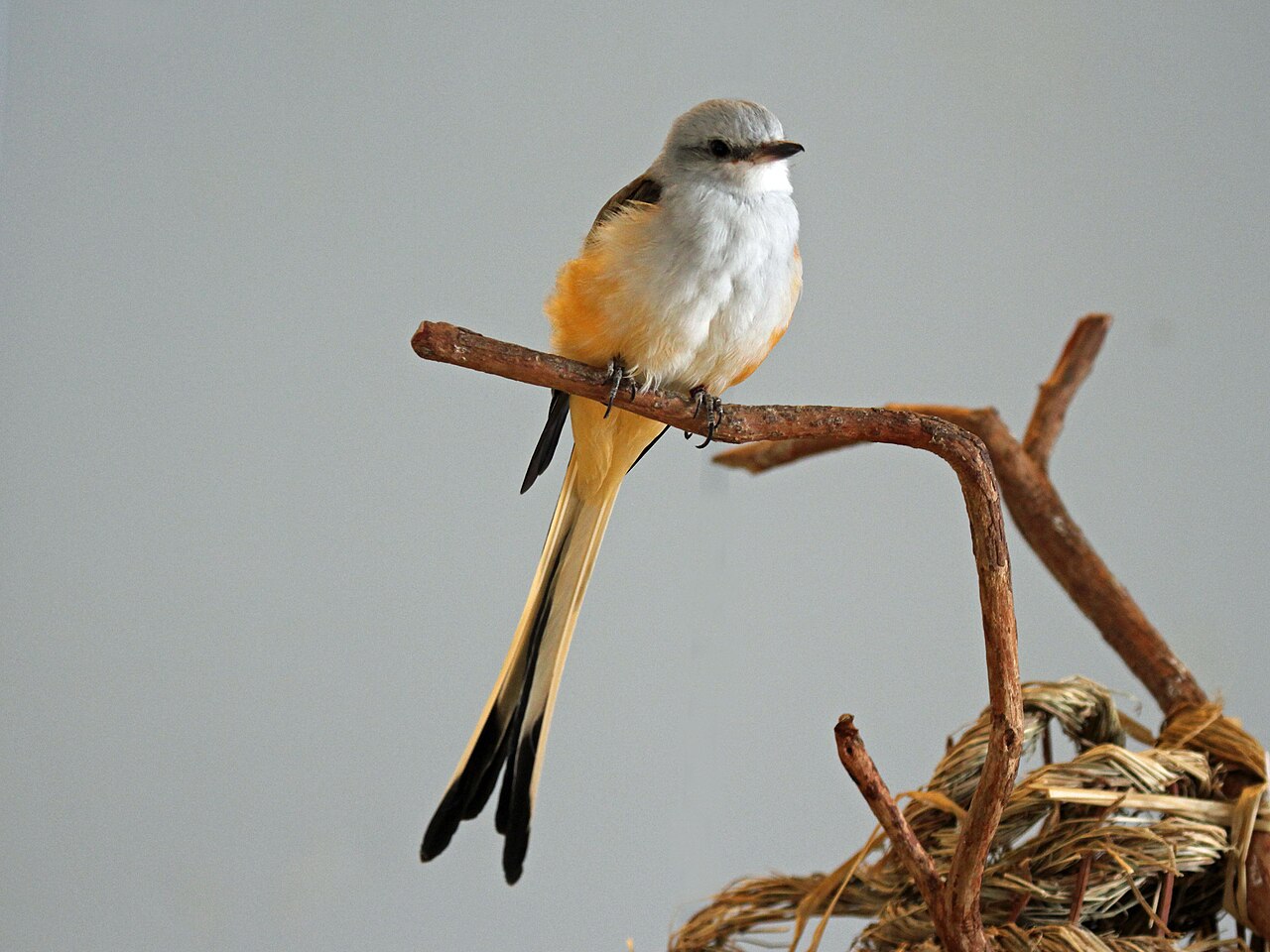
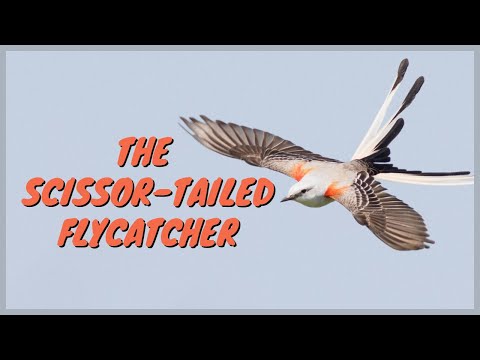
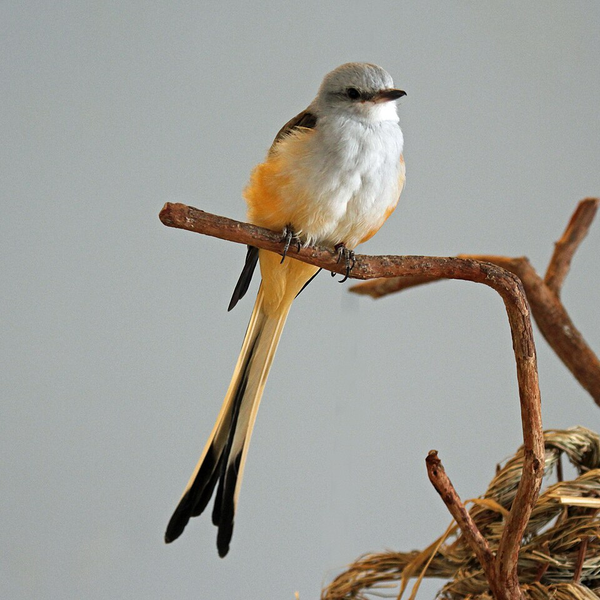
There is nothing to confuse it with: pearl-gray head and back, pale whitish underparts, salmon-pink flanks and wing linings, blackish wings, and a tail so long and deeply forked it seems impossible. In flight the white-edged tail blades snap open and shut like scissors — the move that names the bird. Short-tailed juveniles and females can suggest a kingbird, but the salmon flanks and pale head settle it.
Essential Morphometric Field Marks:
- Body Length & Mass: 8.7 to 14.6 inches (22–37 cm) — the tail alone can exceed 9 inches — and only 1.3 to 2.0 ounces (36–57 grams); nearly half the bird is tail.
- Wingspan: About 15 inches (38 cm); flight is buoyant and acrobatic, with the tail streaming behind or snapping open in courtship zigzags and aerial tumbles.
- Bill Structure & Color: A broad, flat black bill with a slight hook — the standard aerial-insect trap of the tyrant flycatchers, framed by stiff rictal bristles.
- Color Pattern: Pearl-gray head and back, whitish throat and belly, salmon-pink flanks and underwings, blackish wings with pale edging, and a long black tail with white outer edges. Males are brighter, with the longest tails.
- Male vs. Female: Sexes share the pattern; the male’s tail runs longer and his salmon tones richer. Juveniles are duller, with a much shorter tail and pale yellowish flanks.
The sky dancer: the longest tail in the territory, the brightest salmon flanks, and a courtship flight that climbs a hundred feet into backward somersaults and zigzag plunges, tail streaming — one of the great aerial displays of the plains.
Same palette, shorter blades — her tail is noticeably shorter, her salmon softer. She builds the open cup nest in an isolated tree or on a utility pole and incubates while the male patrols the fence lines, chasing off everything from kingbirds to hawks.
Scissor-tailed Flycatcher Vocalization Guide (0 Field Recordings)
The Scissor-tailed Flycatcher is not a singer — its voice is a sharp, squeaky series of bik-bik-bik or ka-quee-ka-quee notes, rising and accelerating, plus excited chatter in flight. The real music is visual: the tail. All recordings below are real field audio via Wikimedia Commons — no simulations. For a deeper library, browse xeno-canto: Scissor-tailed Flycatcher.
1. The Squeaky Commentary
2. The Excited Chatter
3. The Roost Gathering
Habitat, Range & the Southern Plains
The Scissor-tailed Flycatcher lives in open country with scattered perches: pastures, prairies, ranches, roadside corridors, and big rural yards with fences and isolated trees. It needs open air to hunt in, elevated perches to hunt from, and a tree or pole to nest in. Mowed pasture plus a fence line is perfection.

Oklahoma’s Bird, Texas’s Summer Crowd
The breeding range centers on the southern Great Plains — Oklahoma and Texas hold the great majority, with Kansas, Nebraska, Arkansas, Louisiana, Missouri, and New Mexico hosting smaller numbers. It is the official state bird of Oklahoma and an emblem of plains summer.
Scissor-tails winter mainly in Central America, from southern Mexico to Panama, with a small wintering population in southern Florida. For backyard birders: expect them April through October, most visible at dawn and dusk when hunting is best — and in fall, watch wires at dusk for the big pre-migration roosts.
Backyard Behavioral Patterns & Social Dynamics
The Scissor-tailed Flycatcher is half aerial acrobat, half fence-post furniture — a bird that turns open pasture into a stage. Four behaviors explain most of what you will observe:
✂️ The Scissors
The tail is a working rudder: it snaps open and shut in flight, steering the bird through tight turns after dodging insects and streaming behind courtship tumbles. Perched birds often fan and flick it while calling — the display never really stops.
🪰 The Sally-and-Return
Classic flycatcher hunting: sit exposed on a wire or fence, spot a flying insect, dart out, snap it up, and return to the same perch. Grasshoppers, beetles, and bees dominate; on hot evenings one bird can sally a hundred times an hour.
💃 The Sky Dance
The male’s courtship flight is legend: a steep climb, then backward somersaults and zigzag plunges, tail streaming, squeaky calls accelerating — performed over the territory through the breeding season.
👥 The Autumn Wires
Before migration, scissor-tails gather in communal roosts of dozens to hundreds, lining up on wires and bare branches at dusk. It is one of the signature late-summer sights of Oklahoma and Texas — and a fine excuse for an evening walk.
Problem: “Scissor-tails Hunt the Far Fence Line but Never Come Near the House. What Should I Do?”
The three most common Scissor-tailed Flycatcher puzzles all have proven answers:
First, the feeder question: they are aerial insect hunters and simply do not use seed feeders — don’t take it personally. The way to their heart is insects and perches, not seed. Second, the distance problem: scissor-tails hunt where they can see — if your yard has a fence, wire, or dead snag in the open, they will eventually use it; adding a few tall perch stakes near a garden or meadow strip creates hunting stations they adopt within days. Third, the insect question: broad-spectrum yard insecticides strip the flying-insect supply they depend on — skip the fogging, let the meadow strip grow, and the grasshoppers that draw scissor-tails will come back with it. Water helps too: a visible pond edge or dripping bath gets visits on hot plains afternoons.
Method 1: Set the Table — Insects, Not Seed
Design for an aerial insect hunter:
-
Grow a Meadow Strip
Unmowed native grass and wildflowers produce grasshoppers, beetles, and flying insects in exactly the volume a scissor-tail needs. The strip is the feeder; the bird brings the show.
-
Skip Broad Insecticides
Fogging and broad-spectrum sprays remove the food supply — and flycatchers vote with their wings. Targeted, minimal treatment keeps the aerial plankton flying.
-
Offer Live Mealworms as a Treat
Some scissor-tails learn to take live mealworms tossed on an open tray, especially in cool springs when insects are scarce — worth trying where a pair already hunts your fence line.
-
Provide Visible Water
A pond edge, stock tank, or dripping bath in the open draws flycatchers to drink and to hunt the insects that gather over water on summer evenings.
Method 2: Build the Habitat — Perches Over Open Ground
Feed the hunt, and the scissor-tail stays:
-
Keep Fence Lines and Wires
The humble barbed-wire fence is prime scissor-tail real estate — open sightlines plus hunting perches every few yards. Keep fences standing along pasture and garden edges, and expect a bird on the best post.
-
Leave One Dead Snag
An isolated dead branch or standing snag in open ground is a hunting throne and nest-site lookout. If safety allows, leave it; if not, a tall ornamental pole serves the same purpose.
-
Plant Scattered Trees, Not Hedges
Scissor-tails want isolated trees with big sky between them — a lone hackberry or mesquite beats a dense windbreak. Nests go in the open fork of just such a tree.
-
Mow High and Late
Keep pasture grass short enough to hunt over but unmowed strips for insect production, and delay heavy mowing until nesting ends — the balance that keeps both the insects and the birds.
Tool Solution: Recommended Hardware for Scissor-tailed Flycatcher
Equipment matched to an aerial insect hunter of open country:
Native Meadow Strip
No feeder substitutes for a meadow: a seeded strip of native grasses and wildflowers produces the flying insects scissor-tails actually eat.
- • Food: Grasshoppers, beetles, bees
- • Style: Unmowed native strip
- • Placement: Open, sunny ground
Tall Perch Stakes or Snag
A few tall stakes or one standing snag in the open create instant hunting stations — the cheapest bird-attracting hardware on the plains.
- • Height: 6–10 ft, in the open
- • Spacing: Scattered, big sky
- • Bonus: Bluebirds & kingbirds use them too
Pond Edge or Dripping Bath
A visible water source in the open — pond edge, stock tank, or dripping bath — draws flycatchers to drink and concentrates the insects they hunt at dusk.
- • Depth: Shallow, sloped edge
- • Feature: Dripper or ripple
- • Placement: Open ground, visible
Frequently Asked Questions
- Species Profile: The Scissor-tailed Flycatcher (Tyrannus forficatus) is an 8.7–14.6 inch, 1.3–2.0 ounce aerial insect hunter (Tyrannidae), band code STFL — Oklahoma’s state bird.
- ID in One Look: Pearl-gray body, salmon-pink flanks, and an impossibly long black-and-white forked tail that opens and closes like shears in flight.
- The Sound: A sharp, squeaky, accelerating bik-bik-bik — the voice is modest; the tail is the show; real field recordings above.
- Range & Habit: The southern Great Plains, centered on Oklahoma and Texas, April–October; winters mainly in Central America with a foothold in south Florida.
- Feeder Formula: Skip the seed — grow an insect-rich meadow strip, keep fence-line and snag perches, offer visible water, and avoid broad insecticides.
- The Autumn Wires: Before migration, scissor-tails gather in dusk roosts of dozens to hundreds — the signature late-summer spectacle of the plains.
Bird Watching Log
Species: Scissor-tailed Flycatcher (Tyrannus forficatus)
| Scissor-tailed Flycatcher (Forked Tail Seen: Yes / No — Salmon Flanks: Yes / No — Hunting Sally Watched: Yes / No — Perch: Wire / Fence / Snag) | |