
Western Tanager
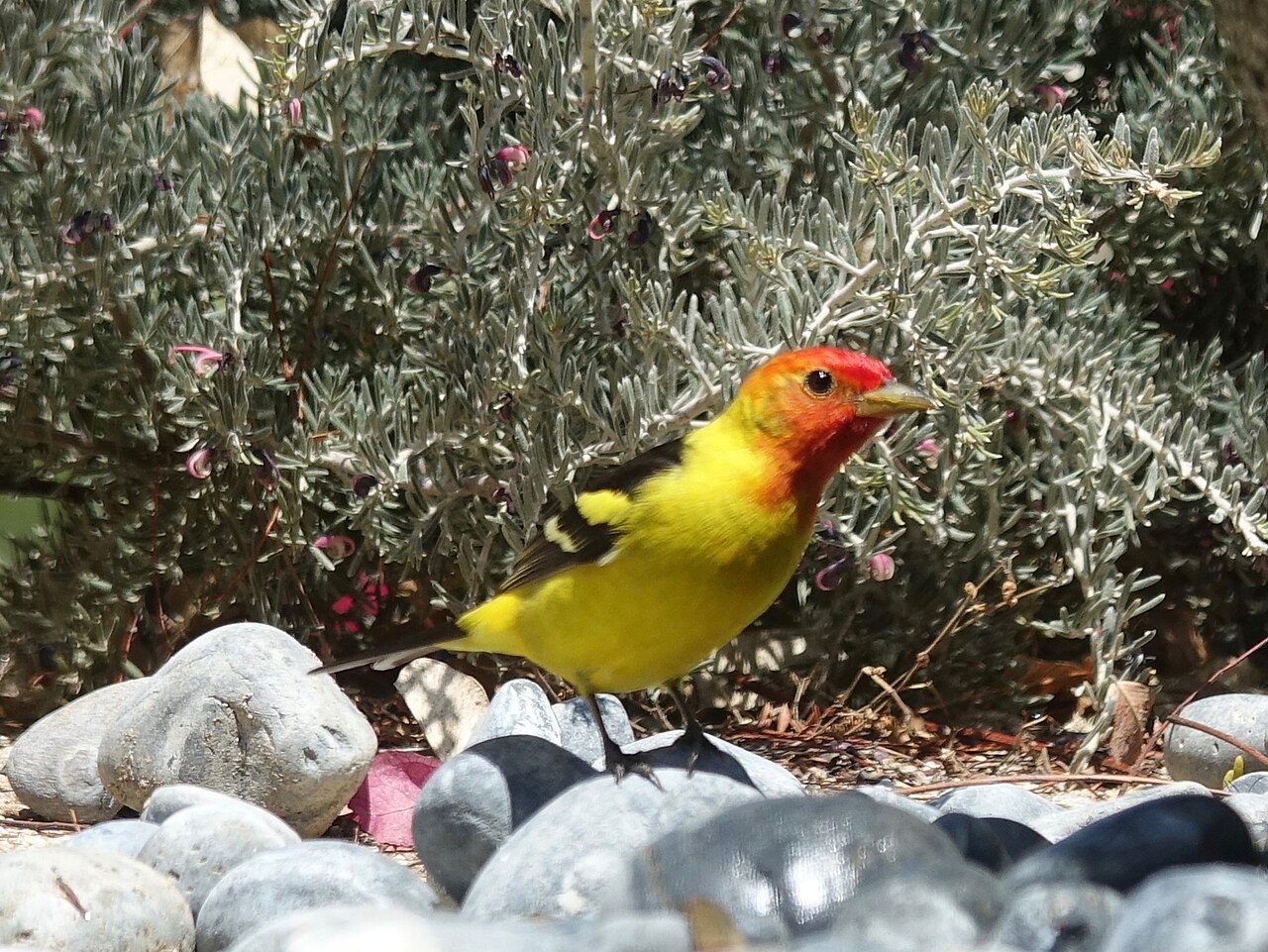


Western Tanager (Piranga ludoviciana): Complete Identification, Habitat Guide & Song Library
Quick Answer: How to Attract & Identify the Western Tanager
The Western Tanager (Piranga ludoviciana) is the West’s most tropical-looking songbird — a breeding male is flame-red on the head, canary-yellow on the body, jet-black on wings and tail, glowing against the dark conifers where he sings his raspy, robin-like carol. Females are yellow-gray with wing bars. Though a bird of pine and fir forest, it is a famous migration visitor to backyards: every spring and fall, tired travelers drop into fruit trees, and orange halves, grape jelly, and moving water can hold one for days. It migrates alongside the Bullock’s Oriole and winters south with the Summer Tanager.
Species Physical Profile & Morphometrics
The Western Tanager belongs to the cardinal family (Cardinalidae) — the Piranga tanagers turned out to be cardinals, not true tanagers. It breeds farther north than any tanager (to the Northwest Territories) and migrates between western conifer forests and the Mexican-Central American highlands.
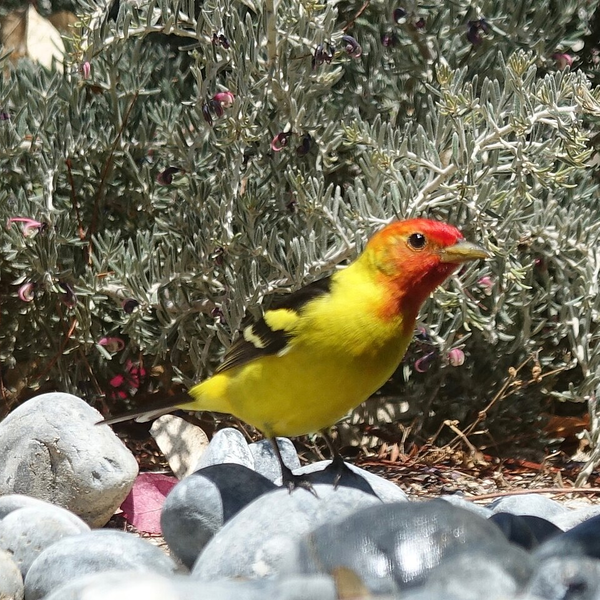
The identification formula for a male: red head + yellow body + black wings with yellow wing bars — nothing else combines the three. The female is yellow below, gray-olive above, with two pale wing bars; she resembles a female Bullock’s Oriole but shows a stouter bill and lacks the oriole’s strong facial pattern. Fall males lose the red head but keep the black-and-yellow body plan.
Essential Morphometric Field Marks:
- Body Length & Mass: 6.3 to 7.5 inches (16–19 cm) and 0.8 to 1.3 ounces (24–36 grams) — a compact, cardinal-billed songbird of the conifer canopy.
- Wingspan: About 11.4 inches (29 cm); flight is swift and slightly undulating between trees, with hover-gleaning pauses at branch tips when feeding.
- Bill Structure & Color: A stout, yellowish, slightly hooked bill — a generalist’s tool for insects and fruit, noticeably thicker than a warbler’s or oriole’s.
- Color Pattern: Breeding male: flame-red head, bright yellow body, jet-black wings with two yellow wing bars, black tail. Female and winter male: yellow below, olive-gray above, wing bars pale. The red comes from diet-acquired pigments — rare among North American birds.
- Male vs. Female: The male carries the flame; the female is quietly golden. She alone incubates the shallow cup nest high on a conifer limb, while he delivers insects and defends the treetop with song.
The flame against the fir: red head, yellow body, black wings — singing raspy carols from the conifer tops and migrating by night, when his red comes from pigments gathered in his food, a rare trick among North American birds.
The golden architect — yellow and gray-olive with pale wing bars; she builds the shallow woven cup far out on a high conifer limb and incubates alone, a streak of gold vanishing into the dark needles.
Western Tanager Vocalization Guide (2 Field Recordings)
The Western Tanager’s song is a raspy, robin-like caroling — short phrases with a husky edge, as if a robin had a sore throat — plus the dry pit-r-ik or pri-dik call heard constantly on migration. All recordings below are real field audio via Wikimedia Commons — no simulations. For a deeper library, browse xeno-canto: Western Tanager.
1. The Raspy Carol
2. The Pri-Dik Call
3. Song at Dawn
Habitat, Range & the Conifer Belt
The Western Tanager breeds in conifer and mixed forest — pine, fir, spruce, and aspen edges from the mountains of the West to the Northwest Territories — and migrates through every western habitat with trees: orchards, parks, desert oases, and backyard fruit trees. On migration it is a genuine backyard bird anywhere in the West.

The Long Flight From the Firs
The breeding range covers the mountainous West from the Northwest Territories to Arizona and New Mexico; winter takes the birds to Mexico and Central America. Migration sweeps the whole West twice a year — which is when backyards enter the story.
For backyard birders: late April–May and August–September are your windows. A western yard with fruiting trees, orange halves, and a dripping birdbath can host flame-faced travelers for days at a time, sometimes in loose groups during strong flight weeks.
Backyard Behavioral Patterns & Social Dynamics
The Western Tanager is a conifer specialist with a sweet tooth — a canopy bird that deigns to visit yards twice a year. Four behaviors explain most of what you will observe:
🔥 The Pigment Diet
The male’s red head is built from dietary pigments rare among North American birds — rhodoxanthin gathered from insects and fruit. Dull feeding seasons literally fade the flame; the bird wears its diet.
🌲 The Treetop Caroler
Males sing from high conifer perches through the breeding season, raspy phrases ringing over the ridge tops — audible far beyond where the small red head can be seen against dark needles.
🍊 The Migration Sweet Tooth
On passage, tanagers hunt fruit and sugar: orange halves, grape jelly, and fruiting trees draw them down from the sky. Cold snaps that ground insects push them to feeders in numbers — the western yard’s best spring event.
🧹 The Hover-Gleaner
Watch the feeding style: short sallies and hover-gleans at branch tips, picking caterpillars and bees from needles — a warbler’s technique on a cardinal’s bill.
Problem: “A Flame-Faced Bird Visited My Yard for Two Days in May and Vanished. What Was It — and How Do I Get It Back?”
The three most common Western Tanager puzzles all have proven answers:
First, the two-day stand: you hosted a migrant — they stop to refuel and move on; the same routes run every spring and fall, so a yard that feeds one tanager will see more. Second, the feeder question: seed is pointless — orange halves, grape jelly, and a dripping birdbath are the draws, and during cold, wet spring spells (when flying insects vanish) they can be genuinely important for grounded migrants. Third, the never-in-summer puzzle: breeding birds hold territories in conifer forest, not yards — unless you adjoin pines or firs, your season is migration; mark the calendar for late April–May and August–September, refresh the oranges, and listen for the dry pri-dik call from the fruit trees.
Method 1: Set the Table — Fruit, Sugar & Moving Water
Design for a migrating fruit-and-insect songbird:
-
Spike Orange Halves
Fresh orange halves on spikes or a platform — the oriole classic — are the number-one tanager draw during migration; replace daily before they dry or mold.
-
Offer Grape Jelly
A small cup of grape jelly beside the oranges doubles the attraction; tanagers, orioles, and catbirds share the setup without conflict.
-
Run a Dripper or Mister
Moving water audible from the trees pulls tired migrants down like a beacon — a dripping or misting bath during flight weeks is worth a yard full of feeders.
-
Plant Fruiting Trees & Shrubs
Serviceberry, chokecherry, elderberry, and crabapple feed passage tanagers naturally — a yard that fruits in May and August hosts the flame every year.
Method 2: Build the Stopover — Water, Fruit & Cover
Feed the passage, and the flame returns:
-
Keep a Migrant Cover Strip
Migrants need to hide between feeding bouts — a dense shrub or small tree clump beside the fruit and water gives tanagers the security to linger days instead of hours.
-
Skip Spring Insecticides
Migrants refuel heavily on caterpillars and flying insects — a sprayed yard in May is a closed restaurant during the tanager’s only reservation.
-
Leave the Dead Top
A dead snag top in a tall tree is a migrant’s lookout — tanagers perch high and exposed on arrival to map the yard before dropping to water.
-
Mark the Fallout Mornings
Cold, wet fronts in May ground migrants in numbers — those mornings, refresh oranges at dawn and keep the binoculars handy; the same dates work every year.
Tool Solution: Recommended Hardware for Western Tanager
Equipment matched to a fruit-loving migration guest:
Orange & Jelly Feeder
A spike-and-cup fruit feeder with fresh orange halves and grape jelly — the proven western tanager magnet during spring and fall passage.
- • Food: Orange halves, grape jelly
- • Style: Spike & cup feeder
- • Peak: Late Apr–May, Aug–Sep
Dripping or Misting Bath
A birdbath with a dripper or mister — audible moving water that pulls migrants from the sky better than any food.
- • Feature: Dripper / mister
- • Placement: Open, shrub edge near
- • Bonus: Warblers & orioles too
Fruiting Tree & Shrub Mix
Serviceberry, chokecherry, elderberry, crabapple — a fruiting sequence that feeds passage tanagers from spring through fall.
- • Plants: Native fruiting mix
- • Season: May & Aug–Sep fruit
- • Years: Improves with maturity
Frequently Asked Questions
- Species Profile: The Western Tanager (Piranga ludoviciana) is a 6.3–7.5 inch, 0.8–1.3 ounce cardinal-family songbird (Cardinalidae), band code WETA — the flame-faced voice of western conifers.
- ID in One Look: Male: red head, yellow body, black wings with yellow wing bars; female: yellow-gray with pale wing bars and a stout yellowish bill.
- The Sound: Raspy, robin-like caroling from the conifer tops, plus the dry pri-dik contact call of migration; real field recordings above.
- Range & Habit: Breeds in western conifer forest to the Northwest Territories; winters Mexico–Central America; a backyard bird twice a year on passage.
- Feeder Formula: Orange halves and grape jelly, a dripping bath, fruiting natives, and a spray-free May — the passage-yard checklist.
- The Dietary Flame: The male’s red head is built from rare dietary pigments — the bird quite literally wears what it eats.
Bird Watching Log
Species: Western Tanager (Piranga ludoviciana)
| Western Tanager (Male Flame / Female Gold — Song Heard: Yes / No — At Oranges: Yes / No — Date & Direction: ___ — Weather Front: Yes / No) | |