
Western Bluebird
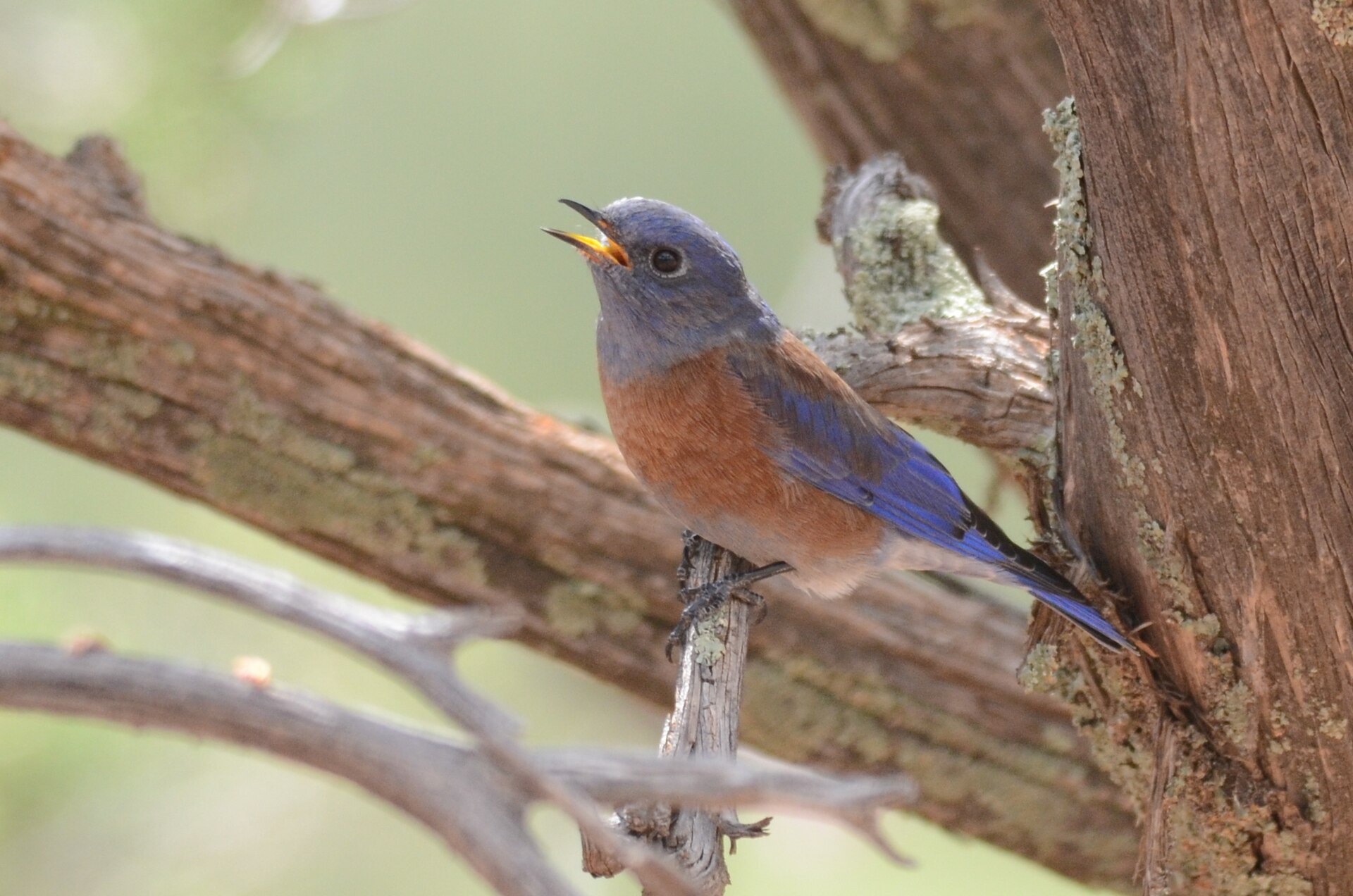



Western Bluebird (Sialia mexicana): Complete Identification, Mealworm Guide & Nest Box Handbook
Quick Answer: How to Attract & Identify Western Bluebirds
The Western Bluebird (Sialia mexicana) is the small thrush of dry open woodlands, oak savannas, and ranch country across the West — the male deep blue with a rusty breast and a rusty patch on the back, the female soft gray-blue. To attract a pair: serve live mealworms in a smooth-sided dish, offer soaked raisins or dried fruit, and mount a nest box with a 1.5-inch entrance hole on a baffled post in open terrain. It shares dry western yards with the California Scrub-Jay and the Pygmy Nuthatch.
Species Physical Profile & Morphometrics
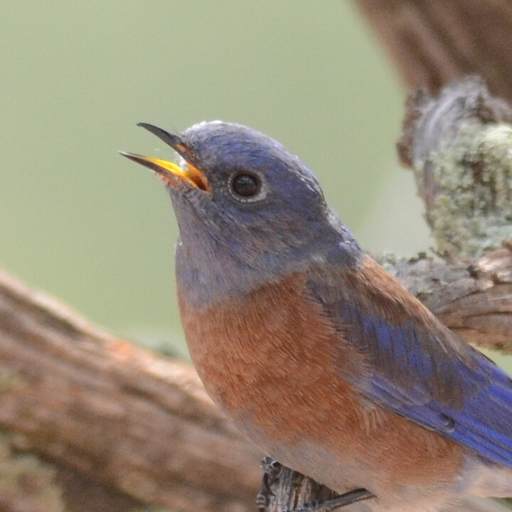
The Western Bluebird is a small, round-headed member of the thrush family (Turdidae) — slightly smaller and darker than its Eastern cousin, and built for dry country. The male’s pattern: deep blue head, throat, and wings, rusty breast and flanks, and a rusty patch across the upper back, with a gray-blue belly.
The identification formula: blue throat + rusty back patch + gray-blue belly. The Eastern Bluebird male has a rusty throat and all-blue back; the Mountain Bluebird male is sky-blue all over with no rust at all. Females are grayer versions of the same pattern — drabber than Eastern females, with orange mostly confined to the flanks.
Essential Morphometric Field Marks:
- Body Length & Mass: about 6.3 to 7.5 inches (16–19 cm) and 0.8 to 1.1 ounces (24–31 grams) — a touch smaller than an Eastern Bluebird, far smaller than an American Robin.
- Wingspan: about 11.8 to 13.4 inches (30–34 cm); flight is light and buoyant between low perches, with frequent hover-gleaning pauses over open ground.
- Bill Structure & Color: A short, straight, dark bill — an insect-catcher’s tool, finer than a finch’s and nothing like a seed-eater’s cone.
- Color Pattern: Male: blue throat (the Eastern’s is rusty), rusty breast and upper-back patch, gray-blue belly. Female: gray-brown head and back, blue wings and tail, pale orange flanks, whitish eye-ring.
- Male vs. Female: The male is the saturated copy; the female wears the same layout in dusted gray. Both sexes share the round thrush silhouette and the low, upright perching style.
Blue above, rust between: deep blue hood and wings with a rusty breast and shoulder patch. He scouts cavities and boxes in late winter, sings his soft dawn warble from a fence post, and does much of the fledgling feeding while the female starts the next nest.
The gray-blue builder: drab at a distance, but her wings and tail flash true blue in the sun. She alone builds the grass nest in the cavity and incubates the 4–6 pale blue eggs for about two weeks.
Western Bluebird Vocalization Guide (2 Field Recordings)
The Western Bluebird’s song is a soft, short, burry warble — quieter and less flowing than the Eastern’s — plus gentle “few” contact notes traded between mates. Both recordings below are real backyard field audio hosted on Wikimedia Commons, recorded by Ryan Winkleman (mirrored from xeno-canto): the male singing from the yard fence while the female incubates eggs in the nest box — a Western Bluebird household in miniature. For a deeper library, browse xeno-canto: Western Bluebird.
1. The Fence Post Morning Song
2. The Daily Dawn Ritual
Habitat, Range & the Human Landscape
The Western Bluebird owns the dry open West: oak savannas, open pine and juniper woodlands, pinyon slopes, orchards, vineyards, ranch pasture, and big rural yards — anywhere sparse ground cover for hunting meets scattered trees, snags, or posts for perches and cavities. Dense forest and watered-lawn suburbia are both poor habitat; the dry, open edge is home.

The Pacific Slope to the Rockies
The range runs from southern British Columbia through the Pacific states, the Great Basin, and the Rockies, south into the Mexican highlands. Mountain and northern breeders are short-distance migrants, drifting downslope in fall; along the Pacific slope and in the Southwest, pairs stay year-round.
Backyards score best with open dry ground, a few low perches, and a snag or box. A rural or semi-rural yard with a post-mounted nest box, a mealworm dish, and a filled birdbath covers the whole checklist.
Backyard Behavioral Patterns & Social Dynamics
The Western Bluebird is the gentle regular of the dry yard — a low-perching hunter with an eye for cavities. Four behaviors explain most backyard encounters:
🦗 The Perch-and-Pounce Hunter
Bluebirds hunt dry ground by sight: a bird sits low on a fence, wire, or branch, drops onto a grasshopper or beetle, and carries it back to the perch. They also hover-glean — hanging in the air a moment to pluck prey from grass stems — a habit no seed-eater shares.
🪺 The Second-Brood Box User
A pair that nests in your box once usually nests in it twice: two broods a season are routine in the West. The male feeds the first fledglings while the female lays the next clutch — clean the box between broods and the same pair often re-lays within two weeks.
❄️ The Mistletoe Flock
In winter the territorial pairs dissolve into loose roaming flocks that work berry crops — with a striking fondness for oak mistletoe, plus juniper and elderberry. A flock dropping into your junipers on a frosty morning is the Western Bluebird’s quietest season, and one of its prettiest.
🤝 The Swallow Standoff
Every open-country cavity is contested: Tree Swallows, House Wrens, and chickadees all want the same box. The proven peace treaty is pairing boxes — two boxes 15–25 feet apart — because Tree Swallows won’t tolerate another swallow pair close by, leaving the neighbor box open for bluebirds.
Problem: “Swallows Took the Box, Sparrows Took the Other One, and Something Raided the Nest. Can I Fix That?”
The three most common Western Bluebird frustrations all have proven answers:
First, the Tree Swallow takeover: swallows and bluebirds want identical real estate — the fix is the paired-box trick: mount two boxes 15–25 feet apart and the swallow pair’s own territorial defense keeps other swallows out, freeing the second box for bluebirds. Second, House Sparrows: they will kill nestlings and bury eggs under their own junk nest — mount boxes away from buildings, barns, and dense shrubs, check weekly, and remove sparrow nests (an unprotected introduced species) promptly; a sparrow spooker over the entrance helps once bluebirds have laid. Third, the raided nest: snakes, raccoons, and cats climb smooth poles easily — a stovepipe or cone baffle below the box stops nearly all of them, and a metal hole guard stops squirrels and woodpeckers from chewing the entrance wider. Bluebirds are loyal: solve the competition once and the same pair will use your box for years.
Method 1: Serve Mealworms & Dried Fruit
Design for a small, insect-eating thrush of dry country:
-
Live Mealworms Are the Magnet
Live mealworms are the fastest way to a Western Bluebird’s routine — visible from a hunting perch across the yard and irresistible to a pair feeding nestlings. Dried mealworms work once the habit is set, but live ones start it.
-
Add Dried Fruit and Raisins
Soaked raisins, currants, and chopped dried fruit match the winter berry diet and carry birds through cold snaps when insects vanish — a handful in the same dish as the mealworms, morning and afternoon.
-
Use a Smooth-Sided or Caged Dish
Serve in a smooth-sided glass or plastic dish worms can’t climb out of, on a pole or platform near the box. In scrub-jay country, a caged mealworm feeder with 1.5-inch openings keeps the big birds from emptying it in one visit.
-
Skip the Seed Entirely
Western Bluebirds do not eat birdseed — a hopper of sunflower means nothing to them. Spend the feeder budget on mealworms, suet crumbles, and fruit, and let the seed feeders serve the finches while the dish serves the bluebirds.
Method 2: Mount the Right Box in the Right Spot
With bluebirds, the nest box is the attraction strategy:
-
The 1.5-Inch Rule
The entrance must be exactly 1.5 inches — big enough for a bluebird, too small for a starling. Add a metal hole guard against chewing squirrels, and a stovepipe baffle on the post against climbers.
-
Post It in Open, Dry Terrain
Mount on a smooth post 4 to 6 feet high in open ground with sparse grass and scattered perches — the drier and more open, the more Western it feels. Face the entrance toward a tree or wire 25–50 feet away so the female has a staging perch.
-
Pair the Boxes in Swallow Country
Where Tree Swallows patrol, hang two boxes 15–25 feet apart: the swallows take one and defend it against other swallows, and the bluebirds raise their brood next door in peace.
-
Keep Water in the Picture
Dry country makes a filled birdbath a genuine attraction — Western Bluebirds drink and bathe daily. A shallow bath near open ground rounds out the territory, and a heated one keeps the winter flock coming.
Tool Solution: Recommended Hardware for Western Bluebirds
Equipment matched to a dry-country, worm-loving, cavity-nesting thrush:
Caged Mealworm Feeder
A smooth-sided dish inside a 1.5-inch-mesh cage on a pole — bluebirds slip in, scrub-jays and starlings stay out, and the daily ration of live mealworms actually reaches the birds it was bought for.
- • Food: Live mealworms, soaked raisins, suet crumbles
- • Style: Caged or window dish, smooth sides
- • Routine: 50–100 worms, morning and afternoon
Western Bluebird Nest Box (1.5-Inch Hole)
A ventilated wood box with an exact 1.5-inch entrance and a front that opens for cleaning — post-mounted with a baffle in open terrain, it is the single most reliable way to turn a passing pair into residents.
- • Entrance: 1.5 in, metal hole guard
- • Mount: 4–6 ft post with stovepipe baffle
- • Placement: Open dry ground, perch 25–50 ft out
Shallow Heated Bird Bath
A shallow bath with a winter heater — in dry western country open water is scarce, and a dependable bath pulls bluebirds, nuthatches, and half the neighborhood’s birds within sight of your chair.
- • Depth: 1–2 in at the edge
- • Extras: Thermostat-controlled heater
- • Placement: Open ground near perches
Frequently Asked Questions
- Species Profile: The Western Bluebird (Sialia mexicana) is a 6.3–7.5 inch, 24–31 gram thrush (Turdidae) of dry open western woodlands — deep-blue male with rust breast and back patch, band code WEBL.
- ID in One Look: Blue throat + rusty back patch + gray-blue belly; the Eastern male has a rusty throat and all-blue back, and the Mountain Bluebird has no rust at all.
- Short-Distance Migrant: Mountain breeders drift downslope in fall; Pacific-slope pairs stay year-round, and winter flocks roam mistletoe and juniper berries.
- The Sound: A soft, burry dawn warble — quieter than the Eastern’s — with gentle “few” contact notes; both recordings above are a real backyard pair at their nest box.
- Feeder Formula: Live mealworms in a caged or smooth-sided dish, plus soaked raisins and dried fruit — and no seed, ever.
- The Box Is the Key: A 1.5-inch-hole box on a baffled post in open dry terrain — paired with a second box in swallow country — turns a passing pair into two-brood residents.
Bird Watching Log
Species: Western Bluebird (Sialia mexicana)
| Western Bluebird (Pair or Flock: ___ — Mealworms Taken: Yes / No — Nest Box Visited: Yes / No — Singing: Yes / No) | |