
Rivoli’s Hummingbird


Rivoli’s Hummingbird (Eugenes fulgens): Complete Identification, Habitat Guide & Behavior Library
Quick Answer: How to Attract & Identify the Rivoli’s Hummingbird
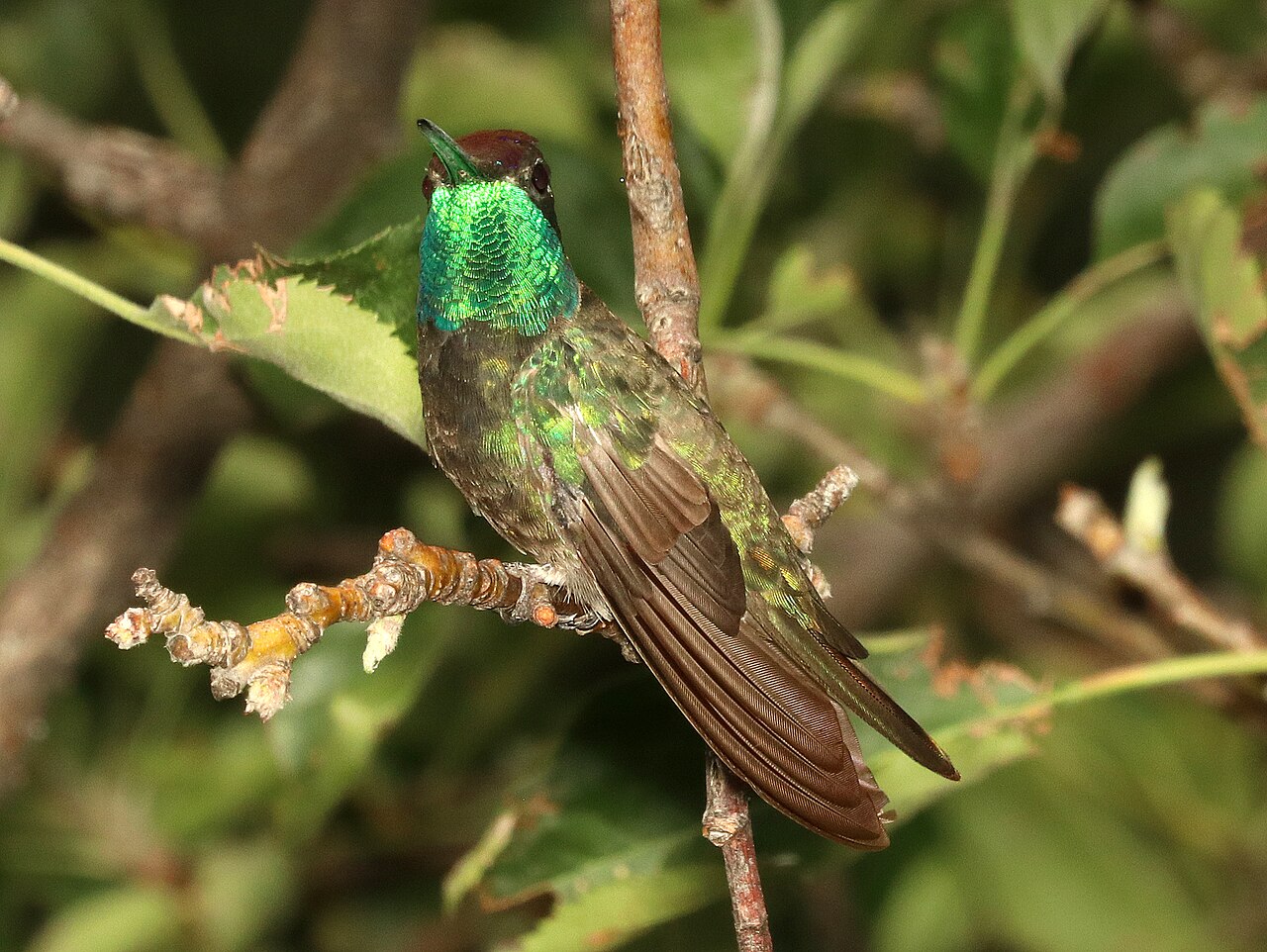
Rivoli’s Hummingbird (Eugenes fulgens) — until recently the Magnificent Hummingbird — is the giant of Arizona’s sky islands: at up to 5.5 inches, it dwarfs the feeder crowd, the male flashing a purple crown and emerald gorget on a dark, long-billed frame. It summers in cool pine-oak canyons of the borderlands and winters in Mexico. The voice is a sharp chip, and the wings beat noticeably slower than smaller hummingbirds’. Canyon yards attract them with large nectar feeders and shade. They share the feeders with the Broad-billed Hummingbird and the Broad-tailed Hummingbird.
Species Physical Profile & Morphometrics
Rivoli’s Hummingbird belongs to the hummingbird family (Trochilidae) and summers in the pine-oak canyons of southeastern Arizona, southwestern New Mexico, and west Texas — the sky islands — wintering in the mountains of Mexico and Central America. It was renamed from Magnificent Hummingbird in 2017.
The identification formula: large size + long black bill + dark body + purple crown and emerald gorget (male). At a feeder it towers over the crowd; the wings beat so slowly the strokes are visible. Females are plain green-gray but share the size and long bill.
Essential Morphometric Field Marks:
- Body Length & Mass: 4.3 to 5.5 inches (11–14 cm) and 0.3 ounces (7–8 grams) — twice the bulk of a Black-chinned, the largest hummingbird regularly in the U.S.
- Wingspan: 7.1 inches (18 cm); flight is powerful with slow, deep wingbeats — you can see the strokes, a field mark in itself.
- Bill Structure & Color: A long, straight black bill — proportionally the longest of U.S. hummingbirds, built for deep-throated mountain flowers.
- Color Pattern: Male: dark green-black body, purple crown, emerald-green gorget. Female: green above, gray below, with pale streaks on the throat and the same outsized bill.
- Male vs. Female: The male is the two-jeweled dark giant; the female is plain but unmistakable by size and bill — both dominate the feeders they choose.
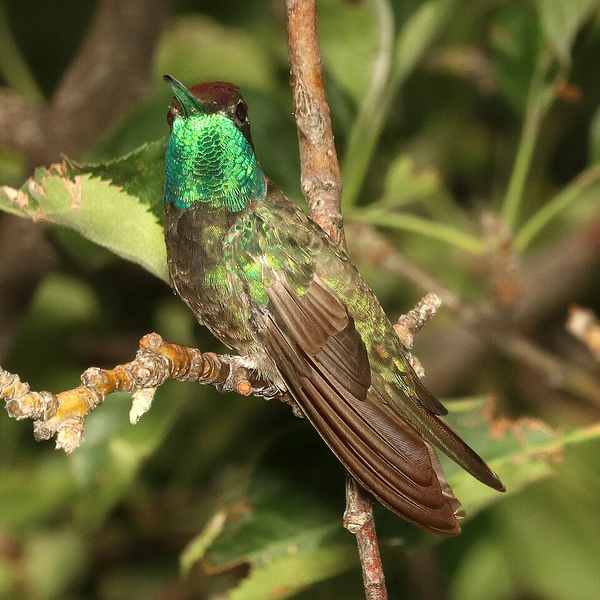
The two-jeweled giant: purple crown and emerald gorget blazing when the light turns, shouldering smaller hummingbirds off the feeder with sheer presence.
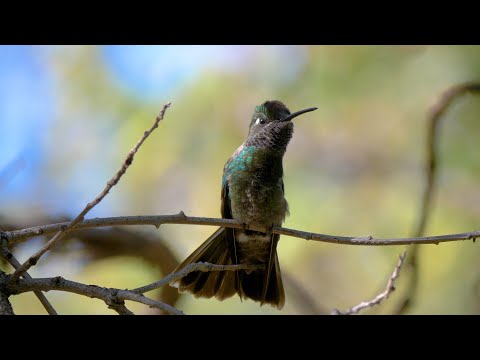
The plain giantess — no jewels, but the same regal size and bill — she nests on a horizontal branch in the cool canyon shade, raising the next generation of sky-island royalty.
Rivoli’s Hummingbird Vocalization Guide (0 Field Recordings)
Rivoli’s Hummingbird’s voice is a sharp, loud chip — bigger and more emphatic than smaller hummingbirds’ — plus the slow whir of its powerful wings. All recordings below are real field audio via Wikimedia Commons — no simulations. For a deeper library, browse xeno-canto: Rivoli’s Hummingbird.
1. The Sharp Chip
2. The Slow Whir
3. The Chase Calls
Habitat, Range & the Pine-Oak Canyons
Rivoli’s Hummingbird summers in cool pine-oak canyons of the sky islands — mountain ranges rising from the desert in southeastern Arizona, southwestern New Mexico, and west Texas. Canyon homes with shaded feeders are now core summer habitat.

The Sky Island Giant
The U.S. range is a scatter of borderland mountain ranges — the Huachucas, Chiricahuas, and their kin — from April to September. Winter takes the population to the mountains of Mexico and Central America, sometimes as far as Panama.
For backyard birders: canyon yards above the desert floor can host them May–August — large shaded feeders in cool canyons are the recipe, and patience: the giant arrives on its own schedule.
Backyard Behavioral Patterns & Social Dynamics
Rivoli’s Hummingbird is a high-elevation aristocrat with a slow wingbeat. Four behaviors explain most of what you will observe:
👑 The Feeder Aristocrat
It dominates by presence — smaller hummingbirds simply yield; the giant feeds unhurried, then retires to a shaded canyon perch.
🐢 The Slow Wingbeat
Its wings beat slowly enough to see the strokes — a flight style closer to a swallow’s than a typical hummingbird’s blur.
🏔️ The Elevation Specialist
It favors cool canyons at 5,000 feet and up — the pine-oak belt; desert-floor feeders rarely see it.
🌄 The Crepuscular Feeder
Most active at dawn and dusk in the canyon — midday belongs to shade; watch the feeders in the golden hours.
Problem: “A Giant Dark Hummingbird Has Claimed My Canyon Feeder. What Is It? What Should I Do?”
The three most common Rivoli’s Hummingbird puzzles all have proven answers:
First, the identity: a hummingbird nearly twice the size of the others with a long black bill is Rivoli’s — turn it to the light; the male flashes purple crown and emerald gorget, the female shows size and bill alone. Second, the monopoly: the giant feeds unhurried and scares no one off with chases — it doesn’t need to; hang extra feeders for the smaller crowd and enjoy the hierarchy. Third, the seasonal disappearance: Rivoli’s leaves for Mexico by September — a late-fall giant at the feeder deserves a second look (Blue-throated Mountain-gem is the alternative), but most years the September silence is simply migration.
Method 1: Set the Table — Big Feeders in Deep Shade
Design for a cool-canyon giant:
-
Hang Large Saucer Feeders
Big-capacity saucer feeders in shade — the giant drinks deep and prefers perching room.
-
Mix 4:1 and Keep Fresh
4:1 sugar water changed every other day — canyon heat spoils nectar fast.
-
Provide Perches Nearby
Shaded bare branches near feeders — Rivoli’s perches long and often between drinks.
-
Add a Dripper
Moving water in the canyon shade — bathing at dawn is part of the giant’s routine.
Method 2: Build the Habitat — Cool Shade & Mountain Blooms
Keep the canyon cool and blooming, and the giant returns:
-
Plant Mountain Natives
Penstemon, agave, and mountain sage — the deep-throated blooms the long bill evolved for.
-
Keep the Shade
Mature canyon trees — sycamore, oak, pine — make the microclimate; never clear the canopy near feeders.
-
Protect Canyon Water
A seep, dripper, or shaded bath — water is canyon gold, for the birder and the bird alike.
-
Watch the Calendar
April arrival, September departure — log the dates; your canyon’s pair keeps a steady year-to-year schedule.
Tool Solution: Recommended Hardware for Rivoli’s Hummingbird
Equipment matched to a sky-island giant:
Large Shaded Saucer Feeder
A big saucer feeder in deep canyon shade — capacity and comfort for the largest guest at the mountain table.
- • Ratio: 4:1, no dye
- • Placement: Deep shade
- • Care: Change every 2 days
Shaded Dripper or Seep
Moving water in the cool shade — dawn bathing and drinking for the whole canyon community.
- • Style: Dripper or small fountain
- • Placement: Shaded, near perches
- • Bonus: Tanagers & warblers too
Mountain Bloom Plantings
Penstemon, agave, and mountain sage on the canyon slope — the deep blooms the long bill is built for.
- • Plants: Penstemon, agave
- • Bloom: Spring–monsoon
- • Bonus: Ten hummingbird species possible
Frequently Asked Questions
- Species Profile: Rivoli’s Hummingbird (Eugenes fulgens) is a 4.3–5.5 inch, 0.3-ounce hummingbird (Trochilidae), band code RIHU — the two-jeweled giant of the sky islands.
- ID in One Look: Huge for a hummingbird, long black bill; male’s purple crown and emerald gorget.
- The Sound: Loud sharp chips and a slow deep wing whir; real field recordings above.
- Range & Habit: Summers in borderland mountain canyons; winters in Mexico; dominates feeders by presence.
- Feeder Formula: Large shaded saucer feeders, fresh 4:1 nectar, canyon perches, moving water.
- The Slow Giant: Watch the wingbeats — visible strokes on a hummingbird mean Rivoli’s has arrived.
Bird Watching Log
Species: Rivoli’s Hummingbird (Eugenes fulgens)
| Rivoli’s Hummingbird (Size vs. Others: ___ — Crown & Gorget Seen: Yes / No — Slow Wingbeat: Yes / No — At Feeder: Yes / No — Date & Time: ___) | |