
Mountain Chickadee


Mountain Chickadee (Poecile gambeli): Complete Identification, Feeder Guide & Song Library
Quick Answer: How to Attract & Identify Mountain Chickadees
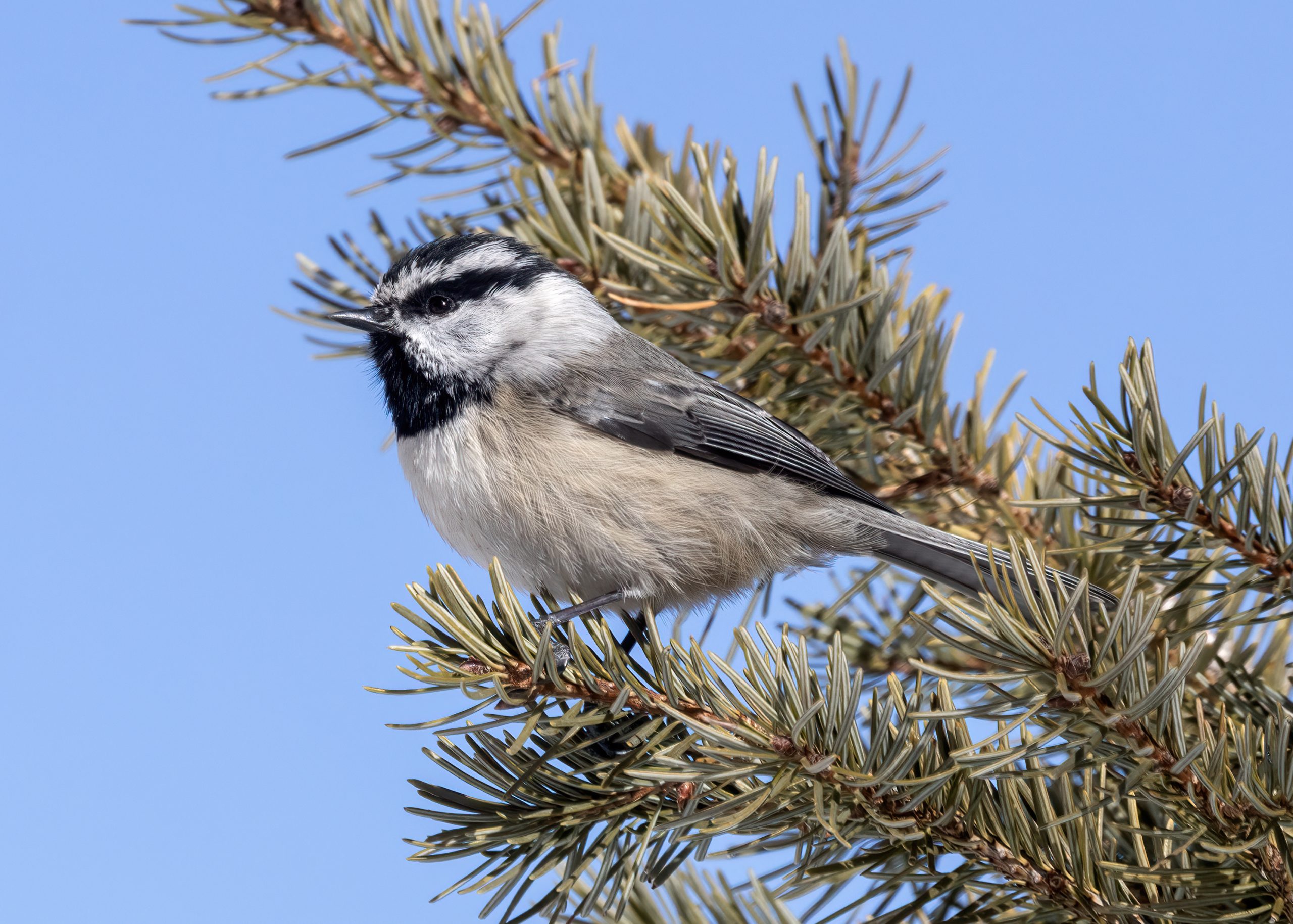
The Mountain Chickadee (Poecile gambeli) is the chickadee of the western mountain conifer forests — Rockies, Cascades, and Sierra Nevada from British Columbia to New Mexico and Arizona’s high country. It wears the classic black cap and bib, but with one decisive difference: a bold white eyebrow stripe through the black cap that no other North American chickadee has. It measures 4.3–5.5 inches and weighs about 11 grams. A year-round resident, it breeds high in spruce-fir and pine forest, then drifts downslope in winter — which is when it visits mountain-town feeders. Listen for the descending three-note “fee-bee-bee” song and the husky “chick-adee-adee” call. Attract it with black oil sunflower, suet, and pine nuts on a feeder placed beside conifers, and hang a nest box among the pines for spring.
Species Physical Profile & Morphometrics
The Mountain Chickadee has the familiar chickadee build — big round head, tiny bill, plump body, long narrow tail — and the same acrobatic style, clinging to cone tips and hanging upside down to pick seeds. It belongs to the tit family (Paridae) and is the characteristic chickadee of the high western forests.
The identification shortcut is the white eyebrow stripe: no other North American chickadee has one. In the Rockies and Cascades, rule out the Black-capped Chickadee (plain black cap, no eyebrow; lower-elevation deciduous woods) and along the coast ranges the Chestnut-backed Chickadee (rich chestnut back and flanks). The Juniper Titmouse of the piñon-juniper belt is plain gray with a pointed crest.
Essential Morphometric Field Marks:
- Body Length & Mass: Averages 4.3 to 5.5 inches (11–14 cm) with an adult mass of about 0.39 ounces (11 grams) — a featherweight built for thin mountain air.
- Wingspan: About 7.5 inches (19 cm), with plain gray wings lacking the bright white feather edging of a Black-capped Chickadee.
- Bill Structure & Color: A short, stubby black bill — equally handy for prying seeds from pine cones and hammering sunflower kernels held under one foot.
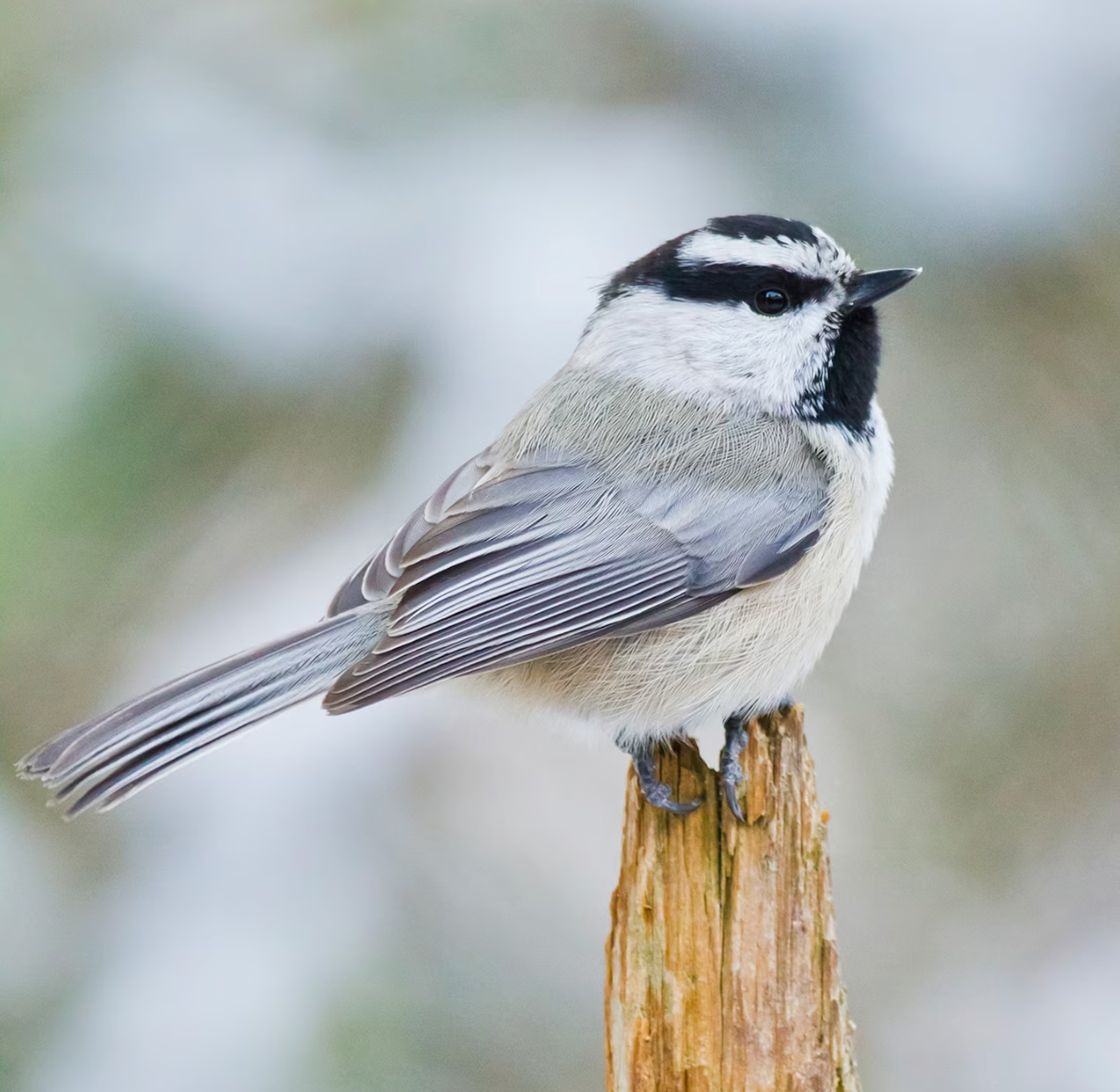
- Color Pattern: Black cap and bib split by a bold white eyebrow stripe, white cheeks, plain gray back and wings, whitish belly, and a soft gray-buff wash on the flanks. Males and females look identical.
Crisp black cap bisected by the signature white eyebrow, a neat black bib, and clean white cheeks. Upperparts are unmarked cool gray — plainer than the Black-capped’s crisply edged wings — with flanks washed pale gray-buff. Adult males and females cannot be separated in the field.
Summer juveniles are fluffier and duller: the black areas look sooty, the white eyebrow is present but softer-edged, and the whole plumage carries a loose, downy texture until the first fall molt sharpens the pattern.
Mountain Chickadee Vocalization Guide (1 Recording + 2 Simulations)
Two sounds cover most encounters: the descending whistled song “fee-bee-bee” and the husky “chick-adee-adee” call — rougher-voiced than any lowland chickadee. Below is one real field recording — calls and gargles recorded at Estes Park, Colorado, by Matthias Sirch, hosted on Wikimedia Commons under a CC BY-SA 4.0 license — followed by two faithful synthesized simulations labeled as such. For more wild audio, browse xeno-canto: Mountain Chickadee.
1. Calls & Gargles — Estes Park, Colorado
2. Descending “Fee-Bee-Bee” Song
3. Husky “Chick-a-Dee-Dee” Call
Habitat, Range & High-Country Resident Biology
Mountain Chickadees live in coniferous mountain forest — ponderosa and lodgepole pine, Douglas-fir, spruce, and true fir — along the great western ranges: the Cascades, Sierra Nevada, and Rockies from British Columbia and Alberta south to New Mexico (our gallery birds come from the Sandia Mountains and Santa Fe Ski Area) and the Arizona sky islands.

Vertical Migrants of the Western Ranges
Mountain Chickadees do not migrate south — they migrate downhill. Breeding birds hold territories in high spruce-fir forest, but when deep snow locks up the peaks, many drift downslope into foothill woods, valley towns, and backyard feeders. That vertical commute is why mountain-town yards see a surge of chickadees after the first big storms.
A yard at any elevation with mature conifers, a reliable feeder, and open water can hold a resident flock. In winter the local band travels with Red-breasted Nuthatches, Golden-crowned Kinglets, and Brown Creepers — find the chickadees and the whole guild follows.
Backyard Behavioral Patterns & Social Dynamics
Mountain Chickadees bring high-country habits straight to the feeder rail. Four signature behaviors explain most of what you will observe:
🤍 The White Eyebrow Giveaway
Every Mountain Chickadee — male, female, even fluffy juveniles — wears the white eyebrow stripe. When a chickadee zips into your western feeder, check the cap first: a white slash through the black confirms the species in under a second, even in backlit mountain glare.
🌲 Cone-Tip Acrobat
In the wild, this bird hangs upside down from pine and spruce cone tips, prying out seeds one by one. The same gymnastics show up at feeders and garden seed heads — our gallery bird working a snow-dusted sunflower head is exactly the technique it uses on wild cones.
🧠 Alpine Cache Memory
Like its lowland cousins, the Mountain Chickadee caches single seeds in bark crevices and needle clusters all autumn and remembers the hiding spots for weeks — insurance against the long, snow-covered high-country winter.
🪵 Woodpecker-Hand-Me-Down Homes
Pairs nest in old woodpecker holes, natural cavities, or holes they excavate in soft dead wood, lining the cup with moss, fur, and feathers. They are enthusiastic nest box tenants in mountain towns — a box hung among pines with a layer of wood shavings is often claimed by early spring.
Problem: Why Mountain Chickadees Pass Your Yard By
Even in the heart of the range, some mountain yards host chickadee flocks daily while others see none. The usual reasons:
First, this is a conifer bird: a bare subdivision lot with lawn and aspens simply does not read as habitat, while the neighbor’s yard under mature pines does. Second, like all chickadees it is a grab-and-go diner that needs cover within a quick dash of the feeder — an exposed pole in open ground gets cautious, fleeting visits at best. Third, mountain winters bury natural food fast: a feeder that goes empty right after a storm teaches the downslope flock to look elsewhere, and a yard that runs dry in November may not be revisited until spring. Fix cover, consistency, and freshness, and the high-country flock adopts you for the season.
Method 1: Build Stations Beside the Conifers
Design for a small, acrobatic bird commuting between feeder and pine boughs:
-
Hang a Tube or Mesh Feeder with Small Perches
A squirrel-resistant tube feeder with short perches suits clinging chickadees and frustrates larger bully birds. Our lab-tested roundup of the Best Tube Feeders for Small Birds compares proven models.
-
Site It Within 10 Feet of a Pine or Spruce
Chickadees stage in conifer branches between every trip to the feeder. A station one quick dash from evergreen cover earns steady traffic and gives the flock instant escape from accipiters patrolling the slope.
-
Keep It Stocked Through Every Storm Cycle
Refill before storms, not after, and knock snow off platform tops at first light. The flock times its hardest feeding push to the hours right after heavy snowfall.
-
Mount a Suet Cage for Subzero Calories
A hanging suet cage beside the seed tube delivers concentrated fat that carries a 11-gram bird through -10°F mountain nights — expect the chickadees, nuthatches, and woodpeckers to share it in rotation.
Method 2: Stock the High-Country Pantry Year-Round
Match the menu — and the real estate — to a conifer specialist that never leaves the range:
-
Lead with Black Oil Sunflower, Add Pine Nuts
Thin-shelled black oil sunflower is the daily staple — easy to open, high in fat, perfect for caching. Pine nuts are the gourmet offering that speaks directly to a cone-feeding specialist, and unsalted peanut pieces round out the menu.
-
Hang a Nest Box Among the Pines by March
A box with a 1-1/8-inch entrance hole, mounted 5–15 feet up on or near conifers, is often claimed as snow melts. Add a layer of wood shavings so the pair can finish “excavating” it themselves.
-
Keep Water Open at Altitude
Open water is scarce in frozen high country — a heated bird bath is a flock-level magnet from November to April. See the Best Heated Bird Baths for freeze-proof models.
-
Leave Standing Dead Wood Where Safe
A well-anchored dead snag away from the house is prime real estate: future nest cavity, insect pantry, and winter roost in one. Where removal is necessary for fire safety, a nest box makes a good substitute.
Tool Solution: Recommended Hardware for Mountain Chickadees
Equipment sized for the smallest resident of the high country:
Squirrel-Resistant Tube Feeder
Weight-activated ports and short perches that favor acrobatic chickadees while shutting out squirrels, jays, and magpies.
- • Capacity: 2 lbs Black Oil Sunflower
- • Ports: 4–6 metal-reinforced feeding ports
- • Mount: Hang or 1-inch pole mount
Black Oil Sunflower + Pine Nuts
Thin-hulled sunflower kernels plus pine nuts — the cone specialist’s exact wild menu, in feeder form.
- • Purity: No milo or wheat filler
- • Kernel Ease: Thin shells, one-hammer open
- • Cache-Ready: Stores dry for weeks
Chickadee Nest Box (1-1/8″ Entry)
Cedar box sized for Paridae, with a predator-excluding 1-1/8-inch entrance — add wood shavings and let the pair finish the excavation.
- • Entrance: 1-1/8 in (28 mm) round hole
- • Floor: 4 × 4 in interior
- • Mount: 5–15 ft among conifers
Frequently Asked Questions
- Species Profile: The Mountain Chickadee (Poecile gambeli) is a 4.3–5.5 inch, 11-gram songbird — black cap and bib, white cheeks, and the signature white eyebrow stripe no other North American chickadee has.
- High-Country Resident: Year-round in western conifer forests from British Columbia to New Mexico; instead of migrating south, it drifts downslope into mountain-town yards in winter.
- Feeder Formula: A tube feeder with black oil sunflower and pine nuts beside conifer cover, plus a suet cage — stocked before every storm and kept full through spring melt.
- Vocal Signature: A sweet, descending three-note “fee-bee-bee” song and a husky “chick-adee-adee” call — rougher than any lowland chickadee.
- Cone-Top Acrobat: It hangs upside down from cone tips prying out seeds, and brings the same gymnastics to sunflower heads and feeders; single seeds are cached and remembered for weeks.
- Nesting: Uses old woodpecker holes and natural cavities, and readily adopts nest boxes with a 1-1/8-inch entrance and a layer of wood shavings.
Bird Watching Log
Species: Mountain Chickadee (Poecile gambeli)
| Mountain Chickadee (Subspecies / Notes: ____________________________) | |