
Red-breasted Nuthatch


Red-breasted Nuthatch (Sitta canadensis): Complete Identification, Feeder Guide & Call Library
Quick Answer: How to Attract & Identify Red-breasted Nuthatches
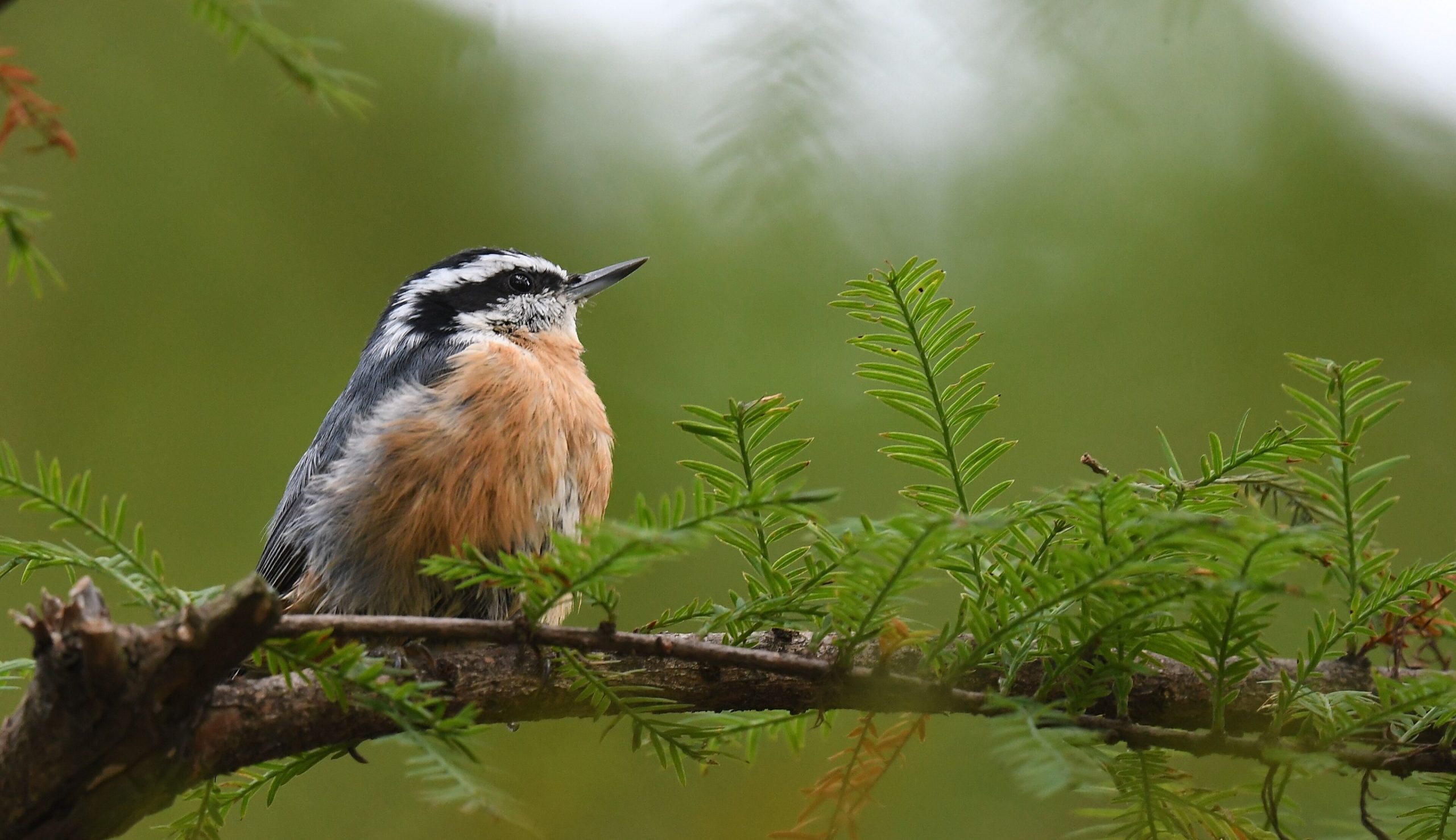
The Red-breasted Nuthatch (Sitta canadensis) is the tiny, hyperactive climber of the northern conifer forest — a 4.3–4.7-inch, 8–13-gram bird in blue-gray above and rusty-orange below, with a bold white eyebrow over a black eye-line and a high, nasal “yank-yank” like a tiny tin horn. A member of the nuthatch family (Sittidae), it hitches headfirst down trunks, wedges conifer seeds into bark crevices and hammers them open, and smears sticky pine resin around its nest-cavity entrance. Males wear a glossy black cap; females a blue-gray one. It is an irruptive migrant: in poor cone-crop years it pours south out of the boreal forest and can blanket feeders as far as the Gulf Coast. Attract it with suet cages, black-oil sunflower, peanuts, and a yard with mature conifers or a standing dead tree.
Species Physical Profile & Morphometrics
The Red-breasted Nuthatch is one of four nuthatch species in North America and the small, northern counterpart of the familiar White-breasted Nuthatch. Where the White-breasted is a bird of deciduous shade trees, this is a bird of spruce, fir, pine, and hemlock — and it is distinctly smaller, with a face pattern that no other backyard bird can match.
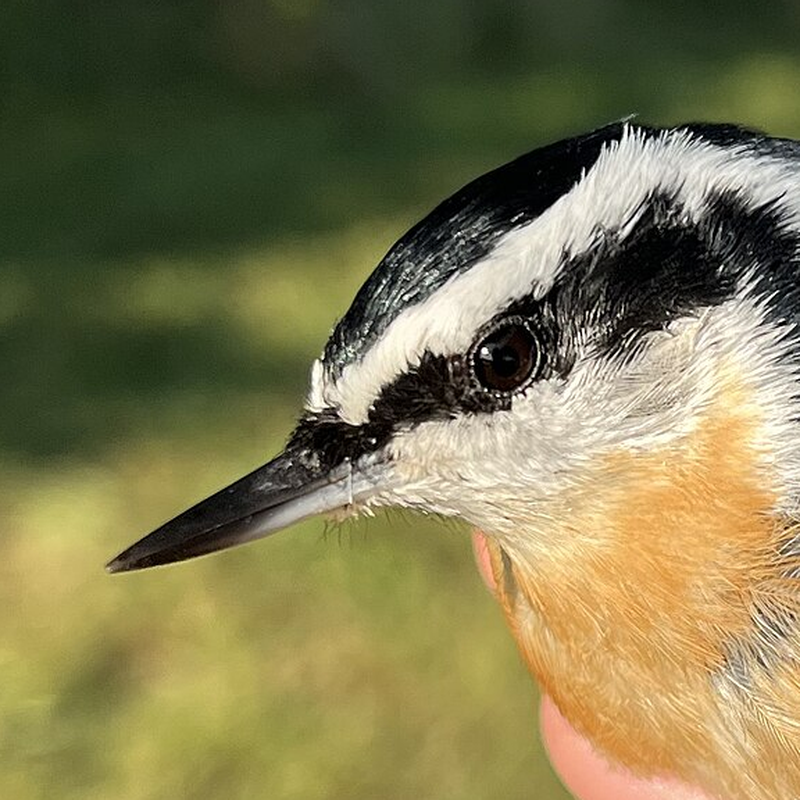
In the field, lock onto the head: a bold black stripe through the eye sits under a crisp white eyebrow, capped in glossy black on the male. The underparts glow rusty-orange, the back and wings are blue-gray, and the tail is short and square — rarely fanned, usually braced against bark. The bill is straight, dark, and chisel-like: a tool for prying, wedging, and hammering.
Essential Morphometric Field Marks:
- Body Length & Mass: Averages 4.3 to 4.7 inches (11–12 cm) with an adult mass of 0.3 to 0.5 ounces (8–13 grams) — roughly two-thirds the bulk of a White-breasted Nuthatch.
- Wingspan: 7.1 to 7.9 inches (18–20 cm), with short, rounded wings built for darting between trunks, not for long flights.
- Bill Structure & Color: A straight, dark, chisel-like bill — slimmer than a chickadee’s, straighter than a woodpecker’s — used to pry bark scales and hammer wedged seeds open.
- Color Pattern: Blue-gray above, rusty-cinnamon below; black eye-line under a white eyebrow; white outer tail spots visible in flight. Feet are oversized gray grappling hooks that grip bark without a tail prop.
Glossy black crown and eye-line framing a bold white eyebrow, with deep rusty-orange underparts. In good light the black cap gleams blue-black; the contrast with the white brow is visible at feeder distance with the naked eye.
Blue-gray crown (not black) and noticeably paler, washed-buff underparts — the fastest way to sex the pair at your suet cage. The white eyebrow and black eye-line are present but softer. Juveniles resemble duller females.
Red-breasted Nuthatch Vocalization Guide (3 Field Recordings)
The voice is the giveaway: a high, nasal “yank-yank-yank”, usually compared to a tiny tin horn — higher, thinner, and delivered faster than the White-breasted Nuthatch’s call. Uniquely among North American nuthatches, the male also has a true song: a slow, evenly spaced series of nasal “eeen eeen eeen” notes heard mostly in late winter and spring. All three cards below are real field recordings with open licenses.
1. The “Yank-Yank” Call — Sandbanks, Ontario
2. Foraging Group in Ponderosa Pines
3. Calls in Yosemite National Park
Habitat, Range & Irruptive Migration Biology
Red-breasted Nuthatches are birds of mature conifer and mixed forest — spruce and fir in the boreal north, pines and hemlocks in the Great Lakes and Appalachians, and Douglas-fir, spruce, and ponderosa in the western mountains. The year-round range runs from Alaska and boreal Canada across the Great Lakes states and down the Appalachian highlands, and through the cordillera of the western United States into the mountains of Mexico.

An Irruptive Migrant Ruled by the Cone Crop
This species’ winter whereabouts are written by the northern cone crop. In years when spruce, fir, and pine seed production fails across the boreal forest, Red-breasted Nuthatches stage a mass exodus beginning in late summer — flooding south well beyond the mapped winter range, sometimes all the way to the Gulf Coast. In good cone years, most stay north.
For backyard birders that means a feast-or-famine visitor: an irruption winter can bring a bird to every suet cage on the block, followed by several winters with none at all. In the North and the western mountains they often travel in mixed flocks with Black-capped Chickadees, kinglets, and Mountain Chickadees.
Backyard Behavioral Patterns & Social Dynamics
Small as it is, this is one of the boldest and most mechanical foragers you will ever host. Four signature behaviors explain most of what you will observe:
🧗 Headfirst Down the Trunk
Nuthatches are the only North American birds that routinely walk straight down a trunk headfirst, gripping with oversized feet instead of bracing with the tail like a woodpecker. The head-down vantage lets them spot insects and seeds in bark crevices that trunk-climbers working upward simply miss.
🔨 Wedge & Whack
The “nuthatch” name is literal: the bird wedges a seed into a bark crevice and hatches it open with hammer blows of the bill. Watch your suet cage closely and you will see a bird fly off with a sunflower seed, jam it into the nearest rough bark, and whack it to pieces — exactly the move in our female gallery photo.
🌲 The Resin Ring
Around its nest-cavity entrance the Red-breasted Nuthatch smears globs of sticky conifer resin — sometimes carrying them in on a bit of bark held like a trowel. The leading theory is that the resin barrier deters predators, ants, and would-be nest rivals. The birds themselves duck under or dart through it.
💾 The Bark-Covered Pantry
Surplus feeder seeds are cached in bark crevices and deliberately covered with a flake of bark or lichen — one of the neatest food-hiding routines of any backyard bird. At the feeder they are famously feisty, scattering birds twice their size, and fussy: they often weigh-test seeds and fly off with the single heaviest one.
Problem: Why Red-breasted Nuthatches Vanish from Your Yard for Years
The classic backyard report runs: “one winter they were everywhere — now I haven’t seen one in three years.” The reasons are built into the bird’s biology:
First, this is an irruptive migrant: its winter range expands and contracts with the northern cone crop, so absence usually means a good seed year up north, not anything wrong with your yard. Second, the menu matters: this bird ignores nyjer and millet and wants concentrated fat and protein — a yard offering only finch mix is invisible to it. Third, structure matters: it forages on the bark of mature trees, and a bare suburban lot with no conifers, no mature trunks, and certainly no dead wood offers nothing to work. When an irruption winter does push birds into your region, a yard already stocked with suet, peanuts, and sunflower near mature trees is the one they will adopt for the season.
Method 1: Set the Table — Suet, Black-Oil Sunflower & Peanuts
Design for a feisty little tree-trunk acrobat with a big appetite for fat:
-
Hang a Suet Cage on or Near a Trunk
A wire suet cage is the single best Red-breasted Nuthatch feeder — every face is clingable, exactly like bark. Mount it on a tree trunk or hang it within a short dart of one, and stock a nut or insect blend. Our lab-tested roundup of the Best Suet Feeders & Cakes compares proven models.
-
Offer Black-Oil Sunflower & Peanuts
Black-oil sunflower seeds and unsalted peanuts (in or out of the shell) are the staple feeder fare — high-fat, high-protein, and sized for wedging and hammering. Skip nyjer, millet, and low-grade mixed seed entirely.
-
Keep Feeders a Short Dart from Mature Trees
Place the station within a few wing-beats of large trunks — ideally conifers. The bird stages on bark, darts in, grabs the heaviest seed, and retreats to a crevice to hammer it open. A pole feeder stranded on open lawn gets ignored.
-
Add a Dependable Water Source
A shallow bath pulls nuthatches in every season, and in the frozen North a heated bird bath keeps your station open when every natural source locks up — exactly when irrupting birds need it most.
Method 2: Keep Them Nesting — Snags, Nest Boxes & Conifer Cover
Turn a winter visitor into a breeding resident:
-
Leave a Standing Dead Tree (Safely)
Red-breasted Nuthatches are one of the few small birds that excavate their own cavity in soft dead wood. A dead trunk or dead limb left standing — well away from the house and foot traffic — is the single most valuable nesting feature you can offer.
-
Hang a Nuthatch-Sized Nest Box
Where no snag is safe to keep, mount a nest box with a 1-1/4-inch entrance hole and about 8 inches of interior depth on a tree or post 5–15 feet up, near conifers. The 1-1/4-inch hole admits nuthatches and chickadees but excludes House Sparrows and starlings.
-
Keep the Conifers, Lichen & Rough Bark
Foraging, caching, and resin-collecting all happen on mature, rough-barked trees. Plant native spruce, fir, pine, or hemlock where space allows, and leave bark scales, lichen, and the odd broken limb in place — that is both pantry and building site.
-
Feed Through Every Season
Resident pairs stay put year-round, and a spring-stocked suet cage helps a female through the one-to-eight weeks of cavity excavation and the 12–13 days of incubation. Keep the station reliable and the pair that winters with you may nest in your yard.
Tool Solution: Recommended Hardware for Red-breasted Nuthatches
Equipment matched to a feisty, bark-clinging, fat-loving acrobat:
Hanging Suet Cage
The classic wire cage a nuthatch can cling to on every face — mounted on or near a trunk, it is the fastest way to get this species feeding daily.
- • Cake: Nut or insect blend
- • Access: Clingable on all sides
- • Mount: Trunk or hook near conifers
Platform Feeder + Peanuts
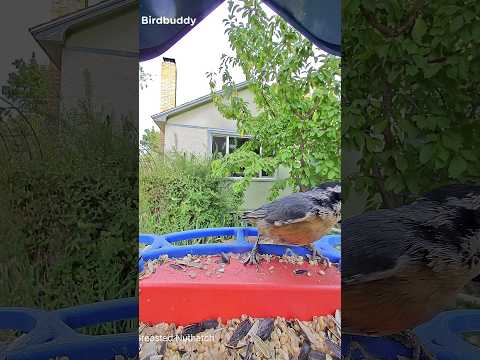
A sturdy platform feeder stocked with black-oil sunflower and unsalted peanuts — the grab-and-go station where the bird picks the single heaviest seed to hammer open on the nearest trunk.
- • Seeds: Black-oil sunflower
- • Nuts: Unsalted peanuts
- • Placement: Short dart from trees
Nuthatch Nest Box
A small nest box with a 1-1/4-inch entrance and about 8 inches of interior depth, mounted 5–15 feet up near conifers — sized for nuthatches and chickadees, too small for starlings and House Sparrows.
- • Entrance: 1-1/4 in
- • Depth: ~8 in interior
- • Mount: 5–15 ft, near conifers
Frequently Asked Questions
- Species Profile: The Red-breasted Nuthatch (Sitta canadensis) is a 4.3–4.7 inch, 8–13 gram climber — blue-gray above, rusty below, with a black eye-line under a bold white eyebrow and a straight chisel-like bill.
- Conifer Specialist: A bird of spruce, fir, pine, and hemlock forests across boreal Canada and Alaska, the Great Lakes, the Appalachian highlands, and the western mountains.
- Irruptive Migrant: Winter movements track the northern cone crop — in failure years the species floods south, sometimes to the Gulf Coast, and can vanish from a yard for years between irruptions.
- Sexes by Crown Color: Males wear a glossy black cap; females show a blue-gray crown with paler underparts.
- Feeder Formula: A suet cage on or near a trunk, black-oil sunflower, and unsalted peanuts near mature trees — plus a shallow or heated bath in the frozen months.
- Signature Behaviors: Hitches headfirst down trunks, wedges and hammers seeds open, caches food under bark flakes, and smears conifer resin around its self-excavated nest entrance.
Bird Watching Log
Species: Red-breasted Nuthatch (Sitta canadensis)
| Red-breasted Nuthatch (Crown Color / Climbing Direction: ____________________________) | |