
Chestnut-backed Chickadee


Chestnut-backed Chickadee (Poecile rufescens): Complete Identification, Feeder Guide & Call Library
Quick Answer: How to Attract & Identify Chestnut-backed Chickadees
The Chestnut-backed Chickadee (Poecile rufescens) is the chickadee of the Pacific coastal forests — a tiny, big-headed acrobat with a brown (not black) cap and bib, bright white cheeks, and a rich chestnut back and flanks. It measures just 3.9–4.7 inches and weighs around 10 grams. A non-migratory year-round resident, it lives from southern Alaska through British Columbia, Washington, and Oregon to California, with a second pocket in the northern Rockies. Unique among North American chickadees, it has no whistled fee-bee song — listen instead for very high, thin “tsee-tsee-tsee” notes and a fast, husky “chick-a-dee-dee-dee.” Attract it with suet, black oil sunflower, and chopped nuts in a hanging tube feeder placed in the shade of conifers or oaks, and expect quick grab-and-go visits all year.
Species Physical Profile & Morphometrics
The Chestnut-backed Chickadee has the familiar chickadee silhouette — oversized round head, tiny bill, plump body, long tail — and the same acrobatic energy, swarming branch tips and hanging upside down to glean insects. It is a member of the tit family (Paridae) and the signature chickadee of the fog belt.
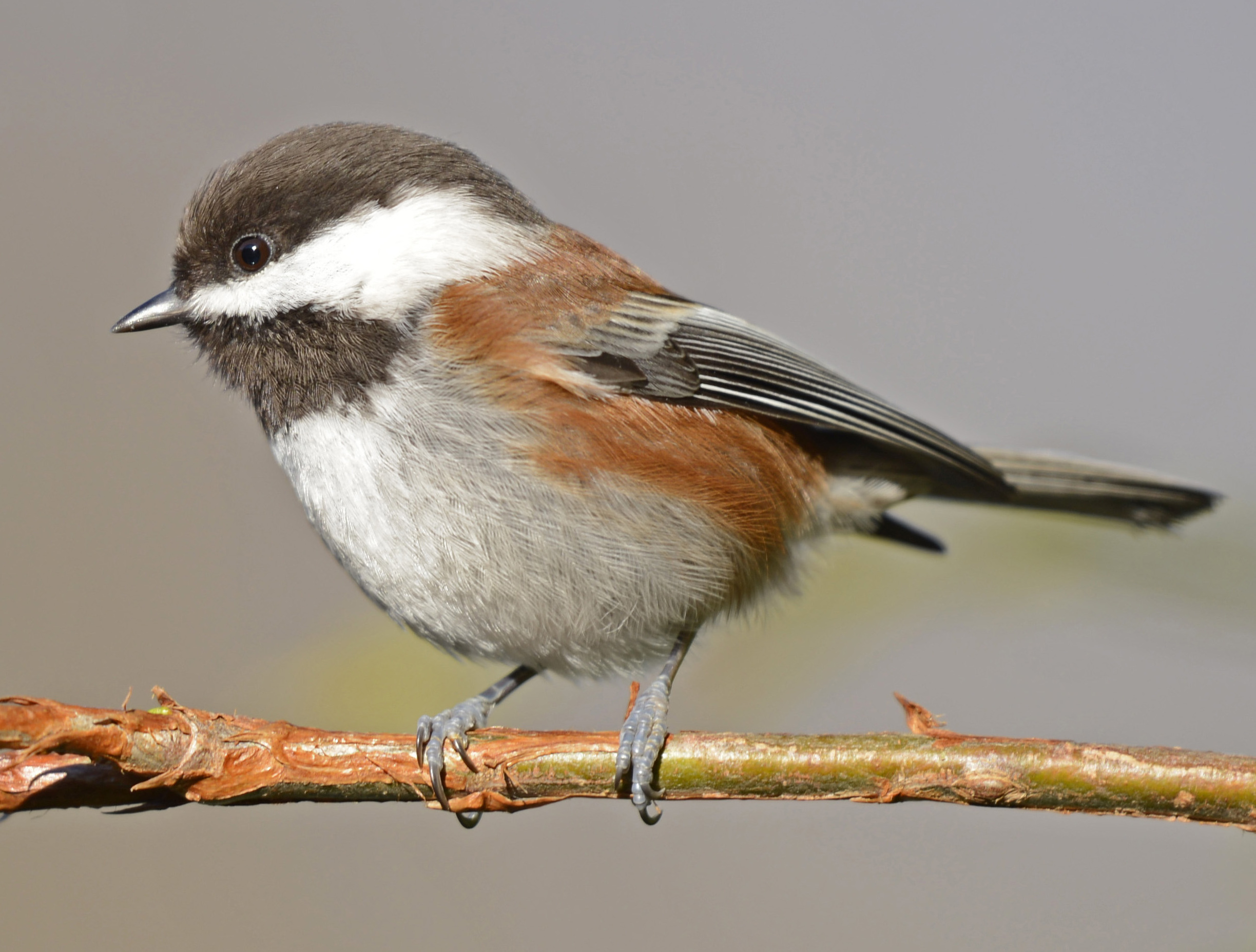
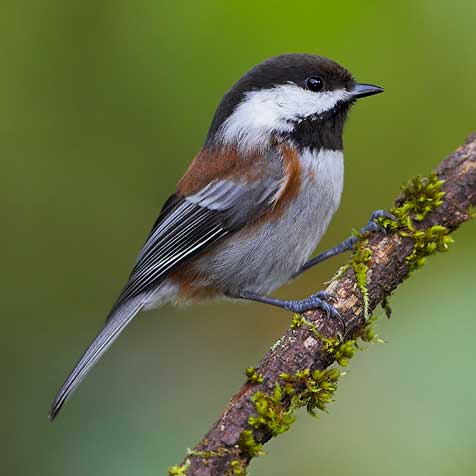
Identification is easy once the light is good: the deep chestnut back and flanks separate it instantly from the gray-backed Black-capped Chickadee that shares its range, and its cap and bib are warm brown rather than jet black. The Mountain Chickadee shows a white eyebrow this species lacks. One quirk to know: birds around San Francisco Bay (subspecies barlowi, like the park bird in our gallery) have much paler, grayish flanks with the chestnut mostly confined to the back.
Essential Morphometric Field Marks:
- Body Length & Mass: Averages 3.9 to 4.7 inches (10–12 cm) with an adult mass of 0.3 to 0.44 ounces (8.5–12.6 grams) — the smallest chickadee in the Northwest.
- Wingspan: About 7.5 inches (19 cm), with plain grayish wings edged subtly in olive.
- Bill Structure & Color: A short, stubby black bill, used to glean insects from needle clusters and hammer open seeds held under one foot.
- Color Pattern: Brown cap and bib, bright white cheeks, rich chestnut back and flanks, and a whitish belly; coastal California birds show reduced rufous on the flanks. Males and females look identical.
Brown hood wrapping the crown and throat, a clean white cheek patch, and a glowing chestnut saddle across the back that spills onto the flanks. Wings and tail are grayish with subtle olive edging. Adult males and females cannot be separated in the field.
Summer juveniles look like fluffier, washed-out adults: the hood is sooty brown, the cheeks creamy, and the chestnut saddle duller and less extensive until the first fall molt deepens the color.
Chestnut-backed Chickadee Vocalization Guide (2 Recordings + 1 Simulation)
Here is the surprise: this species has no whistled song at all — no “fee-bee.” Its entire repertoire is calls: very high, thin “tsee” notes, a fast husky “chick-a-dee-dee-dee,” and social gargles. Both recordings below are real field audio by Jonathon Jongsma, hosted on Wikimedia Commons under CC BY-SA 3.0; the third card is a clearly labeled simulation. For more wild audio, browse xeno-canto: Chestnut-backed Chickadee.
1. High-Pitched Call — California Woodland Edge
2. Foraging Flock Calls — McClellan Ranch Preserve
3. “Chick-a-Dee-Dee” Flock Call
Habitat, Range & Year-Round Resident Biology
Chestnut-backed Chickadees live in moist coniferous forest — Douglas-fir, hemlock, cedar, and redwood — along the Pacific coast from southern Alaska through British Columbia, Washington, and Oregon to California, with a separate pocket in the mountains of northern Idaho and western Montana. In California they are equally at home in live oaks, bays, and even eucalyptus, and they thrive in shaded city parks like San Francisco’s Buena Vista Park, where one of our gallery birds was photographed.

The Fog Belt’s Own Chickadee
These birds never migrate. A pair may spend its entire life within a few acres of damp coastal forest, riding out the mild, wet winters that define the range. Because food is available nearly year-round in the fog belt, Chestnut-backed Chickadees stay spread thin through the woods rather than bunching into large winter flocks.
A shaded yard with mature conifers or oaks, a shrubby understory, and a dependable feeder fits their needs perfectly. In winter they travel with Red-breasted Nuthatches, Golden-crowned Kinglets, and Brown Creepers — the whole guild arriving and leaving together.
Backyard Behavioral Patterns & Social Dynamics
Chestnut-backed Chickadees run the chickadee playbook with a coastal accent. Four signature behaviors explain most of what you will observe:
🤫 The Song-Free Songbird
Unique among North American chickadees, this species never sings a whistled fee-bee. Its voice is all calls — piercing thin “tsee” notes so high some observers can barely hear them. If your western feeder bird is chatty but never whistles, that silence is a field mark in itself.
🌫️ Fog-Belt Foraging Style
Watch the flock work a Douglas-fir or live oak: birds hover-glean at needle and leaf tips and hang upside down along lichen-covered twigs, picking insects and seeds the bigger birds miss. Mossy, shaded branches — like the San Francisco perch in our gallery — are prime hunting grounds.
🧠 Cache Now, Remember Later
Like its relatives, the Chestnut-backed Chickadee hides single seeds in bark crevices and needle clusters throughout autumn and recalls the spots for weeks — one reason a feeder that stays reliably stocked earns such loyal, repeat traffic.
🐇 The Fur-Lined Nest
This species is famous for lining its nest cup with animal fur — rabbit, deer, even hair brushed from cooperative pets. The thick fur blanket hides the eggs and nestlings whenever the parents slip away. A nest box plus a small suet cage of clean pet fur in spring is an irresistible combination.
Problem: Why Chestnut-backed Chickadees Skip Sunny, Exposed Yards
Within the range, the most common complaint is simple: “chickadees everywhere in the park, none at my feeder.” The usual reasons:
First, this is a shade-and-moisture bird: a feeder on a hot, treeless lawn reads as foreign habitat, while the same tube hung under a cedar gets daily visits. Second, the coastal climate works against you — seed in an undrained feeder turns to mold within days of autumn rain, and chickadees inspect every kernel before taking it. Third, a 10-gram bird loses every shoving match with Steller’s Jays, scrub-jays, and starlings at open platform feeders. Give them shaded cover, fresh dry seed, and a feeder the big birds cannot dominate, and the park flock becomes your flock.
Method 1: Hang Stations in the Shade, Near Cover
Design for a small, quick bird of damp, shaded forest:
-
Choose a Hanging Tube Feeder with a Weather Guard
A small-perch tube feeder with a domed rain cover and drainage keeps seed dry through coastal drizzle and favors clinging chickadees over big bully birds. Our lab-tested roundup of the Best Tube Feeders for Small Birds compares proven models.
-
Hang It Under Conifers or Oaks
Suspend the feeder within 10 feet of evergreen or oak cover, in dappled shade. Chickadees stage in the branches between trips, and a shaded station stays fresher longer in any weather.
-
Feed Small Portions, Refresh Often
In the wet season, fill with a day or two of seed at a time and dump anything clumped or musty. A modest, perpetually fresh feeder outperforms a large neglected one — especially once the autumn rains set in.
-
Mount a Suet Cage Where Big Birds Can’t Camp
A hanging suet cage (or an upside-down suet feeder) under the same tree gives the flock concentrated fat while frustrating jays and starlings that dislike clinging underneath.
Method 2: Stock the Coastal Pantry Year-Round
Match the menu — and the real estate — to a resident of the fog belt:
-
Lead with Suet and Chopped Nuts
Suet is the top draw in the cool, damp months, and chopped peanuts or tree nuts are grabbed as fast as you stock them — high-fat, cacheable, and perfectly sized for a grab-and-go bill. Black oil sunflower rounds out the daily ration.
-
Hang a Nest Box — and Offer Nesting Fur
A box with a 1-1/8-inch entrance hole, mounted 5–15 feet up in shade near trees, is often claimed in early spring. Add wood shavings inside, and hang a small wire cage of clean, un dyed pet fur nearby — this fur-lining specialist will find it.
-
Keep a Shaded Bird Bath Filled
A shallow bath in dappled shade pulls chickadees down to drink and bathe between foraging runs, and it serves the whole winter guild of kinglets, nuthatches, and creepers that travels with them.
-
Let Spent Flowers and Cones Stand
Leave seed heads, alder cones, and needle-covered branches undisturbed through fall — they are natural feeders stocked with the insects and seeds this species evolved to glean. Skip pesticides so the caterpillar supply stays strong for nesting season.
Tool Solution: Recommended Hardware for Chestnut-backed Chickadees
Equipment sized for the fog belt’s smallest resident:
Hanging Tube Feeder with Rain Dome
Small perches, drainage ports, and a weather guard that keeps seed dry through coastal drizzle while shutting out jays and squirrels.
- • Capacity: 1.5–2 lbs Sunflower
- • Roof: Domed rain guard included
- • Mount: Hang from shaded branch
Suet Cakes + Chopped Nut Mix
Concentrated fat and protein in grab-and-go portions — exactly what a 10-gram acrobat burns through on wet coastal mornings.
- • Suet: No-melt formula, nut blend
- • Nuts: Chopped, unsalted, cache-ready
- • Purity: No milo or wheat filler
Chickadee Nest Box (1-1/8″ Entry)
Cedar box sized for Paridae — hang it in shade near conifers or oaks, add wood shavings, and offer clean pet fur for the famous fur-lined nest.
- • Entrance: 1-1/8 in (28 mm) round hole
- • Floor: 4 × 4 in interior
- • Mount: 5–15 ft, shaded aspect
Frequently Asked Questions
- Species Profile: The Chestnut-backed Chickadee (Poecile rufescens) is a 3.9–4.7 inch, ~10-gram songbird with a brown cap and bib, white cheeks, and a rich chestnut back; males and females look identical.
- Fog-Belt Resident: Non-migratory along the Pacific coast from southern Alaska to California, plus a pocket in the interior Northwest; San Francisco Bay birds (subspecies barlowi) show paler flanks.
- No Whistled Song: The only North American chickadee without a fee-bee song — listen for piercing thin “tsee” notes and a fast, husky “chick-a-dee-dee-dee.”
- Feeder Formula: A shaded hanging tube feeder with black oil sunflower, plus suet and chopped nuts; keep portions small and fresh through the wet season.
- Fur-Lined Nests: Cavity nester that readily uses nest boxes and famously lines the nest cup with animal fur — offer clean pet fur in spring.
- Flock Guild: Winter flocks travel with kinglets, nuthatches, and creepers — one shaded, well-run station attracts the whole community.
Bird Watching Log
Species: Chestnut-backed Chickadee (Poecile rufescens)
| Chestnut-backed Chickadee (Subspecies / Notes: ____________________________) | |