
Rosy-faced Lovebird


Rosy-faced Lovebird (Agapornis roseicollis): Complete Identification, Habitat Guide & Sound Library
Quick Answer: How to Attract & Identify the Rosy-faced Lovebird
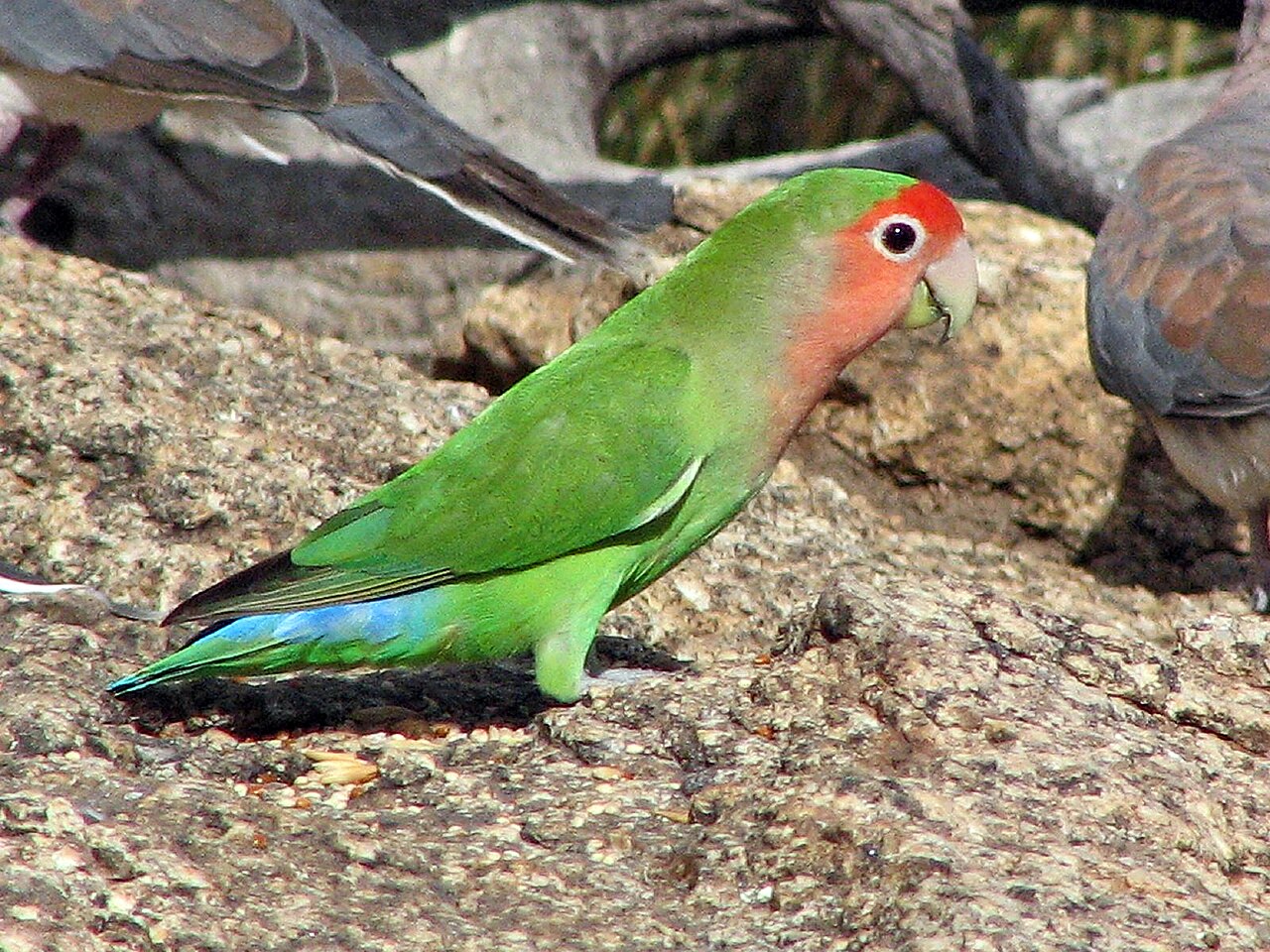
The Rosy-faced Lovebird (Agapornis roseicollis) — the peach-faced lovebird of the pet trade — is the feral parrot of metro Phoenix: a small bright green parrot with a rosy-pink face and a violet-blue rump, descended from escaped pets and breeding wild in Arizona since the 1980s. Its voice is a loud, high-pitched metallic chattering. Flocks visit seed feeders and fruiting trees, and pairs nest in palm crowns and saguaro cavities. Desert yards attract them with sunflower and millet feeders, water, and mature palms. They share the neighborhood with the Inca Dove and the Gila Woodpecker.
Species Physical Profile & Morphometrics
The Rosy-faced Lovebird belongs to the parrot family (Psittaculidae) — a native of arid southwestern Africa whose escaped cage birds founded a self-sustaining feral population across the Phoenix metropolitan area, one of the few parrot populations thriving wild in the United States.
The identification formula: small green parrot + rosy-pink face + blue rump + screeching flock. Nothing else in Arizona matches it. You will usually hear the metallic chatter first, then see the flock arrow across the street to a palm or a feeder.
Essential Morphometric Field Marks:
- Body Length & Mass: 6.3 to 7.1 inches (16–18 cm) and 1.5 to 2.0 ounces (43–57 grams) — a stocky, short-tailed small parrot, big-headed and big-billed for its size.
- Wingspan: Wings are short and pointed, driving the fast, direct, whirring flight of a flock crossing the neighborhood — usually announced by constant chatter.
- Bill Structure & Color: A short, deeply hooked pale horn-colored bill — a seed-cracking and wood-climbing tool of classic parrot design.
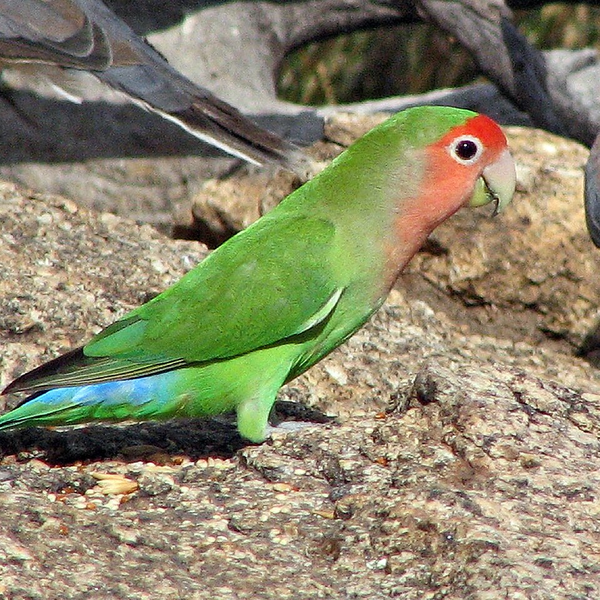
- Color Pattern: Bright green body, rosy-pink face and throat, violet-blue rump; flight feathers dark; juveniles duller with a dark smudge on the bill.
- Male vs. Female: Sexes look identical; bonded pairs sit shoulder to shoulder, preening each other — the behavior that gave lovebirds their name.
The shoulder-to-shoulder mate: rosy-faced and emerald, pressed against his partner on the feeder hook, both chattering at the world between sunflower seeds.
The identical partner — same mask, same blue rump — she tucks strips of palm bark into her rump feathers and flies them home to line the nest cavity, the lovebird family’s famous carpentry trick.
Rosy-faced Lovebird Vocalization Guide (0 Field Recordings)
The Rosy-faced Lovebird’s voice is a loud, high-pitched, metallic chattering — chi-chi-chi-chi — carried on in flight and at the feeder; a flock is audible a block away. All recordings below are real field audio via Wikimedia Commons — no simulations. For a deeper library, browse xeno-canto: Rosy-faced Lovebird.
1. The Flock Chatter
2. The Feeder Squabble
3. The Pair Murmur
Habitat, Range & the Irrigated Desert City
The feral population lives in irrigated desert suburbia: Phoenix, Scottsdale, Mesa, Tempe, and the surrounding metro — neighborhoods with mature palms for nesting, seed feeders and fruiting trees for food, and water features. Native to arid African savanna, the species finds Arizona’s climate familiar and the landscaping generous.

The Escapees That Made Good
Descended from pet-trade escapees, the population has been self-sustaining and growing since the 1980s, spreading across the Phoenix metro — thousands of birds now breed wild in palm crowns and saguaro cavities, one of the most successful feral parrots in North America.
For metro yards: if your street has mature palms and a seed feeder, the local flock already knows your address — or will within days of the feeder going up.
Backyard Behavioral Patterns & Social Dynamics
The Rosy-faced Lovebird is a social, cavity-nesting, feeder-loving desert parrot. Four behaviors explain most of what you will observe:
👥 The Chattering Flock
They live in flocks of a handful to dozens, commuting between roost palms, feeders, and water on fixed daily routes — always talking.
🧺 The Rump Carpenter
The female carries nesting material tucked into her rump feathers — strips of palm bark flown home like a carpenter’s apron full of shavings.
💑 The Lovebird Bond
Pairs sit pressed together and preen each other — the namesake behavior, visible at any feeder with a pair aboard.
🌴 The Palm Tenant
They nest in palm crowns, saguaro holes, and boxes — in Phoenix the untrimmed palm is prime lovebird real estate.
Problem: “A Lovebird Flock Empties My Feeder Daily. What Should I Do?”
The three most common Rosy-faced Lovebird puzzles all have proven answers:
First, the emptied feeder: a flock can drain a tube in a day — either embrace it as the price of the show, or portion-feed by filling the feeder each morning with a measured cup; the flock learns the budget and moves on when it is gone. Second, the are-they-harmful question: they compete little with natives — studies in Phoenix find them using palm cavities natives rarely use — but clean feeders weekly, since crowded parrot flocks spread disease at dirty ports. Third, the escaped-pet question: a tame lovebird at your feeder that lands on people or talks is likely a recent escape — contact a local bird rescue; truly feral birds stay wary.
Method 1: Set the Table — Seed, Water & Palm Shade
Design for a flocking desert parrot:
-
Offer Sunflower & Millet
Black oil sunflower and millet in tube and platform feeders — the flock’s staple; fill with a measured daily portion.
-
Provide Water Year-Round
A birdbath or shallow dish, never dry in summer — desert parrots drink daily and bathe with gusto.
-
Hang Feeders Near Palms
Place feeders within sight of palms or dense trees — the flock stages in cover before dropping to feed.
-
Clean Feeders Weekly
Scrub ports and trays with dilute bleach solution weekly — crowded parrot flocks make hygiene essential.
Method 2: Keep the Palms — Nesting & the Daily Show
Palms are the real estate that makes residents:
-
Keep Mature Palms Untrimmed
Dead palm crowns hold nest cavities — leave them where safety allows, and a pair may move in.
-
Offer a Parrot-Sized Box
A nest box with a 2-inch entrance on a pole or wall may attract a pair — lovebirds take to boxes readily.
-
Watch the Commute Hours
Flocks move early morning and late afternoon — be outside then for the full chattering flyover.
-
Enjoy, Don’t Encourage Escapees
Report tame, handleable birds to a rescue — the feral flock is healthy; new releases carry disease.
Tool Solution: Recommended Hardware for Rosy-faced Lovebird
Equipment matched to a desert parrot flock:
Sunflower Tube Feeder
A sturdy tube of black oil sunflower — lovebirds cling and husk with ease; fill with a measured daily portion to budget the flock.
- • Food: Black oil sunflower
- • Style: Tube or platform
- • Hygiene: Clean weekly
Never-Dry Birdbath
A dependable water source through the Arizona summer — drinking and group bathing are daily flock events.
- • Rule: Never dry
- • Depth: 1–2 inches
- • Bonus: Doves & finches too
Palm Crown & Nest Box
Untrimmed palms plus a 2-inch-entrance nest box — the cavity sites that turn a visiting flock into nesting residents.
- • Entrance: ~2 inches
- • Placement: Pole or wall
- • Bonus: Kestrels may use too
Frequently Asked Questions
- Species Profile: The Rosy-faced Lovebird (Agapornis roseicollis) is a 6.3–7.1 inch, 1.5–2.0 ounce parrot (Psittaculidae), band code RFLO — the feral peach-face of Phoenix.
- ID in One Look: Green body, rosy-pink face, pale hooked bill, violet-blue rump, noisy flock.
- The Sound: Loud metallic chi-chi-chi chatter, heard a block away; real field recordings above.
- Range & Habit: African native; self-sustaining feral population across the Phoenix metro since the 1980s.
- Feeder Formula: Sunflower and millet near palms, never-dry water, weekly cleaning, measured daily portions.
- The Desert Success: Escaped pets that became a wild Arizona flock — enjoy the show, never release more.
Bird Watching Log
Species: Rosy-faced Lovebird (Agapornis roseicollis)
| Rosy-faced Lovebird (Flock Size: ___ — Blue Rump Seen: Yes / No — At Feeder: Yes / No — Palm Nesting Suspected: Yes / No — Date & Time: ___) | |