
Black-headed Grosbeak vs Spotted Towhee
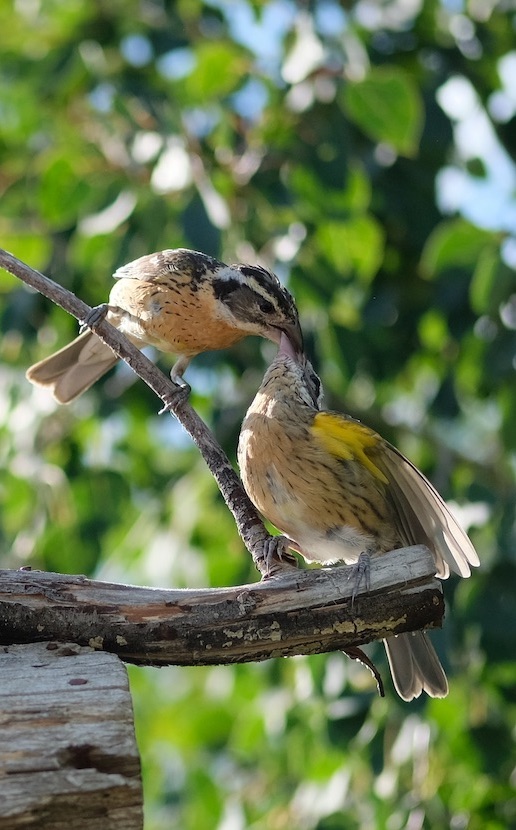


Black-headed Grosbeak vs Spotted Towhee (Pheucticus melanocephalus vs Pipilo maculatus): The Complete Backyard Identification Guide
Quick Answer: The Fastest Way to Tell Them Apart
Two black-and-orange westerners that fool new birders daily. Three rules:
- Bill: a huge pale triangle = grosbeak; thin and dark = towhee.
- Back: solid black = male grosbeak; black with neat white spots = towhee.
- Belly: orange from throat to undertail = grosbeak; white with rufous sides = towhee.
At-a-Glance Comparison Table
The seed-crusher and the leaf-scratcher, side by side. KEY rows separate fastest.
| Feature | Black-headed Grosbeak | Spotted Towhee |
|---|---|---|
| Scientific Name | Pheucticus melanocephalus | Pipilo maculatus |
| Length KEY | 7.1–7.5 in (18–19 cm) | 8.3 in (21 cm) |
| Wingspan | 12.6 in (32 cm) | 10.6–11.8 in (27–30 cm) |
| Weight | 1.2–1.7 oz (34–48 g) | 1.2–1.8 oz (33–50 g) |
| Overall Shape | Stocky songbird with a huge pale triangular bill | Large, long-tailed ground sparrow |
| Male Plumage KEY | Black head and back, rich orange-cinnamon breast and rump, bold black-and-white wings | Black head, back and hood; white-spotted wings, rufous flanks, white belly, red eye |
| Female Plumage | Warm brown with fine streaks, a broad pale eyebrow, and orange-buff underparts; huge pale bill | Same pattern as the male but dark brown where he is black |
| Bill Shape | Enormous pale-gray triangular seed-and-fruit bill | Thick black conical bill |
| Tail | Medium black tail with white spots visible in flight | Long black tail with bold white corners |
| Core Range KEY | Breeds across the western US in open woods and riparian edges; winters mostly in Mexico | West of the Plains — chaparral, thickets and forest edges |
| Migration | Long-distance migrant; in the West roughly April–September | Western birds largely resident; interior birds migrate short distances |
| Feeder Presence | Spring migrants and summer birds visit sunflower and safflower feeders in western yards | Ground-scratches under feeders for sunflower and millet |
| Favorite Foods | Sunflower and safflower at feeders; insects, wild fruit and berries in nature | Seeds and insects from leaf litter |
| Song KEY | Rich, robin-like warble — faster and more hurried than Rose-breasted | A buzzy trill: “drink-your-tea” in the East’s cousin; Spotted gives harsh chips and trills |
| Flight Call | A sharp, metallic “pik” | A nasal, cat-like “mew” from thickets |
| Population Trend | Stable and common across the West | Common in western brushy habitats |
Male Field Marks, Side by Side
Black-headed Grosbeak — Male
- Orange-cinnamon breast (not red) with a black head.
- Bold black-and-white wing patches flash in flight.
- Huge pale bill; orange rump visible as it flies off.
Spotted Towhee — Male
- Black hood over a white-spotted back.
- Rufous flanks + clean white belly + red eye.
- Double-scratch jumps in leaf litter.
Female & Juvenile Marks, Side by Side
Black-headed Grosbeak — Female
- Warm brown, finely streaked, with a broad pale eyebrow.
- Orange-buff wash below; enormous pale bill gives it away.
- Nearly identical to female Rose-breasted — use range and the buffer, browner tones.
Spotted Towhee — Female
- Dark brown replaces the male’s black.
- Same white wing spots and rufous flanks.
- Cat-like mewing call from dense brush.
Part-by-Part Anatomy Breakdown
Every part offers a check:
| Body Part | Black-headed Grosbeak | Spotted Towhee |
|---|---|---|
| Bill | Huge, pale, triangular | Thin, dark, pointed |
| Back | Solid black | Black with neat white spots |
| Breast-to-belly | Orange throughout, fading to yellow | Rufous sides, white belly |
| Eye | Dark | Red |
| Wings | Black with white patches | Black with white spots |
| Foraging | Trees and feeders | Ground — double-scratch in leaf litter |
| Song | Rich, flowing, robin-like warble | Sweet intro notes then a buzzy trill |
Song & Call Comparison
Black-headed Grosbeak
Song: a rich, robin-like warble, noticeably faster and more hurried than a Rose-breasted Grosbeak’s.
Calls: a sharp, metallic pik.
Spotted Towhee
Voice: harsh chips and a buzzy trill; the contact call is a nasal mew.
Behavior: rustles leaves loudly — sounds bigger than it is.
Range & Seasonal Presence
The Black-headed Grosbeak breeds across the West in open woods and streamside groves, migrating to Mexico in winter.
The Spotted Towhee lives year-round in western brush — chaparral, thickets and yard edges — scratching in leaf litter under cover.
Feeder Behavior & Favorite Foods
- Black-headed Grosbeak: sunflower at platform and hopper feeders, spring through fall.
- Spotted Towhee: scattered seed on the ground or low platforms near brush.
- Feeder placement: towhees want cover within a quick dash; grosbeaks visit open feeders.
- Migration note: grosbeaks vanish in winter; towhees stay all year.
Temperament & Flock Behavior
Black-headed Grosbeaks are deliberate and musical — singing robin-like songs from treetops and visiting feeders calmly.
Spotted Towhees are rustling shadows — double-scratching backward in the leaves, exploding into cover at the slightest movement.
6-Step Backyard ID Checklist
- Bill. Huge pale triangle = grosbeak; thin dark = towhee.
- Back. Solid black = grosbeak; white-spotted = towhee.
- Belly. Orange = grosbeak; white with rufous sides = towhee.
- Eye. Dark = grosbeak; red = towhee.
- Foraging. In trees/at feeders = grosbeak; scratching on the ground = towhee.
- Season. Winter black-and-orange bird = towhee.
Frequently Asked Questions
- Bill: Huge pale triangle = grosbeak; thin = towhee.
- Back: Solid black = grosbeak; white spots = towhee.
- Belly: Orange = grosbeak; white + rufous = towhee.
- Eye: Dark = grosbeak; red = towhee.
- Foraging: Trees = grosbeak; ground scratching = towhee.
- Winter: Only the towhee stays.