
House Wren vs Winter Wren


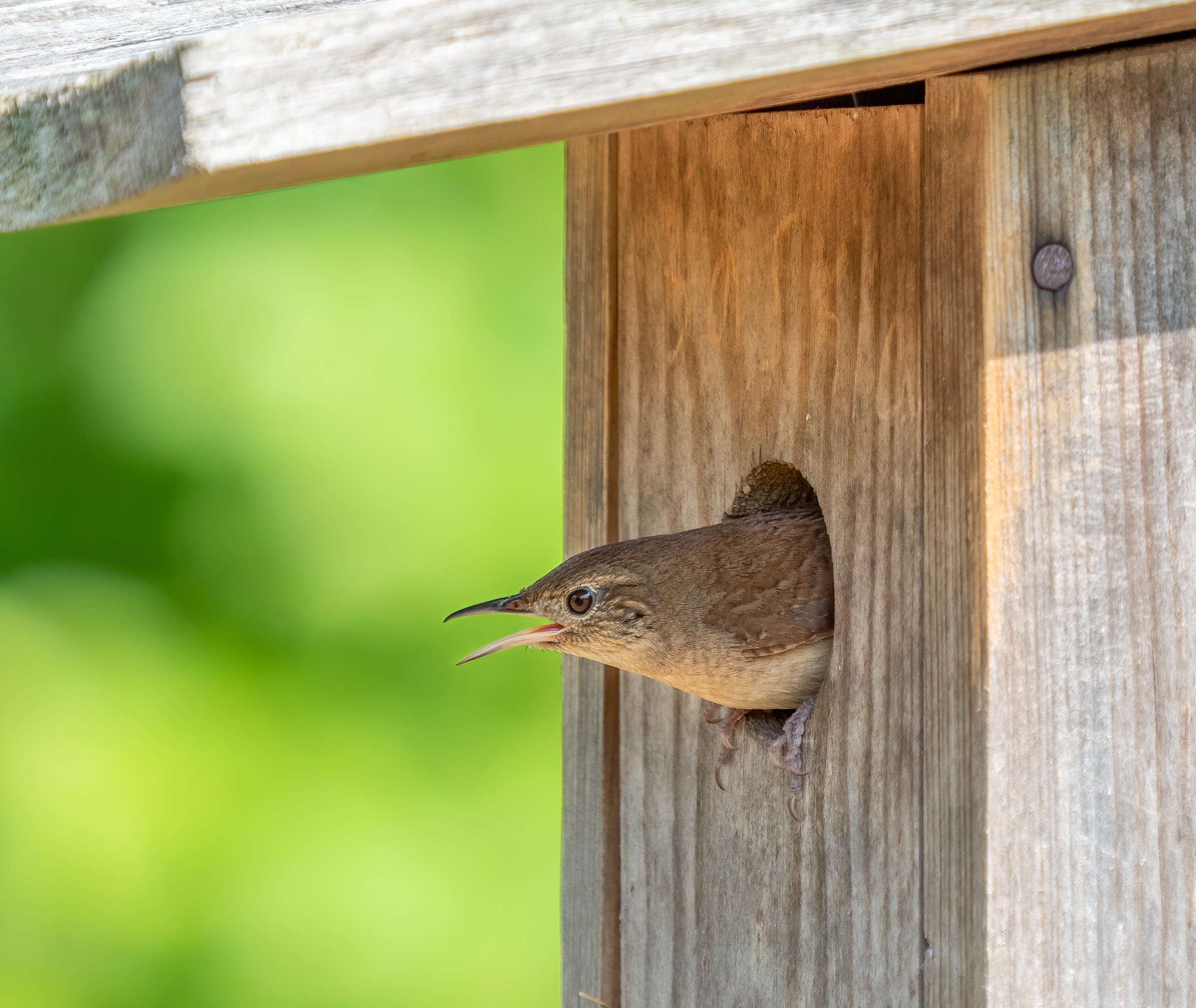


House Wren vs Winter Wren (Troglodytes aedon vs Troglodytes hiemalis): The Complete Backyard Identification Guide
Quick Answer: The Fastest Way to Tell Them Apart
The yard wren and the forest wren. Three rules:
- Color: plain gray-brown = House; dark, barred all over = Winter.
- Tail: noticeable = House; a stub cocked upright = Winter.
- Song: a quick bubbly cascade = House; a tinkling song that goes on for seconds = Winter.
At-a-Glance Comparison Table
The two small brown wrens, side by side. KEY rows separate fastest.
| Feature | House Wren | Winter Wren |
|---|---|---|
| Scientific Name | Troglodytes aedon | Troglodytes hiemalis |
| Length KEY | 4.7 in (12 cm) | 4.0 in (10 cm) |
| Wingspan | 5.9 in (15 cm) | 5.5 in (14 cm) |
| Weight | 0.3–0.4 oz (9–12 g) | 0.3–0.4 oz (8–12 g) |
| Overall Shape | Small, plain brown wren with a thin, slightly decurved bill and a short tail often cocked up | Tiny, dark, stub-tailed wren — the eastern twin of the Pacific Wren |
| Male Plumage KEY | Plain warm brown overall with faint barring on wings and tail, no eyebrow stripe (sexes alike) | Dark brown with heavy fine barring, a faint pale eyebrow and a stub of a cocked tail (sexes alike) |
| Female Plumage | Identical to the male | Identical to the male |
| Bill Shape | Thin, dark, slightly decurved | Thin, dark, short |
| Tail | Short, barred, habitually cocked | Very short, barred, cocked |
| Core Range | Breeds across most of North America; winters in the southern U.S. and Mexico | Breeds in northern and Appalachian forests; winters in the southeastern U.S. |
| Migration | Migrant — northern birds winter in the South; a backyard nester everywhere | Short- to medium-distance migrant; a winter bird of southern brush piles |
| Feeder Presence | Ignores seed but nests in boxes and hunts insects around the yard | Visits brush piles and tangles near feeders for insects and spiders |
| Favorite Foods | Insects and spiders almost entirely | Insects and spiders from logs and leaf litter |
| Song KEY | A bubbling, rushing cascade of notes that rises and falls | A long, tumbling, silvery cascade — remarkable for so tiny a bird |
| Flight Call | A harsh scolding chatter | A sharp double “chimp-chimp” |
| Population Trend | Stable and abundant; the classic backyard nest-box wren | Stable; depends on intact forest floor tangles |
Male Field Marks, Side by Side
House Wren — Male
- Plain brown, no eyebrow, short barred tail.
- Sings a bubbling cascade from a prominent perch.
- Stuffs nest boxes and cavities full of twigs.
Winter Wren — Male
- Tiny, dark, heavily barred, tail a stub.
- Song is a long silvery cascade from the understory.
- Breeds in northern spruce and Appalachian coves.
Female & Juvenile Marks, Side by Side
House Wren — Female
- Identical to the male — both sexes look alike.
- Female adds a soft lining inside the twig mound.
- Fiercely defends the nest site despite her size.
Winter Wren — Female
- Identical to the male.
- Nests in root balls and brushy stream banks.
- In winter, haunts southern brush piles and woodpiles.
Part-by-Part Anatomy Breakdown
Every part offers a check:
| Body Part | House Wren | Winter Wren |
|---|---|---|
| Color | Plain gray-brown, faintly barred wings | Dark chocolate brown, heavily barred overall |
| Tail | Longish, barred, often cocked | A short stub, usually cocked straight up |
| Belly | Pale grayish | Dark with fine barring |
| Eyebrow | Faint pale line | Faint pale line — both weak |
| Size | 4.75 in | 4 in — one of the smallest songbirds |
| Song | A bubbling, excited cascade | An astonishingly long, complex, tinkling cascade |
| Nest | Twig-stuffed nest boxes and cavities | Natural cavities and root tangles in deep woods |
Song & Call Comparison
House Wren
Song: a bubbling, rushing cascade of jumbled notes.
Calls: a harsh scolding churr and rattles.
Winter Wren
Song: a long, tumbling cascade of silvery trills — huge sound, tiny bird.
Calls: a sharp double chimp-chimp.
Range & Seasonal Presence
The House Wren breeds in open woodland and yards across most of the US and southern Canada, wintering in the South.
The Winter Wren breeds in northern conifer forest and winters across the East, mouse-running through root tangles and brush piles.
Feeder Behavior & Favorite Foods
- House Wren: mealworms and suet crumbs in summer; nest boxes with 1.25-inch holes.
- Winter Wren: rarely visits feeders — watch brush piles and woodpiles in winter.
- Cover: a brush pile is the best wren feeder of all.
- House Wrens fill boxes with twigs — a box stuffed with sticks is their claim.
Temperament & Flock Behavior
House Wrens are feisty neighbors — bubbly, bold and notorious for puncturing other birds’ eggs.
Winter Wrens are secretive forest mice, creeping through root balls and stumps, singing a song ten times their size.
6-Step Backyard ID Checklist
- Color. Plain = House; dark and barred = Winter.
- Tail. Longish = House; stub = Winter.
- Belly. Pale = House; dark barred = Winter.
- Song. Bubbly = House; endless tinkling = Winter.
- Habitat. Yard = House; deep woods = Winter.
- Nest. Twig-stuffed box = House; root tangle = Winter.
Frequently Asked Questions
- Color: Plain = House; dark barred = Winter.
- Tail: Longish = House; stub = Winter.
- Song: Bubbly = House; endless tinkling = Winter.
- Habitat: Yard = House; deep woods = Winter.
- Boxes: Twig-stuffed = House Wren.
- Attitude: Egg-puncturer = House Wren.