
Carolina Wren vs House Wren


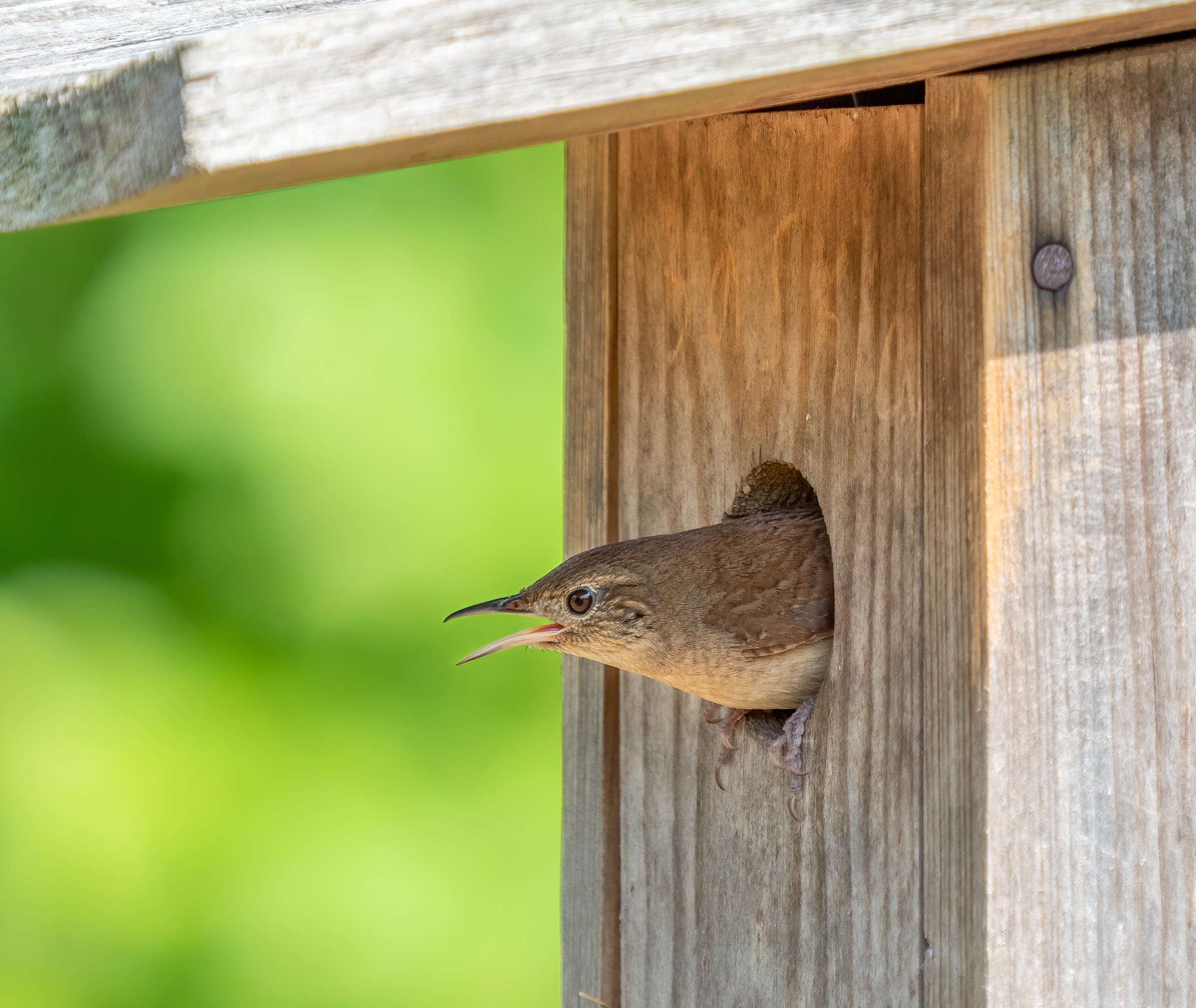

Carolina Wren vs House Wren (Thryothorus ludovicianus vs Troglodytes aedon): The Complete Backyard Identification Guide
Quick Answer: The Fastest Way to Tell Them Apart
The loud rufous wren and the little brown box-nester. Three rules:
- Eyebrow: a bold white stripe = Carolina; faint or absent = House.
- Color: rich rusty rufous = Carolina; plain gray-brown = House.
- Song: ringing “tea-kettle-tea-kettle” = Carolina; an excited bubbly cascade = House.
At-a-Glance Comparison Table
The big southern wren and the tiny yard wren, side by side. KEY rows separate fastest.
| Feature | Carolina Wren | House Wren |
|---|---|---|
| Scientific Name | Thryothorus ludovicianus | Troglodytes aedon |
| Length KEY | 5.5 in (14 cm) | 4.7 in (12 cm) |
| Wingspan | 7.5 in (19 cm) | 5.9 in (15 cm) |
| Weight | 0.6–0.8 oz (18–23 g) | 0.3–0.4 oz (9–12 g) |
| Overall Shape | Plump, round wren with a cocked tail and bold white eyebrow | Small, plain brown wren with a thin, slightly decurved bill and a short tail often cocked up |
| Male Plumage KEY | Rich rufous-brown above, warm buff-orange below, bold white eyebrow, slightly decurved bill (sexes alike) | Plain warm brown overall with faint barring on wings and tail, no eyebrow stripe (sexes alike) |
| Female Plumage | Identical to the male | Identical to the male |
| Bill Shape | Thin, slightly decurved, dark | Thin, dark, slightly decurved |
| Tail | Rufous, barred, habitually cocked up | Short, barred, habitually cocked |
| Core Range | East of the Plains — woods, thickets and shrubby yards; expanding northward | Breeds across most of North America; winters in the southern U.S. and Mexico |
| Migration | Non-migratory resident | Migrant — northern birds winter in the South; a backyard nester everywhere |
| Feeder Presence | A devoted suet and peanut visitor; nests in hanging baskets, mailboxes and garage clutter | Ignores seed but nests in boxes and hunts insects around the yard |
| Favorite Foods | Insects, spiders; suet and peanuts at feeders | Insects and spiders almost entirely |
| Song KEY | A loud, ringing “teakettle-teakettle-teakettle” | A bubbling, rushing cascade of notes that rises and falls |
| Flight Call | A sharp “cheer” and rapid scolds | A harsh scolding chatter |
| Population Trend | Stable and expanding north; hard winters cause local die-offs | Stable and abundant; the classic backyard nest-box wren |
Male Field Marks, Side by Side
Carolina Wren — Male
- Rich rufous back, buff-orange belly, bold white eyebrow.
- Loud “teakettle-teakettle” from deep cover.
- Nests in any sheltered nook around the house.
House Wren — Male
- Plain brown, no eyebrow, short barred tail.
- Sings a bubbling cascade from a prominent perch.
- Stuffs nest boxes and cavities full of twigs.
Female & Juvenile Marks, Side by Side
Carolina Wren — Female
- Identical to the male — but only the male sings the loud song.
- Suet cages and peanut feeders hold pairs all winter.
- A round ball of energy with a cocked tail.
House Wren — Female
- Identical to the male — both sexes look alike.
- Female adds a soft lining inside the twig mound.
- Fiercely defends the nest site despite her size.
Part-by-Part Anatomy Breakdown
Every part offers a check:
| Body Part | Carolina Wren | House Wren |
|---|---|---|
| Upperparts | Rich rufous-brown | Plain gray-brown |
| Underparts | Warm buffy-orange | Pale grayish |
| Eyebrow | Bold white stripe | Faint or absent |
| Bill | Long, slightly decurved | Thin, straight |
| Size | 5.5 in — big for a wren | 4.75 in — small |
| Tail | Long, often cocked, barred | Short, barred, cocked |
| Song | Loud “tea-kettle-tea-kettle-tea” | A bubbling, excited cascade |
Song & Call Comparison
Carolina Wren
Song: a loud, ringing teakettle-teakettle-teakettle.
Calls: a sharp cheer and rapid scolding chatters.
House Wren
Song: a bubbling, rushing cascade of jumbled notes.
Calls: a harsh scolding churr and rattles.
Range & Seasonal Presence
The Carolina Wren is a year-round resident of the Southeast, creeping north along the coast and river valleys; hard winters knock it back.
The House Wren breeds across most of the US and southern Canada in open woodland and yards, wintering in the southern states and Mexico.
Feeder Behavior & Favorite Foods
- Carolina Wren: suet, peanut pieces and mealworms, even in snow; visits all winter.
- House Wren: takes mealworms and suet crumbs in summer; gone south by fall.
- Nest boxes: a small box with a 1.25-inch hole suits a House Wren; Carolinas prefer open shelves, baskets and odd cavities.
- Cover: brush piles and dense tangles hold both species.
Temperament & Flock Behavior
Carolina Wrens are curious, loud and bonded — pairs stay together all year and duet.
House Wrens are feisty cavity competitors that puncture the eggs of neighbors and stuff boxes with twigs.
6-Step Backyard ID Checklist
- Eyebrow. Bold white = Carolina; faint = House.
- Color. Rufous = Carolina; gray-brown = House.
- Size. Big wren = Carolina; tiny wren = House.
- Song. “Tea-kettle” = Carolina; bubbly cascade = House.
- Season. Winter wren at suet in the Southeast = Carolina.
- Nest. Twig-stuffed box = House; cavity with leaves and moss = Carolina.
Frequently Asked Questions
- Eyebrow: Bold white = Carolina; faint = House.
- Color: Rufous = Carolina; gray-brown = House.
- Size: Bigger = Carolina.
- Song: Tea-kettle = Carolina; bubbly = House.
- Season: Winter = Carolina in the South.
- Boxes: Twig-stuffed box = House Wren.