
Harris’s Sparrow


Harris’s Sparrow (Zonotrichia querula): Complete Identification, Feeder Guide & Call Library
Quick Answer: How to Attract & Identify Harris’s Sparrows
The Harris’s Sparrow (Zonotrichia querula) is one of the largest and most striking sparrows on the continent — a plump, big-billed bird whose black hood and bib (solid in breeding plumage, speckled in winter) frame a bright pink bill, with a white belly and rusty-streaked back. Its geography is the marvel: it is the only songbird that breeds exclusively in Canada, and it winters down the middle of the continent on the Great Plains — Kansas, Missouri, Iowa, Nebraska, Oklahoma, and north Texas are its heartland. To attract the winter flocks: serve cracked corn, white millet, and sunflower seeds on a large low platform or scattered on open ground beside a hedgerow or brush pile, and keep a heated bird bath open through the freezes. Listen for the loud metallic “tseek” call and, from late winter, the quavering whistled song — “oh-dear-me, hear me.”
Species Physical Profile & Morphometrics
The Harris’s Sparrow belongs to the New World sparrow family (Passerellidae) and towers over its cousins — it is the largest of the Zonotrichia sparrows and one of the heaviest sparrows at any North American feeder.
The identification formula: big plump body + pink bill + black on the face and bib + white belly, feeding on the ground with a flock near cover.
Essential Morphometric Field Marks:
- Body Length & Mass: 6.7 to 7.9 inches (17–20 cm) and 0.9 to 1.7 ounces (26–49 grams) — bulkier than a White-throated Sparrow, closer to a Fox Sparrow in heft.
- Wingspan: About 10.6 inches (27 cm), with brown wings showing two white wing bars.
- Bill Structure & Color: A large conical bill in bright pink — the single best year-round field mark; no other plain winter sparrow combines this bill with this much black.
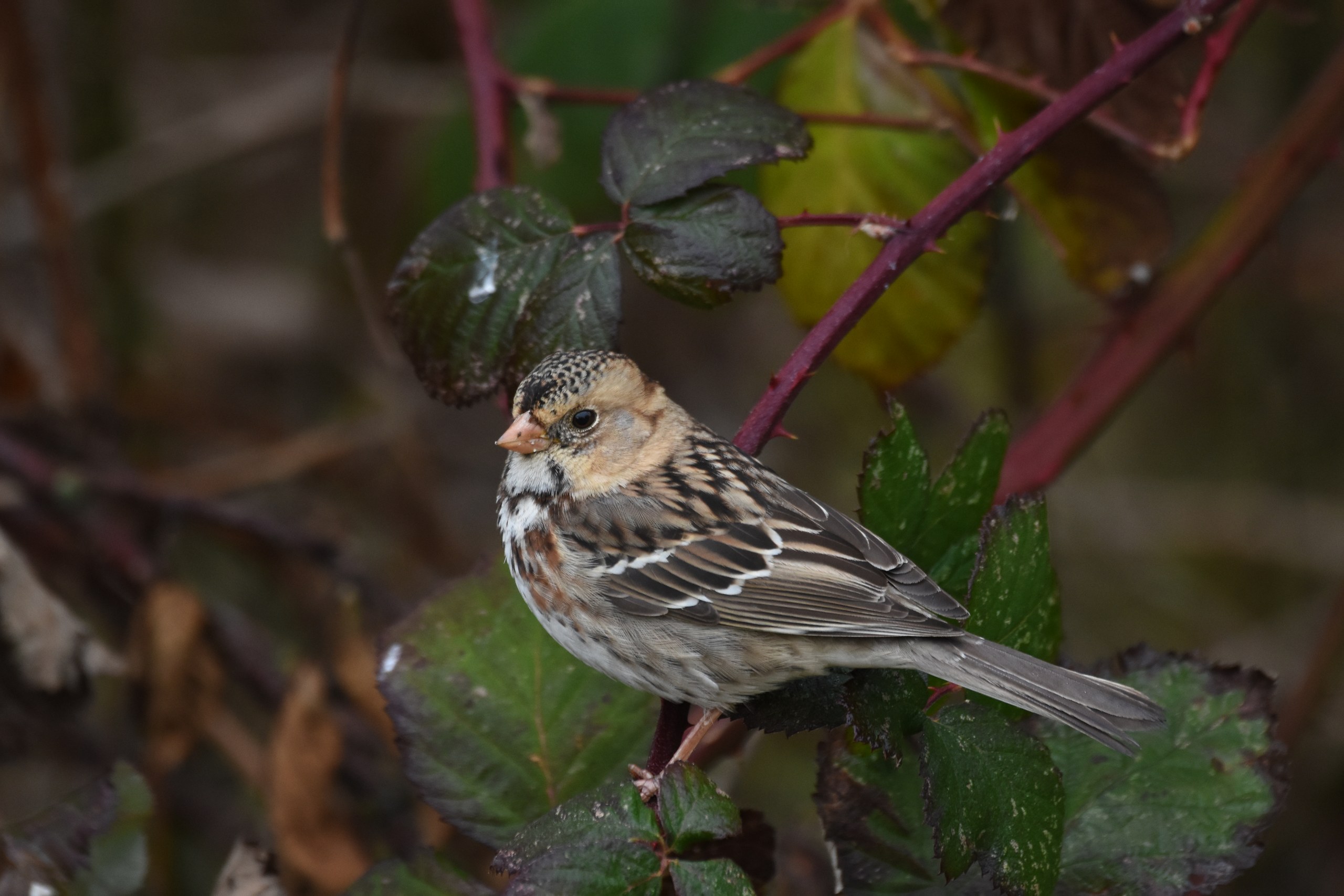
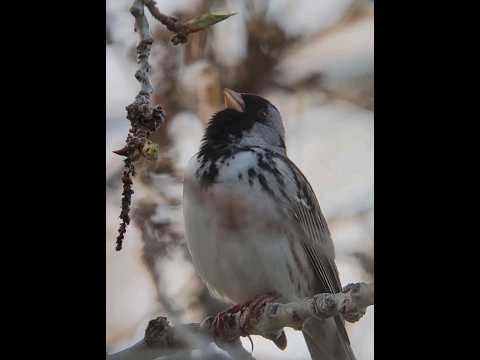
- Color Pattern: Breeding adults wear a solid black hood, face, and bib over a white belly and rusty-streaked back. Winter adults and young birds show the same design softened — black speckling on the crown, a black bib on a buffy face — and the amount of black signals rank in the winter flock.
Jet-black hood and bib from bill to breast, set against gray cheeks, a white belly, and that pink bill — the full tundra formal dress, worn on the Canadian breeding grounds and during spring migration.
Buffy face with black speckling on the crown and a variable black bib — birds with more black are usually older and dominate the flock. Males and females share both looks; age and season drive the difference.
Harris’s Sparrow Vocalization Guide (2 Field Recordings + 1 Simulation)
The song is spare and haunting: two or three clear, quavering whistles on one pitch, then a few more on another — “oh-dear-me, hear me.” Migrants deliver it from shrub tops on mild late-winter days. The everyday voice is a loud, metallic “tseek” or “spink” from the feeding flock. The first two cards below are real field recordings shared under Creative Commons licenses; the third is a clearly labeled acoustic simulation of the song skeleton. For more wild audio, browse xeno-canto: Harris’s Sparrow.
1. Real Recording — The Quavering Song
2. Real Recording — The Metallic “Tseek”
3. Song Simulation — Whistles on Two Pitches
Habitat, Range & the Central Flyway
In summer, Harris’s Sparrows live where forest meets tundra — stunted spruce and willow thickets along the treeline from the Northwest Territories and Nunavut to northern Manitoba. In winter the whole species funnels down the center of the continent into hedgerows, shelterbelts, brushy field edges, and feeder yards of the Great Plains.

Canada’s Only Exclusive Breeder
The orange band tells a unique story: the Harris’s Sparrow is the only songbird in the world that breeds exclusively in Canada — every nest on Earth sits in that narrow treeline belt.
The blue winter band is equally narrow: the central Great Plains, from South Dakota and Iowa through Kansas and Missouri to Oklahoma and north Texas. If your yard sits in that band with a hedgerow and a ground platform, you are in prime Harris’s country.
Backyard Behavioral Patterns & Social Dynamics
The Harris’s Sparrow is a sociable ground bird with a visible social ladder. Four behaviors explain most of what you will observe:
🖤 The Black-Bib Boss
In winter flocks, the amount of black on the head and bib advertises dominance — darker birds are usually older and feed first. Watch the platform and you can literally read the pecking order.
🌾 The Ground Platter Regular
This is a committed ground feeder that takes grain and seed from open dirt, gravel, or a large low tray, walking rather than hopping between bites. Elevated tubes and small perches barely interest it.
👥 The Hedgerow Flock
It winters in loose flocks that shuttle between open ground and dense cover — feed out in the open for minutes, then all dive into the hedgerow together at the first alarm.
🎵 The Late-Winter Whistler
From late February through April, males sing the quavering “oh-dear-me” from shrub tops on mild days — rehearsal for the tundra, and one of the gentlest sounds of a plains winter.
Problem: “A Giant Sparrow with a Black Face Took Over My Ground Feeding Area — What Is It, and How Do I Keep It Around?”
The three most common Harris’s Sparrow puzzles all have reassuring answers:
First, the identity check: a sparrow noticeably bigger than the rest, with black on the face and bib and a pink bill, feeding on the ground in plains-state winter, is a Harris’s Sparrow — the flock’s blackest member is simply its boss. Second, the feeder mismatch: this bird ignores hanging tubes because it is built for large low platforms and open ground — a big tray of cracked corn, millet, and sunflower beside cover will hold the flock all winter. Third, the disappearing act: they all leave for the Canadian treeline in April and May — no seed mix will stop migration, but the same hedgerow-and-platform setup will bring the flock back with the first November frost.
Method 1: Set the Table — The Ground Platter
Design for a big, flocking, ground-feeding sparrow:
-
Serve Cracked Corn, Millet & Sunflower on a Large Low Platform
A wide, stable platform an inch or two off the ground — loaded with cracked corn, white millet, and black oil sunflower — is the Harris’s staple. Size matters: this is a flocking bird nearly cardinal-sized, and a roomy tray lets the whole flock feed at once.
-
Scatter Grain on Open Ground Beside Cover
Scatter mixed grain on bare dirt, gravel, or short grass within a quick dash of a hedgerow — the flock feeds in the open but only where escape cover stands a hop away.
-
Use the Spill Zone
Let hanging feeders serve the finches, and let the spill beneath them serve the Harris’s — a wide catch tray under the tubes makes the arrangement official.
-
Feed Heaviest in Hard Weather
Snow and ice bury the waste grain this species survives on. Top up ground stations before storms, put out only a day or two’s worth, and rake wet patches weekly.
Method 2: Build the Habitat — Hedgerows & Winter Water
Feed the habitat, and the flock follows:
-
Keep or Plant a Dense Hedgerow
A thick shrub row, shelterbelt, or bramble tangle recreates the brushy field edges this species winters in — the flock will commute between it and your ground station all day.
-
Build a Brush Pile Beside the Feeding Area
A loose pile of branches in a quiet corner gives the flock its emergency exit — pile it within a few hops of the platform so the birds feed with confidence.
-
Leave Seed Heads and Stubble Standing
Don’t clear the garden to bare dirt in fall — standing grasses, amaranth, and sunflower stalks are the natural version of your grain tray, right at ground level.
-
Keep Water Open Through Freezes
A shallow bath kept ice-free draws winter flocks daily on the dry plains — a heated bird bath is a genuine survival resource in a hard January.
Tool Solution: Recommended Hardware for Harris’s Sparrows
Equipment matched to a large, flocking, ground-feeding plains sparrow:
Large Ground Platform
A wide, stable tray set an inch or two off the ground beside cover — roomy enough for a whole flock of these big sparrows to feed cracked corn, millet, and sunflower together.
- • Seed: Cracked corn, millet, sunflower
- • Style: Large low platform
- • Placement: Open ground beside hedgerow
Heated Bird Bath
A shallow bath with a thermostatic heater set near cover — open water is the scarcest resource on the frozen plains, and the flock will visit it every day.
- • Depth: 1–2 in, gently sloped
- • Winter: Thermostatic heater
- • Placement: Quick dash from shrubs
Seed Tray Under Hanging Feeders
A wide tray mounted beneath your existing tube feeders — turns finch spillage into a tidy Harris’s ground station and keeps the lawn clean.
- • Seed: Catches spillage
- • Cleanup: Keeps lawn clean
- • Bonus: Serves juncos and doves
Frequently Asked Questions
- Species Profile: The Harris’s Sparrow (Zonotrichia querula) is a big 6.7–7.9 inch, 26–49 gram New World sparrow (Passerellidae) — one of the largest sparrows at any North American feeder, with a bright pink bill.
- ID in One Look: Black hood and bib (solid in breeding plumage, speckled in winter), pink bill, white belly — a ground-feeding flock bird of the plains.
- Canada’s Own: The only songbird that breeds exclusively in Canada; winters down the central flyway on the Great Plains from November into April.
- The Sound: A haunting, quavering “oh-dear-me, hear me” whistle, plus a loud metallic “tseek” from the flock.
- Feeder Formula: Cracked corn, white millet, and sunflower on a large low platform or scattered on open ground beside a hedgerow — plus a heated bath in the freezes.
- Read the Rank: Within a winter flock, more black means higher status — the blackest bird at your tray is the boss.

Bird Watching Log
Species: Harris’s Sparrow (Zonotrichia querula)
| Harris’s Sparrow (Black Bib Seen: Yes / No — Singing: Yes / No — Flock Size: ____________________________) | |