
Mountain Bluebird


Mountain Bluebird (Sialia currucoides): Complete Identification, Mealworm Guide & Nest Box Handbook
Quick Answer: How to Attract & Identify Mountain Bluebirds
The Mountain Bluebird (Sialia currucoides) is the sky-blue thrush of open western country — mountain meadows, sagebrush steppe, ranch pasture, and big rural yards — the male turquoise all over with no rust, the female gray with blue wings and tail. To attract a pair: serve live mealworms in a smooth-sided dish, and mount a nest box with a 1.5-inch entrance on a baffled post in wide-open terrain with an unobstructed view. It shares the open West with the Western Bluebird and the Mountain Chickadee.
Species Physical Profile & Morphometrics
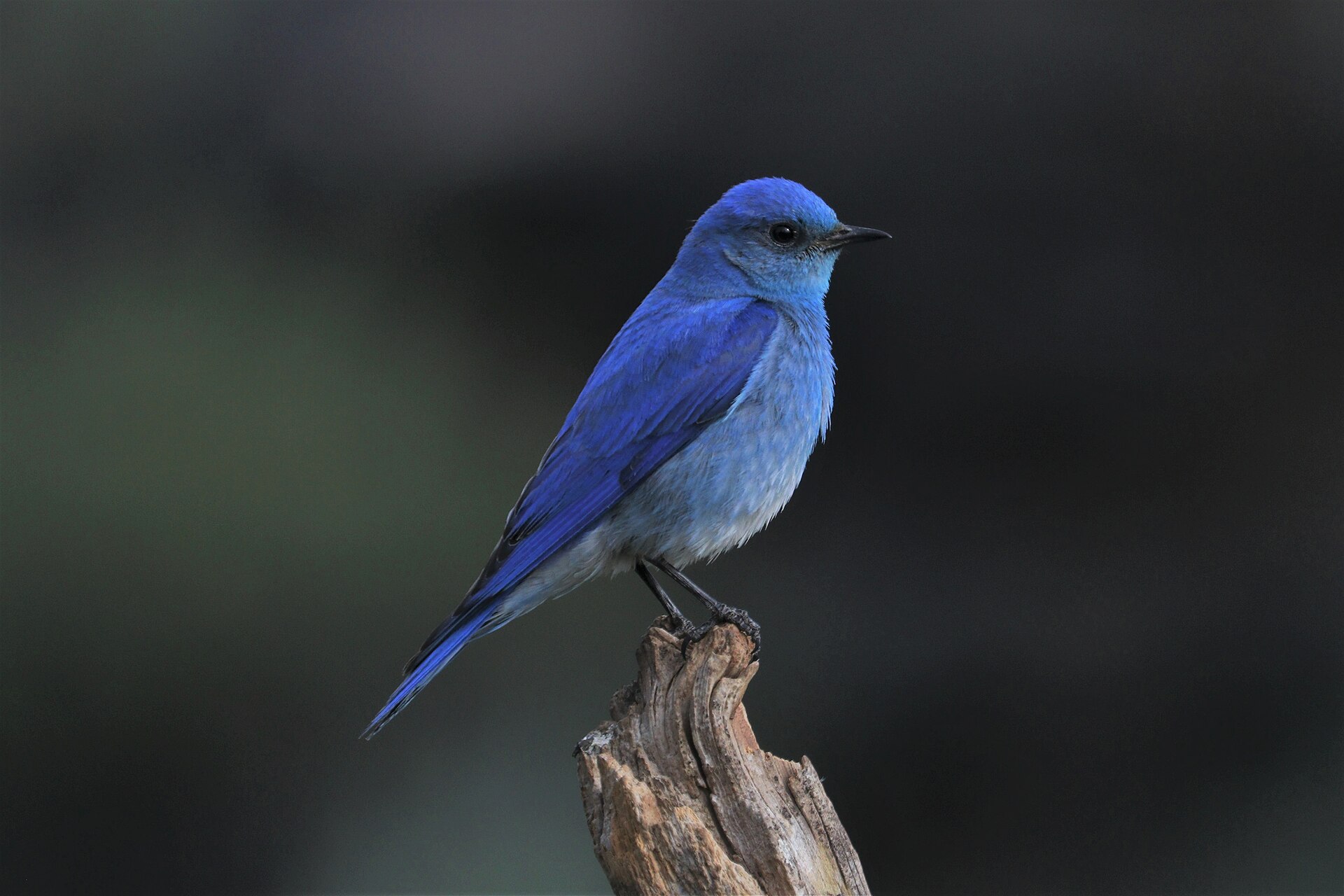
The Mountain Bluebird is a slim, long-winged member of the thrush family (Turdidae) — lankier and longer-tailed than its Eastern and Western cousins, and built for life in wide-open spaces. The male’s pattern is the simplest of any bluebird: brilliant turquoise-blue from head to tail, fading to paler blue on the belly and white at the undertail — with no rust or orange anywhere.
The identification formula: all-blue male + slim long-winged shape + open country. The Western Bluebird male has a rusty breast and back patch; the Eastern male has a rusty throat and white belly. Females are gray-brown with blue wings and tail — the Mountain female is the grayest of the three, usually showing a whitish eye-ring and blue concentrated on the wings, tail, and rump.
Essential Morphometric Field Marks:
- Body Length & Mass: about 6.3 to 7.9 inches (16–20 cm) and about 1.1 ounces (30 grams) — similar in length to the other bluebirds but visibly slimmer and longer-winged.
- Wingspan: about 11.0 to 14.2 inches (28–36 cm); the long wings power the signature hover — hanging over open grass like a miniature kestrel before dropping on prey.
- Bill Structure & Color: A thin, straight, entirely black bill — an insect-catcher’s tool, noticeably finer than any seed-eater’s.
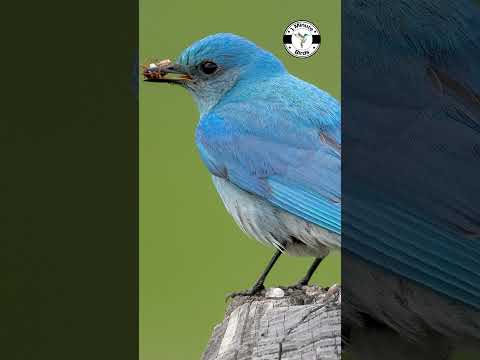
- Color Pattern: Male: cerulean to turquoise blue overall, paler below, whitish belly and undertail, darker flight feathers. Female: gray-brown head, back, and breast, bright blue wings, tail, and rump, whitish eye-ring; some females show a faint rusty tinge on the breast in fresh fall plumage.
- Male vs. Female: The male is the saturated all-blue copy; the female wears gray where he wears blue. Juveniles are spotted like young robins but show blue in the wings and tail from the start.
Sky blue, edge to edge: no other North American songbird his size is this completely blue. He arrives on the breeding grounds days before the female — often while snow still patches the meadow — scouts cavities, and advertises the best box with a wing-waving display at the entrance.
The gray architect: drab gray-brown at a distance, but her wings and tail flash true blue in flight. She makes the final choice of cavity, builds the grass nest alone, and incubates the 4–5 pale blue eggs for about two weeks.
Mountain Bluebird Vocalization Guide (3 Field Recordings)
The Mountain Bluebird has two songs: a loud, chirruping dawn song reminiscent of a small American Robin, and a soft, warbled day song that can run for many minutes — plus a gentle, nasal “tew” contact call. All three recordings below are real field audio hosted on Wikimedia Commons: two by Jonathon Jongsma (mirrored from xeno-canto) of a male singing and calling from a Ponderosa pine, and one from the Yellowstone Sound Library recorded in the park’s Lower Slough Creek Valley. For a deeper library, browse xeno-canto: Mountain Bluebird.
1. The Ponderosa Pine Song
2. The “Tew” Contact Call
3. The Yellowstone Chirp
Habitat, Range & the Human Landscape
The Mountain Bluebird owns the wide-open West: mountain meadows and alpine edges (breeding as high as 12,000 feet), sagebrush steppe, open ponderosa parkland, burned forest openings, prairie, ranch pasture, and big rural lawns — anywhere short grass for hunting meets a cavity and a perch. It is the bluebird of openness itself; dense forest and tight suburban lots are both poor habitat.
Alaska to the Mexican Highlands
The breeding range runs from central Alaska through western Canada and the entire mountain West, east onto the western Great Plains — including the North Dakota badlands — and south through the Rockies into Mexico. Northern and high-elevation birds are migratory, wintering in the Southwest and the Mexican highlands; birds in the middle latitudes may simply drift downslope.
Backyards score best with big open sightlines, short grass, and a post or snag. A rural or semi-rural yard with an open-view nest box, a mealworm dish, and winter juniper or berry plantings covers the whole checklist.
Backyard Behavioral Patterns & Social Dynamics
The Mountain Bluebird is the hover-hawk of the open yard — a long-winged hunter with a fondness for fence posts and cavities. Four behaviors explain most backyard encounters:
🪂 The Hover-and-Drop Hunter
The signature move: a Mountain Bluebird hovers in place 6–15 feet above open grass — wings beating like a tiny kestrel — then drops straight onto a grasshopper or caterpillar. No other bluebird hovers this habitually. If you see a small blue bird hanging mid-air over your meadow, the ID is settled.
🏠 The Wing-Waving Landlord
In early spring the male picks out cavities and advertises them with a wing-flashing display at the entrance — then the female inspects and makes the final call. Watch a male pop in and out of your box with wings spread: the season has begun, and the same box may hold two broods before summer ends.
❄️ The Wandering Winter Flock
The most migratory of the three bluebirds: territorial pairs dissolve into loose flocks that roam the Southwest and Mexican highlands all winter, working juniper berries, mistletoe, and sumac — often mixed with Western Bluebirds and sometimes with robins and solitaires.
🏔️ The Early Returnee
Mountain Bluebirds come back astonishingly early — males on territory in late February and March, singing while snow still lies in the meadow. Cold snaps are the danger: this is when a mealworm dish and a berry planting genuinely save lives, and when your yard gets noticed first.
Problem: “My Box Got Wrens and Swallows Instead — and the Bluebirds Never Even Landed. What Went Wrong?”
With Mountain Bluebirds, failure almost always traces to one of three fixes:
First, the box is not open enough: this species hunts by hover-and-drop over short grass and insists on wide sightlines in every direction — a box tucked among trees or shrubs gets claimed by House Wrens or chickadees while the bluebirds pass overhead. Move it to the most open ground you have, facing open meadow or lawn. Second, Tree Swallows and House Sparrows: swallows want the same open-country cavities — pair two boxes 15–25 feet apart and the swallow pair’s own territorial defense leaves the second box free. House Sparrows are worse: they kill nestlings and bury eggs — mount boxes well away from buildings and feedlots, check weekly, and remove sparrow nests (an unprotected introduced species) promptly. Third, climbing predators: snakes, raccoons, and cats take eggs from unguarded boxes — a stovepipe or cone baffle on the post stops nearly all of them. Mountain Bluebirds are loyal: solve the placement once and the same lineage will return to your box every spring.
Method 1: Serve Mealworms & Winter Fruit
Design for a slim, insect-eating thrush of open country:
-
Live Mealworms Win the Early Season
Live mealworms matter most in late winter and early spring, when males return ahead of the insects — a reliable dish can carry a pair through a late blizzard. Dried mealworms work once the habit is set, but live ones start it.
-
Match the Winter Berry Diet
Soaked raisins, currants, and chopped dried fruit echo the juniper-and-mistletoe diet of the winter flock — offer them in the same dish as the mealworms, morning and afternoon, especially during cold snaps.
-
Choose a Dish They Can Hover Over
Serve in a smooth-sided glass or plastic dish on a low platform or post in the open — Mountain Bluebirds like to approach by hovering above and dropping in. In jay country, a caged feeder with 1.5-inch openings keeps the big birds out.
-
Skip the Seed Entirely
Mountain Bluebirds do not eat birdseed — a tube of sunflower is invisible to them. Spend the feeder budget on mealworms, suet crumbles, and fruit, and let the seed station serve the sparrows and finches.
Method 2: Mount an Open-View Nest Box
With this species, placement is everything:
-
The 1.5-Inch Rule
The entrance must be exactly 1.5 inches — big enough for a bluebird, too small for a starling. Add a metal hole guard against chewing squirrels, and a stovepipe baffle on the post against climbers.
-
Openness Is Non-Negotiable
Mount on a smooth post 4 to 6 feet high in the most open ground available — meadow, pasture, or big lawn — with an unobstructed view in every direction and short grass below for hover-hunting. Face the entrance toward open ground, not cover.
-
Give Them a Hunting Perch
A fence line, wire, or bare snag 25–50 feet from the box doubles as the hunting base and the female’s staging perch on approach — in treeless country, a simple T-post perch next to the box works.
-
Plant the Winter Pantry
Juniper, elderberry, and sumac along the property edge feed the wandering winter flocks — a yard that feeds bluebirds in February is the yard a pair chooses in March. A heated bath in open ground completes the setup.
Tool Solution: Recommended Hardware for Mountain Bluebirds
Equipment matched to an open-country, hover-hunting, cavity-nesting thrush:
Caged Mealworm Feeder
A smooth-sided dish inside a 1.5-inch-mesh cage on a pole in the open — bluebirds slip in, jays and starlings stay out, and the daily ration of live mealworms actually reaches the birds it was bought for.
- • Food: Live mealworms, soaked raisins, suet crumbles
- • Style: Caged or window dish, smooth sides
- • Routine: 50–100 worms, morning and afternoon
Mountain Bluebird Nest Box (1.5-Inch Hole)
A ventilated wood box with an exact 1.5-inch entrance and a front that opens for cleaning — post-mounted with a baffle in genuinely open terrain, it is the single most reliable way to turn a passing pair into residents.
- • Entrance: 1.5 in, metal hole guard
- • Mount: 4–6 ft post with stovepipe baffle
- • Placement: Wide-open ground, perch 25–50 ft out
Shallow Heated Bird Bath
A shallow bath with a winter heater set in open ground — across the dry western winter, open water is scarce, and a dependable bath pulls roaming bluebird flocks within sight of your window on the coldest mornings.
- • Depth: 1–2 in at the edge
- • Extras: Thermostat-controlled heater
- • Placement: Open ground near perches
Frequently Asked Questions
- Species Profile: The Mountain Bluebird (Sialia currucoides) is a 6.3–7.9 inch, ~30 gram thrush (Turdidae) of open western meadows and sagebrush — the all-blue male with no rust, band code MOBL, and state bird of Idaho and Nevada.
- ID in One Look: Male all turquoise-blue with white undertail and no rust; female gray-brown with blue wings, tail, and rump. Slimmer and longer-winged than the other bluebirds — and the only one that habitually hovers.
- The Most Migratory Bluebird: Breeds from Alaska to the Mexican highlands (up to 12,000 ft), winters in wandering southwestern flocks on juniper berries, and returns to territories as early as late February.
- The Sound: A loud chirruping dawn song like a small robin, a soft warbled day song, and a gentle nasal “tew” call — all three recordings above are real field audio.
- Feeder Formula: Live mealworms in a smooth-sided dish, soaked raisins and suet crumbles — most valuable in the cold early-spring window — and no seed, ever.
- Openness Is Everything: A 1.5-inch-hole box on a baffled post in wide-open terrain — paired with a second box in swallow country — is the difference between a pair of bluebirds and a box of wrens.
Bird Watching Log
Species: Mountain Bluebird (Sialia currucoides)
| Mountain Bluebird (Pair or Flock: ___ — Mealworms Taken: Yes / No — Nest Box Visited: Yes / No — Hovering Seen: Yes / No) | |