
Hermit Thrush


Hermit Thrush (Catharus guttatus): Complete Identification, Song Guide & Winter Backyard Handbook
Quick Answer: How to Attract & Identify Hermit Thrushes
The Hermit Thrush (Catharus guttatus) is the brown forest thrush with the warm reddish tail — spotted on the breast like an American Robin chick grown up, but slimmer, browner, and famous for the most beautiful flute song in North America. To attract one in winter: keep leaf litter under berry shrubs, set a ground tray with suet crumbles, mealworms, and soaked raisins, and run a ground-level birdbath next to dense cover. It shares the winter leaf litter with the Fox Sparrow and the Dark-eyed Junco.
Species Physical Profile & Morphometrics
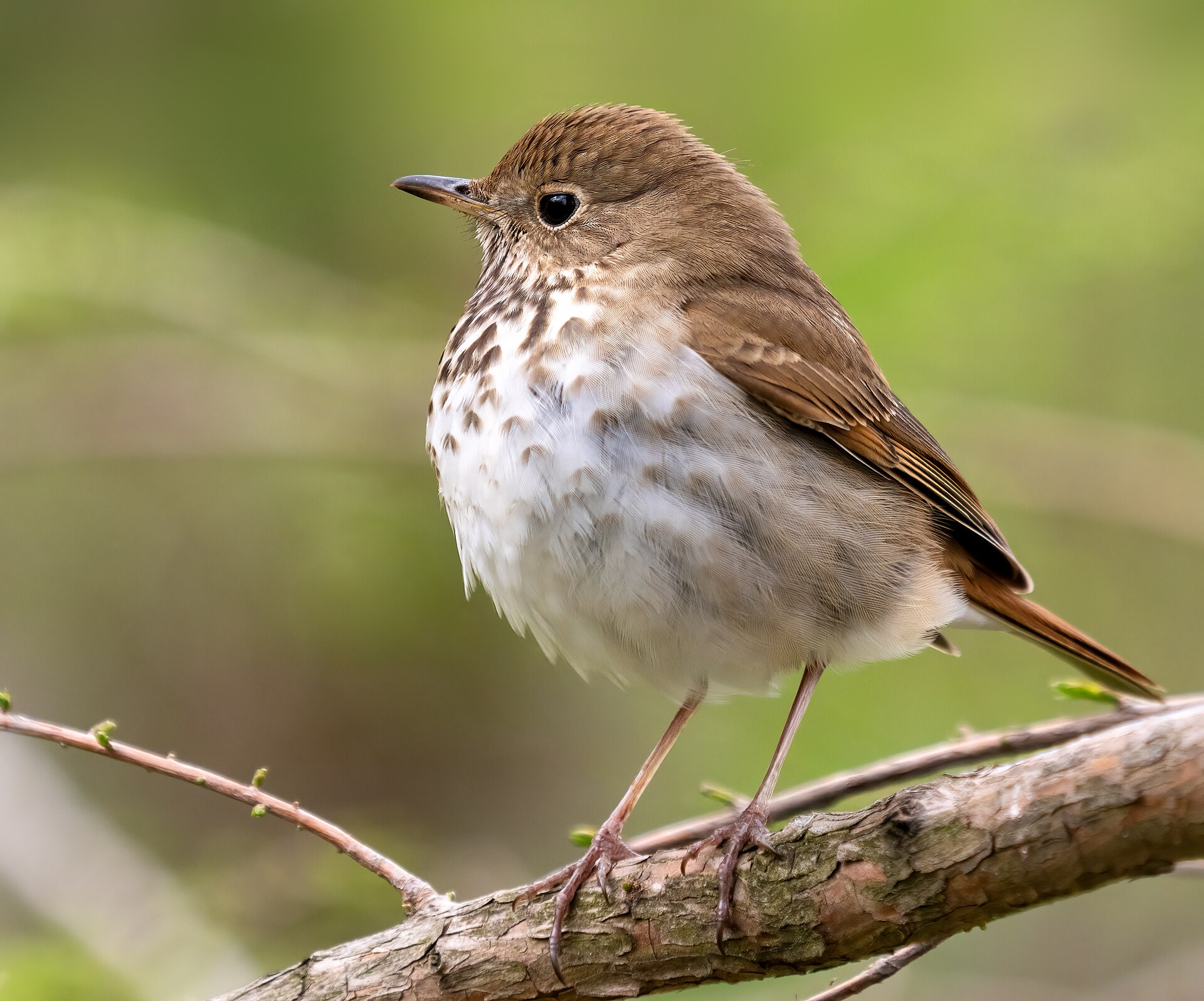
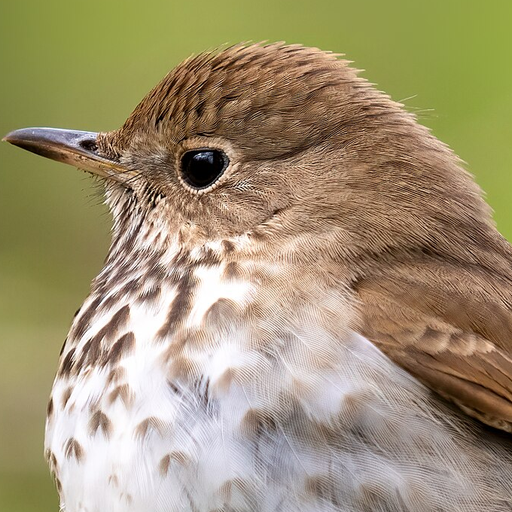
The Hermit Thrush is a compact, round-headed member of the thrush family (Turdidae) — smaller and slimmer than an American Robin, built for quiet work on the forest floor. The pattern: rich brown head, back, and wings; a white eye-ring; dark spots concentrated on the throat and upper breast over a clean white belly; and a distinctly reddish-brown rump and tail that contrast with the duller brown back.
The identification formula: brown back + rusty red tail + white eye-ring + slow tail lift. No other brown spotted thrush combines them. The Wood Thrush is larger and richer rufous overall with big round spots running down the whole belly — and its tail is the same reddish-brown as its back, not a contrast. The Swainson’s Thrush shows a buffy, spectacle-like eye-ring and an olive-brown tail that matches its back; the Veery is reddish-brown everywhere with faint, washed-out spots. And the chunky bird double-scratching in the leaf litter with both feet is a Fox Sparrow — streaked, not spotted.
Essential Morphometric Field Marks:
- Body Length & Mass: about 5.5 to 7.1 inches (14–18 cm) and 0.8 to 1.3 ounces (23–37 grams) — clearly smaller than an American Robin, bigger and longer-legged than any sparrow.
- Wingspan: about 9.8 to 11.4 inches (25–29 cm); flight between cover is low, quick, and direct, usually ending in a dive into thickets rather than an open perch.
- Bill Structure & Color: A thin, straight, dark bill with a pinkish-yellow base to the lower mandible — a ground-forager’s forceps, nothing like a finch’s seed-cracking cone.
- Color Pattern: Brown above with a warm rusty-red rump and tail (the clincher), clean white eye-ring, dark spots on the throat and upper breast, white belly, and pinkish legs.
- The Signature Move: The slow, deliberate tail lift — the bird raises its reddish tail, holds it a beat, and lowers it, over and over. Learn this habit and you will never misname the bird again.
- Male vs. Female: The sexes look alike — same brown back, same rusty tail, same spots. In breeding season the male gives himself away by singing; in your winter yard there is no reliable way to tell them apart by sight.
The voice, not the plumage, marks the male: on the northern breeding grounds he delivers the celebrated flute song from a mid-level perch at dawn and dusk — a long clear opening note, then a short cascade of silvery phrases, each on a different pitch. Both sexes wear the identical brown-and-rust pattern year-round.
She nests where she feeds: the female builds a cup of grass, moss, and leaves on the ground or low in a small tree, and incubates 3–4 pale blue-green eggs for about 12 days. Both parents feed the nestlings insects, and pairs in the south of the breeding range often raise two broods.
Hermit Thrush Vocalization Guide (3 Field Recordings)
The Hermit Thrush sings what many birders and musicians consider the most beautiful bird song in North America: pure, flute-like phrases, each beginning with a long sustained note and then rising or falling through a short series of silvery tones, with a deliberate pause between phrases. Below are three real field recordings — the full song from the breeding forest, and two sets of the calls you will actually hear from winter backyard birds. For a deeper library, browse xeno-canto: Hermit Thrush.
1. The Full Flute Song
2. Calls from the Thicket
3. The Backyard Migrant’s Call
Habitat, Range & the Human Landscape
The Hermit Thrush breeds in northern and mountain forest — coniferous and mixed woods across Canada, Alaska, New England, the Great Lakes region, and down the western mountain chains — favoring forest edges, openings, and dense understory over deep dark woods. Then it does something no close relative does: it winters in the United States. It is the only one of the brown spotted Catharus thrushes that does not fly to the tropics, spending October through April across the southern half of the country, along the Pacific coast, and into Mexico — in brushy woods, parks, and shrubby backyards.
The Thrush That Stays for Winter
Hermit Thrushes migrate at night, and the hardy ones winter farther north than any of their spotted cousins — regularly surviving in the Mid-Atlantic, the Southeast, the Southwest, and up the Pacific coast, with year-round populations along parts of the Pacific slope. A shrubby yard with berries and open water can hold the same bird all winter.
Backyards score best with dense shrubs or a brushy corner for cover, leaf litter left in place, native berry plants, and water at ground level. This is a bird of the shaded edge — give it a thicket to dive into and it will repay you all season.
Backyard Behavioral Patterns & Social Dynamics
The Hermit Thrush is the quiet shadow of the winter yard — a bird you will hear long before you see. Four behaviors explain most backyard encounters:
🚩 The Slow Tail Flag
The Hermit Thrush’s signature gesture: it raises its reddish tail slowly, holds it, and lowers it again, often flicking its wings at the same time. Watch a brown bird on the ground for ten seconds — if the tail comes up like a slow flag, the identification is done.
🎵 The Dusk Flutist
On the breeding grounds the male sings at dawn and especially at dusk, when the pure, echoing phrases carry astonishing distances through quiet forest. Migrants occasionally sing softly from yard trees in April and May — a subdued rehearsal of the summer performance.
🍂 The Leaf-Litter Kicker
Hermit Thrushes feed like miniature robins of the forest floor: hop, stop upright, scan, then flip leaves aside for beetles, caterpillars, and spiders. In fall and winter they switch to berries — swallowed whole, with the pits regurgitated minutes later, a moment our gallery actually caught on camera.
❄️ The Winter Holdout
Every other brown spotted thrush — Wood, Swainson’s, Veery, Gray-cheeked — leaves the United States for the tropics. The Hermit Thrush stays, shifting from insects to fruit and riding out the cold in southern thickets. That is why this forest singer is a realistic backyard bird from October to April.
Problem: “I Hear the Most Beautiful Song at Dusk, But I Never See the Bird — and My Winter Visitor Just Skulks in the Bushes. How Do I Actually Find It?”
The two most common Hermit Thrush frustrations have the same root — this bird lives by cover — and the same family of answers:
First, the invisible singer: on the breeding grounds and in migration the song pours out of dense foliage while the bird itself stays hidden. The fix is to listen for the pause between phrases — each flute phrase starts on a noticeably different pitch — and then glass the mid-level perches, not the treetops; Hermit Thrushes typically sing from a branch partway up, near the trunk. Second, the skulking winter bird: a winter Hermit Thrush patrols a small territory of shrubs and leaf litter and vanishes at the first fast movement. Learn the low “chuck” call (Recording 2 above) and let your ears find the bird, then watch the ground, not the feeder pole — a ground tray placed at the edge of cover, a birdbath set at ground level, and an unraked bed of leaves under the berry bushes turn a glimpsed shadow into a bird that feeds ten feet from your window all winter long. Dense cover is not the obstacle; it is the invitation.
Method 1: Feed at Ground Level & Keep the Leaf Litter
Design for a shy, ground-foraging thrush that distrusts exposed feeders:
-
Serve a Ground Tray of Soft Foods
A low platform or ground tray with suet crumbles, live or dried mealworms, soaked raisins, and chopped fruit matches the natural winter diet — animal protein plus soft fruit. Whole berries and raisins should be soaked until soft; a Hermit Thrush swallows fruit whole.
-
Place It at the Edge of Cover
Set the tray within a quick dash of dense shrubs or a brush pile — never out on the open lawn. The bird’s survival strategy is “feed within one wingbeat of a thicket,” and a tray in the open will be ignored while the same tray two feet from the bushes gets daily visits.
-
Leave the Leaves
Skip the rake under shrubs and along bed edges: an intact leaf layer is the Hermit Thrush’s natural feeding table, full of the beetles, spiders, and overwintering insects it hunts by flipping leaves. A yard with bare, blown-clean beds offers it nothing.
-
Don’t Expect the Hanging Feeders
Hermit Thrushes rarely visit elevated tube or hopper feeders and have no interest in clinging perches. Spend the effort on the ground station, the litter layer, and the berry shrubs — that is where this species lives.
Method 2: Plant Berries & Put Water on the Ground
With Hermit Thrushes, landscaping is the attraction strategy:
-
Plant Native Berry Shrubs
The winter diet runs on fruit: holly, elderberry, brambles, pokeweed, sumac, dogwood, and beautyberry are all documented Hermit Thrush foods. A mixed berry hedge along a fence or property line is both pantry and cover — the two things this bird needs most, in one planting.
-
Run a Ground-Level Birdbath
Hermit Thrushes are enthusiastic bathers that strongly prefer water at their own level — a shallow dish set directly on the ground near cover beats a pedestal bath every time. Keep it filled and clean, and watch for the quiet morning bath routine.
-
Keep It Ice-Free in Winter
In the southern winter range, a heated or frequently refreshed ground bath during cold snaps is a genuine lifeline — open water plus berries is often all it takes to hold a territorial winter bird in one yard for the entire season.
-
Build the Thicket, Then Wait
Dense, layered cover — shrubs over tangles over leaf litter — is non-negotiable. Given a brushy corner, ground food, berries, and ground water, a winter Hermit Thrush will often settle in for months, and in April it may reward the patience with soft song from your own trees before it heads north.
Tool Solution: Recommended Hardware for Hermit Thrushes
Equipment matched to a ground-feeding, berry-eating, cover-loving thrush:
Low Platform / Ground Tray Feeder
A sturdy low tray set beside dense shrubs — the only feeder style a winter Hermit Thrush uses reliably. It presents suet crumbles, mealworms, and soaked fruit at the height this bird actually feeds.
- • Food: Suet crumbles, mealworms, soaked raisins, chopped fruit
- • Style: Low platform or screened ground tray
- • Placement: Directly beside thickets or a brush pile
Low-Mounted Suet Cage
A standard suet cage hung or bracketed just a foot or two off the ground near cover — thrushes that ignore a suet cage at eye level will take crumbles from one set low beside the shrubs during hard weather.
- • Food: Suet cakes, crumbled if possible
- • Mount: 1–3 ft high, adjacent to cover
- • Season: October through April
Ground-Level Heated Bird Bath
A shallow bath that sits on the ground — with a heater or de-icer for winter — placed a short dash from dense cover. For a species that insists on bathing at ground level, this single item outperforms every feeder on the list.
- • Depth: 1–2 in at the edge
- • Extras: Thermostat-controlled heater for cold snaps
- • Placement: On the ground, near shrub cover
Frequently Asked Questions
- Species Profile: The Hermit Thrush (Catharus guttatus) is a 5.5–7.1 inch, 23–37 gram thrush (Turdidae) of northern forest and winter thickets — brown above, spotted breast, white eye-ring, band code HETH.
- ID in One Look: Brown back + reddish tail + white eye-ring + the slow, deliberate tail lift — the only brown spotted thrush whose tail is redder than its back.
- The Winter Holdout: The only Catharus thrush that winters in the United States — expect it in shrubby yards from October through April, a night migrant heading north in spring.
- The Sound: The most celebrated song in North American birding — flute phrases starting on a long sustained note, each phrase on a new pitch; winter birds give a low “chuck” from cover. Three real recordings above.
- Feeder Formula: A ground tray beside cover with suet crumbles, mealworms, soaked raisins, and chopped fruit — plus intact leaf litter, which is a feeding table, not yard waste.
- Landscaping Is the Strategy: Native berry shrubs (holly, elderberry, brambles) + dense thicket + a ground-level birdbath hold a winter bird all season — and may earn you soft song from your own trees in April.
Bird Watching Log
Species: Hermit Thrush (Catharus guttatus)
| Hermit Thrush (Single / Pair: ___ — Red Tail Flick Seen: Yes / No — Ground Bathing: Yes / No — Singing: Yes / No) | |