
Rufous Hummingbird
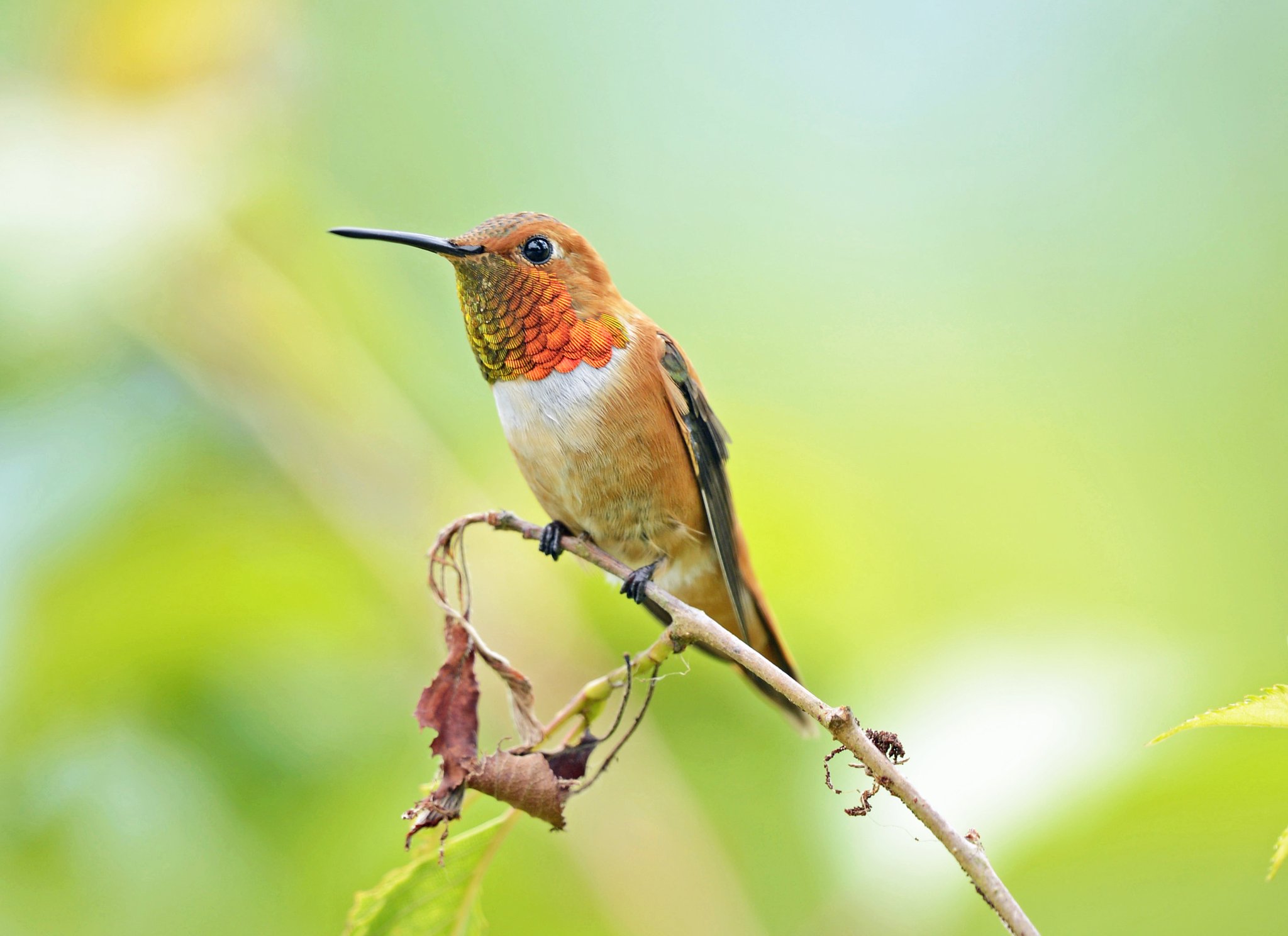


Rufous Hummingbird (Selasphorus rufus): Complete Identification, Feeder Guide & Migration Handbook
Quick Answer: How to Attract & Identify Rufous Hummingbirds
The Rufous Hummingbird (Selasphorus rufus) is the copper-orange sprite of the western mountains and Pacific Coast — a 3-inch, 3-gram bird that migrates up to 3,900 miles between Alaska and Mexico and defends every feeder it finds like a tiny orange tyrant. The male is rusty-orange with a glowing copper-red gorget; the female is green with rusty flanks. To attract migrants: hang red feeders of 4:1 white-sugar water from early spring through fall — several of them, out of sight of each other — and plant the blooms their route follows, from flowering currant to scarlet gilia. It shares western yards with the Anna’s Hummingbird and the Varied Thrush.
Species Physical Profile & Morphometrics
The Rufous Hummingbird is a small, compact member of the hummingbird family (Trochilidae) with a straight black bill, a short tail, and more orange than any other hummingbird on the continent. Even a blur of orange at a mountain flower patch is a strong first clue.
The identification formula: compact body + orange flanks or tail + (on the male) a copper-red gorget over a white chest + an attitude far bigger than the bird. The one genuine look-alike is the Allen’s Hummingbird of coastal California — nearly identical, and safest separated by range and by the male Allen’s green (not rufous) back. Green-backed female-types are trickier: Rufous shows rusty-washed flanks and rufous at the tail base, while Anna’s is plainer gray-green and broader-tailed.
Essential Morphometric Field Marks:
- Body Length & Mass: about 2.8 to 3.5 inches (7–9 cm) and 0.1 to 0.2 ounces (2–5 grams) — small even for a hummingbird, yet famously the most aggressive ounce-for-ounce bird in the yard.
- Wingspan: about 4.3 inches (11 cm); flight is fast and direct, with the deep wing whir of a bird built for a 3,900-mile migration.
- Bill Structure & Color: A straight, slender black bill — short-to-medium for a hummingbird, suited to the small tubular mountain wildflowers along its route.
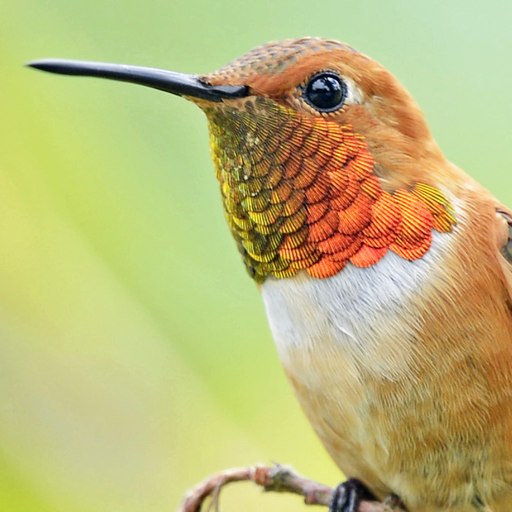
- Color Pattern: Male: rufous-orange back, flanks, and tail with an iridescent copper-red to orange-gold gorget and a clean white chest. A few males show some green on the back but never lose the orange flanks and tail.
- Male vs. Female: The female is green above and whitish below with rufous-washed flanks and a rufous tail base, plus a spangled throat that may hold a few orange-bronze feathers. Juveniles resemble her, young males gaining rusty color through the fall.
The copper tyrant: glowing orange overall with the iridescent gorget. He migrates earliest, claims a feeder or flower patch within hours, and spends his season dive-bombing everything — other hummingbirds, bees, and birds ten times his size. His display dive traces a steep oval with a whining wing whistle.
The mountain architect: green-and-white with rusty flanks, slightly larger than her mate. She alone builds the lichen-covered nest of plant down and spider silk — usually in a shrub or conifer — lays 2 eggs, incubates about 15–17 days, and raises the chicks solo.
Rufous Hummingbird Vocalization Guide (3 Field Recordings)
A Rufous has no true song — its soundtrack is the high, thin “tsip” call, the buzzy chatter of feeder chases, and the whining wing-whistle of the display dive. All three recordings below are real field audio, shared by observers on iNaturalist under commercial-use licenses — no simulations. For a deeper library, browse xeno-canto: Rufous Hummingbird.
1. The Display Dive
2. The Feeding Calls
3. The Summer Visitor
Habitat, Range & the Human Landscape
The Rufous Hummingbird owns the western edge of the continent: coastal scrub and forest edges on the northbound trip, mountain meadows and subalpine wildflower fields on the southbound trip — and any backyard with flowers or a feeder in between. It breeds farther north than any other hummingbird on Earth.

A Clockwise Loop the Length of the Rockies
The breeding range (orange) runs from Oregon and Idaho north through British Columbia to southern Alaska — the northernmost hummingbird nursery on the planet. The winter range (purple) centers on the oak-pine highlands of Mexico, with a growing scatter of wintering birds along the Gulf Coast. Between the two lies one of migration’s great detours: north along the flower-rich coast in spring, south through the Rocky Mountain meadows in fall — a clockwise loop of up to 3,900 miles each way.
Backyards score best by feeding the corridor: early bloomers for the northbound wave (flowering currant, salmonberry), late-summer mountain flowers for the southbound wave (scarlet gilia, penstemon, Indian paintbrush), and clean feeders bridging both.
Backyard Behavioral Patterns & Social Dynamics
The Rufous Hummingbird packs more fight and more flight into 3 grams than any bird in the West. Four behaviors explain most backyard encounters:
⚔️ The Feistiest Hummingbird
Rufous territoriality is legend: a single male will chase off every other hummingbird at a feeder — plus bees, butterflies, and birds many times his size — and females defend their feeding grounds just as fiercely. It is pure energy economics: on a 3,900-mile commute, a defended feeder is survival.
🗺️ The Clockwise Loop
Spring migrants ride the coastal flower bloom north — flowering currant and salmonberry from California to Alaska. Fall migrants swing inland to the Rocky Mountain meadows, riding the late-summer bloom of scarlet gilia and penstemon south. Same bird, two different highways, one giant clockwise loop.
🧠 The Memory Champion
Banded Rufous return to the same yards — even the same feeders — year after year, arriving within days of their previous dates. Their spatial memory is exceptional: they map flower patches along the entire migration route and revisit them like scheduled fuel stops.
🌙 The Torpor Trick
Cold mountain nights on migration would kill a bird this small without torpor: a controlled shutdown where body temperature and heart rate plunge — from over 1,000 beats per minute to a tiny fraction — saving enough energy to greet the dawn, and the feeder, alive.
Problem: “One Rufous Took Over Every Feeder and Chases Even the Big Birds. Can I Fix That?”
The three most common Rufous Hummingbird frustrations all have proven answers:
First, the feeder tyrant: you cannot train a Rufous to share — but you can out-geometry him: hang two or three feeders around corners and on different sides of the house, so no single bird can see them all at once. The tyrant guards one; everyone else feeds in peace. Second, the vanishing act: Rufous are migrants, and most yards only host them for a few weeks each spring and fall — that is normal, not a failure; keep feeders fresh through the whole corridor season (February–April and July–September) and the same banded birds may return on schedule next year. Third, spoiled nectar: sugar water ferments fast — dump, scrub, and refill weekly, and every 2–3 days in hot weather, with an occasional 10% bleach rinse for black mold in the ports. Solve these three and your yard becomes a reliable station on one of the great migration routes.
Method 1: Mix & Serve Perfect Nectar
Design for a long-distance migrant that arrives hungry and remembers everything:
-
The 4:1 Recipe
Mix 1 part plain white sugar to 4 parts water — ¼ cup of sugar per 1 cup of water — stirred until clear (brief boiling helps it dissolve; cool before filling). This matches the sweetness of the wildflower nectar hummingbirds evolved on.
-
Never Red Dye, Never Honey
Skip red food coloring entirely — the red parts of the feeder itself are all the advertising needed. Honey is dangerous: it grows a fungus that is fatal to hummingbirds. White sugar only — no brown sugar, no raw sugar, no sweeteners.
-
Hang Early, Hang Several
Get feeders up before the migration wave — by late February on the coast, by early July in the mountains — and hang two or three out of sight of each other. A Rufous that finds your feeder on day one of its trip will list your yard as a fuel stop for life.
-
Clean on a Schedule
Empty, scrub, and refill every week — every 2–3 days in hot weather — whether or not the feeder looks empty. Mountain sun ferments nectar faster than you think; a weekly 10% bleach rinse (rinsed thoroughly) keeps the ports mold-free.
Method 2: Plant the Migration Corridor
Feeders win the visit; the right bloom dates hold the route:
-
Early Bloomers for the Northbound Wave
The spring migration rides the first tubular blooms of the year: flowering currant, salmonberry, columbine, and coral honeysuckle. A yard that blooms in March and April catches the males on their way north — the earliest migrants of the season.
-
Late Bloomers for the Southbound Rush
The fall migration rides the mountain-meadow bloom: scarlet gilia, penstemon, Indian paintbrush, bee balm, and crocosmia. July-to-September flowers catch the southbound flood — males first, then a second wave of females and juveniles.
-
Leave the Cobwebs and the Fluff
Nesting females build from spider silk and plant down — willow fluff, dandelion clocks, thistledown. Leave eave cobwebs standing and a patch of seed heads untrimmed, and a female may saddle her lichen-covered nest on a shrub within view of your window.
-
Skip the Pesticides, Add a Mister
Hummingbirds need tiny insects and spiders for protein — nectar alone cannot raise chicks — so a pesticide-free garden feeds them twice. On hot afternoons a mister on foliage draws them in to bathe between chase battles.
Tool Solution: Recommended Hardware for Rufous Hummingbirds
Equipment matched to a fiercely territorial long-distance migrant:
Red Hummingbird Feeder (with Ant Moat)
A red feeder with a built-in ant moat and bee-proof ports that comes apart easily for scrubbing — the fuel station a migrating Rufous will remember and revisit for years.
- • Food: 4:1 white-sugar water, no dye, no honey
- • Style: Easy-clean reservoir, ant moat, bee guards
- • Routine: Scrub and refill weekly — sooner in heat
Second & Third Feeders (Out of Sight)
The only reliable answer to Rufous territoriality: spare feeders hung around corners and on different sides of the house, so the resident tyrant cannot guard them all. Window-mounted versions double as close-up viewing stations.
- • Placement: Out of sight of the main feeder
- • Style: Window-mount for close viewing
- • Effect: Lets females and juveniles feed in peace
Mister or Shallow Bird Bath
Hummingbirds bathe in fine spray and on wet leaves rather than deep pools — a mister aimed at foliage, or a bath with a very shallow edge, gets heavy use from thirsty migrants on hot afternoons.
- • Depth: Fine spray or under 1 in of water
- • Extras: Timer or dripper for dry spells
- • Placement: Near perching shrubs, in view of flowers
Frequently Asked Questions
- Species Profile: The Rufous Hummingbird (Selasphorus rufus) is a 2.8–3.5 inch, 2–5 gram hummingbird (Trochilidae) of the West — the male all copper-orange with a glowing gorget, the female green with rusty flanks, band code RUHU.
- ID in One Look: Compact body + orange flanks or tail; a copper-red gorget over a white chest is the male. Coastal California’s near-identical Allen’s is the only real confusion risk.
- The Epic Migration: Up to 3,900 miles each way — Alaska to Mexico — north along the coastal bloom in spring, south through Rocky Mountain meadows in fall, with small numbers now wintering on the Gulf Coast.
- The Sound: No true song — thin “tsip” calls, buzzy chase chatter, and the whining wing-whistle of the display dive; three real field recordings above.
- Feeder Formula: 4:1 white-sugar water, no dye and no honey, scrubbed weekly — and two or three feeders hung out of sight of each other, because one Rufous will try to own them all.
- Garden Formula: Feed the corridor — flowering currant and salmonberry for spring, scarlet gilia and penstemon for fall — no pesticides, cobwebs left standing, and a mister for bathing.
Bird Watching Log
Species: Rufous Hummingbird (Selasphorus rufus)
| Rufous Hummingbird (Copper Gorget Seen: Yes / No — Feeder Visits: ___ — Chases Watched: Yes / No — Orange Flanks: Yes / No) | |