
Costa’s Hummingbird
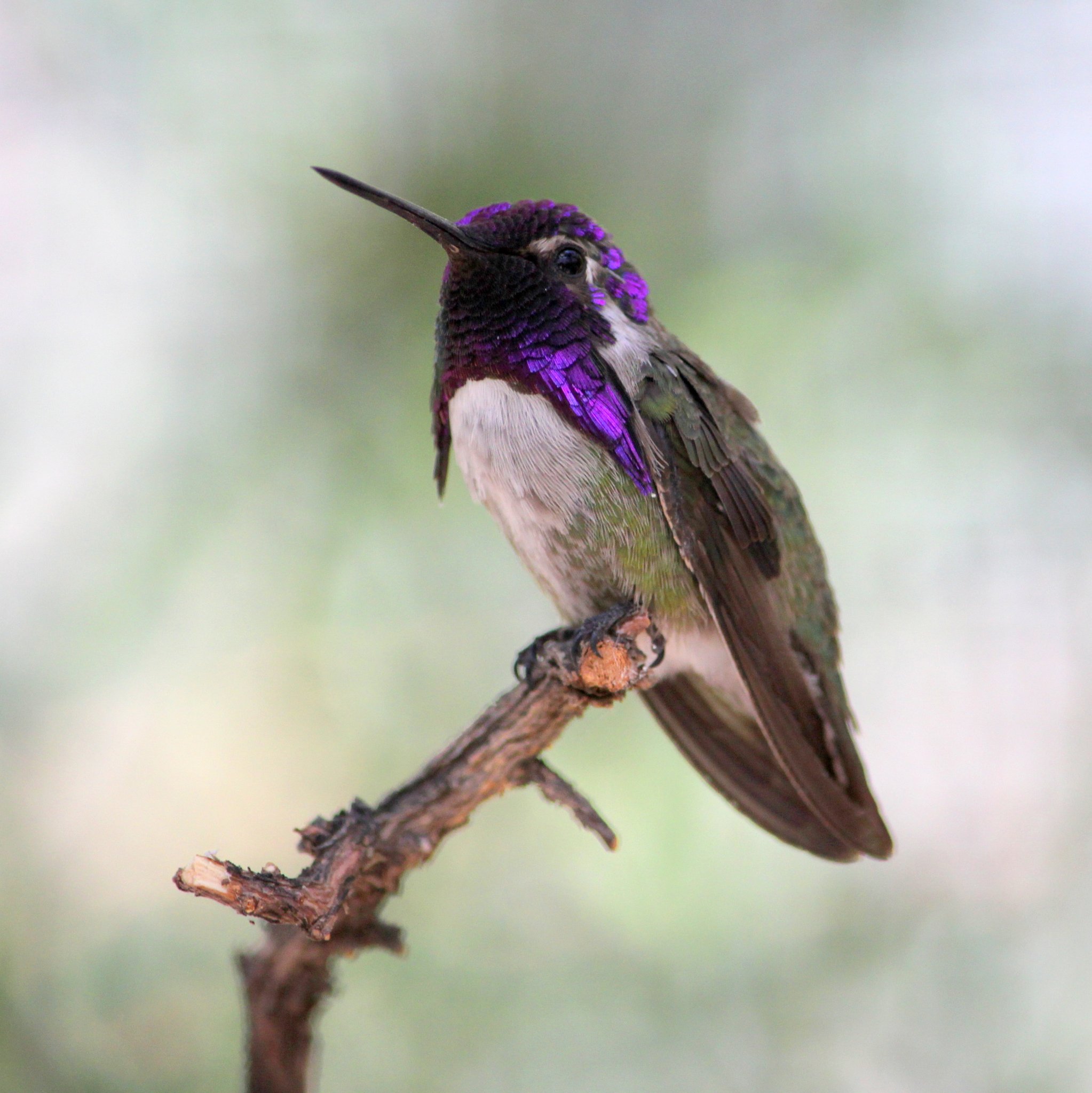


Costa’s Hummingbird (Calypte costae): Complete Identification, Feeder Guide & Desert Attraction Handbook
Quick Answer: How to Attract & Identify Costa’s Hummingbirds
The Costa’s Hummingbird (Calypte costae) is the desert jewel of the Sonoran and Mojave Deserts — a 3.5-inch bird that times its nesting to the spring desert bloom and wears the most theatrical head in the West: a violet-purple crown and gorget flared into long sideburns. The female is a compact green-and-gray desert sprite. To attract them: hang red feeders of 4:1 white-sugar water in dappled shade, refresh them relentlessly in the heat, and plant the desert bloom — chuparosa, ocotillo, fairy duster, desert willow, and agave. It shares southwestern yards with the year-round Anna’s Hummingbird and the river-corridor Black-chinned Hummingbird.
Species Physical Profile & Morphometrics
Costa’s Hummingbird is a small, compact member of the hummingbird family (Trochilidae) with a slightly downcurved bill, a short tail, and — on the male — the most extravagant gorget in the desert West. It was named for the Marquis de Beauregard, Louis Costa, a 19th-century French nobleman and hummingbird collector.
The identification formula: small desert hummingbird + (on the male) violet crown AND violet gorget flared into sideburns + a low-desert address. The everyday confusion species is the Anna’s Hummingbird, which shares its California-Arizona range; Anna’s is larger and rose-pink (never violet) on the head, and the male Anna’s gorget covers the whole throat without the long flared tufts.
Essential Morphometric Field Marks:
- Body Length & Mass: about 3 to 3.5 inches (7.5–9 cm) and 0.1 ounces (2.5–3.5 grams) — compact and short-tailed next to Anna’s and Black-chinned.
- Wingspan: about 4.3 inches (11 cm); flight is quick and darting between scattered desert shrubs.
- Bill Structure & Color: A medium-long, slightly downcurved black bill — matched to the curved tubes of chuparosa and ocotillo blooms.
- Color Pattern: Male: iridescent violet-purple crown and gorget, the gorget feathers elongated into long ‘sideburns’ that flare past the sides of the neck; green back, gray-white chest, dusky short tail.
- Male vs. Female: The female is green above and gray-white below with a lightly streaked throat, white tips on the outer tail feathers, and no gorget. Juveniles resemble her; young males sprout scattered violet feathers on the throat through their first fall.
The violet showman: crown and gorget flashing royal purple, sideburn tufts flared wide in display. He courts with a looping shuttle flight — swinging in wide arcs before the female while giving thin, high whistles — then defends a blooming chuparosa or feeder from a bare twig perch.
The desert timekeeper: plain green and gray, she times nesting to the desert’s late-winter and spring bloom, building a tiny cup of plant down and spider silk on a sheltered branch, laying 2 eggs, and raising the chicks alone before the killing heat of June arrives.
Costa’s Hummingbird Vocalization Guide (3 Field Recordings)
Costa’s is a quiet hummingbird: the high, thin “tsip” from a desert perch, the buzzy chatter of feeder disputes, and — in courtship — the male’s thin whistles over a looping shuttle display. All three recordings below are real field audio shared by observers on iNaturalist under commercial-use licenses — no simulations. For a deeper library, browse xeno-canto: Costa’s Hummingbird.
1. The Sonoran Spring Voice
2. The Autumn Visitor
3. The Western Edge
Habitat, Range & the Human Landscape
Costa’s Hummingbird owns the low desert: creosote flats, ocotillo and chuparosa washes, saguaro slopes, and desert-edge chaparral — plus the irrigated desert cities that bloom inside that world, from Palm Springs to Tucson.

The Sonoran–Mojave Specialist
The breeding range (yellow) spans the Sonoran and Mojave Deserts — southern California and Nevada’s tip through Arizona into northwestern Mexico. The green belt along Baja California and the west Mexican coast holds birds year-round, and the blue tip of southern Baja is winter-only territory. Within the deserts, Costa’s keeps a bloom-driven calendar: nest in the flower-rich spring, escape the killing heat of summer, drift back as autumn cools.
Backyards score best by planting the desert’s own calendar: chuparosa and penstemon for the spring nesting flush, desert willow and agave for the shoulder seasons, and a shaded, scrubbed feeder to bridge every gap.
Backyard Behavioral Patterns & Social Dynamics
Costa’s Hummingbird lives by the desert’s rhythm — bloom, heat, torpor, and return. Four behaviors explain most backyard encounters:
🌵 The Desert Bloom Specialist
Costa’s times its entire nesting season to the late-winter and spring flower flush — chuparosa, ocotillo, and desert lavender. Chicks fledge before the brutal June heat, and many adults then leave the low desert entirely. A yard that blooms in March is a nursery; a yard that only blooms in summer misses them.
💜 The Violet Sideburns
The male’s gorget feathers extend into long flared tufts past the neck — raised wide in courtship, they wrap his head in violet. His display is a looping shuttle flight before the female, tracing wide arcs while he whistles — one of the great close-up shows of the desert spring.
🌙 The Cold-Night Trick
Desert nights swing from hot afternoons to near-freezing dawns. Costa’s survives them with torpor — a controlled overnight shutdown of body temperature and heart rate — then needs calories fast at first light. A feeder that is fresh and unfrozen at dawn is genuine life support.
🏜️ The Desert Gardener’s Friend
Few hummingbirds take to desert landscaping better: Costa’s works fairy duster, desert willow, agave, and salvias in irrigated yards across Phoenix, Tucson, Palm Springs, and Las Vegas, and learns a reliable feeder within days — often returning to the same yard season after season.
Problem: “My Hummingbirds Disappear Every Summer — Am I Doing Something Wrong?”
The three most common Costa’s Hummingbird frustrations all have proven answers:
First, the summer vanishing act: almost certainly normal. When the low desert passes 105–110°F, Costa’s withdraw upslope or toward the coast until autumn — it is their calendar, not your feeder. Keep one station fresh anyway for the handful that stay, and expect the flock back from October. Second, fermented nectar: desert heat spoils sugar water in days — hang feeders in dappled shade, fill partway, and dump, scrub, and refill every 2–3 days in summer, with an occasional 10% bleach rinse for black mold. Third, bees and ants: choose a feeder with bee guards and a built-in ant moat, avoid yellow parts, wipe outside drips, and move the feeder a few feet if a bee scout finds it. Work with the desert’s rhythm and the birds will too.
Method 1: Mix & Serve Perfect Nectar (Desert Edition)
Design for the harshest feeding climate in the hummingbird world:
-
The 4:1 Recipe
Mix 1 part plain white sugar to 4 parts water — ¼ cup of sugar per 1 cup of water — stirred until clear (brief boiling helps it dissolve; cool before filling). This matches the sweetness of the desert wildflower nectar hummingbirds evolved on.
-
Never Red Dye, Never Honey
Skip red food coloring entirely — the red parts of the feeder itself are all the advertising needed. Honey is dangerous: it grows a fungus that is fatal to hummingbirds. White sugar only — no brown sugar, no raw sugar, no sweeteners.
-
Shade It, Half-Fill It
Hang feeders in dappled shade — under a patio edge or mesquite — and fill only what the birds drain in two or three days. Desert sun cooks full feeders by noon; small and fresh beats big and fermented every time.
-
Winter Freeze, Summer Sprint
Summer: scrub and refill every 2–3 days without fail. Winter: desert nights freeze — bring the feeder in after dark and re-hang it at dawn for birds coming out of torpor. In mild weeks, a weekly deep clean still applies.
Method 2: Plant the Desert Bloom Garden
Feeders win the visit; the right desert natives hold the season:
-
The Spring Anchors
Time the nesting flush with the desert’s own flowers: chuparosa, ocotillo, desert lavender, and penstemon. A yard blooming from February through April hosts displaying males and nesting females at the most important moment of their year.
-
The Heat-Proof Backbone
Carry the hot months with desert willow, agave, fairy duster, and autumn sage — drought-proof natives that keep some nectar flowing even when most birds have withdrawn, and greet the first returnees in fall.
-
Leave the Cobwebs and the Fluff
Nesting females build from spider silk and plant down — willow fluff, dandelion clocks, thistledown. Leave eave cobwebs standing and a patch of seed heads untrimmed, and a female may saddle her tiny lichen-dotted nest on a sheltered branch in view of your window.
-
Skip the Pesticides, Add a Mister
Hummingbirds need tiny insects and spiders for protein — nectar alone cannot raise chicks — so a pesticide-free garden feeds them twice. In dry desert air a mister on foliage doubles as a bathing station and a shimmering advertisement for your yard.
Tool Solution: Recommended Hardware for Costa’s Hummingbirds
Equipment matched to a heat-tested, bloom-following desert specialist:
Red Hummingbird Feeder (with Ant Moat & Bee Guards)
A red feeder with a built-in ant moat, bee-proof ports, and no yellow parts that comes apart easily for scrubbing — essential where summer nectar spoils in days and bees patrol every sugar source.
- • Food: 4:1 white-sugar water, no dye, no honey
- • Style: Easy-clean reservoir, ant moat, bee guards
- • Routine: Scrub every 2–3 days in desert heat
Second Feeder (Out of Sight)
A spare feeder serves double duty: hung around a corner, it breaks up territorial standoffs with resident Anna’s Hummingbirds — and on freezing desert nights it is the dawn station you re-hang while the main feeder thaws indoors.
- • Placement: Out of sight of the main feeder
- • Style: Window-mount for close viewing
- • Effect: Peace at the ports, warmth at dawn
Mister or Dripper
Hummingbirds bathe in fine spray and on wet leaves rather than deep pools — a mister aimed at foliage, or a dripper over a shallow stone, is desert luxury that draws birds from across the neighborhood on hot afternoons.
- • Depth: Fine spray or under 1 in of water
- • Extras: Timer for the hottest hours
- • Placement: Near perching twigs, in view of flowers
Frequently Asked Questions
- Species Profile: Costa’s Hummingbird (Calypte costae) is a 3–3.5 inch, 2.5–3.5 gram hummingbird (Trochilidae) of the Sonoran and Mojave Deserts — the male violet-crowned with flared gorget sideburns, the female compact green-and-gray, band code COHU.
- ID in One Look: Small desert hummingbird; the male’s violet crown AND violet flared sideburns are unique. The pink-headed, larger Anna’s is the everyday look-alike.
- The Bloom Calendar: Nests January–May timed to the desert flower flush, escapes the hottest low desert in summer, and drifts back from October — Baja and west Mexican populations stay year-round.
- The Sound: Thin “tsip” chips from a bare perch, buzzy feeder chatter, and the male’s high whistles over a looping shuttle display; three real field recordings above.
- Feeder Formula: 4:1 white-sugar water, no dye and no honey, hung in dappled shade and scrubbed every 2–3 days in heat — brought in on freezing winter nights and re-hung at dawn.
- Garden Formula: Plant the desert bloom — chuparosa, ocotillo, and penstemon for spring; desert willow, agave, and fairy duster for the hot months — no pesticides, and a mister for bathing.
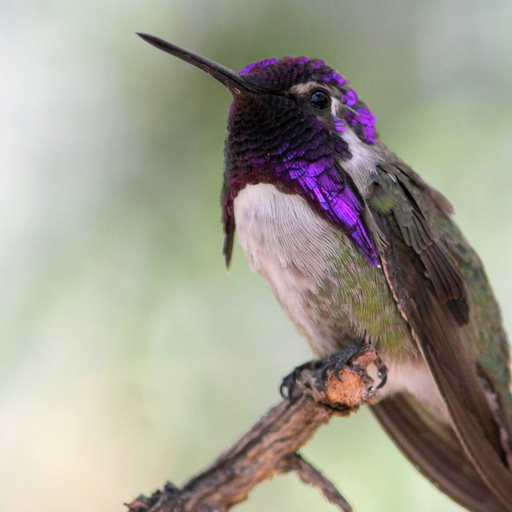
Bird Watching Log
Species: Costa’s Hummingbird (Calypte costae)
| Costa’s Hummingbird (Violet Crown Seen: Yes / No — Feeder Visits: ___ — Sideburn Flare: Yes / No — Thin Chips Heard: Yes / No) | |