
Pacific Golden-Plover


Pacific Golden-Plover (Pluvialis fulva): Complete Identification, Habitat Guide & Sound Library
Quick Answer: How to Attract & Identify the Pacific Golden-Plover
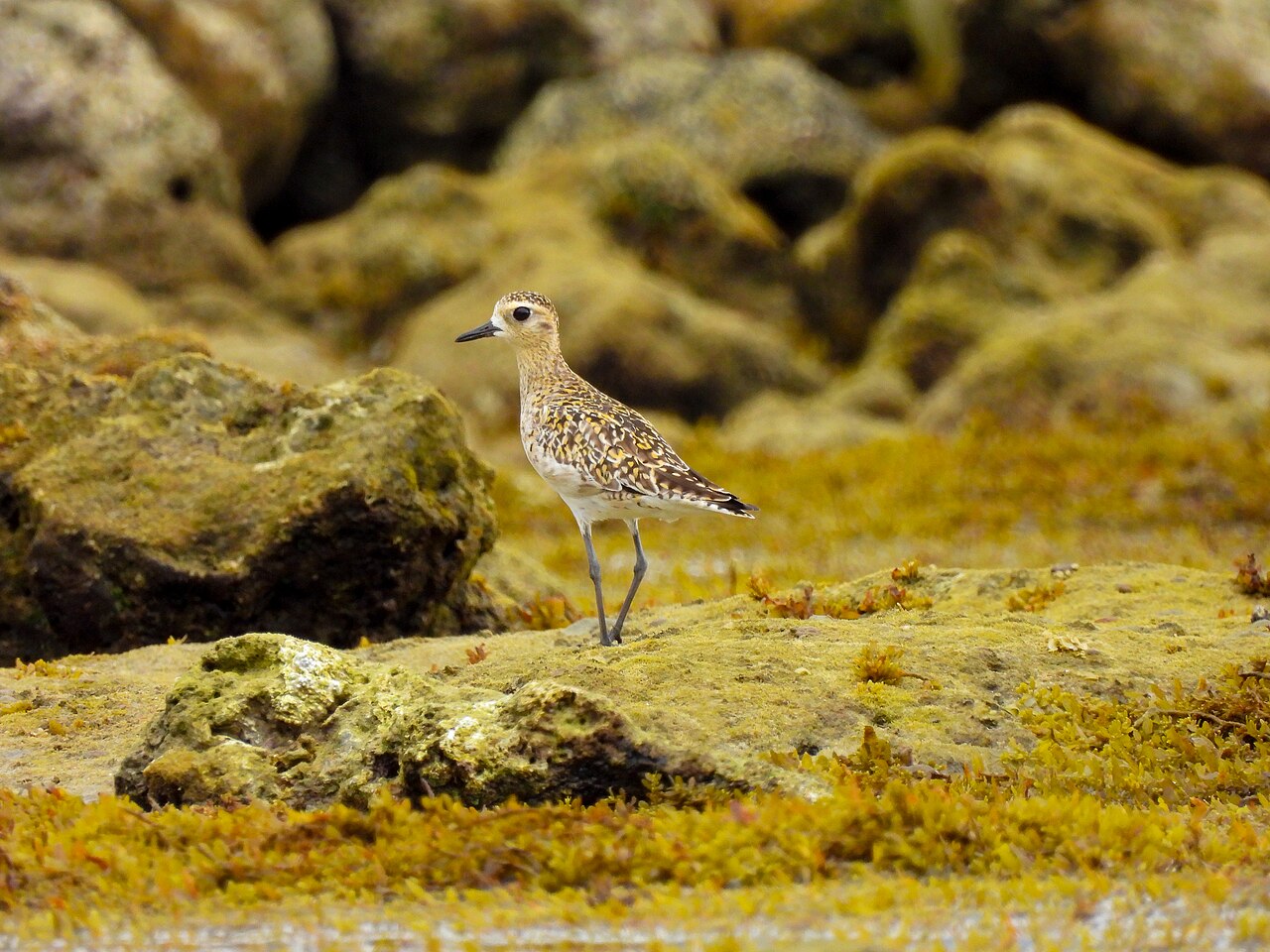
The Pacific Golden-Plover (Pluvialis fulva) — the Kolea of Hawaiian tradition — is the gold-spangled shorebird of Hawaiian lawns. Each fall it flies nonstop over the open Pacific from Alaska, a journey of roughly three days, returning to the very same lawn it held the winter before. In winter dress it is golden-brown and spangled, feeding run-stop-peck across short grass. Its voice is a clear, whistled tu-weep. You do not attract the Kolea — it adopts your lawn; short grass, no pesticides, and tolerance are the whole recipe. They share the greens with the Zebra Dove and the Common Myna.
Species Physical Profile & Morphometrics
The Pacific Golden-Plover belongs to the plover family (Charadriidae) — a shorebird that breeds on Alaskan and Siberian tundra and winters across the Pacific, with Hawaii its most famous wintering ground.
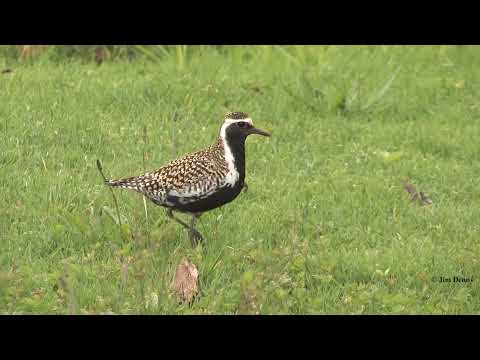
The identification formula: upright shorebird + gold-spangled back + short black bill + on a lawn. It runs, stops, stands tall, and pecks — the plover rhythm. In April, departing birds molt into dramatic black-bellied breeding plumage before the Alaska flight. The whistled tu-weep overhead is the island autumn’s announcement.
Essential Morphometric Field Marks:
- Body Length & Mass: 9.4 to 11.0 inches (24–28 cm) and 4.3 to 6.7 ounces (122–190 grams) — an upright, long-legged, round-headed shorebird.
- Wingspan: Wings are long and pointed — built for the epic nonstop ocean crossing between Alaska and Hawaii, roughly 2,500 miles over open water.
- Bill Structure & Color: A short, straight black bill — the plover tool for pecking insects and worms off short grass and mudflats.
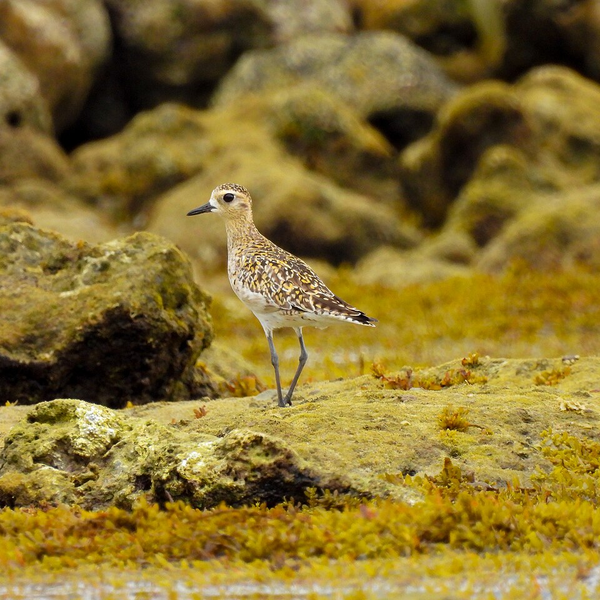
- Color Pattern: Winter birds are golden-brown above, spangled with gold and black, plain-faced with a pale eyebrow; breeding dress is jet-black from face to belly, edged in gold and white.
- Male vs. Female: In breeding plumage the male’s black underparts are deeper and cleaner; in winter plumage the sexes are alike — Hawaii sees mostly the golden winter dress.
The returning landlord: gold-spangled and upright on the same lawn he claimed last winter, running and pecking by day, whistling tu-weep at rivals — and in April, turning black-bellied for the flight back to the tundra.
The spangled neighbor — same gold, same lawn-territory instincts — she holds her own winter territory a few lawns away, returning to it as faithfully as he returns to his.
Pacific Golden-Plover Vocalization Guide (0 Field Recordings)
The Pacific Golden-Plover’s voice is a clear, ringing whistle — tu-weep or chu-wit — given in flight and from the lawn, the sound islanders associate with the bird’s August return. All recordings below are real field audio via Wikimedia Commons — no simulations. For a deeper library, browse xeno-canto: Pacific Golden-Plover.
1. The Tu-weep Whistle
2. The Territory Call
3. The Departure Chorus
Habitat, Range & the Island Lawn
In Hawaii the Pacific Golden-Plover winters on short-grass open ground: lawns, golf courses, pastures, airfields, parks, and coastal mudflats. Each bird holds a defended feeding territory — often the same lawn it used in years past — while other birds stay on the shorelines.

Three Days Over Open Ocean
The species breeds on the tundra of western Alaska and Siberia and winters across the Pacific from Hawaii to Australia. The Alaska-to-Hawaii leg is flown nonstop over open ocean — roughly 2,500 miles, some three days without food or rest, one of the great migrations on Earth.
For island residents: the same bird comes back to the same lawn every fall, arriving in August and leaving in late April. If a golden plover works your yard, you are part of an ancient, loyal geography.
Backyard Behavioral Patterns & Social Dynamics
The Pacific Golden-Plover is a lawn-territory shorebird and one of Earth’s great migrants. Four behaviors explain most of what you will observe:
🏃 The Run-Stop-Peck
It feeds in the plover rhythm — run a few steps, stop tall, peck, repeat — working a lawn methodically for hours each day.
📍 The Faithful Territory
Each bird defends the same lawn all winter and returns to it year after year — researchers have documented site fidelity across a decade.
🌊 The Nonstop Flight
The Alaska-to-Hawaii crossing is flown without landing, roughly three days over open ocean — among the longest overwater migrations of any shorebird.
⚫ The April Transformation
Before departing, birds molt into black-bellied breeding plumage on the Hawaiian lawns — watch your winter bird turn into a stranger in April.
Problem: “The Golden Plover on My Lawn Disappeared in Late April. What Should I Do?”
The three most common Pacific Golden-Plover puzzles all have proven answers:
First, the April disappearance: nothing is wrong — your bird left for Alaska to breed, and it will very likely be back on the same lawn in August. Mark your calendar and watch for the returning whistle. Second, the is-it-the-same-bird question: almost certainly yes — golden plovers show extraordinary site fidelity; the August bird on your lawn is the individual that left in April. Third, the why-won’t-it-come-closer question: plovers are wired cautious — a bird that feeds near your chair does so because you sit still; stand up fast and it flushes. Slow movements and a settled routine are how you earn a plover’s tolerance.
Method 1: Keep the Lawn Bird-Friendly — Short Grass, No Poison
Design for a feeding shorebird:
-
Keep Grass Short & Open
Plovers feed on short, open turf where they can see danger coming — a normal mowed lawn is already ideal.
-
Skip Pesticides Completely
The bird eats lawn insects, grubs, and worms — a sprayed lawn is an empty table; organic turf keeps the pantry full.
-
Mow Around a Feeding Bird
When a plover is working a section, give it a wide berth with the mower — it will shift aside and resume.
-
Leave Water Puddles
After rain, puddles and damp turf draw worms to the surface — the plover’s best hunting is right after a shower.
Method 2: Live With the Calendar — August to April
Sync your yard to the Kolea year:
-
Watch for the August Return
Late summer brings the first whistled tu-weep overhead — note the date your lawn bird reappears; it will be eerily consistent.
-
Give Fall Birds Feeding Space
Returning birds are thin from the ocean crossing — October is the time for maximum tolerance and zero flushing.
-
Watch the April Molt
In April your bird turns black-bellied before departure — the transformation is one of Hawaii’s great yard spectacles.
-
Mark Departure & Return
Keep a note of departure and arrival dates each year — your log becomes a personal migration study.
Tool Solution: Recommended Hardware for Pacific Golden-Plover
Equipment matched to a lawn-territory shorebird:
Organic Short-Grass Lawn
Short turf free of pesticides — the feeding ground that keeps a golden plover loyal to your address.
- • Surface: Short grass
- • Chemicals: None
- • Bonus: Worm-rich after rain
Chair & Binoculars at Distance
A settled chair and 8x binoculars — plovers tolerate a still watcher and reward patience with close natural behavior.
- • Method: Sit still
- • Distance: 30+ ft
- • Timing: All day
Arrival & Departure Log
A notebook of your bird’s August return and April departure — citizen science from your own lawn chair.
- • Track: Dates yearly
- • Watch: April molt
- • Share: eBird checklists
Frequently Asked Questions
- Species Profile: The Pacific Golden-Plover (Pluvialis fulva) is a 9.4–11.0 inch, 4.3–6.7 ounce shorebird (Charadriidae), band code PAGP — the Kolea of Hawaiian lawns.
- ID in One Look: Gold-spangled back, short black bill, upright posture, run-stop-peck on short grass.
- The Sound: A clear whistled tu-weep — August’s announcement of return; real field recordings above.
- Range & Habit: Breeds on Alaskan tundra, winters on Hawaiian lawns after a nonstop three-day ocean flight.
- Yard Formula: Short pesticide-free grass, mowing tolerance, still watching — the bird does the rest.
- The Faithful Traveler: Same bird, same lawn, every August — mark the date and it will teach you the calendar.
Bird Watching Log
Species: Pacific Golden-Plover (Pluvialis fulva)
| Pacific Golden-Plover (On Lawn: Yes / No — Whistle Heard: Yes / No — Plumage: Gold / Black-Bellied — Territory Behavior: Yes / No — Date & Time: ___) | |