
Pacific Wren


Pacific Wren (Troglodytes pacificus): Complete Identification, Habitat Guide & Sound Library
Quick Answer: How to Attract & Identify the Pacific Wren
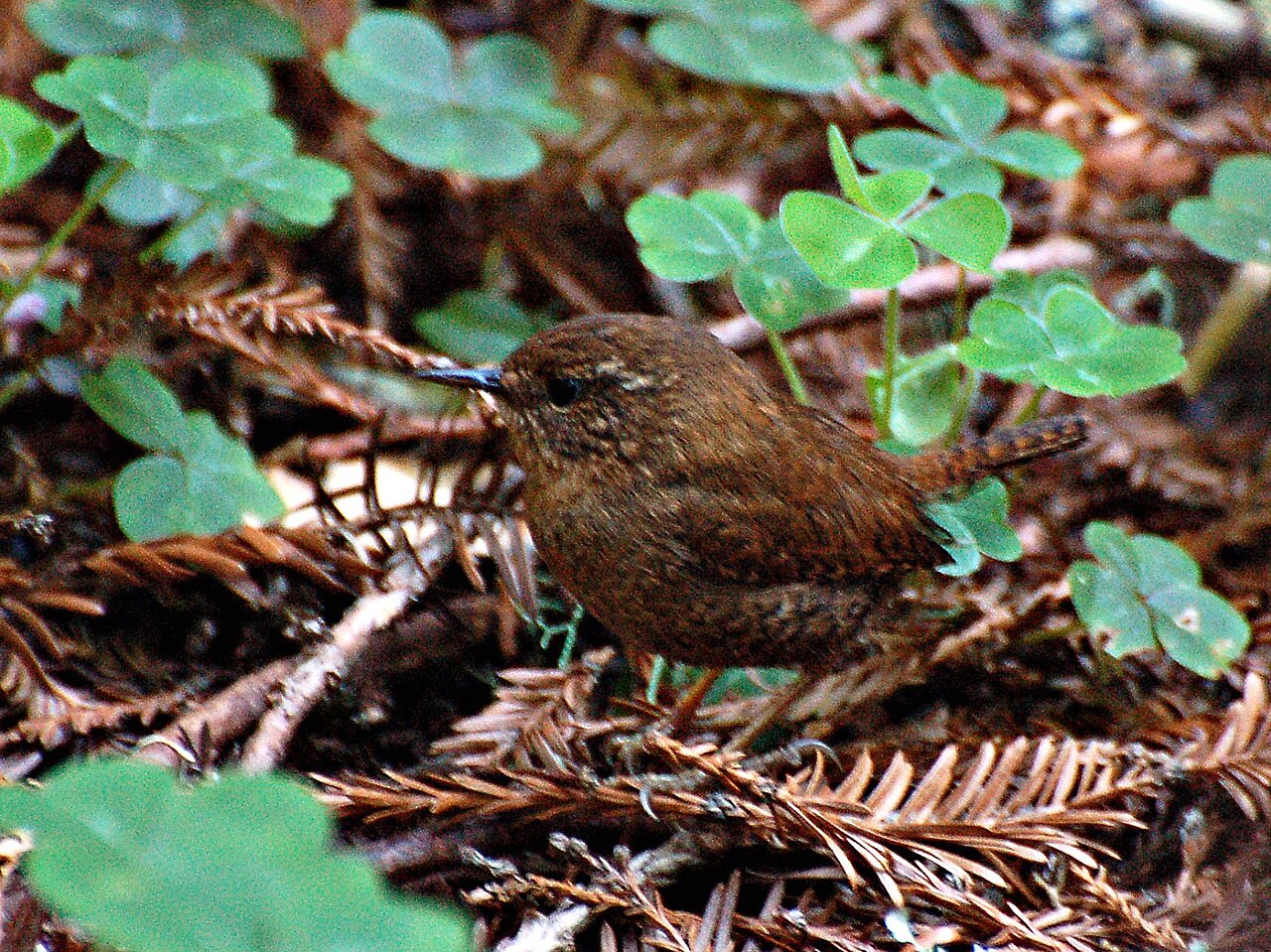
The Pacific Wren (Troglodytes pacificus) is the tiny dark wren of the Pacific coastal rainforest — deep rufous-brown, barred wings, tail cocked upright, and a song astonishingly long and loud for its size — a cascading torrent of trills. It forages mouse-like through brush piles, root wads, and mossy logs and nests in hidden cavities and domes. Coastal yards attract them with brush piles, shade, and dense native understory. They share the forest floor with the Chestnut-backed Chickadee and the Varied Thrush.
Species Physical Profile & Morphometrics
The Pacific Wren belongs to the wren family (Troglodytidae) and was split from the Winter Wren in 2010 — it breeds along the Pacific slope from Alaska to California in moist coniferous forest.
The identification formula: tiny dark rufous body + cocked barred tail + torrential song + rainforest shade. The Winter Wren is paler, grayer, and eastern; Bewick’s Wren is larger, longer-tailed, and bold-white-eyebrowed. In dark coastal understory, a mouse-sized brown shadow singing a waterfall is this bird.
Essential Morphometric Field Marks:
- Body Length & Mass: 3.5 to 4.3 inches (9–11 cm) and 0.3 to 0.4 ounces (8–12 grams) — one of North America’s smallest songbirds.
- Wingspan: 4.7 to 6.3 inches (12–16 cm); flight is a short whirring dash from one cover to the next.
- Bill Structure & Color: A thin, slightly decurved dark bill — a probe for spiders and insects in bark crevices and moss.
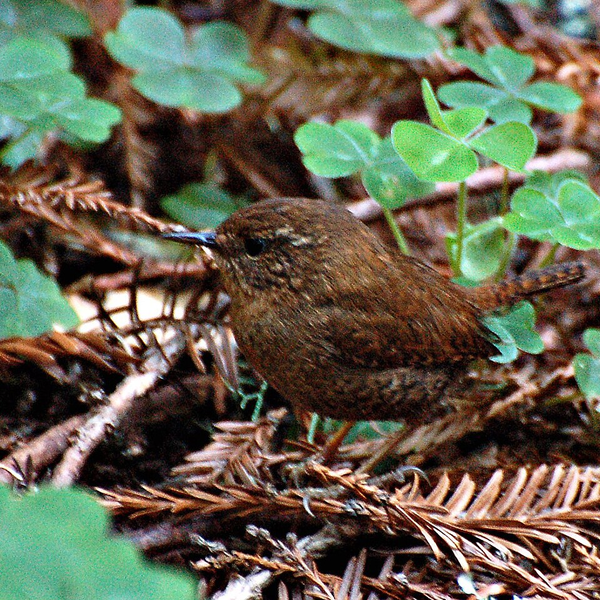
- Color Pattern: Dark rufous-brown overall with fine black barring on wings, tail, and flanks; a faint pale eyebrow; belly slightly warmer than the back.
- Male vs. Female: The sexes look alike — he sings the torrents; she builds most of the domed nest and incubates.
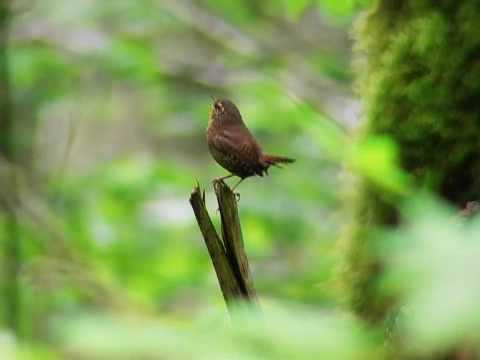
The torrent singer: a four-inch bird pouring out a song that runs five seconds and a hundred notes, from a mossy perch deep in the shade.
Identical in plumage — she weaves the domed nest of moss and grass into a root wad and lines it with feathers and hair.
Pacific Wren Vocalization Guide (1 Field Recording)
The Pacific Wren’s song is a long, cascading torrent of trills and tinkling notes — among the most complex songs of any North American bird. All recordings below are real field audio via Wikimedia Commons — no simulations. For a deeper library, browse xeno-canto: Pacific Wren.
1. The Torrent Song
2. The Timp Call
3. The Dawn Burst
Habitat, Range & the Coastal Rainforest
The Pacific Wren lives in the mossy understory of moist coniferous forest — old growth, riparian corridors, and shaded ravines from Alaska to California — wherever logs, root wads, and deep shade hold the damp.

The Voice of the Old Growth
Range runs along the Pacific slope from Alaska through British Columbia, Washington, and Oregon into California — largely resident, with some birds shifting downslope in winter.
For backyard birders: shaded coastal yards with brush piles, ferns, and mature conifers can hold a resident pair — you will hear the waterfall song long before you see the mouse in the shadows.
Backyard Behavioral Patterns & Social Dynamics
The Pacific Wren is an understory mouse with a giant voice. Four behaviors explain most of what you will observe:
🐭 The Mouse Path
It forages mouse-like through roots, moss, and brush — hopping into crevices and disappearing under logs.
🎶 The Giant Song
The male’s song runs five seconds and a hundred-plus notes — one of the loudest songs per gram of any bird on Earth.
🏠 The Hidden Dome
The nest is a mossy dome tucked into a root wad or bank crevice — invisible until the adults ferry food.
🐓 The Cocked Tail
The stub tail is held bolt upright — the classic wren attitude in a bird the size of a walnut.
Problem: “How Do I Find a Pacific Wren? What Should I Do?”
The three most common Pacific Wren puzzles all have proven answers:
First, the invisible singer: the song blasts from deep shade at knee height — freeze, watch the brush pile edges, and look for movement rather than color; patience beats pursuit. Second, the wren confusion: check the habitat and voice — dark rainforest understory and a torrent song mean Pacific Wren; open shrubs and a bold white eyebrow mean Bewick’s; houses and garages mean House Wren (eastern Washington and beyond). Third, the vanished winter bird: coastal birds stay all year but sing less — in winter, listen for the hard timp call at dawn and check brush piles after frost, when foraging runs all daylight.
Method 1: Set the Table — Brush Piles & Rotting Logs
Design for a ground-level rainforest wren:
-
Build a Brush Pile
A loose stack of branches in deep shade — foraging floor, song perch, and nest shelter in one.
-
Leave Logs to Rot
Fallen logs and root wads stay put — mossy dead wood is the pantry and the housing.
-
Keep the Shade
Mature conifers and native ferns — the cool, damp understory this bird requires.
-
Keep Cats Indoors
Ground-foraging wrens are cat prey — an indoor cat is a wren’s best friend.
Method 2: Build the Habitat — Moist Shade & Spider Country
Keep it dark, damp, and buggy, and the pair stays all year:
-
Mulch Deeply
Undisturbed leaf litter and mulch — the spider and insect layer wrens harvest.
-
Water the Shade Garden
A dripper or seep in the fern bed — moisture sustains the understory food web.
-
Skip the Tidy-Up
No fall cleanup under conifers — the mess is the habitat.
-
Listen at Dawn
First light is concert time — the torrent song locates the territory long before the bird shows.
Tool Solution: Recommended Hardware for Pacific Wren
Equipment matched to a rainforest-floor wren:
Shaded Brush Pile
A loose branch stack under the conifers — the single best wren habitat a coastal yard can offer.
- • Placement: Deep shade
- • Structure: Loose & layered
- • Bonus: Towhees & sparrows too
Dripper or Seep
Moving water in the shade garden — sustains insects and gives wrens a bath spot under cover.
- • Placement: Under shrubs
- • Flow: Gentle drip
- • Bonus: Warblers & thrushes
Leaf Litter & Mulch
Undisturbed litter under the evergreens — the spider crop that feeds a wren through winter.
- • Rule: No leaf blowing
- • Depth: Natural accumulation
- • Bonus: Fox sparrows scratch here
Frequently Asked Questions
- Species Profile: The Pacific Wren (Troglodytes pacificus) is a 3.5–4.3 inch, 0.3–0.4 ounce wren (Troglodytidae), band code PAWR — the singing mouse of the rainforest.
- ID in One Look: Dark rufous puffball, barred cocked tail, deep shade.
- The Sound: A five-second torrent of trills; real field recordings above.
- Range & Habit: Pacific slope resident from Alaska to California; nests in root wads and brush.
- Feeder Formula: Brush piles, logs, litter, and shade — feeders are optional.
- The Size Trick: The loudest song in the yard may come from its smallest bird.
Bird Watching Log
Species: Pacific Wren (Troglodytes pacificus)
| Pacific Wren (Torrent Song Heard: Yes / No — Cocked Tail Seen: Yes / No — Brush Pile Visited: Yes / No — Nest Dome Found: Yes / No — Date & Time: ___) | |