
Red-naped Sapsucker


Red-naped Sapsucker (Sphyrapicus nuchalis): Complete Identification, Habitat Guide & Sound Library
Quick Answer: How to Attract & Identify the Red-naped Sapsucker
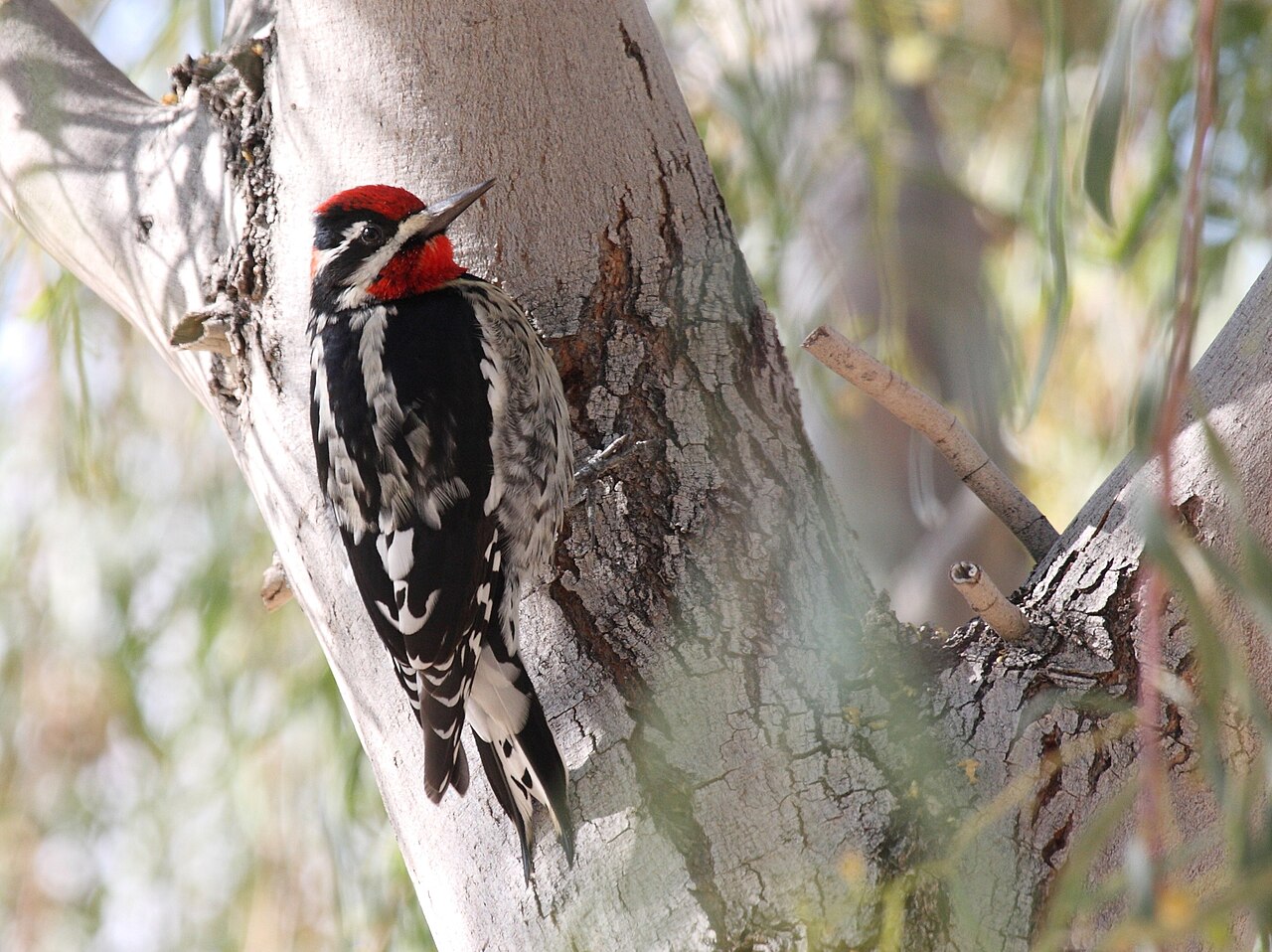
The Red-naped Sapsucker (Sphyrapicus nuchalis) is the sap-well driller of the mountain West — a black-and-white woodpecker with a red crown and nape, a long white wing stripe, and a yellowish wash on the belly. It drills neat rows of sap wells in aspen, birch, and pine, then guards the flowing wells against all comers — hummingbirds and warblers feed at them too. The voice is a mewing mee-ah and irregular drumming. Western yards attract them with suet and mature deciduous trees. They share the forest with the Red-breasted Sapsucker and the Yellow-bellied Sapsucker.
Species Physical Profile & Morphometrics
The Red-naped Sapsucker belongs to the woodpecker family (Picidae) and breeds in the mountains of the interior West — the Rockies, Great Basin ranges, and Cascades’ east slope — wintering south into Mexico. It was once lumped with the Yellow-bellied Sapsucker as one species.
The identification formula: red crown + red nape patch + long white wing stripe + black bib. The Yellow-bellied Sapsucker lacks the red nape and shows a neater white-bordered black bib; the Red-breasted Sapsucker has the entire head and breast red. In the Rockies, a sapsucker with a red nape is this species.
Essential Morphometric Field Marks:
- Body Length & Mass: 7.1 to 8.7 inches (18–22 cm) and 1.1 to 2.3 ounces (32–66 grams) — a compact, sturdy woodpecker of mid-size.
- Wingspan: 16.0 to 16.9 inches (41–43 cm); flight is deeply undulating between sap trees, with a flash of the long white wing stripe.
- Bill Structure & Color: A straight, dark, chisel-tipped bill — precise enough to drill clean rectangular wells without killing the tree.
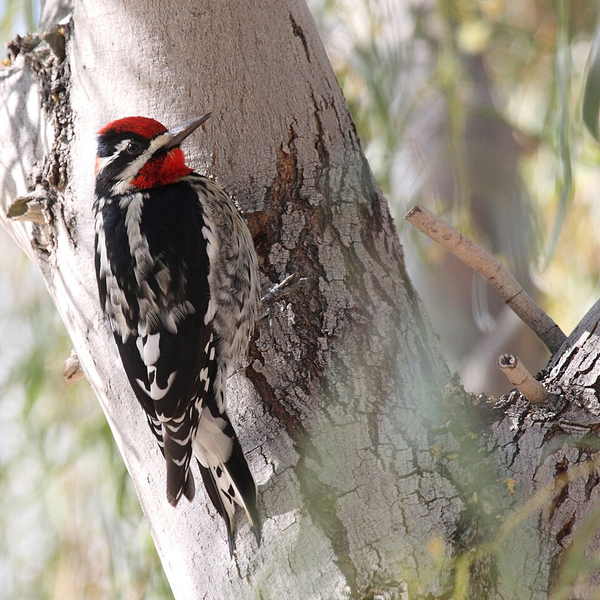
- Color Pattern: Black and white overall with a red forehead, crown, and nape, black bib edged in white, yellowish-washed belly, barred back, and a long white stripe on the folded wing.
- Male vs. Female: The male’s throat is entirely red; the female’s red throat carries a white chin patch — at the sap wells, chin color tells the pair apart.
The well-keeper: red from forehead to nape, working his rows of sap wells like a farmer checking irrigation lines, chasing off any hummingbird that lingers too long.
The white-chinned partner — same red crown and nape, but her red throat breaks at a white chin — she shares the wells and the nest cavity, drilled fresh into a living aspen with heartwood fungus.
Red-naped Sapsucker Vocalization Guide (0 Field Recordings)
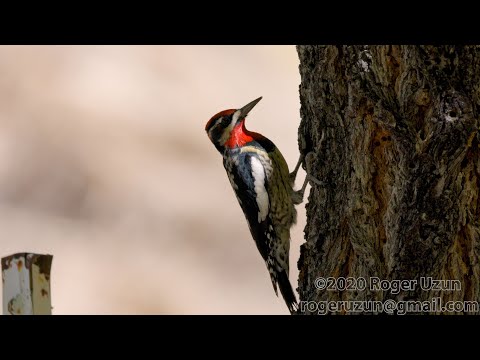
The Red-naped Sapsucker’s voice is a mewing, slurred mee-ah — a cat-like complaint — plus an irregular, stuttering drum unlike any other woodpecker’s. All recordings below are real field audio via Wikimedia Commons — no simulations. For a deeper library, browse xeno-canto: Red-naped Sapsucker.
1. The Mewing Call
2. The Stuttering Drum
3. Well Defense Chatter
Habitat, Range & the Aspen West
The Red-naped Sapsucker breeds in mountain deciduous groves: aspen stands, cottonwood and willow streamside forest, and mixed conifer edges across the interior West. In winter it drops to lower-elevation woodlands, orchards, and yards from the Southwest into Mexico.

The Rockies’ Well-Driller
Breeding range spans the interior mountain West from British Columbia to Arizona and New Mexico. Come fall, the mountains empty: the whole population shifts to lower woodlands of the Southwest and Mexico, returning with the aspen leaf-out in April.
For backyard birders: mountain yards with aspen, birch, or mature fruit trees host them April–September; lower-elevation southwestern yards see them at suet October–March — two different neighborhoods, two different seasons.
Backyard Behavioral Patterns & Social Dynamics
The Red-naped Sapsucker is a methodical farmer of living trees — a woodpecker with a crop. Four behaviors explain most of what you will observe:
🩸 The Well Driller
It drills neat horizontal rows of small rectangular wells in bark, returning hourly to lap the flowing sap with a brush-tipped tongue — some trees carry years of overlapping rows.
🛡️ The Well Guard
The wells are defended fiercely — hummingbirds, warblers, and other sapsuckers are chased off, though the trespassers keep coming: the sap flows too sweet to abandon.
🏗️ The Living-Tree Nester
Uniquely, sapsuckers often excavate nest cavities in living aspens infected with heartwood fungus — soft inside, sound outside; a new cavity each year.
🍰 The Winter Suet Guest
At lower elevations in winter it becomes a suet feeder regular — a mountain bird on your patio, quieter and tamer than in its breeding season.
Problem: “Neat Rows of Holes Appeared in My Tree’s Bark. Is It Dying? What Should I Do?”
The three most common Red-naped Sapsucker puzzles all have proven answers:
First, the worry about the tree: those rows are sap wells, and on a healthy mature tree they are cosmetic, not fatal — sapsuckers farm the same trees for years without killing them; only protect young or stressed trees with a wrap of burlap. Second, the identification: in the mountain West it is Red-naped (red crown plus red nape); on the Pacific slope it is Red-breasted (whole head red); east of the Rockies, Yellow-bellied (no red nape). Third, the missing winter bird: mountain sapsuckers leave for the season — the wells stop flowing, the birds head south, and your aspen rests until April; watch for hummingbirds at the old wells next spring.
Method 1: Set the Table — Suet & the Right Trees
Design for a sap-farming woodpecker:
-
Hang Suet in Winter
A suet cage on a mature trunk — the winter staple at lower-elevation yards across the Southwest.
-
Keep Aspens & Birches
Mature aspen, birch, cottonwood, and fruit trees are the farm — a yard with them is a yard with wells.
-
Let the Wells Flow
Do not wrap or tar healthy trees with active wells — the sapsucker manages them, and the whole yard’s birds benefit.
-
Offer Water Nearby
A shallow bath near the sap trees — even sap-drinkers need plain water, especially in winter cold snaps.
Method 2: Build the Habitat — Aspen Groves & Tolerance
Keep the grove healthy, and the wells return each April:
-
Plant Native Aspen & Willow
Aspen, willow, and cottonwood on moist ground recreate breeding habitat — mountain yards with groves hold pairs for generations.
-
Leave Fungus-Hearted Trees
A living aspen with heartrot is nest real estate — if it is not a hazard, keep it standing; sapsuckers seek exactly these.
-
Protect Wells from Damage
Keep pruning sealants off well rows — let the tree compartmentalize naturally; the bird’s farming is gentler than it looks.
-
Watch the Spring Return
Late March–April: listen for the stuttering drum on still mornings — the wells reopen within days of the birds’ return.
Tool Solution: Recommended Hardware for Red-naped Sapsucker
Equipment matched to a sap-farming mountain woodpecker:
Suet Cage Feeder
A suet cage on a mature trunk — the winter lifeline that keeps sapsuckers visiting southwestern yards daily.
- • Food: Suet cakes
- • Placement: Mature trunk
- • Season: October–March
Aspen & Birch Plantings
Mature deciduous grove trees — the only feeder that also feeds hummingbirds, warblers, and butterflies.
- • Trees: Aspen, birch, willow
- • Feature: Sap wells
- • Bonus: Hummingbirds at wells
Shallow Birdbath
A shallow bath kept ice-free in cold snaps — winter sapsuckers drink and bathe like any other bird.
- • Depth: One to two inches
- • Winter: Heated in freezes
- • Placement: Near trees
Frequently Asked Questions
- Species Profile: The Red-naped Sapsucker (Sphyrapicus nuchalis) is a 7.1–8.7 inch, 1.1–2.3 ounce woodpecker (Picidae), band code RNSA — the sap-well farmer of the mountain West.
- ID in One Look: Red crown plus red nape, black bib, yellowish belly, long white wing stripe.
- The Sound: Mewing mee-ah calls and a stuttering, irregular drum; real field recordings above.
- Range & Habit: Breeds in western mountain groves, winters at southwestern low elevations; farms living trees for sap.
- Feeder Formula: Winter suet on mature trunks, standing aspen and birch, and tolerance for the well rows.
- The Public Fountain: Its wells feed hummingbirds, warblers, and butterflies — hosting a sapsucker means hosting a crowd.
Bird Watching Log
Species: Red-naped Sapsucker (Sphyrapicus nuchalis)
| Red-naped Sapsucker (Male Full Red Throat / Female White Chin — Wells Found: Yes / No — At Suet: Yes / No — Stuttering Drum: Yes / No — Date & Time: ___) | |