
Yellow-bellied Sapsucker


Yellow-bellied Sapsucker (Sphyrapicus varius): Complete Identification, Feeder Guide & Call Library
Quick Answer: How to Attract & Identify Yellow-bellied Sapsuckers
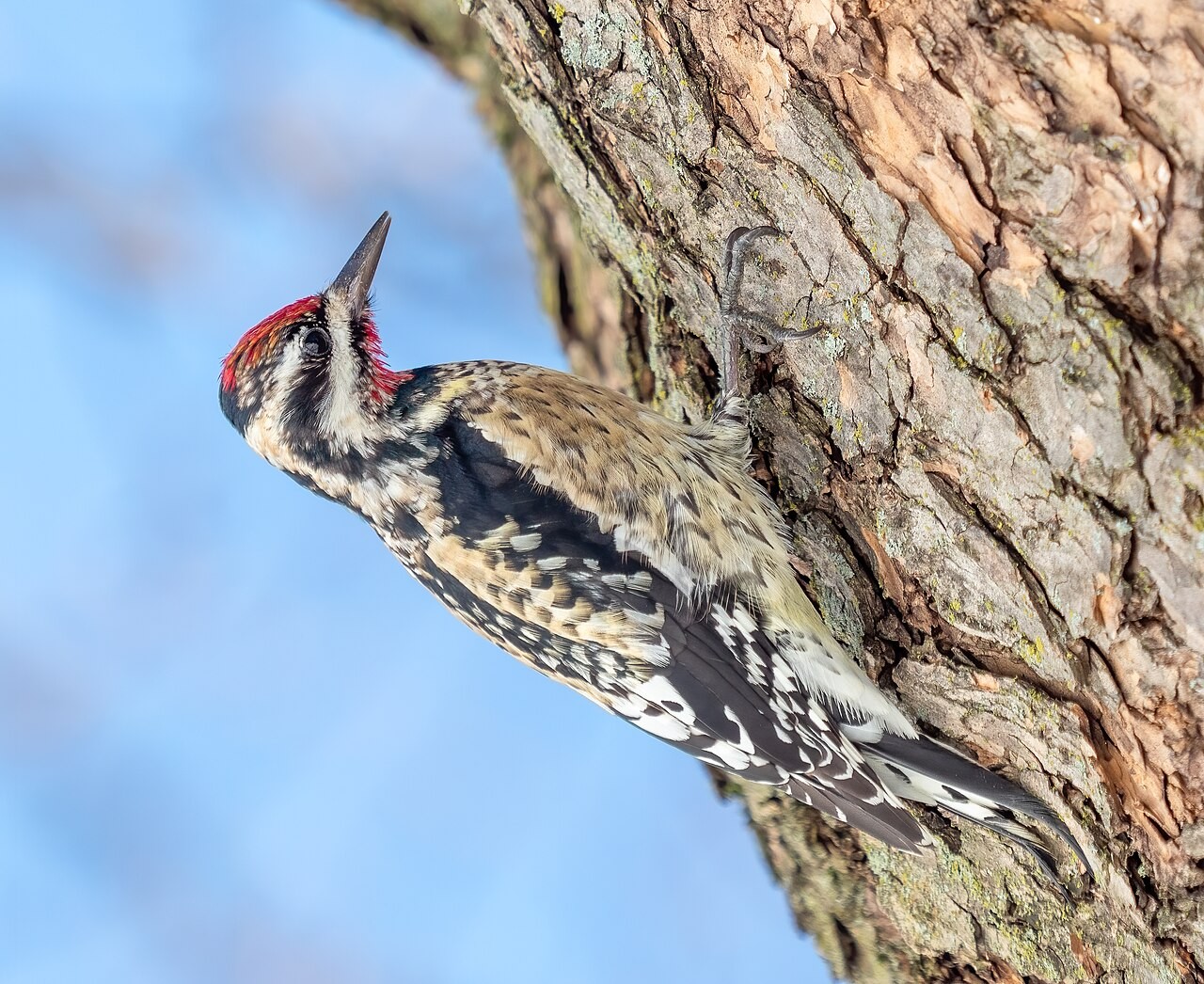
The Yellow-bellied Sapsucker (Sphyrapicus varius) is the robin-sized woodpecker that drills neat horizontal rows of sap wells into birch, maple, and holly — the only woodpecker in eastern North America that migrates, so most eastern yards meet it as a winter visitor. Look for the red crown, the black bib, the pale yellow wash on the belly, and the bold white stripe down the folded wing; the male’s throat is red, the female’s white. To attract it: hang a suet cage, keep a hummingbird feeder out through the shoulder seasons for sugar water, and leave a birch or maple with existing wells untouched. Listen for the nasal mewing call and the irregular, stuttering drum roll that no other woodpecker makes. It winters alongside the Downy Woodpecker at suet across the Southeast.
Species Physical Profile & Morphometrics
The Yellow-bellied Sapsucker is a mid-sized member of the woodpecker family (Picidae) — larger than a Downy, smaller than a Hairy Woodpecker — built around one specialization: a short, stout bill for drilling sap wells and a brush-tipped tongue for lapping up what flows out.
The identification formula: red crown + black bib + barred back + bold vertical white wing stripe, on a trunk with rows of fresh holes. Then read the throat: red means male, white means female.
Essential Morphometric Field Marks:
- Body Length & Mass: about 7.1 to 8.7 inches (18–22 cm) and 1.5 to 1.9 ounces (43–55 grams) — robin-sized, sitting neatly between the Downy and Hairy Woodpeckers.
- Wingspan: about 13.4 to 15.8 inches (34–40 cm); in flight the white wing stripe shows as a long panel on the folded wing, a mark no similar woodpecker carries.
- Bill Structure & Color: A short, stout, chisel-tipped bill, dark gray — and behind it a tongue tipped with stiff brush-like bristles made for mopping up sap.
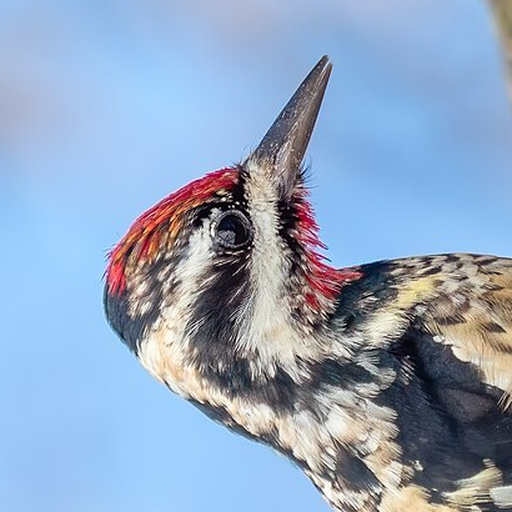
- Color Pattern: Black back barred and mottled with white, a black bib edged in white, a pale belly washed yellow (often faint), a red crown in both sexes, and the diagnostic long white stripe on the folded wing.
- Male vs. Female: The male’s throat is solid red, blending into the red crown; the female’s throat is white below the red crown. Juveniles are scruffier, brown-washed versions with the same wing stripe.
Red crown, red throat: the bib’s black frame encloses a solid scarlet throat patch, and the yellow belly wash tends to show best on him in good light. Males winter farther north than females, so a mid-December sapsucker in the mid-Atlantic is usually a him.
Red crown, white throat: same crown, same bib, but the throat inside the frame is clean white. Females winter deeper south — into the Gulf states and Central America — so the bird at a Georgia feeder in February is often a her.
Yellow-bellied Sapsucker Vocalization Guide (2 Field Recordings + 1 Simulation)
This is a quiet woodpecker most of the year: a nasal, squeaky, downward-slurred mew — like a catbird with a head cold — is the everyday note. The drumming is the real signature: an irregular roll that decelerates unevenly, as if the bird lost count, utterly unlike the steady roll of a Downy or Hairy. The first two cards below are real field recordings shared under Creative Commons licenses; the third is a clearly labeled acoustic simulation of the stuttering drum. For more wild audio, browse xeno-canto: Yellow-bellied Sapsucker.
1. Real Recording — The Nasal Mew
2. Real Recording — The Stuttering Drum
3. Drum Simulation — Morse Code on Bark
Habitat, Range & the Two-Season Map
The Yellow-bellied Sapsucker lives a double life: summers in northern birch and aspen forest, winters in eastern woodlands, orchards, and shade-tree yards — anywhere it can keep a set of sap wells flowing.

Canada in Summer, the Eastern States in Winter
Sapsuckers breed from Alaska and across Canada into the northern tier of states — New England, the Great Lakes, the Appalachians — then withdraw south every fall. The winter range covers the eastern United States from the mid-Atlantic to Texas, with some birds reaching Mexico and Central America.
Notably, males winter farther north than females — one of the clearest cases of sex-split wintering among North American birds. A Pennsylvania yard in December likely hosts a male; a Louisiana yard in February, more likely a female.
Backyard Behavioral Patterns & Social Dynamics
The Yellow-bellied Sapsucker runs a small farm on your tree trunk. Four behaviors explain most backyard encounters:
🩸 The Well Keeper
The bird drills horizontal rows of small square holes — sap wells — then patrols them daily, lapping sap with a brush-tipped tongue and re-drilling the wells to keep them flowing. A favorite birch or maple can carry years of tidy parallel scars.
🍬 The Sugar-Water Sipper
Sapsuckers are documented visitors to hummingbird feeders, sipping sugar water — especially in early spring before sap runs freely. A wintering bird may also guard its suet cage or sugar source against other birds.
🦋 The Accidental Feeder of Others
The wells feed far more than their maker: hummingbirds, bats, butterflies, and bees all drink from them. Ruby-throated Hummingbirds arriving before flowers bloom time their migration to follow the sapsucker’s wells north.
🥁 The Morse-Code Drummer
Spring territories are announced with an irregular, decelerating drum roll — a fast start that stumbles into spaced taps. Once you can pick that stutter out of the dawn chorus, you will never misread it as a Downy or a Red-bellied Woodpecker.
Problem: “My Tree Is Covered in Neat Rows of Little Holes — What Did This, and Is the Tree Dying?”
The three most common Yellow-bellied Sapsucker puzzles all have reassuring answers:
First, the rows of holes: that is this bird’s farming, not borers or disease. Healthy mature trees shrug off years of well-tending — the same favorite trunk often serves for a decade. Second, the exception worth watching: if a small or already-stressed ornamental is being drilled in bands all the way around the trunk, the bird can girdle it. Loosely wrapping that stretch in burlap or hardware cloth during the drilling season usually moves the bird to a neighboring tree without harm to either party. Third, the hummingbird-feeder mystery: if the sugar water is vanishing with no hummingbirds in sight, look for a quiet, barred woodpecker clinging nearby — wintering sapsuckers have learned the feeder is a well that never runs dry.
Method 1: Set the Table — Suet, Sugar Water & Bark Butter
Design for a sap specialist that winters at the suet cage:
-
Hang a Suet Cage in a Tree
Suet is the most dependable sapsucker draw in winter — hang a standard cage on or beside a trunk rather than in the open, since this bird feeds most confidently on vertical bark. Insect-blend cakes suit its mixed diet.
-
Keep a Hummingbird Feeder Out Longer
Sugar water is a proven sapsucker draw in early spring and late fall. Leave one feeder up through the shoulder seasons — the sapsucker sips without damaging it, and the earliest hummingbirds will share the wells it drills.
-
Smear Bark Butter on a Trunk
Bark butter or soft suet spread directly on bark mimics the bird’s natural surface-feeding style and holds it in view longer than a cage does — a trick that also suits the Brown Creeper working the same trunk.
-
Offer Water Year-Round
A shallow bath near cover — heated in winter — rounds out the station; sapsuckers drink and bathe like any other winter guest.
Method 2: Build the Habitat — Birch, Maple & Well Trees
Feed the habitat, and the sapsuckers follow:
-
Plant or Keep Paper Birch and Maple
Paper birch, sugar maple, hickory, and hemlock are classic well trees. A single mature birch in the yard is a sapsucker magnet all by itself — in breeding season, aspen and birch stands are the heart of the territory.
-
Never “Clean Up” a Well Tree
Resist the urge to wrap, tar, or cut a tree marked with old wells — those rows are the sapsucker’s pantry and an open invitation for the bird to return. A healthy tree with well scars is a sign of a working ecosystem, not damage.
-
Leave Snags for Nesting in the North
If you live in the breeding range, a standing dead or fungus-softened aspen or birch is prime cavity real estate — pairs excavate a fresh hole each spring, often in the same living-but-softened trunk for years.
-
Skip the Insecticides
Sapsuckers eat the insects drawn to their own wells — an un-sprayed tree keeps the whole food web running: sap, insects, sapsucker, hummingbirds.
Tool Solution: Recommended Hardware for Yellow-bellied Sapsuckers
Equipment matched to a trunk-feeding, sap-loving winter guest:
Trunk-Mounted Suet Cage
A single or double suet cage hung flat against, or directly beside, a trunk — the layout a sapsucker instinctively recognizes as a feeding surface, and the most reliable way to hold a wintering bird in view.
- • Food: Insect-blend or peanut suet cakes
- • Style: Standard cage, trunk-adjacent
- • Placement: On or beside bark, quiet cover
Hummingbird Feeder (Extended Season)
An ordinary nectar feeder kept filled through fall and early spring — the sugar-water well a wandering sapsucker will adopt as its own, weeks before and after the hummingbirds it serves in summer.
- • Food: 4:1 water-to-sugar nectar, no dye
- • Style: Perch-friendly basin design
- • Placement: Near trees, refreshed weekly
Heated Bird Bath
A shallow basin with a thermostatic heater — wintering sapsuckers drink daily, and open water in a freeze keeps the whole woodpecker guild, from sapsucker to Pileated Woodpecker, anchored to your yard.
- • Depth: 1–2 in, gently sloped
- • Winter: Thermostatic heater or de-icer
- • Placement: Open ground beside cover
Frequently Asked Questions
- Species Profile: The Yellow-bellied Sapsucker (Sphyrapicus varius) is a 7.1–8.7 inch, 43–55 gram woodpecker (Picidae) — red-crowned, black-bibbed, with a bold white wing stripe and a faint yellow belly.
- ID in One Look: Red crown plus black bib plus vertical white stripe on the folded wing; males have a red throat, females a white one — and the tree nearby usually shows its rows of sap wells.
- A True Migrant: The East’s only fully migratory woodpecker — breeds in northern birch and aspen forest, winters across the eastern states, males wintering north of females.
- The Sound: A nasal, slurred mewing call, and an irregular decelerating drum roll that stutters like Morse code — unique among woodpeckers.
- Feeder Formula: A trunk-adjacent suet cage, an extended-season hummingbird feeder for sugar water, and bark butter smeared on a trunk.
- The Well Keeper: Its sap wells feed hummingbirds, bats, and butterflies too — and healthy trees tolerate them for years.
Bird Watching Log
Species: Yellow-bellied Sapsucker (Sphyrapicus varius)
| Yellow-bellied Sapsucker (Throat: Red / White — At Suet: Yes / No — Sap Wells Seen: Yes / No — Drumming Heard: Yes / No) | |