
Summer Tanager


Summer Tanager (Piranga rubra): Complete Identification, Habitat Guide & Song Library
Quick Answer: How to Attract & Identify the Summer Tanager
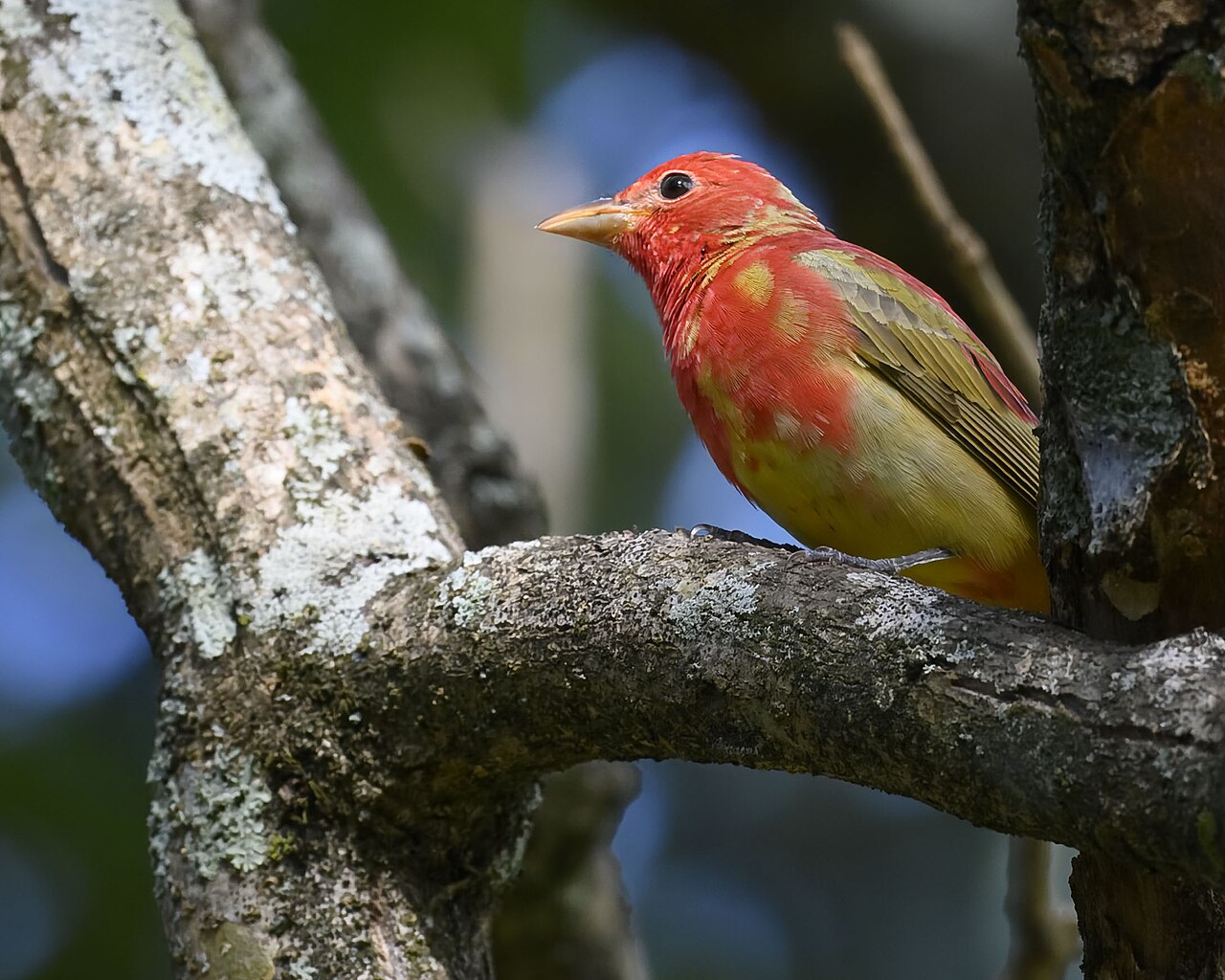
The Summer Tanager (Piranga rubra) is the only entirely red bird in North America — the male is solid rose-red from crown to tail, with no black wings or tail to break the color — while the female glows mustard-gold. It is a bee and wasp specialist, snatching them on the wing and beating the sting out on a branch. The song is a rich, melodic, robin-like caroling drifting from mid-canopy oaks. Southern and eastern woodland yards can attract them with grape jelly, orange halves, moving water, and insect-friendly (spray-free) trees. They summer alongside the Baltimore Oriole and the Northern Cardinal.
Species Physical Profile & Morphometrics
The Summer Tanager belongs to the cardinal family (Cardinalidae) — DNA moved the Piranga tanagers out of the true tanagers and into the cardinal clan, which explains the stout bill and rich song. It summers across the southern and eastern U.S. in open woodland and winters from Mexico to South America.
The identification formula: all-red male with no black anywhere + stout pale bill. The Northern Cardinal has a crest and black face; the Scarlet Tanager male has jet-black wings and tail; the Summer Tanager’s wings and tail are red like the rest. Females are mustard-yellow below and olive above, brighter and more uniform than a female Scarlet — and again, the wings are unblackened.
Essential Morphometric Field Marks:
- Body Length & Mass: 6.7 to 7.9 inches (17–20 cm) and 1.0 to 1.1 ounces (28–32 grams) — cardinal-sized, long-tailed, and smoothly proportioned.
- Wingspan: 11.0 to 11.8 inches (28–30 cm); flight is strong and level, with quick sallies from a perch after bees and wasps working the canopy.
- Bill Structure & Color: A stout, slightly hooked pale horn-colored bill — thick enough to crush a wasp, pale enough to notice; a key mark separating it from cardinal and Scarlet Tanager.
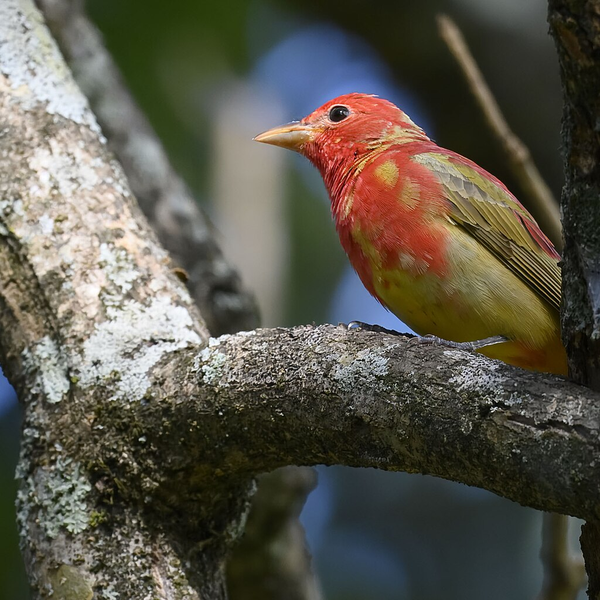
- Color Pattern: Male: solid rose-red overall, wings and tail included. Female: mustard-gold below, olive-yellow above, wings unblackened. Young males patch red into the gold like a mosaic.
- Male vs. Female: The sexes wear entirely different colors — solid red versus golden mustard — and both sing: the female answers from the nest area with a softer version of his caroling phrases.
The all-red original: rose-red crown to tail without a fleck of black, singing rich robin-like phrases from mid-canopy oaks and sallying out to snap bees from the air — then thrashing them senseless on a branch.
The golden half — mustard-yellow below, olive above, quietly beautiful and surprisingly vocal: she sings softly near the nest, a shallow cup of grass and weed stems saddled on a horizontal limb over a clearing.
Summer Tanager Vocalization Guide (3 Field Recordings)
The Summer Tanager’s song is rich, melodic caroling — robin-like phrases but smoother and more uniform, delivered in long sequences from mid-canopy — and the classic call is a staccato pit-ti-tuck or pik-i-tuk. All recordings below are real field audio via Wikimedia Commons — no simulations. For a deeper library, browse xeno-canto: Summer Tanager.
1. The Canopy Caroling
2. The Pit-Ti-Tuck
3. Song Across the Clearing
Habitat, Range & the Southern Canopy
The Summer Tanager breeds in open woodland and forest edge: oak and pine-oak woods, riverside forest, parks, and big-treed southern neighborhoods. Western birds follow cottonwood corridors through desert country. It keeps to mid-levels and canopy, so yards adjoining mature open woods are its suburban habitat.

The South’s Reddest Summer Voice
The breeding range spans the southern half of the U.S. — the Southeast from Texas to the Carolinas, up the Mississippi valley to the Midwest, with a western population along desert rivers in Arizona, New Mexico, and California’s far southeast. Winter takes the whole population to Mexico and Central and South America.
For backyard birders: May through August, any southern yard adjoining mature oaks or riverside woods can host a singing male — and a yard offering jelly, orange halves, and a water drip occasionally pulls him down from the canopy to arm’s length.
Backyard Behavioral Patterns & Social Dynamics
The Summer Tanager is a wasp-eating, robin-voiced original — a canopy bird with feeder potential. Four behaviors explain most of what you will observe:
🐝 The Wasp Specialist
Bees and wasps are the staple: the bird snatches them on the wing, returns to a perch, and beats them against the branch to crush the stinger before swallowing. Nests of paper wasps are raided repeatedly — free pest control in feathers.
🎵 The Robin That Isn’t
The song so resembles an American Robin’s that birders learn to separate them: the tanager’s phrases are smoother, more uniform, and lack the robin’s alternating ups and downs — and they come from the canopy of southern oaks in June, when robins have mostly stopped.
🍇 The Jelly & Orange Guest
Like its oriole cousins, the Summer Tanager visits grape jelly and orange halves, especially in migration and on cool, insect-poor mornings — a canopy bird you can, with luck, watch at the feeder.
🌳 The Mid-Canopy Life
Tanagers live between the forest floor and the treetops — feeding, singing, and nesting on horizontal mid-canopy limbs, often over clearings and water. Learn to scan the mid-levels, not the treetops.
Problem: “I Hear the Robin-Like Song but the Red Bird Never Shows Itself. What Should I Do?”
The three most common Summer Tanager puzzles all have proven answers:
First, the canopy ghost: tanagers sing from mid-canopy and sit still — learn the pit-ti-tuck call and watch the horizontal limbs over clearings; patient scanning at dawn, when song is constant, will put your glass on the red. Second, the feeder question: they are not seed birds — grape jelly in a small cup, orange halves on a spike, and a dripping water feature are the draws, most effective in migration (April–May, August–September) and cool snaps when insects are scarce. Third, the one-week stand: many yards host tanagers only in passage — mark your calendar; the same migrant may reappear the same week next spring, and a yard with mature oaks, water, and zero broad insecticides is worth its detour every year.
Method 1: Set the Table — Jelly, Fruit & the Insect Pantry
Design for a bee-eating canopy songbird:
-
Offer Grape Jelly & Oranges
A small cup of grape jelly and orange halves on spikes — the oriole setup — tempts tanagers too, especially during migration and cool, insect-scarce mornings.
-
Keep Flying Insects Plentiful
The real feeder is the air: skip yard fogging and broad insecticides; a yard rich in bees, wasps, and flying insects is the tanager’s definition of a stocked pantry.
-
Run a Dripper or Mister
Moving water — a dripper or mister on a bath — pulls canopy birds down like nothing else; tanagers bathe and drink at dusk and dawn when song pauses.
-
Plant Fruiting Shrubs
Native fruiting plants — mulberry, black cherry, pokeweed, elderberry — feed migrating tanagers in late summer when they shift from wasps to fruit for the journey south.
Method 2: Build the Habitat — Mature Woods Edge & Water
Feed the canopy, and the red returns each May:
-
Preserve Mature Oaks & Pines
Territories center on mature open woodland — protect veteran oaks and pines on your lot and the forest edge that adjoins it; canopy takes a lifetime to replace.
-
Favor Horizontal Limbs Over Clearings
Nests saddle onto horizontal branches over openings — yards and clearings edged with such limbs are nest-site real estate; prune with the mid-canopy in mind.
-
Let the Paper Wasps Be (at a Distance)
A paper-wasp nest at the far end of the lot is tanager groceries — tolerate the out-of-the-way colonies and let the birds do the harvest.
-
Mark the Migration Windows
Late April–May and August–September: keep jelly fresh, water dripping, and binoculars by the window — passage birds reward the prepared yard.
Tool Solution: Recommended Hardware for Summer Tanager
Equipment matched to a fruit-and-insect canopy specialist:
Jelly & Orange Feeder
A cup-and-spike fruit feeder with grape jelly and orange halves — the migration magnet that occasionally holds a singing male all season.
- • Food: Grape jelly, orange halves
- • Style: Cup & spike feeder
- • Peak: Migration & cool mornings
Bath with Dripper or Mister
Moving water audible from the canopy — the single most effective way to pull a singing tanager down into the open.
- • Feature: Dripper or mister
- • Placement: Open, near shrub edge
- • Times: Dawn & dusk
Native Fruiting Shrubs
Mulberry, black cherry, elderberry, pokeweed — the late-summer fruit that fuels the flight to Central America.
- • Plants: Cherry, mulberry, elderberry
- • Season: Late summer–fall
- • Bonus: Orioles & grosbeaks too
Frequently Asked Questions
- Species Profile: The Summer Tanager (Piranga rubra) is a 6.7–7.9 inch, 1.0–1.1 ounce cardinal-family songbird (Cardinalidae), band code SUTA — the only entirely red bird in North America.
- ID in One Look: Male: solid rose-red, wings and tail included, with a stout pale bill; female: mustard-gold and olive, wings unblackened.
- The Sound: Smooth robin-like caroling from mid-canopy plus the staccato pit-ti-tuck call; real field recordings above.
- Range & Habit: Breeds across the southern half of the U.S. in open woodland; winters Mexico to South America; in yards mainly April–May and August–September.
- Feeder Formula: Grape jelly and orange halves, a dripping bath, fruiting shrubs, and a spray-free yard full of bees and wasps.
- The Wasp Policy: This bird eats stinging insects for a living — crushing stingers on the branch — free pest control in rose-red feathers.
Bird Watching Log
Species: Summer Tanager (Piranga rubra)
| Summer Tanager (Male Red / Female Gold — Song Heard: Yes / No — Pit-Ti-Tuck: Yes / No — At Jelly: Yes / No — Habitat: Oaks / River Woods) | |