
California Scrub-Jay


California Scrub-Jay (Aphelocoma californica): Complete Identification, Feeder Guide & Call Library
Quick Answer: How to Attract & Identify California Scrub-Jays
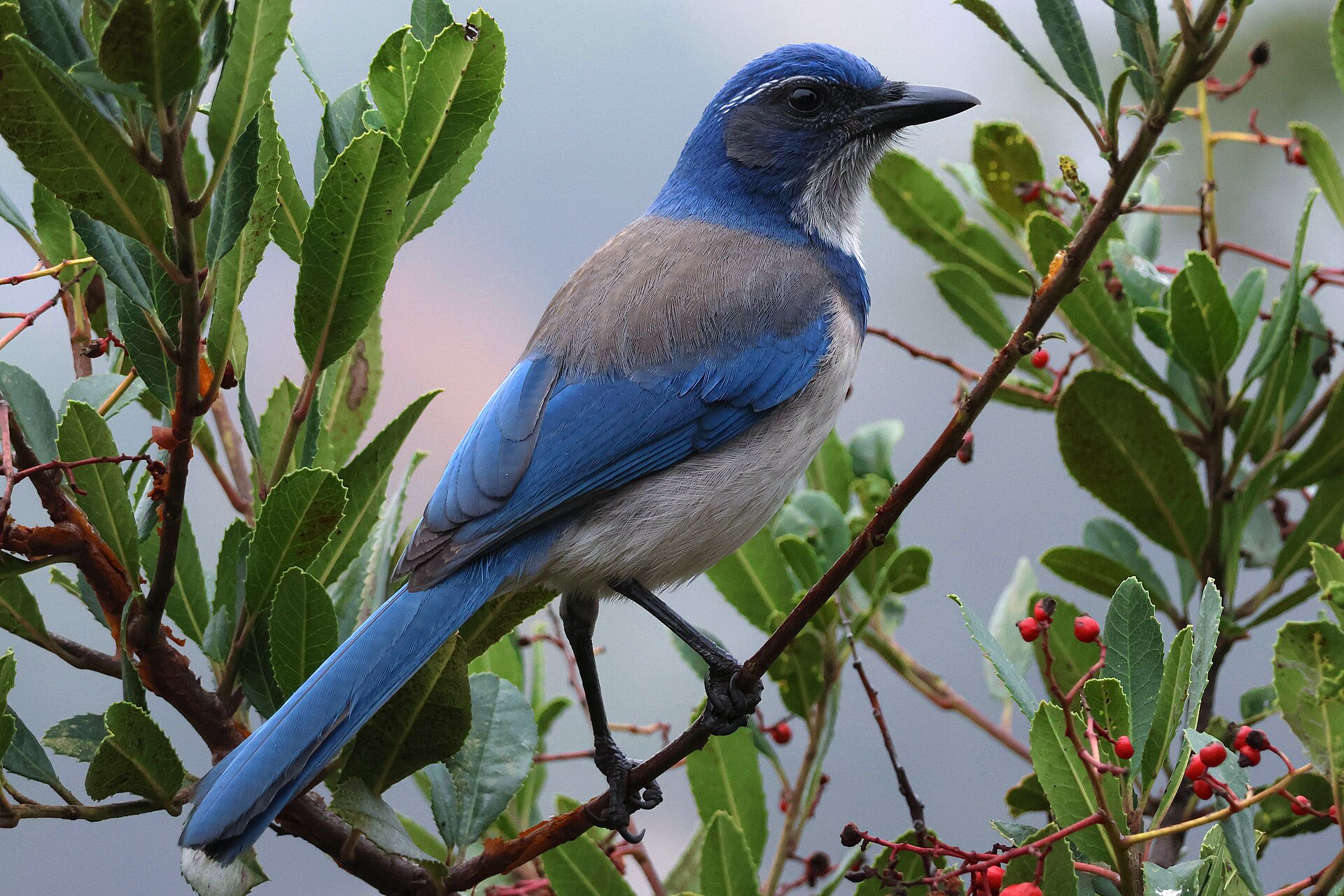
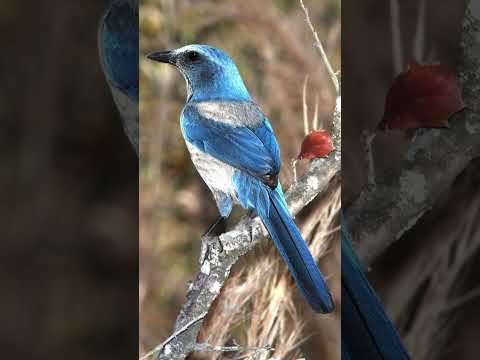
The California Scrub-Jay (Aphelocoma californica) is the crestless azure-blue jay of the Pacific slope — blue head, wings, and tail, a white throat framed by a blue breast band, and a gray-brown back patch. A crow-family bird of oak woodlands, chaparral, and suburban yards, it is bold, clever, and famous for caching thousands of acorns each fall and remembering where nearly all of them are. To attract it: offer whole peanuts in the shell and sunflower on a large platform feeder, and keep a bird bath filled. Listen for the loud, raspy “shreep” call — there is no melodic song. It shares coastal yards with the Oak Titmouse and the California Towhee.
Species Physical Profile & Morphometrics
The California Scrub-Jay is a large songbird of the crow and jay family (Corvidae) — and one of the most studied bird minds on Earth: experiments at UC Davis showed these jays remember what they cached, where, and when, and even re-hide food when a rival is watching. Until 2016 it was lumped with the interior Woodhouse’s Scrub-Jay as the “Western Scrub-Jay” — the two are now separate species.
The identification formula: azure-blue head, wings, and tail + white throat with blue breast band + gray-brown back patch + NO crest. The smooth, rounded crown is the fastest separator from the crested Steller’s Jay.
Essential Morphometric Field Marks:
- Body Length & Mass: about 11 to 11.8 inches (28–30 cm) and 2.5 to 3.5 ounces (70–100 grams) — Blue Jay size, but slimmer and longer-tailed in profile.
- Wingspan: about 15.3 inches (39 cm); flight is a quick, level dash from shrub to shrub, tail fanning on landing.
- Bill Structure & Color: A stout, straight, pointed black bill — strong enough to hammer acorns against a branch and nimble enough to pick an ant off a leaf.
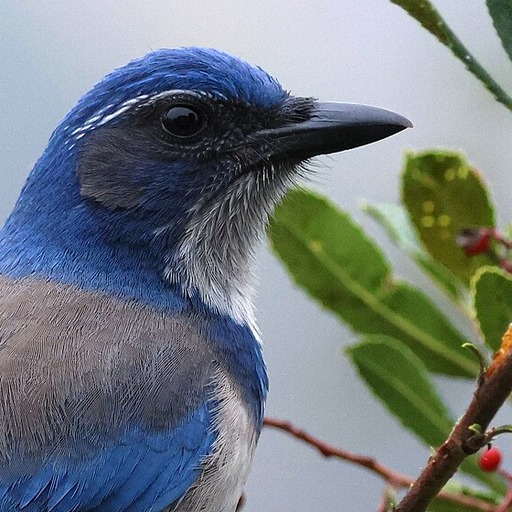
- Color Pattern: Azure-blue head, wings, and long tail; a clean white throat framed by a blue breast band; a gray-brown back patch between the blue; whitish-gray belly; faint pale eyebrow over a dark eye mask. No crest, no white in the wings or tail.
- Male vs. Female: The sexes look identical — same blue, same breast band; males average slightly larger. Pairs stay together on the same territory all year, which is the real clue you are watching a mated pair.
Same uniform, same attitude: plumage identical to the female, averaging a touch larger. He sings the quiet, gurgling courtship “whisper song” in spring and escorts his mate to the feeder — often yielding the first peanut to her.
Same uniform, chief nest-builder: identical blue-and-white plumage. She builds the twig cup low in dense shrub cover and incubates while the male stands sentinel — listen for the pair’s soft duetting close to the nest in March and April.
California Scrub-Jay Vocalization Guide (2 Field Recordings)
The California Scrub-Jay’s voice is all business: a loud, raspy, rising “shreep”, a rapid scolding “check-check-check” series, and quiet gurgling notes between mates — no melodious song. Both recordings below are real field audio hosted on Wikimedia Commons — no simulations. For a deeper library, browse xeno-canto: California Scrub-Jay.
1. The Raspy “Shreep” Call
2. The Scolding Series
Habitat, Range & the Pacific Slope
The California Scrub-Jay owns the Pacific coastal slope from southwestern Washington to Baja California — oak woodlands, chaparral, riverside scrub, and, increasingly, the suburbs woven through them. If your yard mixes oaks, shrubs, and open ground, you already have its floor plan.

Puget Sound to the Baja Peninsula
The range runs in a coastal ribbon from the Puget Sound lowlands of Washington through western Oregon and nearly all of California west of the Sierra Nevada and Cascades, continuing down Baja California. East of the Sierra crest the species hands off to its duller, paler cousin, the Woodhouse’s Scrub-Jay. Birds are strictly non-migratory — pairs hold the same patch of oaks or the same suburban block for years.
Backyards score best in oak or chaparral country, but plain suburbia works: a fence line, a shrub bed, a bird bath, and a peanut platform can hold a resident pair in the middle of a city.
Backyard Behavioral Patterns & Social Dynamics
The California Scrub-Jay is the sharp-eyed mayor of the coastal backyard. Four behaviors explain most encounters:
🌰 The Acorn Banker
Each fall a single scrub-jay can hide thousands of acorns, one per spot, scattered across its territory — and laboratory studies show it remembers what it hid, where, and when for months. The forgotten fraction sprouts: these jays are genuine oak planters.
👀 The Wary Cacher
If another jay watches it bury food, a scrub-jay will often return later and secretly re-hide the cache — behavior that implies it can imagine what another bird knows. This “theory of mind” research made the species famous far beyond birding circles.
🏘️ The Bold Neighbor
Few wild birds tame down faster: scrub-jays learn household routines in days, patrol picnic tables and patios, and will take peanuts from an outstretched hand once trust is established. Boldness is the species’ superpower — and occasionally its nuisance.
🚨 The Sentinel
A perched scrub-jay is a living burglar alarm: it posts up on the highest shrub, spots hawks and cats early, and erupts in raspy scolding that every bird in the yard obeys. Learn its alarm cadence and you will find the predators it finds.
Problem: “Scrub-Jays Bury Peanuts in My Lawn and Hog the Feeder. Can I Fix That?”
The three most common California Scrub-Jay complaints all have workable answers:
First, peanuts in the lawn and flowerpots: that is caching, the species’ signature — the bird is saving for winter, and most caches get retrieved. If sprouts annoy you, ration the offering (a handful of peanuts in the morning instead of a full feeder) and pull the occasional oak seedling; it is a small rent for the entertainment. Second, feeder dominance: don’t fight it, partition it — give the jays their own platform with whole peanuts several yards away, and hang tube feeders with short perches the jay can’t work. Third, stolen pet food and raided nests: feed pets indoors and keep kibble off the patio; nest-raiding is natural crow-family behavior, and dense native shrub cover gives nesting songbirds the protection they need.
Method 1: Set the Table — Whole Peanuts & a Platform
Design for a bold, clever nut specialist:
-
Lead with Whole Peanuts in the Shell
The fastest scrub-jay magnet there is — in-shell peanuts on a platform get hammered open on the spot or carried off to cache in your flower beds. Expect the local pair to learn your refill schedule within days.
-
Use a Large, Rigid Platform
A scrub-jay is too big for tube perches and distrusts swinging feeders. A large tray or fly-through platform, firmly mounted within a quick dash of shrub cover, is the landing pad it will commit to.
-
Add Sunflower and Suet
Black oil sunflower is the everyday staple, and a suet cage carries the pair through the cool, wet coastal winter when insects vanish — the same cage your Northern Flicker will happily share.
-
Ration to Manage the Caching
Because surplus food gets buried, serve measured portions — a dozen peanuts each morning beats a topped-up feeder. You get daily visits at a predictable hour, and the lawn stays mostly sprout-free.
Method 2: Build the Habitat — Oaks, Toyon & Water
Feed the habitat, and the jays follow:
-
Plant (or Keep) a Native Oak
Oaks are the anchor of scrub-jay country — coast live oak, valley oak, or interior live oak depending on your area. One acorn-bearing oak can hold a jay pair for decades and feeds the caching instinct that defines the species.
-
Add Berry Shrubs like Toyon
Toyon, elderberry, and coffeeberry add winter fruit and dense cover in one package — the classic chaparral structure the species evolved in, scaled down to garden size.
-
Provide a Bird Bath They Trust
Scrub-jays are enthusiastic, splashy bathers — a shallow basin with open sightlines near a shrub gets daily use, and in dry-summer California a reliable bath can matter more than any feeder.
-
Leave a Dense Corner for Nesting
Pairs nest low in thick shrub cover and go quiet and secretive in spring. Keep pruning and foot traffic away from the densest corner of the yard from March through June and you may host a family.
Tool Solution: Recommended Hardware for California Scrub-Jays
Equipment matched to a large, bold, peanut-caching corvid:
Large Platform / Tray Feeder
A big, rigid tray or fly-through platform — the only common feeder style a scrub-jay commits to with confidence, and the natural stage for peanuts, sunflower, and acorns you collect yourself.
- • Food: Whole peanuts, sunflower, cracked corn
- • Style: Large rigid tray, drain holes
- • Placement: Firm mount, a short dash from shrub cover
Wire Peanut Wreath / Suet Cage
A wire wreath holding whole in-shell peanuts — or a solidly mounted suet cage for winter — turns feeding into a show: the jay clings, hammers, and flies off to cache the prize in your garden.
- • Food: Whole peanuts in the shell; suet blocks
- • Style: Wire wreath or heavy-duty suet cage
- • Placement: A few yards from small-bird feeders
Heated Bird Bath
A shallow basin with clean, moving water — essential in California’s dry summers, and a thermostatic heater covers frosty Sierra-foothill and high-desert-edge mornings where the species reaches inland.
- • Depth: 1–2 in, gently sloped
- • Winter: Thermostatic heater or de-icer
- • Placement: Open sightlines beside dense cover
Frequently Asked Questions
- Species Profile: The California Scrub-Jay (Aphelocoma californica) is an 11–11.8 inch, 70–100 gram corvid (Corvidae) of the Pacific slope — azure-blue head, wings, and tail, white throat with blue breast band, gray-brown back patch, band code CASJ.
- ID in One Look: Crestless blue jay + white throat + blue breast band is diagnostic on the coast; the smooth crown separates it instantly from the crested Steller’s Jay.
- Strictly Non-Migratory: Pairs hold the same territory all year from Washington to Baja — your feeder jay is the same individual all twelve months.
- The Sound: A loud, raspy, rising “shreep” and a scolding “check-check-check” — no melodious song at all.
- Feeder Formula: Whole peanuts in the shell and sunflower on a large rigid platform near shrubs, plus a bird bath — serve measured portions, because the surplus gets buried in your lawn.
- The Famous Memory: Scrub-jays remember what they cached, where, and when — and re-hide food when a rival is watching, a hallmark of animal intelligence research.
Bird Watching Log
Species: California Scrub-Jay (Aphelocoma californica)
| California Scrub-Jay (Peanut Taken: Yes / No — Caching Seen: Yes / No — Shreep Heard: Yes / No — Sentinel Posted: Yes / No) | |