
Greater Roadrunner


Greater Roadrunner (Geococcyx californianus): Complete Identification, Habitat Guide & Call Library
Quick Answer: How to Attract & Identify the Greater Roadrunner
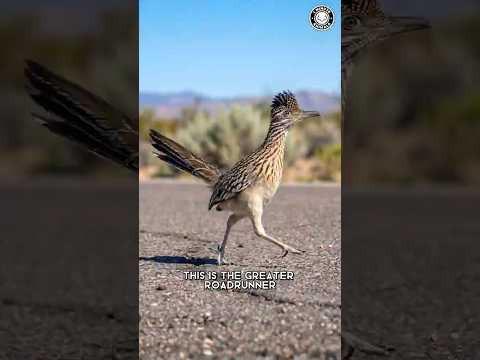
The Greater Roadrunner (Geococcyx californianus) — the state bird of New Mexico — is the Southwest’s most charismatic ground bird: a two-foot-long ground cuckoo that sprints up to 20 mph after lizards, mice, and snakes, rattlesnakes included. With its shaggy crest, long white-tipped tail, and streaked camouflage, it stalks desert yards, ranchland, and scrub suburbs from California to Texas. You won’t attract it with seed — water features, lizard-friendly habitat, and an untidy desert corner are the invitation. Pairs mate for life and duet with soft, dove-like coo-coo-coo calls. It shares desert backyards with the Gila Woodpecker and the Curve-billed Thrasher.
Species Physical Profile & Morphometrics
The Greater Roadrunner belongs to the cuckoo family (Cuculidae) — a ground-going cousin of the tree cuckoos, built for speed: long legs, a long balancing tail, and feet with two toes forward and two back that leave X-shaped tracks in desert dust. It is the largest cuckoo in North America and one of the very few birds that routinely kills and eats rattlesnakes.
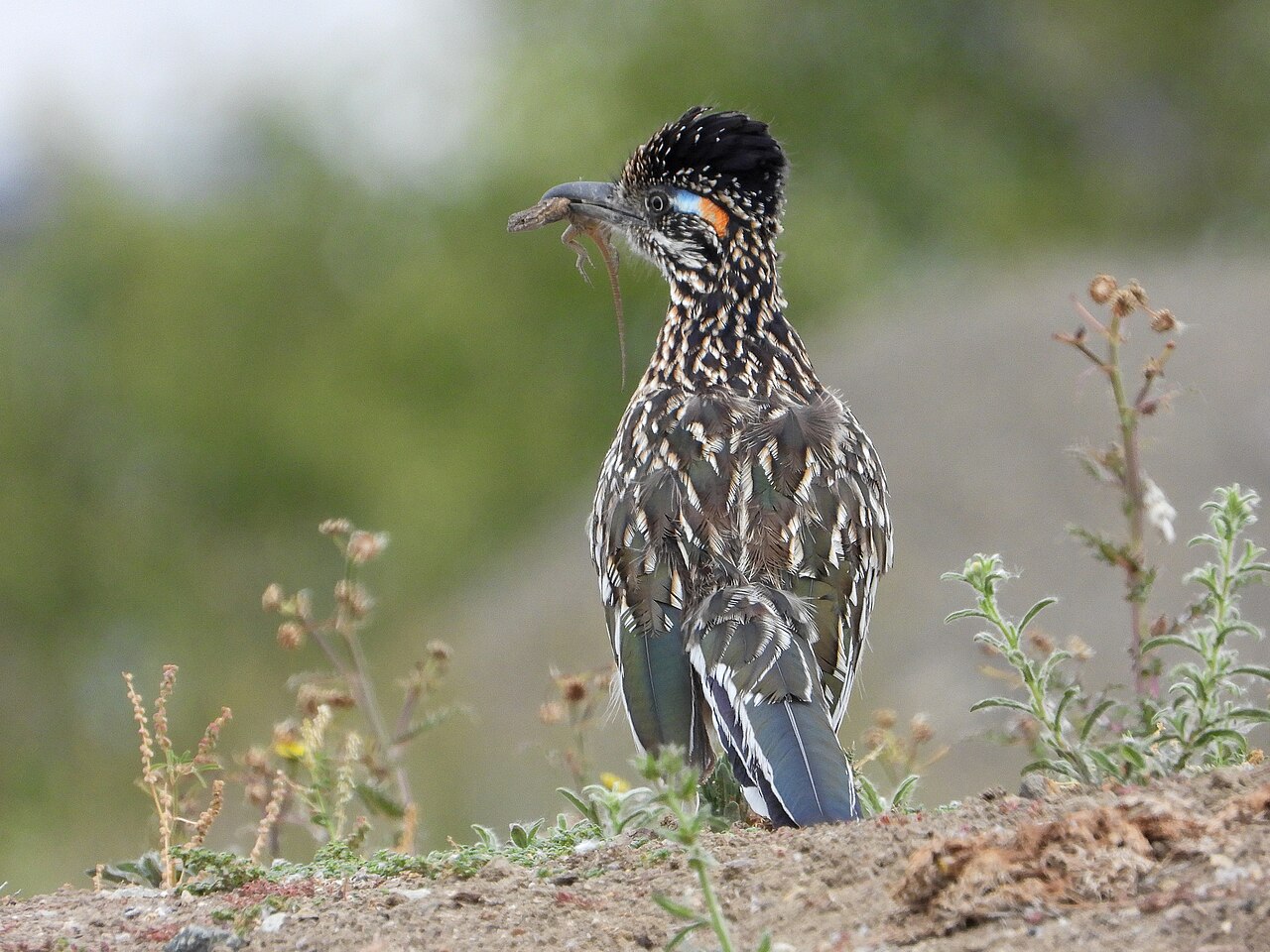
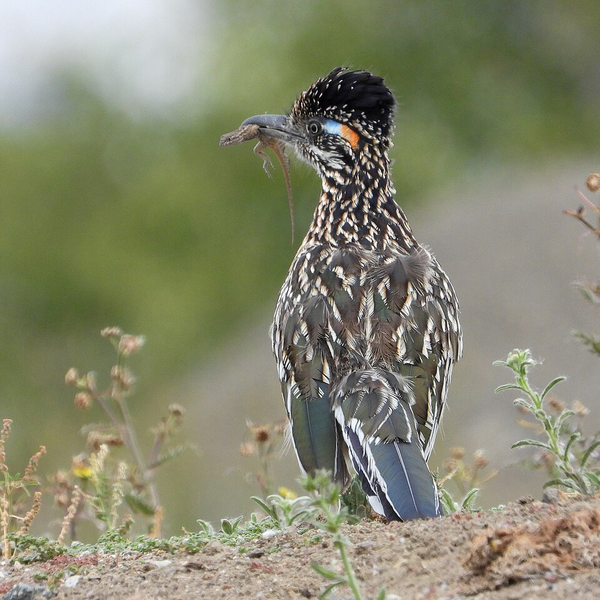
Unmistakable. Big, long-tailed, long-legged, crested, streaked brown-and-buff, running flat-out across open ground — there is no second candidate. Perched birds show the shaggy crest, the stout slightly decurved bill, and bare blue-and-orange skin behind the eye. In flight — rare and brief — it reveals a white crescent on the wing before planing to the ground, where it would rather be.
Essential Morphometric Field Marks:
- Body Length & Mass: 20.5 to 21.3 inches (52–54 cm) including the long tail, and 7.8 to 19 ounces (221–538 grams) — half the length is tail; males average larger than females.
- Wingspan: 17 to 24 inches (43–61 cm); flight is rare, short, and gliding — a downhill plane to the next bush. Running, up to 20 mph, is the real locomotion.
- Bill Structure & Color: A long, heavy, slightly decurved bluish-gray bill — a spear for lizards and a club for snakes, wielded with rapid head strikes and rock-pounding swings.
- Color Pattern: Streaked and mottled brown, black, buff, and white overall, a shaggy erectile crest, a long dark tail edged with white tips, and — seen up close — a patch of bare blue and orange skin behind each eye.
- Male vs. Female: Sexes look alike; the male averages slightly larger. Behavior tells more: the deep-cooing advertising bird of spring is typically the male, and both parents take turns at the nest and at feeding the chicks lizards whole.
The deep cooer: slightly larger, and in spring the bird that delivers the low, dove-like coo-coo-coooo advertising calls from a perch at dawn, tail dipping with each note. He builds the nest platform of sticks and feeds the female snakes while she incubates.
Same streaks, same speed — nearly identical plumage and just as deadly with a lizard. She lays 3–6 eggs in the stick nest, and both parents hunt from dawn to dusk to feed a brood that can swallow astonishingly large prey whole.
Greater Roadrunner Vocalization Guide (1 Field Recording)
The Greater Roadrunner’s song is unexpected from such a fierce hunter: a soft, low, dove-like coo-coo-coo-coooo that descends and fades, carrying surprisingly far across still desert air at dawn. The second classic sound is mechanical — bill clacking, a dry wooden rattle used in alarm and pair contact. All recordings below are real field audio via Wikimedia Commons — no simulations. For a deeper library, browse xeno-canto: Greater Roadrunner.
1. The Dawn Cooing
2. The Bill Clack
3. Calls of the Pair
Habitat, Range & the Desert Edge
The Greater Roadrunner lives wherever the Southwest is open, dry, and crawling with prey: desert scrub, chaparral, grassland, ranchland, and the big-lot fringes of desert cities like Tucson, Phoenix, and Albuquerque. It needs bare ground to run, low cover to hunt around, and a thorny tree or cactus to nest in. Desert yards with natural landscaping are prime roadrunner territory.

The Year-Round Voice of the Southwest
The roadrunner’s range blankets the American Southwest — California’s deserts, Nevada, Utah, Arizona, New Mexico, Texas, and the southern Plains fringe east to Louisiana and Missouri’s bootheel — and runs deep into Mexico. Everywhere in that range it is resident: the same pair may hold your neighborhood for years.
For backyard birders the message is opportunity: in the desert suburbs and rural Southwest, a roadrunner is a legitimate yard bird. Properties with native desert landscaping, ground-level water, and healthy lizard populations get regular patrols — the bird trots the same route every day, and a patient watcher learns its schedule.
Backyard Behavioral Patterns & Social Dynamics
The Greater Roadrunner is a velociraptor with manners — a ground predator that happens to be charming. Four behaviors explain most of what you will observe:
🏃 The Sprinter
Roadrunners run down prey at up to 20 mph — crest flat, tail level, legs a blur. They would rather sprint than fly, and even crossing a road they trust their legs. Watch a hunting bird: it freezes mid-stride, one foot raised, then strikes like a thrown dart.
🐍 The Snake Killer
Yes, the legend is true: roadrunners kill rattlesnakes. Working in pairs or alone, they bait the strike, dodge, and snatch the snake behind the head, then batter it against rock until it stops moving. The prize is swallowed headfirst, sometimes over an hour as it digests.
☀️ The Sunbather
On cold desert mornings a roadrunner turns its back to the sun and flares its back feathers, exposing a patch of black skin that absorbs heat — a solar panel that lets the bird save calories it would otherwise burn staying warm.
💍 The Lifelong Pair
Roadrunner pairs mate for life and hold the same territory year-round. The male courts with food offerings — a lizard presented tail-first — and the pair duets softly at dawn. A yard with one roadrunner actually has two.
Problem: “A Roadrunner Trots Through My Yard but Never Stops. What Should I Do?”
The three most common Greater Roadrunner situations all have proven answers:
First, the pass-through bird: a roadrunner on patrol is working a circuit — it will stop where hunting and water reward it. A ground-level water dish, an untidy corner with native shrubs, and a lizard-rich rock pile turn a pass-through yard into a scheduled stop. Second, the feeder question: roadrunners ignore seed entirely — don’t try. What they will take is offered meat: a few mealworms or a mouse, yes, but resist habituating a wild predator; water and habitat are the ethical invitation. Third, the worry about smaller birds: a resident roadrunner may occasionally take a nestling, but it mostly hunts reptiles and rodents — its presence is a sign of a healthy desert yard, and most songbirds treat it with watchful calm rather than panic. Give it room, keep pets supervised, and enjoy the best free pest control in the Southwest.
Method 1: Set the Table — Prey, Water & Desert Shelter
Design for a running desert predator:
-
Provide Ground-Level Water
The single most reliable draw: a shallow water dish or ground-level birdbath kept full through the desert summer. Roadrunners get moisture from prey but drink readily, and water anchors a daily route.
-
Build a Lizard-Friendly Corner
Flat rocks, a small rock pile, and native bunch grasses make lizard habitat — and lizards make roadrunner habitat. An xeriscaped corner with stones beats any feeder.
-
Leave Native Desert Cover
Native shrubs, agaves, and cactus clumps give roadrunners hunting cover, shade, and nest sites. Gravel-only yards are deserts to a bird, too — keep or plant the real thing.
-
Skip the Rodent Poison
Roadrunners eat mice and young rats — poisoned rodents kill their predators. Snap traps in a barn, yes; anticoagulant bait where a roadrunner hunts, never.
Method 2: Build the Territory — What Keeps a Pair for Life
Feed the territory, and the roadrunner adopts you:
-
Keep a Thorny Nest Tree
Roadrunners nest 3–10 feet up in thorny trees and cholla — mesquite, hackberry, or a dense cactus clump. A yard with one good protected fork is a potential nest site for a decade.
-
Watch the Dawn Patrol
Learn the bird’s schedule: most yard roadrunners patrol at first light and again near dusk. Quiet observation from a window — never pursuit — builds the bird’s tolerance and your viewing.
-
Offer Space, Not Snacks
Resist taming attempts: a roadrunner that expects handouts becomes a nuisance and a road statistic. Water, prey habitat, and respectful distance keep the relationship wild and long.
-
Protect from Pets
A free-roaming cat is no match for a roadrunner’s alertness, but dogs can corner one — supervise pets where roadrunners hunt, and the birds will keep their relaxed daily routes.
Tool Solution: Recommended Hardware for Greater Roadrunner
Equipment matched to a desert ground predator:
Ground-Level Water Dish
A wide, shallow dish kept clean and full through the hot season — the one reliable way to schedule a roadrunner’s daily visit.
- • Depth: 1–2 in, stable base
- • Refresh: Daily in summer
- • Placement: Open ground, visible
Rock & Brush Pile
Flat stones and a loose brush pile in a sunny corner — lizard and rodent habitat that turns your yard into hunting grounds worth patrolling.
- • Build: Flat rocks, loose limbs
- • Location: Sunny desert corner
- • Bonus: Thrashers & quail use it too
Native Thorny Tree
A mesquite, hackberry, or dense cholla — the protected fork where a pair may nest year after year, 3–10 feet off the ground.
- • Species: Mesquite, hackberry, cholla
- • Height: 6–15 ft mature
- • Placement: Quiet side of the lot
Frequently Asked Questions
- Species Profile: The Greater Roadrunner (Geococcyx californianus) is a 20.5–21.3 inch ground cuckoo (Cuculidae), band code GRRO — New Mexico’s state bird and the fastest running bird that can fly.
- ID in One Look: Shaggy crest, long white-tipped tail, streaked desert camouflage, stout decurved bill — and legs built for 20-mph sprints.
- The Sound: Soft, descending dove-like coo-coo-coo at dawn, plus dry mechanical bill-clacking; real field recordings above.
- Range & Habit: Resident year-round across the Southwest from California to Texas and deep into Mexico; pairs hold lifelong territories.
- Feeder Formula: Skip seed — offer ground-level water, lizard-rich rock piles, native desert cover, and a thorny nest tree.
- The Snake Legend Is Real: Roadrunners kill rattlesnakes with speed, precision head strikes, and rock-pounding — then swallow them headfirst.
Bird Watching Log
Species: Greater Roadrunner (Geococcyx californianus)
| Greater Roadrunner (Crest Raised: Yes / No — Running Seen: Yes / No — Prey Carried: ___ — Cooing Heard: Yes / No — Bill Clacking: Yes / No) | |