
Java Sparrow
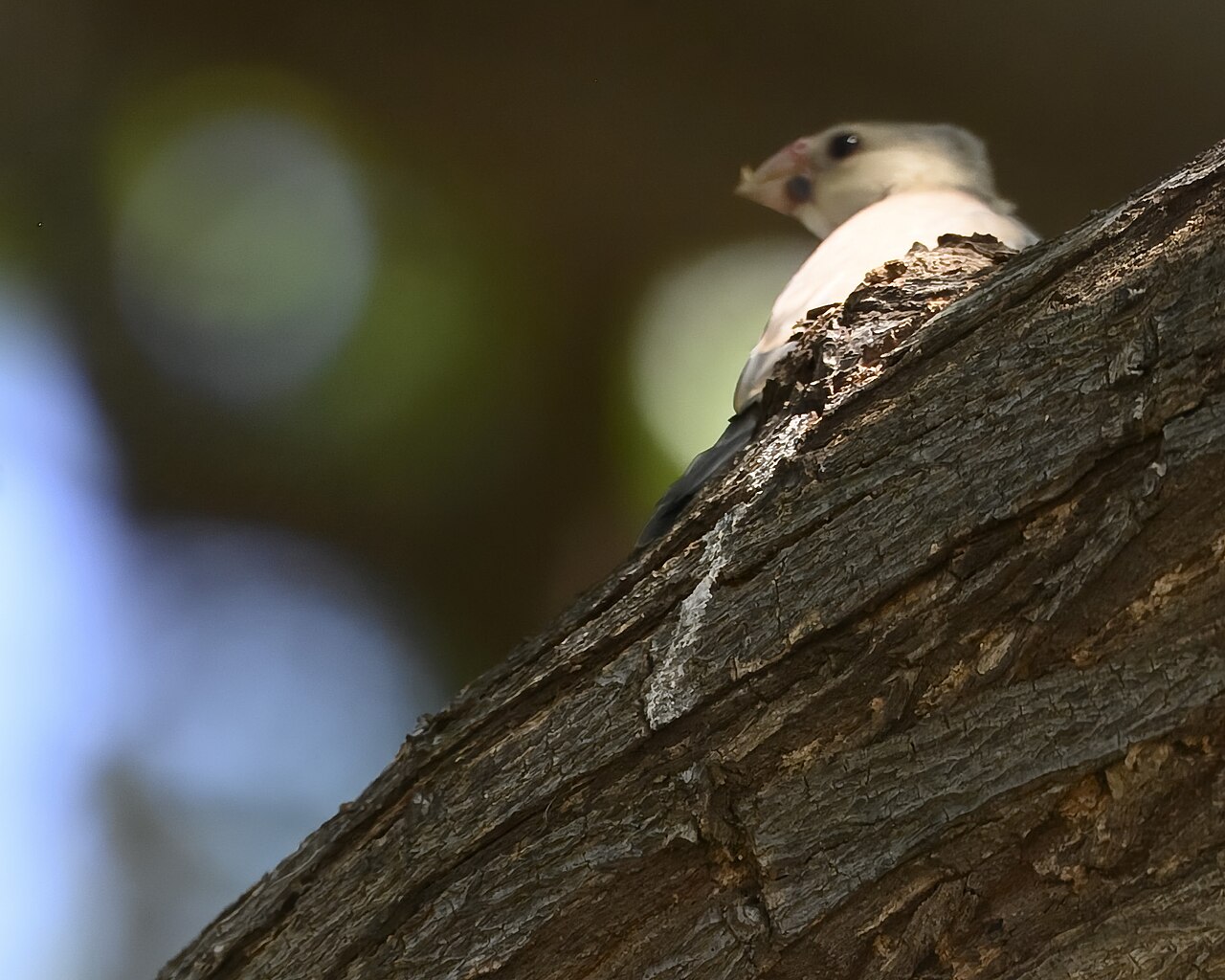


Java Sparrow (Padda oryzivora): Complete Identification, Habitat Guide & Sound Library
Quick Answer: How to Attract & Identify the Java Sparrow
The Java Sparrow (Padda oryzivora) — also called the Java finch or rice bird — is the gray flocking finch with the carnival head: black cap, huge white cheek patches, and an oversized pink bill. Endangered in its native Java and Bali, it thrives as an introduced bird in Hawaii’s lowland grass and parks. Its voice is a soft clucking and bell-like tinkling. It feeds on grass seeds in tight flocks. Island yards attract them with un-mowed grass seed heads, scattered millet, and a ground water dish. They share the lawn with the Common Waxbill and the Zebra Dove.
Species Physical Profile & Morphometrics
The Java Sparrow belongs to the estrildid finch family (Estrildidae) — the waxbills and munias — a native of Java and Bali introduced to Hawaii in the 1960s and now common in grassy lowlands on several islands.
The identification formula: gray body + black head + white cheek patch + huge pink bill — nothing else in Hawaii comes close. They are almost always in flocks; a dozen gray birds rising from a seeding lawn, white cheeks flashing, is the classic sighting.
Essential Morphometric Field Marks:
- Body Length & Mass: 5.9 to 6.7 inches (15–17 cm) and 0.7 to 1.0 ounces (20–28 grams) — a stocky, big-headed finch, the heavyweight of Hawaii’s estrildids.
- Wingspan: Wings are short and pointed, built for whirring flock dashes from lawn to tree — not for distance.
- Bill Structure & Color: A huge, deep-pink conical bill — a seed-cracking machine that handles grass seeds other finches cannot husk.
- Color Pattern: Slate-gray back and breast, pinkish belly, jet-black head with big white cheek patches, red eye-ring, and white undertail coverts.
- Male vs. Female: Sexes look alike; males have a slightly larger bill and eye-ring and do the singing — a soft, bell-like jingle from a perch.
The jingling carnival bird: black-masked and pink-billed, singing his soft bell-like song from the grass stalk, then dropping into the flock to husk seeds with machinery precision.
The matched partner — same mask, slightly finer bill — she shares the big untidy grass nest in a tree cavity or palm crown, both parents shuttling seed to the chicks.
Java Sparrow Vocalization Guide (2 Field Recordings)
The Java Sparrow’s voice is soft for such a bold-looking bird: clucking contact notes, a bell-like tinkling song, and the flock’s murmuring chatter. All recordings below are real field audio via Wikimedia Commons — no simulations. For a deeper library, browse xeno-canto: Java Sparrow.
1. The Bell Jingle
2. The Flock Chatter
3. The Takeoff Whir
Habitat, Range & the Seeding Lawn
In Hawaii the Java Sparrow lives in open grassy country: park lawns, golf courses, pasture edges, roadsides, and gardens with seeding grass — always near trees or shrubs for cover. It is a bird of the dry and mesic lowlands, gathering wherever grass goes to seed.

The Refugee from the Rice Paddies
Native to Java and Bali — where trapping for the cage-bird trade has made it endangered in the wild — the species was introduced to Hawaii in the 1960s and now thrives on Oahu, Hawaii, Maui, and other islands. Hawaii holds one of the healthiest populations anywhere.
For island yards: a lawn allowed to go to seed at the edges, a millet scatter, and a water dish will pull in the local flock — and you will be hosting a species that is vanishing from its native islands.
Backyard Behavioral Patterns & Social Dynamics
The Java Sparrow is a flocking grass-seed specialist with a machinery-grade bill. Four behaviors explain most of what you will observe:
👥 The Tight Flock
Outside nesting they live in flocks of a dozen to hundreds, feeding shoulder to shoulder and rising as one when alarmed.
🌾 The Grass-Seed Machine
The huge bill husks grass seeds at speed — watch a flock work a seeding lawn and you are watching a harvest crew.
🏰 The Communal Nester
They nest in big untidy grass balls in tree cavities and palm crowns, often several pairs close together — a small colony in one tree.
💧 The Water Regular
Flocks drink and bathe at the same water daily — a dependable dish becomes a flock appointment, morning and afternoon.
Problem: “A Big Flock Visited for a Week, Then Vanished. What Should I Do?”
The three most common Java Sparrow puzzles all have proven answers:
First, the wandering flock: flocks track seeding grass — when your lawn’s seed heads are stripped, they move to the next field. Stagger your mowing (leave one section seeding at all times) and keep the millet scatter constant, and the flock returns daily instead of weekly. Second, the is-it-endangered question: yes — in Java and Bali it is Endangered from cage-bird trapping; the Hawaiian population is introduced but important, so enjoy and protect your flock. Third, the which-finch question: small brown estrildids at the same lawn are usually Common Waxbills or munias — the Java is the big gray one with the carnival head; size and the white cheeks settle it.
Method 1: Grow the Harvest — Seed Heads & Daily Millet
Design for a grass-seed harvest crew:
-
Let Grass Go to Seed
Leave a lawn section or verge un-mowed until the seed heads ripen — a self-growing Java Sparrow buffet.
-
Scatter Millet Daily
White millet on open ground at a set hour — the dependable supplement that turns a visiting flock into a resident one.
-
Stagger the Mowing
Mow in rotation — one strip always in seed — so the food supply never drops to zero.
-
Provide a Ground Water Dish
A shallow pan refreshed daily — flocks bathe together, and the bathing show is half the reward.
Method 2: Keep the Flock Safe — Cover, Cats & Quiet
Flocks feed where escape is close:
-
Feed Beside Tree Cover
Scatter seed within a short flight of trees or tall shrubs — a flock will not linger on a lawn far from refuge.
-
Keep Cats Indoors
A ground-feeding flock is cat bait — indoor cats are the price of hosting this endangered species.
-
Offer a Palm or Cavity Tree
If your yard has palms or old trees with cavities, a colony may nest — leave dead palm crowns where safe.
-
Watch at the Appointed Hours
Flocks feed early morning and late afternoon — be seated quietly then, and the lawn will fill.
Tool Solution: Recommended Hardware for Java Sparrow
Equipment matched to a flocking estrildid finch:
Seeding Lawn Strip + Millet
An un-mowed grass strip plus a daily millet scatter — harvest and insurance policy in one station.
- • Food: Grass seed, millet
- • Style: Ground scatter
- • Timing: Same hour daily
Wide Shallow Water Pan
A broad pan with an inch of water — flocks drink and bathe together; refresh it daily and the appointment is kept.
- • Depth: 1 inch
- • Style: Ground level
- • Bonus: Doves & waxbills
Palm Crown & Cavity Tree
Mature palms or cavity-bearing trees near the feeding lawn — nest colony potential for a species that needs it.
- • Feature: Cavities, crowns
- • Style: Untrimmed where safe
- • Bonus: Mynas & finches
Frequently Asked Questions
- Species Profile: The Java Sparrow (Padda oryzivora) is a 5.9–6.7 inch, 0.7–1.0 ounce estrildid finch (Estrildidae), band code JASP — the carnival-headed rice bird of Hawaiian lawns.
- ID in One Look: Gray body, black head, white cheeks, huge pink bill — always in flocks.
- The Sound: Soft bell-like jingle and flock chatter; real field recordings above.
- Range & Habit: Endangered in native Java and Bali; thriving introduced population in Hawaiian grassy lowlands.
- Garden Formula: Seeding grass strip, daily millet scatter, ground water dish, tree cover nearby.
- The Conservation Twist: Hawaii’s feral flocks are a lifeline for a species vanishing at home.
Bird Watching Log
Species: Java Sparrow (Padda oryzivora)
| Java Sparrow (Flock Size: ___ — White Cheeks Seen: Yes / No — At Millet: Yes / No — At Water: Yes / No — Date & Time: ___) | |