
Juniper Titmouse
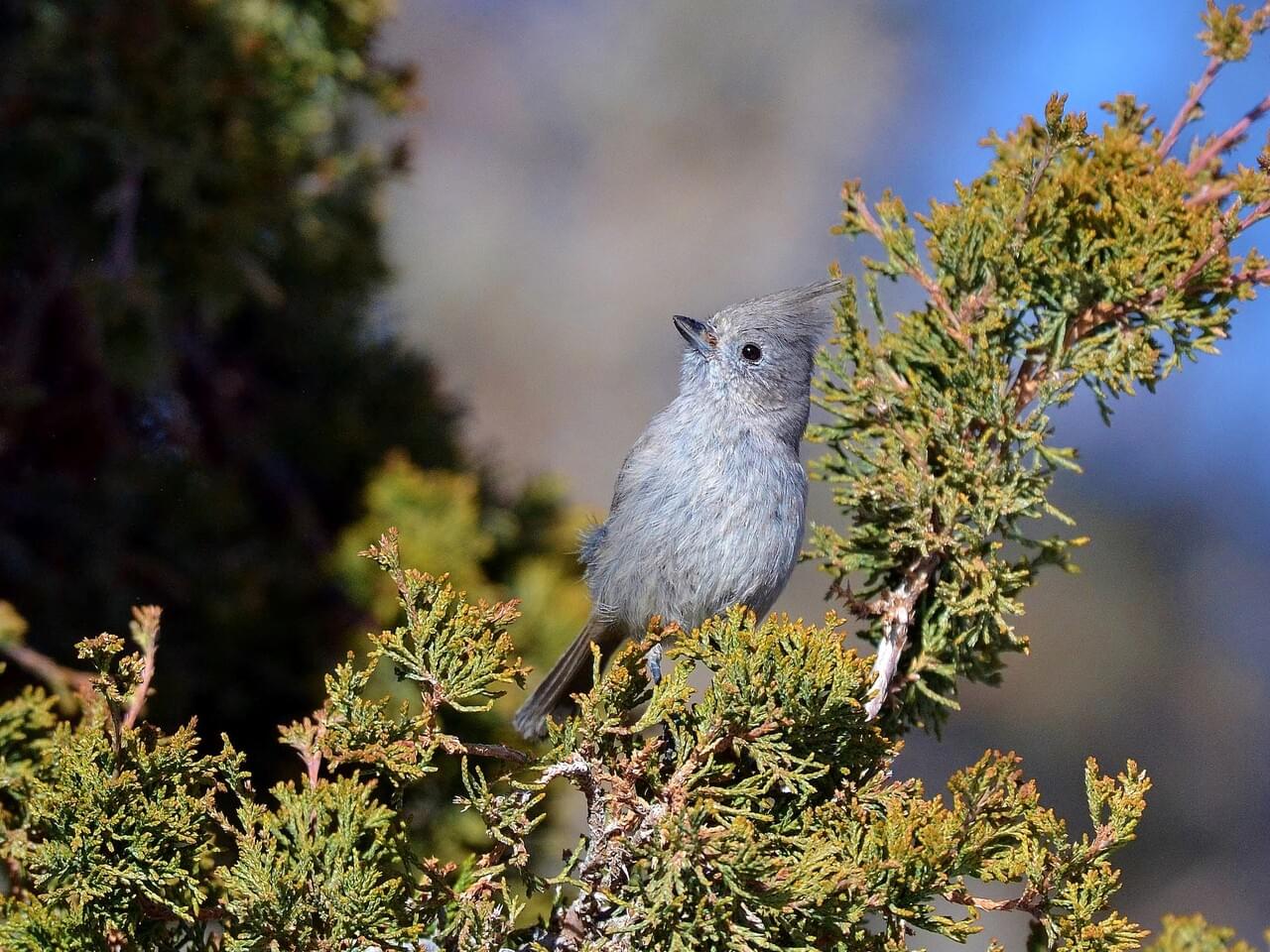


Juniper Titmouse (Baeolophus ridgwayi): Complete Identification, Feeder Guide & Call Library
Quick Answer: How to Attract & Identify Juniper Titmice
The Juniper Titmouse (Baeolophus ridgwayi) is the plain gray titmouse of the pinyon-juniper West — a 5.5–5.75-inch acrobat with a short crest, stubby bill, and beady black eye on an unmarked gray face. A non-migratory year-round resident of the Great Basin and interior Southwest, it rolls out a rapid single-pitch song and scratchy “tsicka-dee-dee” calls. Mated pairs hold the same territory all year and roost overnight in cavities. In arid country, attract them with black oil sunflower, suet, and peanut pieces near juniper or pinyon cover — and above all a dependable water source, often the single biggest draw on dry land. Hang a nest box with a 1-1/4-inch entrance for spring.
Species Physical Profile & Morphometrics
The Juniper Titmouse is one of the two “plain titmice” split apart in 1996 — separated from its California cousin, the Oak Titmouse, by differences in song, habitat, and genetics. It wears the tit family (Paridae) uniform in its plainest form: soft gray from crest to tail, a stubby bill, and a large dark eye.
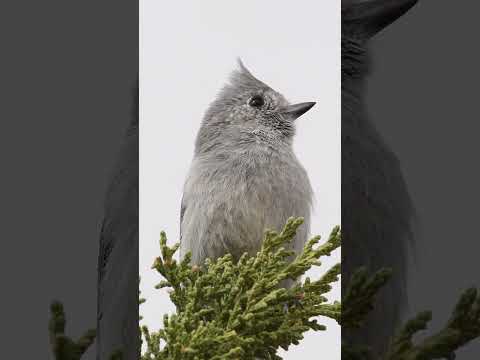
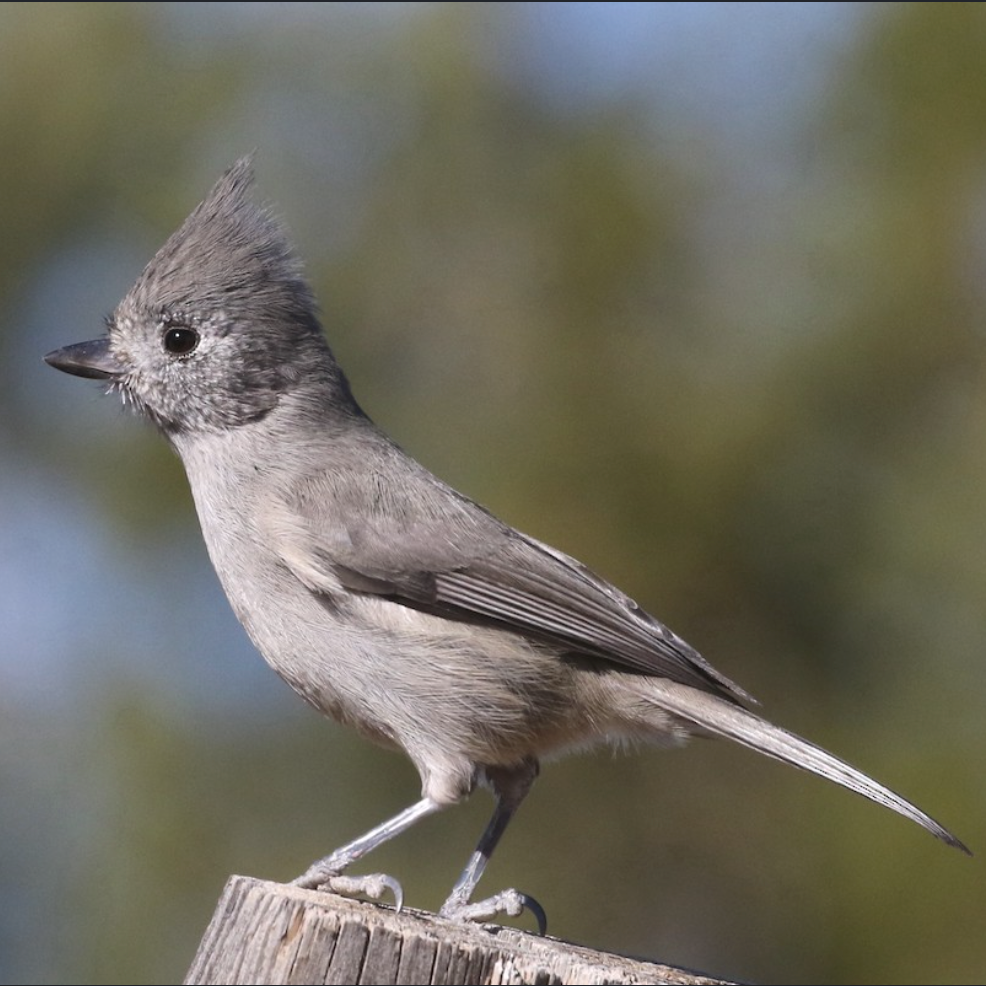
In the field, absence of pattern is the pattern: cool gray above, paler gray below, a short crest that lifts and flattens with mood, and no black, white, or rust anywhere. Compared side by side, the Oak Titmouse is subtly browner; the surest separator is the song — the Juniper rolls its notes on a single pitch, while the Oak lets each phrase drop at the end. The two species overlap only in a sliver of California, so habitat and range usually settle the ID.
Essential Morphometric Field Marks:
- Body Length & Mass: Averages 5.5 to 5.75 inches (14–14.6 cm) with an adult mass of 0.4 to 0.7 ounces (12–21 grams).
- Wingspan: About 9 inches (23 cm), with plain gray wings and a medium-long gray tail.
- Bill Structure & Color: A short, stubby gray-black bill built for gleaning insects from juniper sprays and hammering seeds open against a branch.
- Color Pattern: Plain cool gray above, paler below, short crest, unmarked face with a prominent black eye. Males and females look identical, and juveniles closely match adults.
Uniform cool gray from the lifted crest down the back, washing to pale gray on the breast, with the dark eye standing out on the plain face. Adult males and females cannot be separated in the field.
Summer juveniles look like slightly fluffier adults in the same plain gray. Young birds may linger with their parents for months — and occasionally stay on to help raise the next brood.
Juniper Titmouse Vocalization Guide (3 Simulations)
The song is a rapid, rolling series of whistled notes on one pitch — the field mark that separates this species from the Oak Titmouse even where plumage will not. The call is a scratchy, chickadee-like “tsicka-dee-dee.” No commercial-use field recordings of this species are currently hosted on Wikimedia Commons, so all three cards below are clearly labeled acoustic simulations built to the published descriptions of its voice. For real wild audio, browse xeno-canto: Juniper Titmouse.
1. Rolling Song — Single-Pitch Series
2. Scratchy Contact Call — “Tsicka-Dee-Dee”
3. Dawn Song Bouts
Habitat, Range & Year-Round Resident Biology
Juniper Titmice are birds of the pinyon-juniper woodland belt — the open, fragrant woodlands that cover the mesas and foothills of the Great Basin and interior Southwest. The range runs through Nevada, Utah, western Colorado, Arizona, and New Mexico, with edges in Idaho, Wyoming, and eastern California — where it narrowly meets the Oak Titmouse.

A Homebody of the High Desert
These birds never migrate. A mated pair holds the same stretch of woodland in every season, roosting overnight in cavities, dense foliage, or birdhouses, and riding out both desert heat and high-country snow on its home ground.
A yard with mature junipers or pinyons, a shrub layer, water, and a steady feeder fits their needs exactly. Outside the breeding season, family groups drift short distances and may join small mixed flocks with Mountain Chickadees and nuthatches.
Backyard Behavioral Patterns & Social Dynamics
Juniper Titmice are quiet, methodical birds of open woodland. Four signature behaviors explain most of what you will observe:
🌰 Hammer, Cache, Remember
A titmouse carries a seed to a branch, pins it and hammers it open — like the gallery bird with a seed in its bill — and stashes surplus in bark crevices. Pinyon seeds and juniper berries are wild staples; sunflower and peanuts are the feeder equivalents.
📣 The Single-Pitch Roller
The song is a rapid roll of notes on one unwavering pitch — the voice of pinyon-juniper country at dawn. Learn this roll and you can separate this species from the Oak Titmouse by ear alone, even where the two look identical.
👨👩👧 The Family That Stays
Pairs hold permanent year-round territories, and unusually for titmice, young birds sometimes remain with their parents and help feed the next season’s nestlings — one of the few hints of cooperative breeding in the family.
🕳️ The Cavity Sleeper
Juniper Titmice roost overnight in cavities, dense foliage, or birdhouses. A nest box near the junipers can serve as winter bedroom and spring nursery for the same faithful pair.
Problem: Why Juniper Titmice Skip Dry, Exposed Yards
Across the interior West the usual complaint runs: “titmice in the hills, none at my feeder.” The reasons are predictable:
First, this is a woodland-anchored bird: a feeder far from junipers or pinyons forces a long, hawk-visible flight for every seed, so the birds forage elsewhere. Second, the menu matters: bargain mixes heavy in milo and millet get inspected and rejected — this species shops for sunflower, suet, and peanuts. Third, and unique to the arid West, a dry yard is a dead end: where natural water is scarce for months, a property without a bird bath simply offers less than the canyon up the road. Put the right menu near tree cover and keep water running — the resident pair will fold your yard into its territory.
Method 1: Set the Table — Seeds, Suet & Water
Design for a methodical resident of dry country:
-
Anchor with Black Oil Sunflower
A hopper or tube feeder with a tray filled with black oil sunflower is the daily staple. Our lab-tested roundup of the Best Tube Feeders for Small Birds compares proven models.
-
Hang Suet in the Shade
A shaded suet cage stocked with a nut blend supplies concentrated fat through both desert summers and high-desert winters. Use no-melt formulas where summer heat is fierce.
-
Offer Peanut Pieces
Unsalted peanut pieces on a platform or in a mesh feeder disappear fast — high-fat, cacheable, and sized for a stubby hammering bill.
-
Keep Water Running Year-Round
A shallow bird bath or dripper near shrubs is often the single fastest way to attract titmice in arid country. In freezing months, a heated bath keeps the station open when natural water locks up.
Method 2: Keep Them Year-Round — Cavities & Juniper Cover
Turn a resident pair into permanent neighbors:
-
Hang a Nest Box Near the Trees
A box with a 1-1/4-inch entrance hole mounted 5–15 feet up near junipers or pinyons is prime real estate in early spring — and doubles as a winter roost, so leave it up all year.
-
Keep Safe Dead Limbs Standing
Where it is safe, leave snags and dead branches on mature trees — natural cavities are scarce in open woodland, and this species depends on holes it cannot excavate for itself.
-
Offer Nesting Fibers in Spring
Titmice line the nest with grass, bark strips, hair, and feathers — a small wire cage of clean pet fur near the box gets plucked apart piece by piece as the season starts.
-
Feed Through Every Season
Because pairs never leave their territory, summer reliability matters as much as winter. Keep sunflower and suet stocked and skip pesticides, so the insect supply stays strong for nesting season.
Tool Solution: Recommended Hardware for Juniper Titmice
Equipment matched to a settled resident of the high desert:
Hopper or Tube Feeder with Tray
Holds black oil sunflower dry and dispenses it at perches sized for titmice, with a tray for the hammer-and-cache crowd.
- • Capacity: 2–3 lbs Sunflower
- • Roof: Weather-shedding lid
- • Mount: Pole or hook near trees
Suet Cage + Peanut Pieces
No-melt nut-blend suet plus unsalted peanut pieces in a mesh feeder — the fastest way to win a titmouse’s loyalty in hot or cold extremes.
- • Suet: No-melt nut blend
- • Nuts: Chopped, unsalted, cache-ready
- • Purity: No milo or wheat filler
Titmouse Nest Box (1-1/4″ Entry)
Cedar box sized for Paridae — hang it near junipers or pinyons, add wood shavings, and leave it up all year as a winter roost and spring nursery.
- • Entrance: 1-1/4 in (32 mm) round hole
- • Floor: 4 × 4 in interior
- • Mount: 5–15 ft, near tree cover
Frequently Asked Questions
- Species Profile: The Juniper Titmouse (Baeolophus ridgwayi) is a 5.5–5.75 inch, 12–21 gram songbird in plain cool gray with a short crest and beady black eye; males and females look identical.
- Interior West Resident: Non-migratory in pinyon-juniper woodlands across Nevada, Utah, western Colorado, Arizona, and New Mexico — split from the Oak Titmouse as a distinct species in 1996.
- The Single-Pitch Song: A rapid roll of notes on one pitch separates it by ear from the Oak Titmouse, whose phrases drop at the end.
- Feeder Formula: Black oil sunflower, suet, and peanut pieces near tree cover — plus a dependable water source, the top draw in arid country.
- Cavity Nester & Sleeper: Uses natural cavities, old woodpecker holes, and nest boxes (1-1/4-inch entrance) for both nesting and overnight roosting.
- Family Ties: Mated pairs hold permanent territories, and young birds sometimes stay to help feed the next brood — rare cooperative breeding among titmice.
Bird Watching Log
Species: Juniper Titmouse (Baeolophus ridgwayi)
| Juniper Titmouse (Subspecies / Notes: ____________________________) | |