
Oak Titmouse


Oak Titmouse (Baeolophus inornatus): Complete Identification, Feeder Guide & Call Library
Quick Answer: How to Attract & Identify Oak Titmice
The Oak Titmouse (Baeolophus inornatus) is the plain-plumaged voice of California’s oak country — a 4.7–5.75-inch gray-brown acrobat with a short crest, stubby bill, and beady black eye on an unmarked face. A non-migratory year-round resident of oak woodlands from southwest Oregon through California west of the Sierra Nevada to northwest Baja, it trades in scratchy “tsicka-dee-dee” calls and whistled song phrases repeated three to seven times. Mated pairs hold the same territory all year and even sleep in cavities. Attract them with suet, black oil sunflower, and peanuts on an elevated feeder near oaks, keep water available, and hang a nest box with a 1-1/4-inch entrance.
Species Physical Profile & Morphometrics
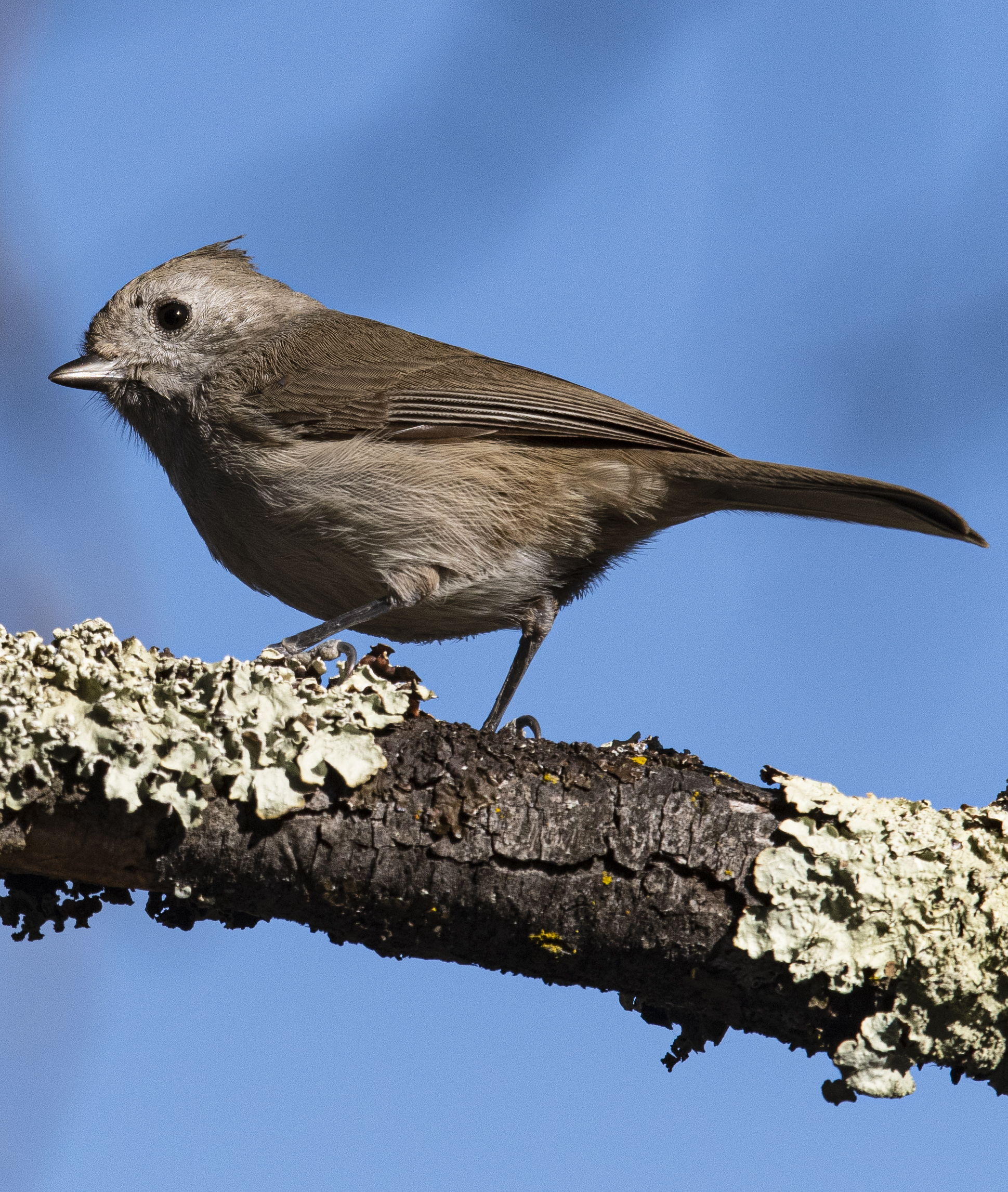
The Oak Titmouse is the most plainly dressed member of the tit family (Paridae) — no black bib, no bold pattern, just soft gray-brown plumage, a short crest, and an oversized dark eye. Until 1996 it was lumped with the interior Juniper Titmouse as the “Plain Titmouse”; the two were split on differences in song, habitat, and genetics.
In the field, plainness is the pattern: gray-brown above, paler gray below, a short crest that lifts and flattens with mood, and a short, stout bill. The nearly identical Juniper Titmouse is slightly grayer and sings rapid single-pitch trills — but the two barely overlap, so a titmouse in a California oak woodland is this species. The Tufted Titmouse of the East shows rusty flanks and a black forehead, and its range never touches this bird’s.
Essential Morphometric Field Marks:
- Body Length & Mass: Averages 4.7 to 5.75 inches (12–14.6 cm) with an adult mass of 0.3 to 0.7 ounces (10–21 grams) — smaller and lighter than the eastern titmice.
- Wingspan: About 9 inches (23 cm), with plain gray-brown wings and a medium-long tail.
- Bill Structure & Color: A short, stubby gray-black bill used to glean insects from oak bark and hammer seeds open against a branch.
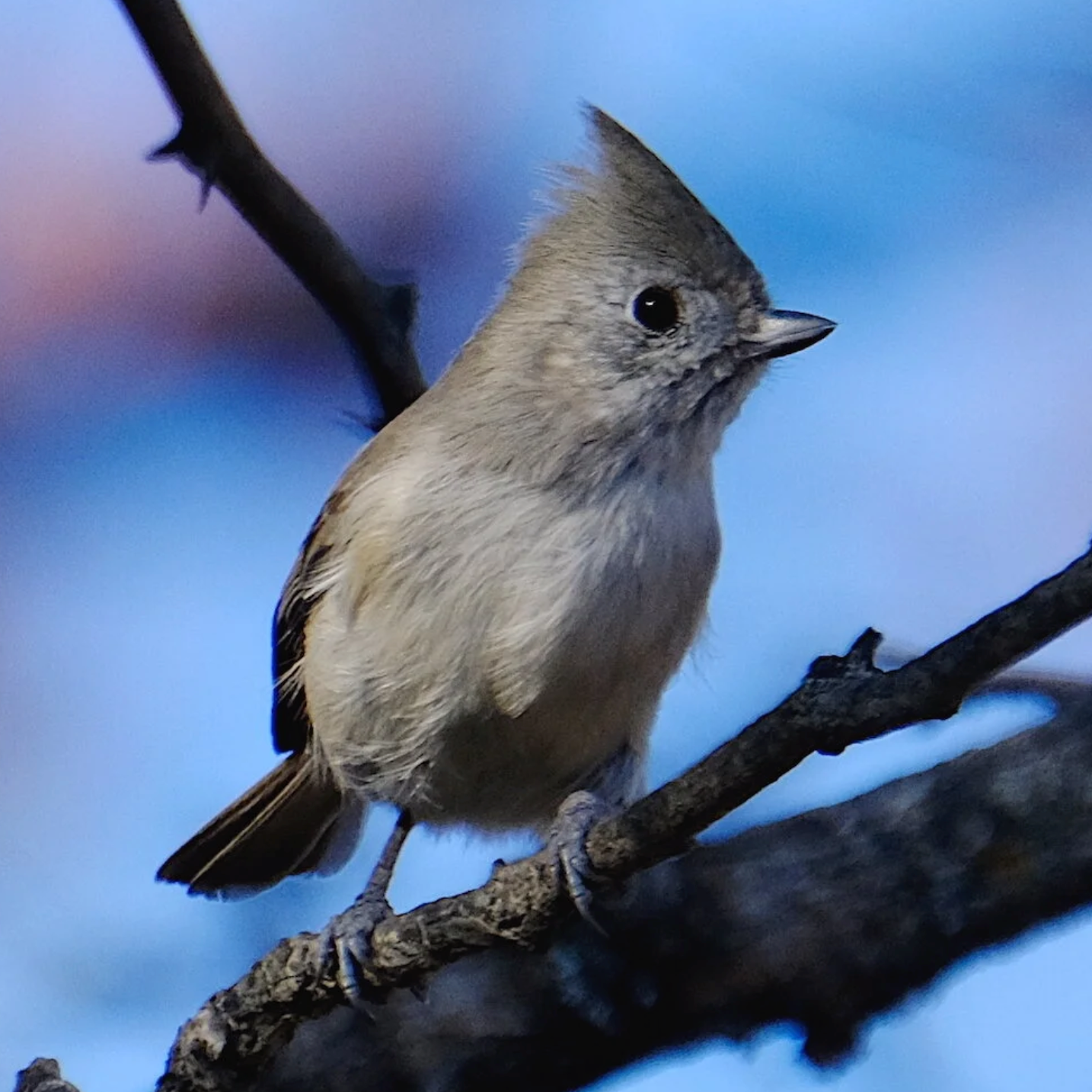
- Color Pattern: Plain gray-brown above, paler below, short crest, plain face with a prominent black eye. Males and females look identical, and juveniles closely match adults.
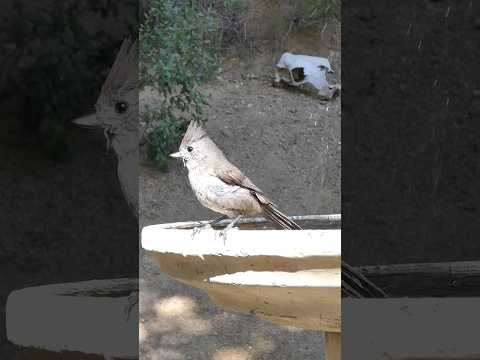
Uniform gray-brown upperparts fading to pale gray underparts, with the short crest usually at least partly raised. Adult males and females cannot be separated in the field.
Summer juveniles look like slightly fluffier adults with the same plain gray pattern — the family resemblance is immediate, and young birds stay with their parents for weeks after fledging.
Oak Titmouse Vocalization Guide (3 Recordings)
The song is a series of clear, whistled phrases of two or three notes — the last note dropping in pitch — repeated three to seven times before the bird switches to a new pattern. The everyday call is a scratchy “tsicka-dee-dee” that mated pairs use to stay in touch. All three recordings below are real field audio hosted on Wikimedia Commons under Creative Commons licenses; for more wild audio, browse xeno-canto: Oak Titmouse.
1. Song — Chaparral Hills East of San Francisco Bay
2. Pair Calls — McClellan Ranch Preserve
3. Canopy Calls — Picchetti Ranch Open Space Preserve
Habitat, Range & Year-Round Resident Biology
Oak Titmice live in warm, dry oak and oak-pine woodlands — valley oak savannas, foothill live oak, and oak-lined riparian corridors — plus suburban yards with mature oaks nearby. The range hugs the Pacific slope from southwest Oregon through California west of the Sierra Nevada into northwest Baja California, pointedly skipping the treeless floor of the Central Valley.

An Oak-Country Homebody
Few backyard birds are more settled: mated pairs hold the same territory in every season, never migrate, and even roost overnight in cavities, dense foliage, or birdhouses. Where a reliable oak stands, a pair of titmice is rarely far away.
A yard with mature oaks, a shrub layer, water, and a steady feeder meets every need. Outside the breeding season they may drift with small mixed flocks, but home base stays the same few acres for life.
Backyard Behavioral Patterns & Social Dynamics
Oak Titmice are quieter and more deliberate than their eastern cousins. Four signature behaviors explain most of what you will observe:
🌰 Hammer, Cache, Remember
A titmouse carries a seed to a branch, hammers it open with its stubby bill, and stashes surplus items in bark crevices. Studies show they relocate caches using landmarks like rocks with impressive accuracy — one more reason a dependable feeder earns daily visits.
📣 The Eventual-Variety Singer
Males sing a whistled phrase three to seven times in a row before switching patterns — a style researchers call “eventual variety.” Listen on a spring morning and you can count the repeats, then hear the whole neighborhood answer.
💑 Mated for the Long Haul
Pairs stay together year-round on a permanent territory, keeping contact with scratchy “tsicka-dee-dee” calls as they forage. The two birds visiting your feeder are very likely a bonded pair, not a passing crowd.
🕳️ The Cavity Sleeper
Oak Titmice roost overnight in cavities, birdhouses, or dense foliage — a habit caught in our gallery’s nest-hole portrait. A nest box hung near oaks can serve as both winter bedroom and spring nursery.
Problem: Why Oak Titmice Skip Oak-Poor Yards
Within the range, the usual complaint runs: “titmice in the park’s oaks, none at my feeder.” The reasons are predictable:
First, this is an oak-anchored bird: a feeder in a treeless yard reads as foreign habitat, while the same station hung near a mature oak gets daily visits. Second, the menu matters: cheap mixes heavy in milo and millet get inspected and rejected — this species shops for suet, sunflower, and peanuts. Third, the dry-season crunch: through California’s long rainless summer, natural food and water thin out, and a feeder left empty for weeks teaches a territorial pair to forage elsewhere. Put the right menu near an oak, add water, and keep it stocked year-round — the resident pair will fold your yard into its territory.
Method 1: Set the Table — Suet, Sunflower & Peanuts
Design for a methodical, oak-loving resident:
-
Lead with Suet
A shaded suet cage is the top draw — Oak Titmice are famously fond of suet and peanut butter. In hot inland summers, use no-melt formulas and keep cakes out of direct sun.
-
Anchor with Black Oil Sunflower
A hopper or tube feeder with a tray filled with black oil sunflower covers the daily staple. Our lab-tested roundup of the Best Tube Feeders for Small Birds compares proven models.
-
Offer Peanuts and Chopped Nuts
Unsalted peanut pieces on a platform or in a mesh feeder disappear fast — high-fat, cacheable, and sized for a stubby hammering bill.
-
Mount It Near an Oak, Add Water
Hang feeders within a short dash of oak or shrub cover — titmice stage in the branches between trips. A shallow bird bath nearby is a major draw through the dry California summer.
Method 2: Keep Them Year-Round — Cavities & Oak Cover
Turn a resident pair into permanent neighbors:
-
Hang a Nest Box Near Oaks
A box with a 1-1/4-inch entrance hole mounted 5–15 feet up near oak cover is often claimed in early spring — and this species roosts in boxes through the winter too, so leave it up year-round.
-
Keep Safe Dead Limbs Standing
Where it is safe, leave snags and dead branches on mature trees — natural cavities are scarce real estate for a bird that cannot excavate hard wood, and their loss is a known pressure on the species.
-
Offer Nesting Fibers in Spring
Titmice line the nest with grass, moss, hair, and feathers — a small wire cage of clean pet fur near the box gets plucked apart piece by piece in March and April.
-
Feed Through the Dry Season
Because pairs never leave their territory, summer and fall reliability matters as much as winter. Keep suet and sunflower stocked and skip pesticides, so the insect supply stays strong for nesting season.
Tool Solution: Recommended Hardware for Oak Titmice
Equipment matched to a settled, cavity-loving resident:
Hopper or Tube Feeder with Tray
Holds black oil sunflower dry and dispenses it at perches sized for titmice, with a tray for the hammer-and-cache crowd.
- • Capacity: 2–3 lbs Sunflower
- • Roof: Weather-shedding lid
- • Mount: Pole or hook near oaks
Suet Cage + Peanut Pieces
The combination this species is most famous for loving — no-melt suet for summer, nut blends for the cool season, and unsalted peanut pieces year-round.
- • Suet: No-melt nut blend
- • Nuts: Chopped, unsalted, cache-ready
- • Purity: No milo or wheat filler
Titmouse Nest Box (1-1/4″ Entry)
Cedar box sized for Paridae — hang it near oaks, add wood shavings, and leave it up all year as a winter roost and spring nursery.
- • Entrance: 1-1/4 in (32 mm) round hole
- • Floor: 4 × 4 in interior
- • Mount: 5–15 ft, near oak cover
Frequently Asked Questions
- Species Profile: The Oak Titmouse (Baeolophus inornatus) is a 4.7–5.75 inch, 10–21 gram songbird in plain gray-brown with a short crest and beady black eye; males and females look identical.
- Pacific Slope Resident: Non-migratory in oak woodlands from southwest Oregon through California west of the Sierra Nevada to northwest Baja California — splitting from the Juniper Titmouse as a distinct species in 1996.
- Settled Pairs: Mated pairs hold the same territory year-round, keep contact with scratchy “tsicka-dee-dee” calls, and roost overnight in cavities or birdhouses.
- Feeder Formula: Suet first, plus black oil sunflower and unsalted peanut pieces on an elevated feeder near oak cover — with water through the dry season.
- Cavity Nester: Uses natural cavities, old woodpecker holes, and nest boxes (1-1/4-inch entrance); keeping old oaks and safe snags standing directly supports the species.
- Song Pattern: Whistled two- or three-note phrases repeated three to seven times before switching — the “eventual variety” style that makes dawn listening a counting game.
Bird Watching Log
Species: Oak Titmouse (Baeolophus inornatus)
| Oak Titmouse (Subspecies / Notes: ____________________________) | |