
Palm Warbler


Palm Warbler (Setophaga palmarum): Complete Identification, Habitat Guide & Sound Library
Quick Answer: How to Attract & Identify the Palm Warbler
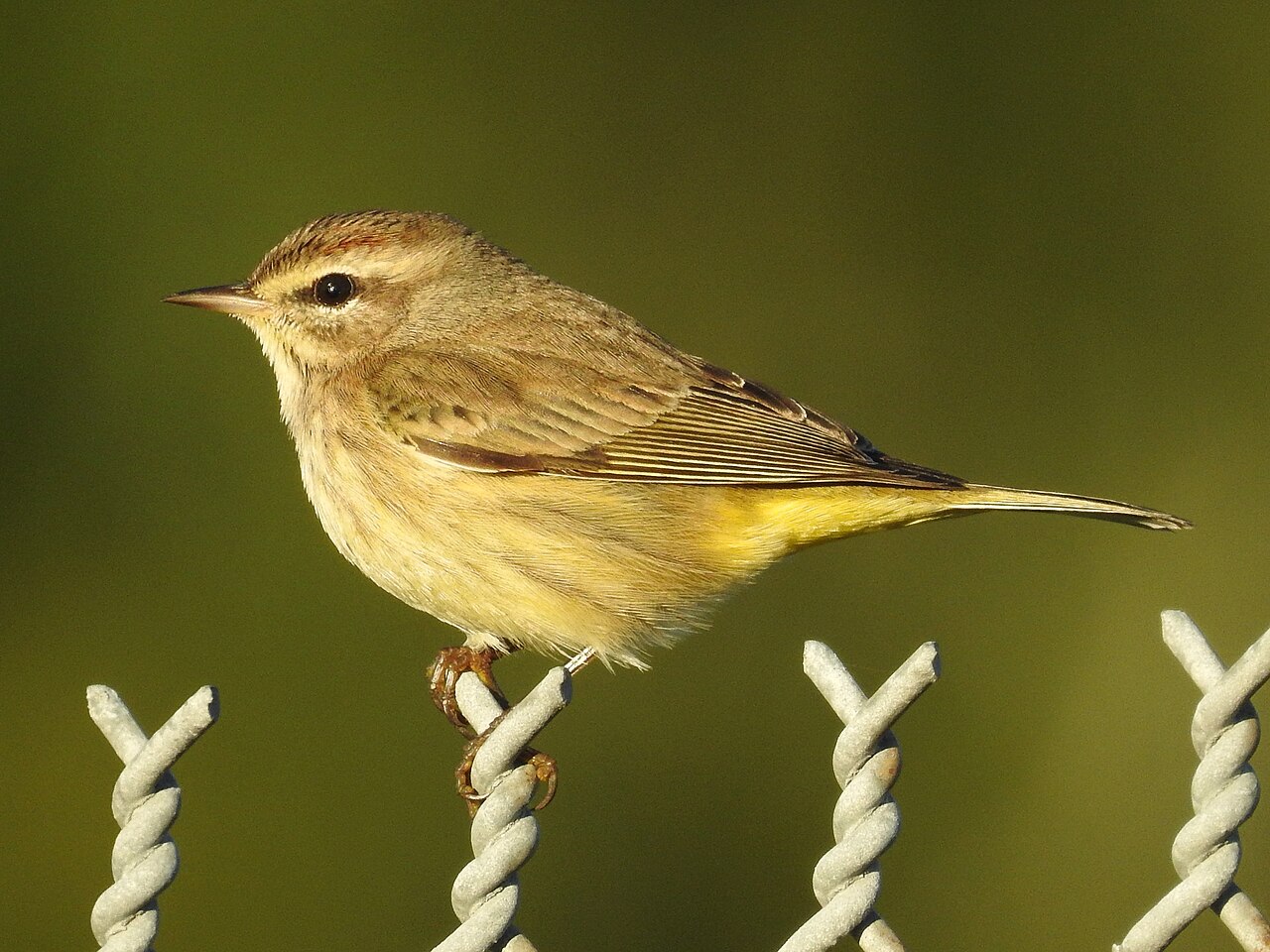
The Palm Warbler (Setophaga palmarum) is the tail-pumping ground warbler of southern winters — streaked brown-and-yellow with a rusty cap, yellow undertail coverts, and a tail that pumps incessantly. It forages on open ground — lawns, path edges, and mudflats — unusual for a warbler, and winters across the Southeast and Gulf Coast. The song is a buzzy trill; the call a sharp chip. Winter yards attract them with low platform seed, shallow ground water, and quiet lawn edges. They share the winter ground with the Yellow-rumped Warbler and the Chipping Sparrow.
Species Physical Profile & Morphometrics
The Palm Warbler belongs to the warbler family (Parulidae) and breeds in boreal bog forest across Canada, wintering in the Southeast, Gulf Coast, and Caribbean — where it forages on open ground and pumps its tail without pause.
The identification formula: ground-walking warbler + incessant tail pumping + yellow undertail + rusty cap. The Yellow-rumped Warbler forages in trees and shows a yellow rump; the Pine Warbler stays in pines. A warbler walking the lawn, tail bouncing, is a Palm.
Essential Morphometric Field Marks:
- Body Length & Mass: 4.7 to 5.5 inches (12–14 cm) and 0.3 to 0.5 ounces (7–13 grams) — a slim, long-legged warbler built for the ground.
- Wingspan: 7.9 to 8.3 inches (20–21 cm); flight is low and short — this bird prefers to walk.
- Bill Structure & Color: A thin, straight dark bill — the warbler standard, sized for ground insects and small seeds.
- Color Pattern: Streaked brown-and-yellow plumage, rusty cap, yellow eyebrow and undertail coverts; western birds are whiter below, eastern yellower.
- Male vs. Female: The sexes look alike — the rusty cap dulls in winter but the tail-pumping never stops.
The lawn pacer: walking the grass edge with the tail bouncing like a metronome, snatching insects off the blades.
Identical in pattern — slightly duller cap; she nests on the ground in the boreal bog while he sings from a stunted spruce.
Palm Warbler Vocalization Guide (1 Field Recording)
The Palm Warbler’s song is a buzzy, rapid trill; the call a sharp chip given constantly on winter lawns. All recordings below are real field audio via Wikimedia Commons — no simulations. For a deeper library, browse xeno-canto: Palm Warbler.
1. The Buzzy Trill
2. The Sharp Chip
3. The Seep Call
Habitat, Range & the Winter Lawn
The Palm Warbler breeds in boreal bogs across Canada and winters in open country across the Southeast — lawns, parks, path edges, dunes, and muddy fields — anywhere the ground is open and the insects are low.

The Warbler That Walks
Breeding range spans boreal Canada from the Northwest Territories to Labrador; winter range covers the Southeast, Gulf Coast, and Caribbean, with smaller numbers up the Pacific coast.
For backyard birders: southern winter yards with open lawn edges, low seed platforms, and shallow water host Palm Warblers from October to April — the friendliest warbler of the winter yard.
Backyard Behavioral Patterns & Social Dynamics
The Palm Warbler is a ground-walking warbler with a metronome tail. Four behaviors explain most of what you will observe:
🐓 The Tail Pump
The tail bobs up and down incessantly — the fastest identification shortcut in the warbler family.
🚶 The Ground Walker
It forages walking on open ground — lawns, paths, mud — picking insects and small seeds like a tiny sparrow.
🌾 The Seed Taker
It is one of the few warblers that takes seed from low platforms and the ground in winter.
❄️ The Southern Winter
It winters in the Southeast and Gulf — a tropical-family bird spending the cold months on American lawns.
Problem: “How Do I Host Winter Palm Warblers? What Should I Do?”
The three most common Palm Warbler puzzles all have proven answers:
First, the lawn warbler: a small streaked bird walking your grass, tail bouncing, is behaving normally — Palm Warblers are ground birds; enjoy the close views. Second, the identity check: the incessant tail pump plus yellow undertail separates it from sparrows and pipits; the rusty cap completes the set. Third, the feeder question: they take seed from low platforms and the ground — scatter white millet on a cleared patch near cover and the lawn pacers will adopt it by the week.
Method 1: Set the Table — Low Seed & Shallow Water
Design for a ground-foraging winter warbler:
-
Scatter White Millet
Low platform or cleared ground — the seed a winter Palm Warbler actually takes.
-
Provide a Ground Bath
Shallow dish at lawn’s edge — drinking and bathing at ground level, warbler-style.
-
Keep a Quiet Lawn Edge
Unmowed margins and path edges — the foraging lane of the tail-pumper.
-
Skip Lawn Insecticide
Ground insects are the main course — a sprayed lawn is an empty lawn.
Method 2: Build the Habitat — Open Ground & Cat Safety
Keep the ground safe and the edges wild, and the bird stays all winter:
-
Keep Cats Indoors
Ground-walking warblers are the easiest prey — the one rule that matters most.
-
Leave Path Edges Untidy
Leaf litter at the lawn margin — the insect supply along the foraging lane.
-
Watch the Migration Waves
April and September bring passage birds — northern lawns host them briefly on the way through.
-
Learn the Chip
The sharp chip gives them away — ears find the bird on the shadiest lawn corner.
Tool Solution: Recommended Hardware for Palm Warbler
Equipment matched to a ground-walking winter warbler:
Low Platform with White Millet
Seed at ground level — the rare warbler feeder setup that actually works.
- • Feed: White millet
- • Style: Low platform
- • Bonus: Juncos & sparrows too
Shallow Ground Dish
Inch-deep water at the lawn’s edge — the winter warbler’s drinking station.
- • Depth: 1 inch
- • Placement: Lawn edge
- • Bonus: All ground birds
Untidy Lawn Margin
An unmowed, littered edge along the lawn — the insect pantry of a wintering Palm Warbler.
- • Rule: No mowing or spray
- • Feature: Leaf litter
- • Bonus: Towhees & wrens too
Frequently Asked Questions
- Species Profile: The Palm Warbler (Setophaga palmarum) is a 4.7–5.5 inch, 0.3–0.5 ounce warbler (Parulidae), band code PAWA — the tail-pumping ground warbler.
- ID in One Look: Walking on the lawn, tail pumping, yellow undertail flashing.
- The Sound: Sharp chip calls all winter; buzzy trill on the bog; real recordings above.
- Range & Habit: Boreal bog breeder; winters on southeastern lawns and open ground.
- Feeder Formula: Low millet platform and a ground bath — the warbler exception.
- The Metronome: The tail never stops — the fastest field mark in the family.
Bird Watching Log
Species: Palm Warbler (Setophaga palmarum)
| Palm Warbler (Tail Pumping Seen: Yes / No — Rusty Cap Seen: Yes / No — Chip Heard: Yes / No — Ground Foraging Watched: Yes / No — Date & Time: ___) | |