
Black-throated Sparrow


Black-throated Sparrow (Amphispiza bilineata): Complete Identification, Habitat Guide & Sound Library
Quick Answer: How to Attract & Identify the Black-throated Sparrow
The Black-throated Sparrow (Amphispiza bilineata) is the most sharply dressed bird of the desert Southwest — a small sparrow in formal wear: black bib on a white breast, bold white stripes framing the gray head. It walks the open desert floor for seeds and sings a tinkling, silvery song from a cactus top. Desert-edge yards attract them with scattered millet, open bare ground, and dependable water. They share the scrub with the Cactus Wren and the Gambel’s Quail.
Species Physical Profile & Morphometrics
The Black-throated Sparrow belongs to the New World sparrow family (Passerellidae) and is a bird of open desert scrub across the Southwest — breeding from Washington’s shrub-steppe to Texas and Mexico, wintering mostly in the southern half of that range.
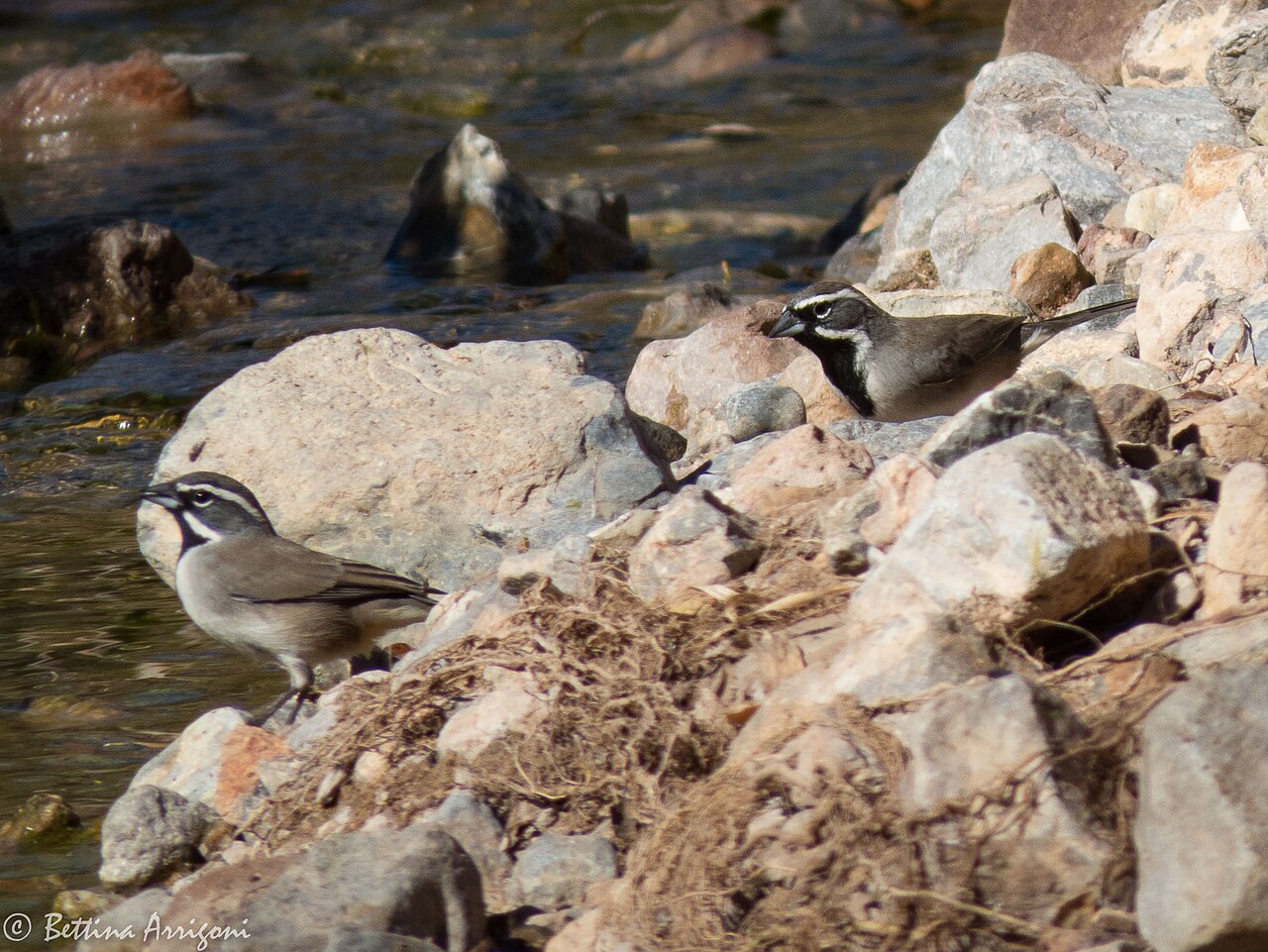
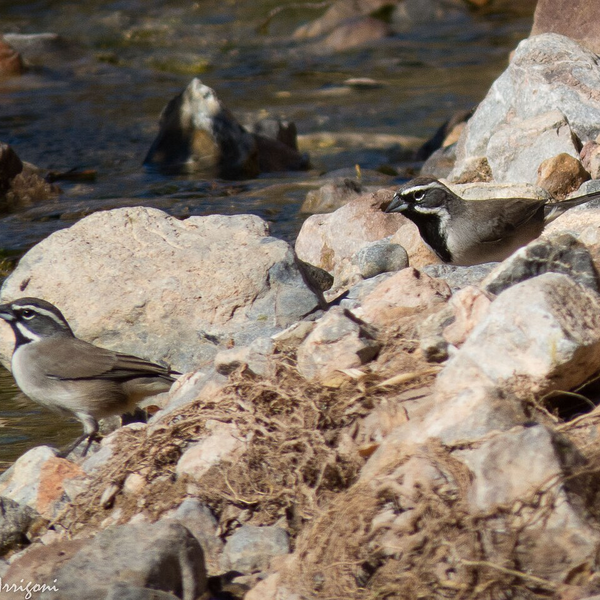
The identification formula: black bib + white head stripes + gray body + cocked tail. Nothing else in the desert wears the bib. Young birds lack the full bib but show the white head stripes; the tail, habitually cocked and flicked, is a giveaway at distance.
Essential Morphometric Field Marks:
- Body Length & Mass: 4.3 to 5.5 inches (11–14 cm) and 0.3 to 0.5 ounces (8.5–15 grams) — small, slim, and long-tailed, quick on its feet.
- Wingspan: 7.7 inches (19.7 cm); flight is low and darting between shrubs, tail cocked on landing.
- Bill Structure & Color: A small, conical gray bill — fine seed-picking forceps for desert grass and forb seeds.
- Color Pattern: Gray above, white below with a crisp black bib on the throat, bold white stripes above and below the eye, and white corners on the cocked tail.
- Male vs. Female: The male’s bib is larger and glossier black; the female’s is smaller and duller — pairs run the desert floor together within a shrub’s shadow of each other.
The formally dressed tenor: black bib crisp against white, singing his tinkling song from the top of a cholla as the desert cools at dusk.
The smaller-bibbed partner — same white-striped face, softer bib — she nests low in a desert shrub and runs the seed trails with her mate at dawn.
Black-throated Sparrow Vocalization Guide (0 Field Recordings)
The Black-throated Sparrow’s song is a tinkling, silvery jumble — two quiet notes then a tinkling trill, like coins dropped on glass. All recordings below are real field audio via Wikimedia Commons — no simulations. For a deeper library, browse xeno-canto: Black-throated Sparrow.
1. The Tinkling Song
2. The Dawn Chorus
3. The Soft Calls
Habitat, Range & the Open Desert
The Black-throated Sparrow lives in open desert scrub: creosote flats, cholla and yucca slopes, sagebrush steppe, and rocky desert uplands — the most open country of any sparrow. Desert-edge yards with native scrub and bare ground fall squarely within its foraging range.

The Desert’s Formal Voice
Breeding range spans the interior West’s arid lands from Washington’s shrub-steppe through the Great Basin to Arizona, New Mexico, and Texas. Winter draws the population south into the desert Southwest and Mexico, where the tinkling song rarely pauses even in January.
For backyard birders: desert-edge yards anywhere in the range can host them — bare ground, scattered millet, and a water dish are the whole recipe, with winter visits the rule across the southern half of the range.
Backyard Behavioral Patterns & Social Dynamics
The Black-throated Sparrow is an open-ground walker with a silvery voice. Four behaviors explain most of what you will observe:
🚶 The Desert Walker
It walks and runs rather than hops, covering open ground between shrubs with tail cocked — a gait that identifies it before the bib shows.
🎐 The Tinkling Tenor
The male sings his silvery tinkling song from shrub and cactus tops at dawn and dusk — even through the desert winter.
🌵 The Open-Ground Forager
It feeds on bare soil between shrubs, picking tiny seeds one by one — a bird of the open space, not the thicket.
💧 The Water Visitor
Despite desert adaptation, it visits dependable water daily in hot months — a ground basin is the desert yard’s surest magnet.
Problem: “Small Brown Birds Work My Desert Yard — How Do I Find the Black-throated Sparrow?”
The three most common Black-throated Sparrow puzzles all have proven answers:
First, the brown-bird blur: watch the gait — this species walks and runs with its tail cocked; then glass the head for the white stripes and the bib, which read clearly even in backlight. Second, the seasonal shift: many desert yards host them September–April only — northern birds winter in the southern desert; if your winter visitors vanish in May, they have gone north to breed. Third, the feeder indifference: they prefer seed scattered on bare ground to any feeder — a daily handful of millet on open soil near a shrub beats the fanciest tube.
Method 1: Set the Table — Millet on Open Soil & Water
Design for an open-desert walker:
-
Scatter Millet on Bare Soil
White millet on open ground between shrubs — refreshed at dawn; the walkers patrol the same circuit daily.
-
Keep Patches Unplanted
Bare gravel and soil patches are habitat, not blemishes — resist covering every inch with plants.
-
Provide Ground Water
A shallow basin at ground level with open sightlines — desert birds drink where they can watch for hawks.
-
Skip the Pesticides
No ant or weed killer on feeding ground — the seed crop and the bird’s safety both depend on it.
Method 2: Build the Habitat — Native Scrub & Quiet
Keep the desert honest, and the bib stays year-round:
-
Plant Native Desert Shrubs
Creosote, brittlebush, cholla, and sagebrush — scattered shrubs over open ground are the exact architecture.
-
Leave Grass Seed Standing
Unmown native grass patches seed the ground naturally — the free feeder that restocks itself.
-
Keep Cats Indoors
Ground-walking birds are cat prey first — desert yards host sparrows only where cats do not hunt.
-
Watch the Golden Hours
Dawn and dusk are feeding and singing time — midday belongs to the shade; plan your watching accordingly.
Tool Solution: Recommended Hardware for Black-throated Sparrow
Equipment matched to an open-desert sparrow:
Bare-Ground Millet Scatter
White millet on open soil between shrubs at dawn — the simplest desert feeding station there is.
- • Food: White millet
- • Placement: Open ground near shrubs
- • Timing: Dawn
Ground-Level Water Basin
A shallow basin with open sightlines — in the dry months it outdraws every seed you could offer.
- • Depth: One to two inches
- • Placement: Open, visible
- • Rule: Never dry in summer
Native Scrub Plantings
Creosote, brittlebush, and native grasses — the open-shrub structure the species is built for.
- • Plants: Creosote, brittlebush
- • Structure: Open & scattered
- • Bonus: Quail & thrashers too
Frequently Asked Questions
- Species Profile: The Black-throated Sparrow (Amphispiza bilineata) is a 4.3–5.5 inch, 0.3–0.5 ounce sparrow (Passerellidae), band code BTSP — the formally dressed walker of the desert Southwest.
- ID in One Look: Black bib, white-striped gray head, cocked tail, walking gait on open ground.
- The Sound: A tinkling, silvery song at dawn and dusk; real field recordings above.
- Range & Habit: Open desert scrub across the Southwest; northern birds winter south; walks rather than hops.
- Feeder Formula: Millet on bare ground, ground-level water, scattered native shrubs, standing grass seed.
- The Desert Voice: The tinkling dawn song is the sound of the Southwest itself — earn it with water and open soil.
Bird Watching Log
Species: Black-throated Sparrow (Amphispiza bilineata)
| Black-throated Sparrow (Bib Seen: Yes / No — Walking Gait: Yes / No — Song Heard: Yes / No — At Ground Seed: Yes / No — At Water: Yes / No — Date & Time: ___) | |