
Canyon Towhee


Canyon Towhee (Melozone fusca): Complete Identification, Feeder Guide & Call Library
Quick Answer: How to Attract & Identify Canyon Towhees
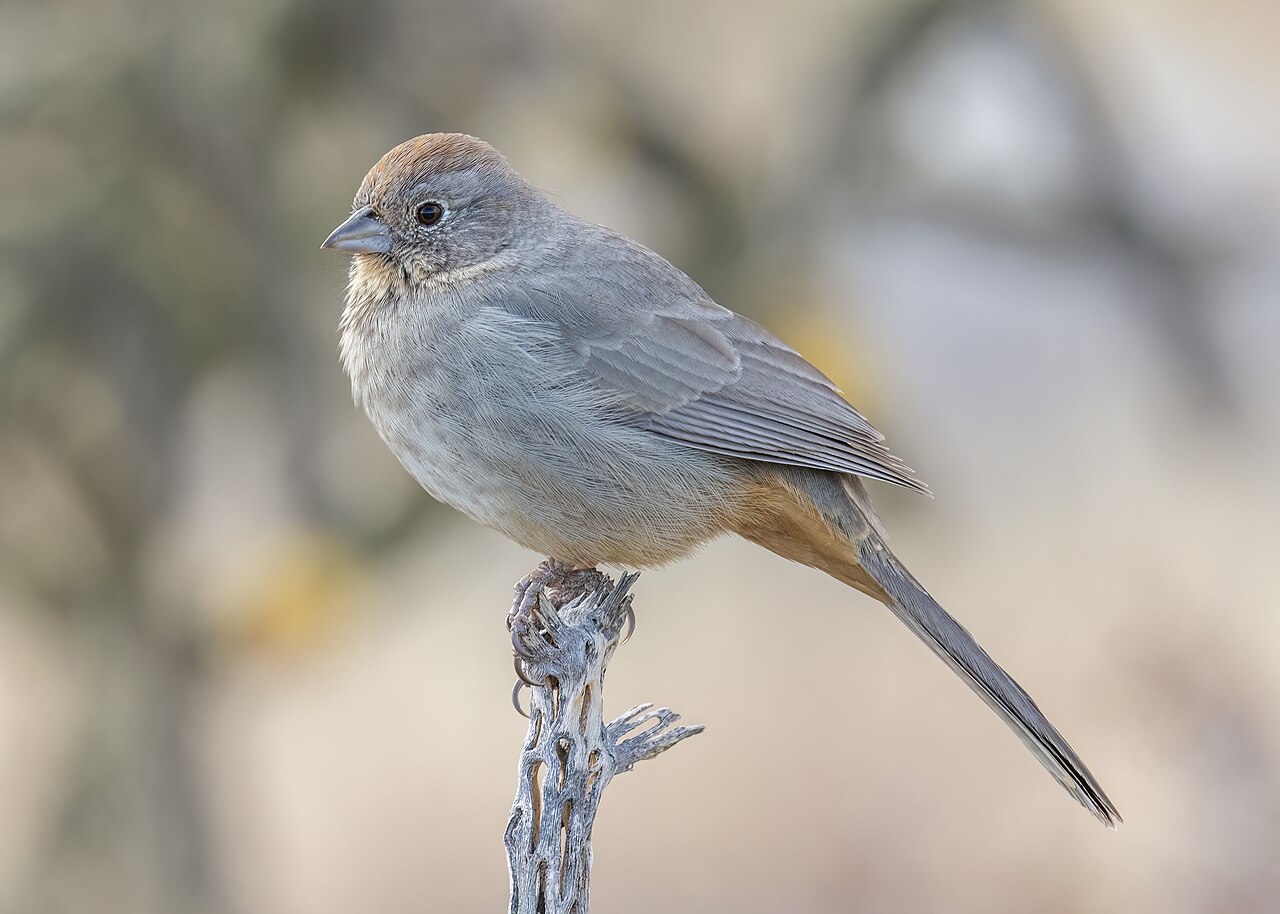
The Canyon Towhee (Melozone fusca) is a big, long-tailed ground sparrow of southwestern desert yards — plain earthy brown, with a rufous crown, a buffy streak-bordered throat, and rusty undertail coverts that show as it hops away. A year-round resident from Arizona, New Mexico, southern Colorado, and west Texas south into Mexico, it feeds by double-scratching on open ground beside birds like the Spotted Towhee and the Dark-eyed Junco. To attract it: put out a shallow, faithfully refilled water basin, then scatter cracked corn, millet, and black oil sunflower on open ground or a low platform beside shrubs. Listen for the rough, nasal “shedup” call and the tinkling, unhurried song.
Species Physical Profile & Morphometrics
The Canyon Towhee belongs to the New World sparrow family (Passerellidae) and is one of the largest towhees in a southwestern yard — a chunky body, a short thick bill, a noticeably long tail, and long legs built for running. Until 1989 it was lumped with the California Towhee as a single species called the “Brown Towhee.”
The identification formula: plain earthy brown + rufous crown + buffy streaked throat + rusty undertail coverts, running or double-scratching on bare desert ground near shrubs.
Essential Morphometric Field Marks:
- Body Length & Mass: 8.3 to 9.8 inches (21–25 cm) and 1.3 to 1.9 ounces (37–53 grams) — one of the biggest sparrows in the desert Southwest, between a sparrow and a robin in bulk.
- Wingspan: about 11.5 inches (29 cm), with short, rounded wings used for brief, low dashes — this species runs far more readily than it flies.
- Bill Structure & Color: A short, thick, conical seed bill, dark gray-brown; legs are long and pinkish, built for scratching.
- Color Pattern: Earthy brown overall, slightly paler below, with a warm rufous crown, a buffy throat bordered by dusky streaks, often a small dark spot in the center of the breast, and rusty-buff undertail coverts — the key confirming mark. Eyes are dark; juveniles look similar but duller and faintly streaked.
Desert camouflage with warm accents: plain earthy brown set off by the rufous crown and rusty undertail. He advertises by voice — a tinkling, unhurried song from a shrub top, fence post, or rooftop after the rains begin.
A mirror image of her mate: sexual dimorphism is minimal, and both sexes wear the same plain brown suit and share the same field marks. Pairs form long-lasting, often lifelong bonds and forage together year-round.
Canyon Towhee Vocalization Guide (3 Clearly Labeled Acoustic Simulations)
The Canyon Towhee’s voice is softer and less metallic than its California cousin’s. The song is a variable, tinkling series of slurred, even-pitched notes with an unhurried, sometimes slightly stuttering rhythm; the everyday call is a rough, nasal “shedup” or “deeyup”, plus a thin high “seep” from cover. Because no freely licensed field recordings of this species are currently available for embedding, all three cards below are clearly labeled acoustic simulations built to published descriptions — use them as memory aids, not as documentary audio.
1. Song Simulation — The Tinkling Series
2. Call Simulation — The Nasal “Shedup”
3. Call Simulation — The Thin “Seep”
Habitat, Range & the Desert Southwest Corridor
This is a bird of dry, rocky, shrubby country: desert grasslands, arroyos, mesquite thickets along streams, pinyon-juniper foothills, and the scrubby corners of southwestern towns and suburbs — anywhere thorny cover stands beside bare, scratchable ground.

A Southwestern Resident, Every Month of the Year
The Canyon Towhee lives year-round from Arizona, New Mexico, southern Colorado, and west Texas south through the Mexican highlands to Oaxaca, mostly avoiding the coasts. It does not migrate: the bird scratching under your mesquite in January is the same neighbor that nested in the cholla in spring.
Unlike its California cousin, this is the towhee of the interior desert and foothills — and where suburbs replace desert, it adjusts well, working gravel yards, parking lots, and feeding stations as readily as wild arroyos.
Backyard Behavioral Patterns & Social Dynamics
The Canyon Towhee is a calm, confiding ground bird of desert towns. Four behaviors explain most backyard encounters:
🍂 The Double-Scratcher
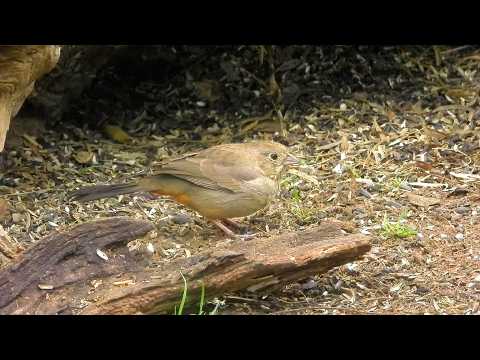
The signature move: a quick jump forward, then an even quicker jump back, scratching with both feet to overturn leaves and gravel and expose seeds and insects — quieter and more deliberate than the bigger towhees, but the same technique.
🏃 The Runner
This species stays close to the ground and often runs rather than flies, covering the distance between shrubs and feeding patch in a quick, low sprint. When it does fly, it is a short, slow, maneuverable hop into the nearest cover.
🚗 The Parking-Lot Forager
Near homes and trailheads, Canyon Towhees famously work parking lots, picking insects from car grilles and ducking under parked cars when disturbed — a quirk that makes them one of the most approachable birds in the Southwest.
💞 The Lifelong Pair
Pairs are monogamous and often bonded for life, foraging side by side and exchanging soft squeals and chatters. They defend territory loosely and often tolerate neighboring towhees at a good feeding station.
Problem: “A Big Plain Brown Bird Walks Around My Yard and Under My Car Like It Owns the Place. What Is It?”
The three most common Canyon Towhee puzzles all have reassuring answers:
First, the anonymous brown bird: plain plumage is the whole point — confirm it with the rufous crown, buffy streak-bordered throat, and rusty undertail coverts, plus the run-first, double-scratch feeding style. Second, the bird under the car: gleaning insects from grilles and using parked vehicles as portable cover is documented, normal Canyon Towhee behavior — no cause for concern. Third, the look-alikes: the California Towhee is the near-twin of the Pacific slope but lacks this species’ desert range; the Abert’s Towhee shares desert riversides but wears a black mask around the bill and a longer, darker tail; the Spotted Towhee is instantly separated by its black hood and white-spangled back.
Method 1: Set the Table — Cracked Corn & Sunflower, Served Low
Design for a big, ground-feeding desert sparrow:
-
Use the Ground You Already Have
A bare soil patch, gravel corner, or rocky edge beside shrubs is already prime towhee ground — scatter feed directly on it. In desert yards the natural floor is the feeder.
-
Serve Cracked Corn & Millet on Open Ground
Cracked corn and white millet scattered beside cover are proven staples — this species also takes milo and rolled oats at feeding stations. A handful each morning on the same patch builds a daily route.
-
Add Black Oil Sunflower on a Low Platform
Black oil sunflower on a low, stable platform or ground tray adds the high-fat seed towhees crack most eagerly — and the same tray will serve the towhees, doves, and sparrows that share the station.
-
Try a Seed Block or Cylinder
Canyon Towhees readily cling to pressed seed blocks and cylinders set low near cover — a tidy option for windy desert yards where loose seed blows away.
Method 2: Build the Habitat — Desert Cover, Litter & Water
Feed the habitat, and the towhees follow:
-
Plant or Keep Dense Native Shrubs
Mesquite, acacia, four-wing saltbush, and desert hackberry supply the thorny, quick-escape cover this species requires — and double as nesting structure, since towhees nest low in shrubs, cholla, and yucca.
-
Leave a Litter & Brush Corner
Leaf litter under the shrub border plus a simple brush pile creates the foraging floor and hawk cover that turn a feeding stop into a territory. Skip the cleanup in at least one corner.
-
Put Water at the Top of the List
In the arid Southwest, a shallow basin of clean water near cover is the single strongest draw — Canyon Towhees drink and bathe daily, and a faithful water source is often what turns a visitor into a resident. In freezing foothill winters a heated bird bath keeps it open.
-
Keep Cats Indoors
Ground-feeding birds near homes are highly vulnerable to domestic and feral cats — a documented, serious threat to this species. A catio or indoor routine protects the pair that adopts your yard.
Tool Solution: Recommended Hardware for Canyon Towhees
Equipment matched to a big, ground-feeding desert resident:
Low Platform / Ground Tray
A wide, stable tray set on or near bare ground beside shrubs, filled with cracked corn, millet, and black oil sunflower — the serving style a running, double-scratching bird actually trusts.
- • Seed: Cracked corn, millet, milo, black oil sunflower
- • Style: Ground tray or low platform
- • Placement: Bare soil or gravel beside dense shrubs
Seed Block / Cylinder
A pressed seed cylinder on a low holder near cover — tidy in windy desert yards, long-lasting, and readily worked by clinging towhees, as field photos of this species confirm.
- • Food: Pressed mixed seed block
- • Build: Low, stable, weather-resistant holder
- • Placement: Within a quick dash of thorny cover
Shallow Bird Bath
A shallow basin with gently sloped sides set near shrub cover — in desert country, reliably clean water is often the busiest station in the yard, and a heater keeps it open on frosty foothill nights.
- • Depth: 1–2 in, gently sloped
- • Dry climate: Refill daily in summer
- • Placement: Beside, never far from, shrubs
Frequently Asked Questions
- Species Profile: The Canyon Towhee (Melozone fusca) is a large 8.3–9.8 inch, 37–53 gram New World sparrow (Passerellidae) with a short thick bill, long tail, and long running legs.
- ID in One Look: Plain earthy brown with a rufous crown, buffy streak-bordered throat, small dark central breast spot, and rusty undertail coverts — running or double-scratching on bare desert ground. Males and females look alike.
- A Year-Round Southwestern Resident: Lives from Arizona, New Mexico, southern Colorado, and west Texas south through the Mexican highlands and does not migrate; pairs are often bonded for life.
- The Sound: A variable, tinkling song of slurred, even-pitched notes from a shrub top, plus a rough nasal “shedup” call and a thin “seep” from cover.
- Feeder Formula: Water first — a faithfully filled shallow basin near cover — then cracked corn, millet, and black oil sunflower on open ground, gravel, or a low platform; seed blocks work too.
- Quirky but Harmless: Around homes and trailheads this species works parking lots, picking insects off car grilles and ducking under vehicles when disturbed — a documented, charming habit.

Bird Watching Log
Species: Canyon Towhee (Melozone fusca)
| Canyon Towhee (Rufous Crown Seen: Yes / No — Double-Scratching: Yes / No — Rusty Undertail: Yes / No) | |