
Golden-crowned Sparrow


Golden-crowned Sparrow (Zonotrichia atricapilla): Complete Identification, Feeder Guide & Call Library
Quick Answer: How to Attract & Identify Golden-crowned Sparrows
The Golden-crowned Sparrow (Zonotrichia atricapilla) is a large, gentle ground sparrow of Pacific coast winters — look for the golden-yellow stripe across the crown, framed by black in breeding plumage and softened to dusky brown in winter, over a plain, un-streaked gray-brown breast. It breeds in the willow thickets of Alaska and northwestern Canada, then winters from British Columbia to California in brushy gardens, hedgerows, and feeder yards — often flocking with White-crowned Sparrows. To attract the winter flocks: scatter white millet and cracked corn on open ground or a low platform beside dense shrubs, keep seed heads standing, and offer a shallow birdbath near cover. Listen for the flat, sharp “tseep” of the flock and, on still late-winter afternoons, the mournful three-note song — “oh-dear-me.”
Species Physical Profile & Morphometrics
The Golden-crowned Sparrow belongs to the New World sparrow family (Passerellidae) and is one of the four crowned Zonotrichia sparrows — big, plump, and plain-bodied, with all the finery reserved for the top of the head.
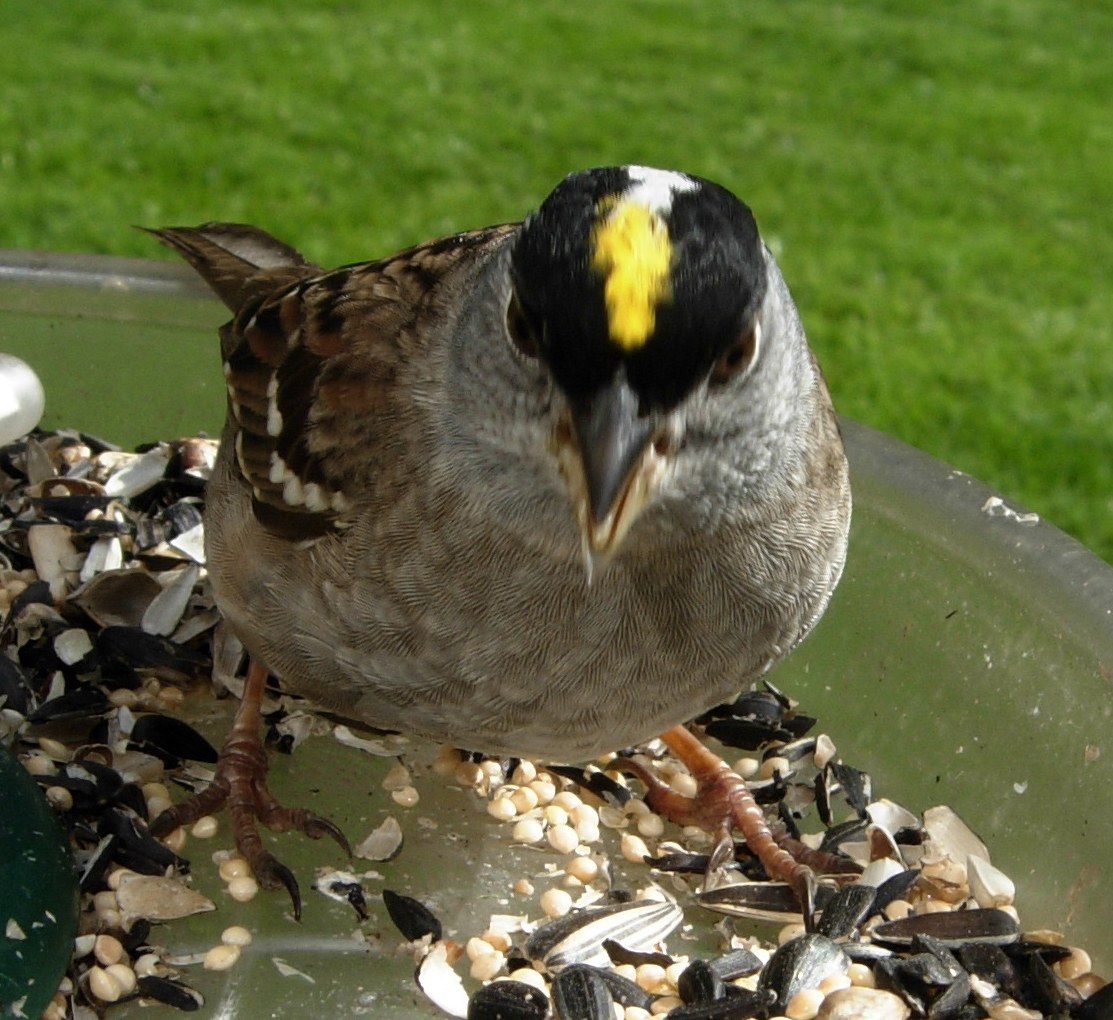
The identification formula: golden crown stripe + plain gray-brown breast + large plump build, feeding quietly on the ground in a winter flock.
Essential Morphometric Field Marks:
- Body Length & Mass: 6.7 to 7.9 inches (17–20 cm) and 1.0 to 1.2 ounces (28–34 grams) — the same big, full-chested build as its close cousin the White-crowned Sparrow.
- Wingspan: About 9.5 inches (24 cm), with plain brown wings showing only faint wing bars.
- Bill Structure & Color: A conical seed bill in pinkish-brown with a dusky tip — smaller and duller than a Harris’s Sparrow‘s bright pink bill.
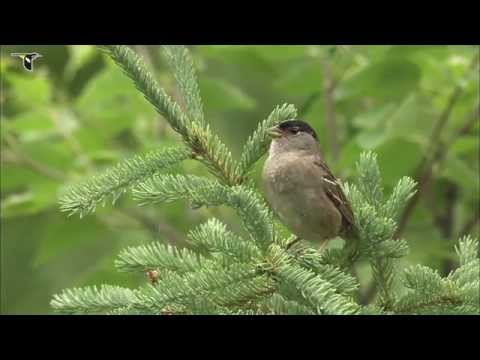
- Color Pattern: The crown carries a golden-yellow central stripe — framed by solid black in spring, softened to dusky brown in winter — over a plain gray-brown face and un-streaked breast, with a brown streaked back. No white throat patch, no crisp head striping: the plainness below is part of the ID.
Black and gold formal dress: a jet-black crown framing a blazing golden stripe, sharp enough to read across the yard. Worn from spring molt through the northern breeding season.
Muted but still golden: the crown dulls to dusky brown with a softer gold center, and first-winter birds show only a hint of gold on the forehead. Males and females share both looks — season and age, not sex, drive the difference.
Golden-crowned Sparrow Vocalization Guide (3 Labeled Simulations)
The song is the most plaintive of the crowned sparrows: three clear, slow whistles sliding down in pitch — “oh-dear-me,” sometimes with a tired fourth note — delivered from a shrub top, even on winter afternoons. The flock call is a flat, sharp “tseep.” No freely licensed field recordings of this species are currently available for republication, so the three cards below are clearly labeled acoustic simulations built to published descriptions. For real recordings, browse xeno-canto: Golden-crowned Sparrow.
1. Song Simulation — “Oh-Dear-Me”
2. Call Simulation — The Flock “Tseep”
3. Song Simulation — The Full Mournful Phrase
Habitat, Range & the Pacific Corridor
In summer this sparrow nests in stunted willow and alder thickets above the treeline across Alaska and northwestern Canada. In winter it comes down the Pacific corridor into brushy gardens, hedgerows, chaparral edges, and backyard thickets from British Columbia to California and Baja.

A West Coast Winter Bird
The orange breeding band lies across Alaska and northwestern Canada — subalpine willow country. The yellow ribbon is the Pacific migration corridor the whole species travels twice a year.
The blue winter band hugs the Pacific coast from Vancouver Island to Baja, densest in Washington, Oregon, and California. If your garden sits in that band with a shrub bed and a ground station, this bird is a realistic winter regular.
Backyard Behavioral Patterns & Social Dynamics
The Golden-crowned Sparrow is a quiet, confiding flock bird of the wet season. Four behaviors explain most of what you will observe:
👑 The Mixed-Crown Flock
It winters shoulder-to-shoulder with White-crowned Sparrows, the flock feeding as one loose company — scan any winter sparrow flock on the coast for the plain-breasted birds with the golden touch on the crown.
🐾 The Patient Double-Scratcher
Like its crowned cousins it feeds by hopping forward and scratching back with both feet, but at a calmer tempo — working leaf litter and bare dirt methodically, never far from a shrub to dive into.
🛁 The Daily Bather
A regular at shallow water — even in the cool wet winter it bathes and drinks daily. A low birdbath set near brushy cover will be adopted within days.
🎵 The Mournful Winter Singer
Unlike most winter visitors, this one sings all winter — the slow, descending “oh-dear-me” drifting from the shrubbery on gray afternoons is one of the signature sounds of a Pacific coast garden.
Problem: “Plain Big Sparrows Feed Under My Bushes All Winter — No Stripes, No Crest, Just a Hint of Gold. What Are They?”
The three most common Golden-crowned Sparrow puzzles all have reassuring answers:
First, the plainness trap: in winter plumage this species hides its finery — look closer for the golden stripe on the crown, the large plump build, and the completely un-streaked breast; the White-crowned Sparrows feeding beside them show crisp black-and-white head stripes instead. Second, the feeder bypass: it is a ground-feeding flock bird — white millet and cracked corn scattered on open ground beside the shrub bed will be found the first morning, while the hanging tubes above go ignored. Third, the May goodbye: the whole flock leaves for Alaska in spring and no seed will hold them — expect the first returnees with the October rains.
Method 1: Set the Table — Millet & Grain, Served Low
Design for a calm, flocking ground feeder:
-
Scatter White Millet on Open Ground Beside Shrubs
White proso millet scattered where lawn meets shrub bed is the staple — small-seeded and served at the level this bird feeds. A handful each morning builds a daily flock habit.
-
Add Cracked Corn on a Low Platform
Cracked corn and mixed grain on a stable low tray suits the whole crowned-sparrow flock — roomy enough for several big birds to feed shoulder to shoulder. The feeder style comparison guide covers platform options.
-
Seed the Leaf Litter
Scatter seed right into the leaf bed under the shrubs and let the flock double-scratch for it — the most natural presentation, and the quiet rustling tells you they are there.
-
Keep Ground Stations Fresh in the Wet Season
Pacific winter rain spoils ground seed fast. Scatter a day or two’s worth at a time, rotate soggy spots, and rake the patch weekly.
Method 2: Build the Habitat — Brushy Cover & Water
Feed the habitat, and the flock follows:
-
Keep a Dense Shrub Border
Thick shrubs, berry bushes, and brambly corners supply the cover this species feeds beside all winter — a yard that is all lawn will not hold them, no matter the seed.
-
Leave Seed Heads Standing
Skip the fall cutback — grasses, amaranth, and garden flowers gone to seed are a self-refilling ground feeder at exactly the right height.
-
Maintain a Leaf-Litter Bed
Leave the leaves under the shrub line — a deliberate litter bed is pantry and scratching floor in one, and the flock will work it daily.
-
Offer a Shallow Bath Near Cover
This species bathes daily even in cold rain — a shallow, gently sloped bath within a quick dash of shrubs will be adopted immediately. A heated bird bath keeps it open during cold snaps.
Tool Solution: Recommended Hardware for Golden-crowned Sparrows
Equipment matched to a calm, flocking, ground-feeding coastal sparrow:
Low Platform / Ground Tray
A stable tray set low beside a shrub border, filled with white millet and cracked corn — the serving style a ground-feeding flock actually trusts.
- • Seed: White millet, cracked corn
- • Style: Low platform or ground tray
- • Placement: Open spot beside dense shrubs
Shallow Bird Bath
A shallow bath with gently sloped sides set near brushy cover — this species bathes daily even through the cool, wet coastal winter.
- • Depth: 1–2 in, gently sloped
- • Cold snaps: Thermostatic heater
- • Placement: Quick dash from shrubs
Seed Tray Under Hanging Feeders
A wide tray mounted beneath your existing tube feeders — turns finch spillage into an official crowned-sparrow ground station without extra refilling.
- • Seed: Catches spillage
- • Cleanup: Keeps patio clean
- • Bonus: Serves towhees and juncos
Frequently Asked Questions
- Species Profile: The Golden-crowned Sparrow (Zonotrichia atricapilla) is a large 6.7–7.9 inch, 28–34 gram New World sparrow (Passerellidae) with a pinkish-brown bill and a plain breast.
- ID in One Look: Golden stripe across the crown — framed black in spring, dusky in winter — over a big, plump, un-streaked body; feeding on the ground in a mixed crowned-sparrow flock.
- A Coastal Winter Bird: Breeds in Alaska and northwestern Canada; winters along the Pacific coast from October into early May.
- The Sound: A mournful three-note descending whistle — “oh-dear-me” — sung even in winter, plus a flat, sharp “tseep” from the flock.
- Feeder Formula: White millet and cracked corn scattered low beside shrubs, seed heads left standing, a leaf-litter bed, and a shallow bath near cover.
- Crown Tells the Season: Bright black-and-gold means spring-ready; a dull dusky crown in December is just the winter coat — the same bird sharpens before flying north.

Bird Watching Log
Species: Golden-crowned Sparrow (Zonotrichia atricapilla)
| Golden-crowned Sparrow (Gold Stripe Seen: Yes / No — Singing: Yes / No — Flock Size: ____________________________) | |