
Red-crested Cardinal


Red-crested Cardinal (Paroaria coronata): Complete Identification, Habitat Guide & Sound Library
Quick Answer: How to Attract & Identify the Red-crested Cardinal
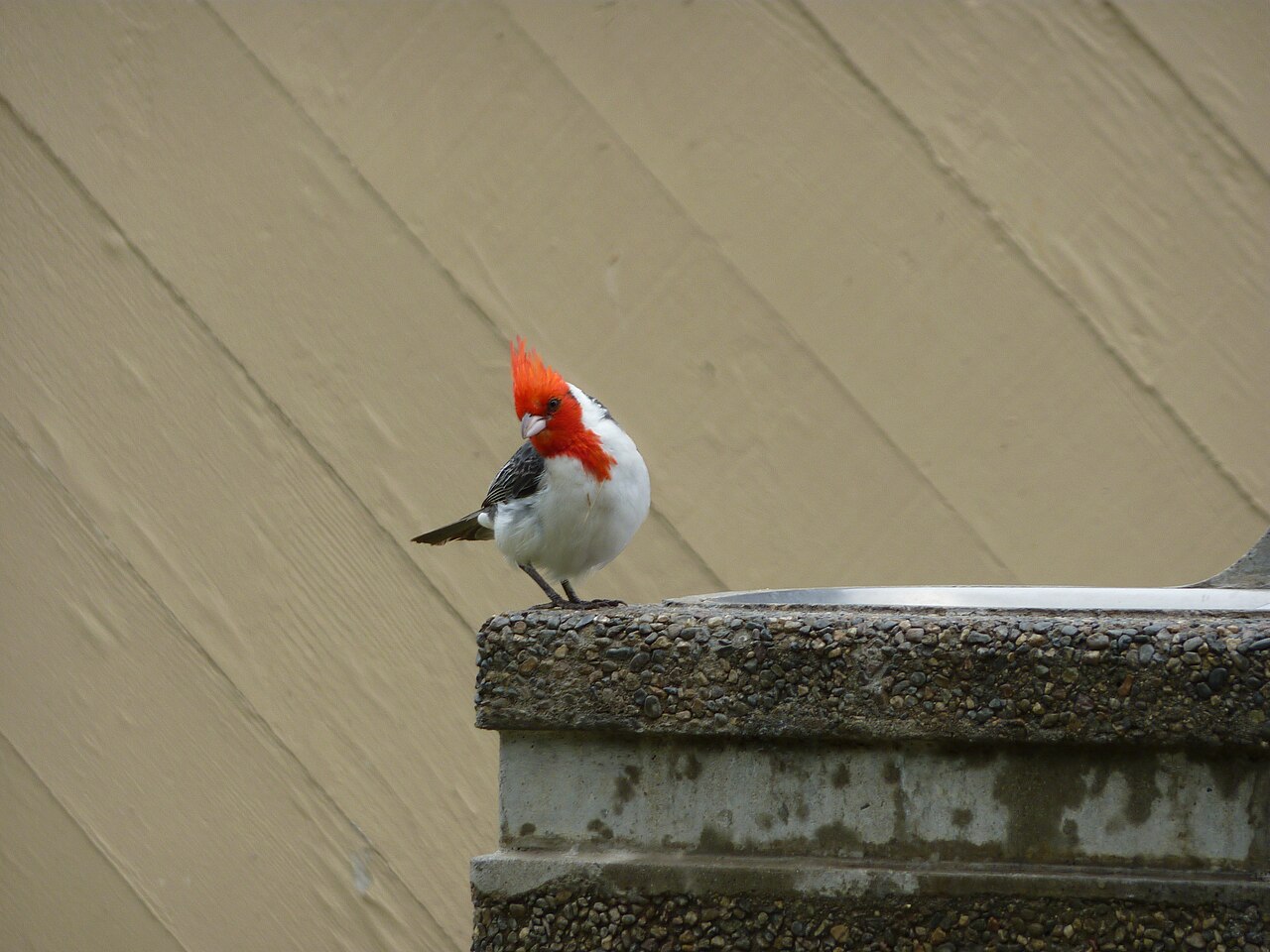
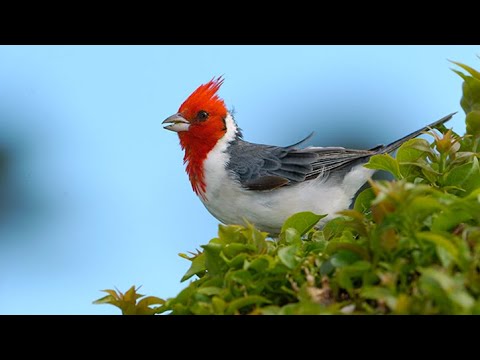
The Red-crested Cardinal (Paroaria coronata) is the crimson-hooded songbird of Hawaiian parks — despite the name it is a tanager, not a true cardinal, imported from South America around 1930. The entire head, crest, and throat are red over a gray back and white belly. Its voice is a clear, cheerful whistled song. It forages on the ground for seeds and insects and visits feeders. Island yards attract them with scattered seed, a water dish, and fruiting shrubs. They share the lawn with the Zebra Dove and the Common Myna.
Species Physical Profile & Morphometrics
The Red-crested Cardinal belongs to the tanager family (Thraupidae) — a South American species introduced to Hawaii around 1930 and now common in the lowlands of Oahu and several other islands.
The identification formula: full crimson head and crest + gray back + white belly. A true Northern Cardinal is red all over with a black mask and a thick orange bill; this bird’s red stops at the throat like a hood. Brown-headed juveniles follow the parents — do not mistake them for a different species.
Essential Morphometric Field Marks:
- Body Length & Mass: 7.1 to 7.9 inches (18–20 cm) and 0.8 to 1.1 ounces (22–30 grams) — robin-postured but slimmer, with a longish tail.
- Wingspan: Wings are medium and rounded, suited to short flights between lawn and tree — this is a bird of open ground near cover.
- Bill Structure & Color: A stout, pale, conical seed-eating bill — lighter in color than a true cardinal’s thick orange wedge.
- Color Pattern: Crimson head, crest, and throat in a complete hood; silver-gray back and wings; clean white underparts. Juveniles swap the red for brown.
- Male vs. Female: Sexes look alike, both wearing the full crimson hood — pairs are usually told apart by behavior, not plumage.
The crimson hood: red-headed and white-breasted, singing his cheerful whistle from the park tree, then dropping to the lawn to hop-feed beside his mate like a yard-long shadow.
The matching partner — same red hood, same tuxedo — she builds a neat cup in a garden shrub and the pair leads their brown-headed juveniles to the seed scatter a month later.
Red-crested Cardinal Vocalization Guide (0 Field Recordings)
The Red-crested Cardinal’s song is a clear, cheerful series of whistles — often rendered whee-chee-chee or what-cheer, cheer, cheer — reminiscent of, but thinner than, a Northern Cardinal’s. All recordings below are real field audio via Wikimedia Commons — no simulations. For a deeper library, browse xeno-canto: Red-crested Cardinal.
1. The Cheerful Whistle
2. The Pair Calls
3. The Juvenile Beg
Habitat, Range & the Island Lowlands
In Hawaii the Red-crested Cardinal lives in parks, gardens, resort grounds, farmland edges, and dry forest margins — open ground with scattered trees, from sea level into the lower hills. It is a bird of the sunny lowlands, happiest where lawns meet shrubby cover.

South America’s Gift to the Islands
Native to northern Argentina, Bolivia, Paraguay, Uruguay, and southern Brazil, the species was introduced to Hawaii around 1930 and is now common on Oahu and established on Maui, Hawaii, and other islands — plus a separate introduced population in Puerto Rico.
For island yards: a lawn with a seed scatter, a water dish, and a fruiting shrub or shade tree is everything this species asks. Pairs hold year-round territories — your morning pair will still be yours next year.
Backyard Behavioral Patterns & Social Dynamics
The Red-crested Cardinal is a ground-foraging, pair-living songbird of the sunny lowlands. Four behaviors explain most of what you will observe:
🐇 The Hop-Forager
It hops across open lawns picking seeds and insects — one of the few Hawaiian songbirds as comfortable on the ground as in a tree.
💑 The Year-Round Pair
Pairs hold territory together all year — where you see one red hood, the second is a few hops away.
🐣 The Brown-Hatted Brood
Juveniles wear brown heads through their first months — family groups of red parents and brown youngsters are a common lawn scene.
🎤 The Persistent Singer
Males sing through most of the year from exposed perches — the cheerful whistle is a fixture of the island soundscape.
Problem: “Is the Red Bird in My Hawaiian Yard a Northern Cardinal?”
The three most common Red-crested Cardinal puzzles all have proven answers:
First, the which-cardinal question: look at the belly — a Northern Cardinal (also introduced in Hawaii) is red from crest to tail with a black mask; the Red-crested Cardinal’s red stops at the throat, over a white belly and gray back. Second, the brown-headed mystery bird: a brown-headed bird hopping with red parents is a juvenile Red-crested, not a new species — the crimson comes in with the first molt. Third, the feeder bully worry: these cardinals are peaceful — unlike mynas they share seed politely; scatter in two spots and the whole lawn flock eats together.
Method 1: Set the Table — Ground Seed & Fresh Water
Design for a ground-foraging songbird:
-
Scatter Seed on the Lawn Edge
Millet and small mixed seed on open ground near cover — the species’ natural feeding style, exactly as-is.
-
Provide a Water Dish
A shallow dish of fresh water — they drink and bathe daily, especially through the dry season.
-
Plant Fruiting Shrubs
Fruit-bearing shrubs and trees add the wild half of the menu — berries and buds supplement the seed.
-
Feed at Quiet Hours
Refresh seed early morning — the pair arrives on schedule and forages before foot traffic begins.
Method 2: Grow the Refuge — Shrubs, Trees & Safety
Cover within a hop is what keeps them resident:
-
Keep Shrubby Edges
Dense shrubs beside the lawn are escape cover and nest sites — the pair needs both within a short dash.
-
Leave a Shade Tree
A mid-sized tree over the lawn serves as singing stage, lookout, and afternoon refuge.
-
Keep Cats Indoors
Ground-foraging birds cannot survive a stalking cat — the indoor-cat rule protects the pair that trusts your lawn.
-
Skip Lawn Chemicals
Pesticide-free grass keeps the insects and seed heads the birds actually eat — a sprayed lawn is an empty table.
Tool Solution: Recommended Hardware for Red-crested Cardinal
Equipment matched to a crimson-hooded ground forager:
Lawn-Edge Seed Scatter
A daily scatter of millet and small seed beside the shrub line — the simple station that makes a pair resident.
- • Food: Millet, small seed
- • Style: Ground scatter
- • Timing: Early morning
Shallow Water Dish
A fresh shallow dish near the feeding patch — drinking and bathing happen daily, and the show is half the pleasure.
- • Depth: 1 inch
- • Refresh: Daily
- • Bonus: All garden birds
Shrub & Shade Tree
Dense shrubs at the lawn edge plus one mid-sized tree — nest site, stage, and refuge in one planting.
- • Structure: Dense shrubs
- • Tree: Mid-size shade
- • Bonus: Fruit for the menu
Frequently Asked Questions
- Species Profile: The Red-crested Cardinal (Paroaria coronata) is a 7.1–7.9 inch, 0.8–1.1 ounce tanager (Thraupidae), band code RCCA — a South American red hood in Hawaiian parks.
- ID in One Look: Full crimson head and crest, gray back, white belly; juveniles brown-headed.
- The Sound: Cheerful what-cheer whistles from the park trees; real field recordings above.
- Range & Habit: Introduced ~1930; common in Hawaiian lowland parks and gardens; hops lawns in year-round pairs.
- Garden Formula: Ground seed scatter, a water dish, fruiting shrubs, cats indoors.
- The Friendly Impostor: Not a cardinal at all — a tanager that outshines most of them.
Bird Watching Log
Species: Red-crested Cardinal (Paroaria coronata)
| Red-crested Cardinal (Adult or Juvenile: A / J — Pair Seen: Yes / No — Singing: Yes / No — On Ground: Yes / No — Date & Time: ___) | |