
Saffron Finch


Saffron Finch (Sicalis flaveola): Complete Identification, Habitat Guide & Sound Library
Quick Answer: How to Attract & Identify the Saffron Finch
The Saffron Finch (Sicalis flaveola) is the golden ground-finch of Hawaii’s dry lowlands — a South American species introduced to the islands in the 1960s. Despite the name it is a tanager, not a true finch. The male glows saffron-yellow with an orange crown; the female is duller olive-yellow. Its voice is a cheerful, repetitive song and sharp chip calls. It feeds on the ground on seeds. Island yards attract them with scattered millet, a ground water dish, and open sunny ground beside shrubs. They share the dry country with the Common Waxbill and the Zebra Dove.
Species Physical Profile & Morphometrics
The Saffron Finch belongs to the tanager family (Thraupidae) — a South American grassland species introduced to Hawaii in the 1960s, now established in the dry leeward lowlands of the Big Island, Oahu, and other islands.
The identification formula: glowing yellow finch-shaped bird + orange crown (male) + on the ground in dry country. The Yellow-fronted Canary is smaller, streaky-backed, and yellow-faced; the Saffron is a wash of gold. In dry leeward grassland, a golden bird hopping on bare ground is this species.
Essential Morphometric Field Marks:
- Body Length & Mass: 5.1 to 5.9 inches (13–15 cm) and 0.6 to 0.8 ounces (17–23 grams) — a stocky, short-tailed ground finch.
- Wingspan: Wings are short and rounded, built for quick dashes between ground and shrub — open-country finch style.
- Bill Structure & Color: A stout, pale, conical seed bill — pinkish-horn in color, built for grass seeds picked off the ground.
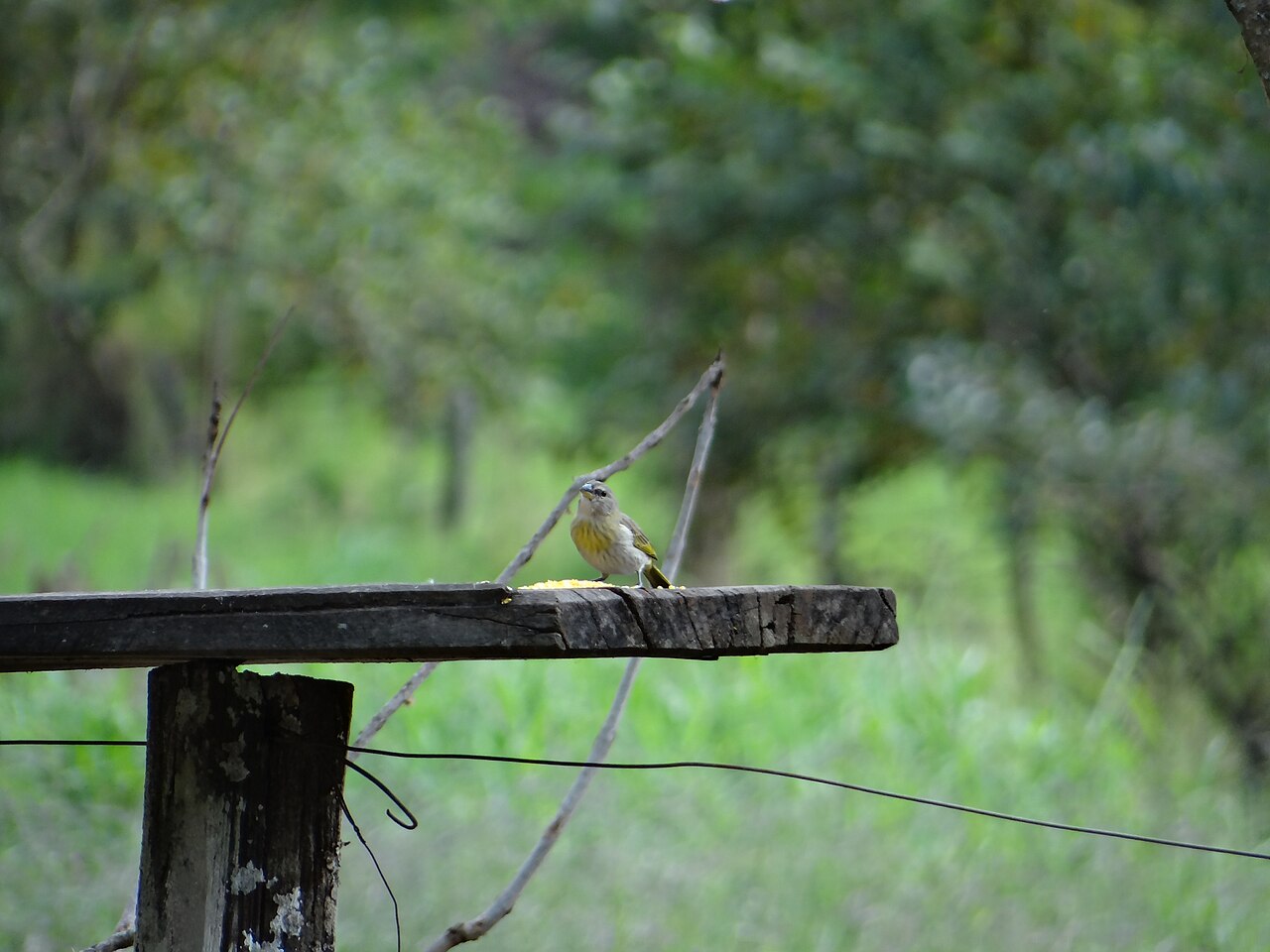
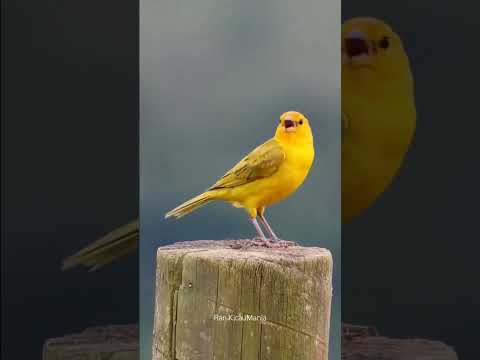
- Color Pattern: The male is saffron-yellow overall with an orange crown and olive-streaked back; the female is duller olive-yellow with faint streaking below.
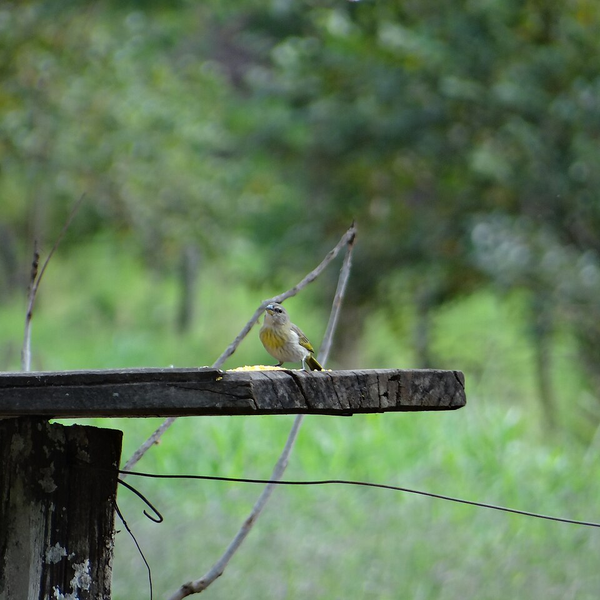
- Male vs. Female: The male is brighter and more uniformly golden, his crown glowing orange; the female and juveniles are gray-olive with a yellow wash — pairs forage side by side.
The golden glow: saffron body and orange crown catching the leeward sun, singing his cheerful phrases from a fence post, then hopping down to feed on the bare ground at his mate’s side.
The olive partner — the same shape in muted gold — she lines a cavity nest in a post or wall hole, and the pair feeds streaky juveniles on the same sunny patch of ground.
Saffron Finch Vocalization Guide (1 Field Recording)
The Saffron Finch’s song is a cheerful, repetitive series of sweet notes — chee-chee-chee, chur-chur — delivered from posts and shrub tops, plus sharp chip contact calls. All recordings below are real field audio via Wikimedia Commons — no simulations. For a deeper library, browse xeno-canto: Saffron Finch.
1. The Cheerful Song
2. The Chip Calls
3. The Alarm
Habitat, Range & the Dry Leeward Lowlands
In Hawaii the Saffron Finch lives in dry open country: leeward grassland, pasture, scrub, ranch land, and garden edges — sunny ground with short grass, bare patches for feeding, and shrubs or posts for song and cover. It is a bird of the rain-shadow side of the islands.

South America’s Gold in Leeward Hawaii
Native to open country across much of South America, the species was introduced to Hawaii in the 1960s and is now commonest on the dry leeward sides of the Big Island and Oahu, with populations on other islands.
For leeward yards: sunny open ground, a seed scatter, and a water dish are the whole recipe — this is one of the few Hawaiian songbirds that genuinely prefers the dry sunny side.
Backyard Behavioral Patterns & Social Dynamics
The Saffron Finch is a golden ground-feeder of the sunny dry country. Four behaviors explain most of what you will observe:
🐇 The Ground Hopper
It feeds by hopping across bare earth and short grass, picking fallen seeds — a lawn and patio bird in the dry districts.
🕳️ The Cavity Nester
Pairs nest in holes — wall cavities, posts, old nests of other birds — a fence-post hole may host a family.
💑 The Year-Round Pair
Mates stay together through the year, feeding side by side and singing within earshot of each other.
☀️ The Sun Lover
Unlike most island songbirds, it favors hot, dry, open ground — the leeward specialist that sings through the heat of the day.
Problem: “My Yard Has Several Yellow Birds. Which Is the Saffron Finch?”
The three most common Saffron Finch puzzles all have proven answers:
First, the yellow-bird sort-out: the Saffron Finch is gold all over with an orange crown, stocky, on the ground; the Yellow-fronted Canary is tiny with a streaked back and yellow face; the Yellow Warbler is slim, in trees, and unstreaked. Second, the dull female mystery: the gray-olive bird with the golden male is his mate — females are much duller but share the stocky shape and ground habit. Third, the feeder refusal: this species prefers ground scatter over hanging feeders — spread millet on a patio edge or bare patch, and the pair arrives within days.
Method 1: Set the Sunny Table — Scatter & Water
Design for a ground-feeding golden finch:
-
Scatter Millet on Bare Ground
White millet on a patio edge or bare patch in the sun — the exact feeding style this species prefers.
-
Provide a Ground Water Dish
A shallow pan in the open — dry-country birds drink daily, and bathing happens in the midday heat.
-
Feed at the Same Hours
Refresh seed early morning and late afternoon — the pair learns the schedule quickly.
-
Keep It Sunny
Place the station in open sun, not shade — Saffron Finches choose the warm bright ground.
Method 2: Grow the Refuge — Shrubs, Posts & Nest Holes
A shrub line and a hole make residents:
-
Keep a Shrub Border
Dense shrubs beside the feeding ground are escape cover — feed within a dash of them.
-
Leave Posts & Cavities
Fence posts with holes and untrimmed palms are nest sites — a pair that nests is a pair that stays.
-
Skip Lawn Chemicals
Unsprayed ground keeps seed heads and insects — the wild pantry that supplements your scatter.
-
Keep Cats Indoors
A ground-feeding pair cannot survive a stalking cat — the indoor-cat rule applies in gold as in gray.
Tool Solution: Recommended Hardware for Saffron Finch
Equipment matched to a golden ground-finch:
Sunny Ground Scatter
Millet on bare sunny ground beside the shrub line — the simple station a pair adopts within the week.
- • Food: White millet
- • Placement: Open sun
- • Timing: Morning & afternoon
Open Water Pan
A shallow pan in the sun — dry-country birds drink and bathe through the heat, in plain view of a shaded chair.
- • Depth: 1 inch
- • Style: Ground level
- • Bonus: Whole yard flock
Post Hole & Palm Crown
Untrimmed palms and holed posts near the feeding ground — cavity nest sites that convert visitors to residents.
- • Feature: Cavities
- • Location: Near feeding
- • Bonus: Other cavity birds
Frequently Asked Questions
- Species Profile: The Saffron Finch (Sicalis flaveola) is a 5.1–5.9 inch, 0.6–0.8 ounce tanager (Thraupidae), band code SAFF — the golden ground-finch of leeward Hawaii.
- ID in One Look: Gold all over, orange crown on the male, stocky shape, on the ground in dry sunny country.
- The Sound: Cheerful repetitive song from posts and shrubs; real field recordings above.
- Range & Habit: South American tanager introduced in the 1960s; dry leeward lowlands of the Big Island, Oahu, and beyond.
- Garden Formula: Sunny ground scatter of millet, open water pan, shrub border, nest cavities.
- The Leeward Specialist: When the dry side glows gold at your feet, that is the Saffron Finch.
Bird Watching Log
Species: Saffron Finch (Sicalis flaveola)
| Saffron Finch (Male or Female: M / F — Singing: Yes / No — On Ground: Yes / No — At Water: Yes / No — Date & Time: ___) | |