
Brown-headed Nuthatch


Brown-headed Nuthatch (Sitta pusilla): Complete Identification, Feeder Guide & Call Library
Quick Answer: How to Attract & Identify Brown-headed Nuthatches
The Brown-headed Nuthatch (Sitta pusilla) is the tiny squeaky-toy songbird of the southern pinelands — a 3.9–4.3-inch, roughly 10-gram climber in blue-gray and white with a warm brown cap and a crisp white spot on the back of the neck. A member of the nuthatch family (Sittidae), it hops headfirst down pine trunks, pries insects from bark — sometimes using a bark flake as a tool — and chatters in a high, squeaky “chee-da” that sounds like a rubber duck. It is a non-migratory resident of southeastern pine forests from Texas to Delaware, a cooperative breeder whose grown sons help at the nest, and an enthusiastic user of small-entrance nest boxes. Attract a pair with suet, sunflower seeds, chopped peanuts, mature pines, and a safe standing snag.
Species Physical Profile & Morphometrics
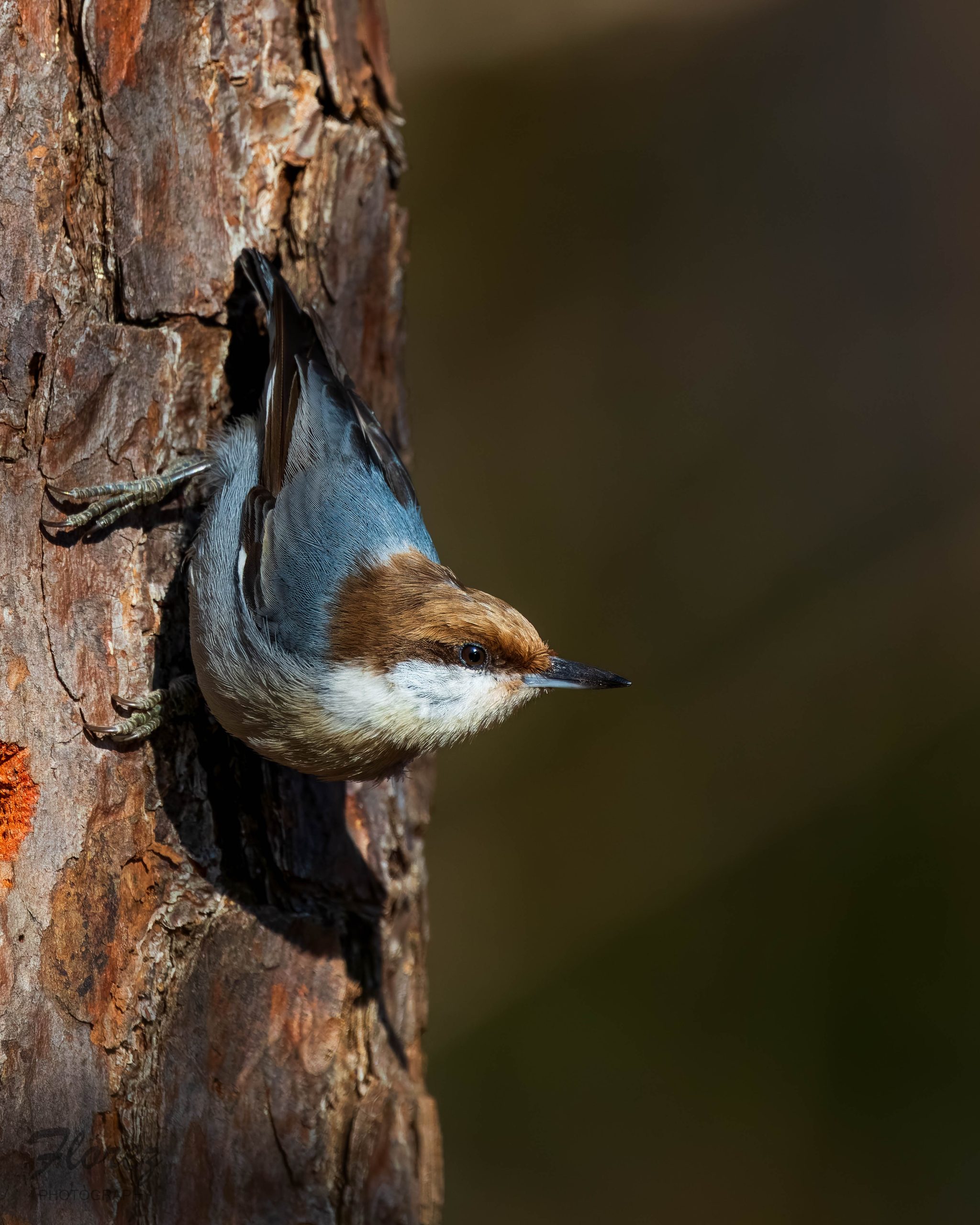
The Brown-headed Nuthatch is the smallest nuthatch in the East and the only one with a brown crown. Its two close relatives — the White-breasted and Red-breasted Nuthatches — both wear black caps and lack this species’ secret handshake: a bright white spot on the nape, hidden until the bird bends its head, then flashed like a signal.
In the field, expect a compact, short-tailed, big-headed silhouette working pine bark at any angle — up, down, sideways, upside down. The plumage is subtle but crisply patterned: blue-gray above, whitish to buffy below, with the brown cap running to the eye and a dark line through it. If the bird opens its bill, the voice removes all doubt: nothing else in the pinelands squeaks like a dog toy.
Essential Morphometric Field Marks:
- Body Length & Mass: Averages 3.9 to 4.3 inches (10–11 cm) with an adult mass of roughly 0.35 ounces (10 grams) — slightly smaller than the Red-breasted Nuthatch, with proportionally shorter wings.
- Wingspan: 6.3 to 7.1 inches (16–18 cm), with short rounded wings for darting between pine trunks.
- Bill Structure & Color: A straight, dark, chisel-like bill — built for prying bark scales, hammering wedged seeds, and (famously) gripping a bark flake used as a lever.
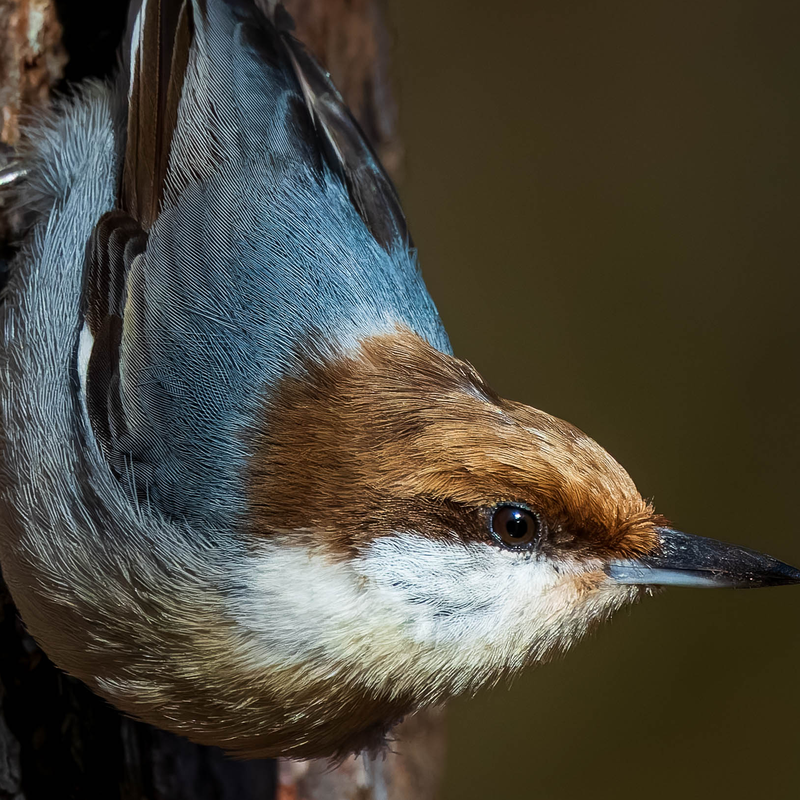
- Color Pattern: Brown cap to the eye; white nape spot; blue-gray back and wings; whitish throat and belly washing buffy on the flanks. Sexes look alike — unlike many backyard birds, males and females share the same pattern.
The white spot on the back of the neck is unique among North American nuthatches and the fastest confirmation when the bird is overhead or facing away — as in our second gallery photo. Look for the flash of white as the bird bends to probe a crevice.
Both other eastern nuthatches wear black crowns. Any small nuthatch in a southern pine wood with a brown crown and whitish (not rusty) underparts is this species — and the squeaky-toy call settles it outright.
Brown-headed Nuthatch Vocalization Guide (3 Acoustic Simulations)
The voice is the great identifier: a high, squeaky, two-syllable “chee-da” or “kit-kit” — regularly and accurately compared to air escaping a rubber squeeze toy. A vocalizing flock has been likened to a small flotilla of rubber duckies. Honest note: no openly licensed field recording of this species is currently available in the Wikimedia audio commons, so all three cards below are clearly labeled acoustic simulations built to published descriptions of the calls. For real wild audio, browse xeno-canto: Brown-headed Nuthatch.
1. The Squeaky-Toy Call — “Chee-Da”
2. Flock Chatter — The Rubber-Duck Flotilla
3. Soft Contact Notes — Pair Communication
Habitat, Range & Year-Round Resident Biology
Brown-headed Nuthatches are pine specialists of the American Southeast — loblolly and shortleaf pine across much of the region, longleaf and slash pine on the coastal plain. The year-round range runs from eastern Texas and the southeastern corner of Oklahoma across Arkansas, Louisiana, Mississippi, Alabama, Georgia, and Florida, and up the Piedmont and coastal plain of the Carolinas and Virginia to Maryland’s Eastern Shore and southern Delaware. They skip the Mississippi River lowlands and never migrate.

Treetops for Food, Dead Wood for Homes
The species splits its needs between two kinds of trees: it forages high on live pines — picking insects from bark and seeds from cones — but it nests in dead ones, excavating its own cavity in well-rotted snags and stumps, sometimes barely above eye level. A pine wood with no dead wood is a cafeteria with no bedrooms.
Pairs hold permanent territories and are frequently joined by helper males from previous broods. In winter they often roam in mixed flocks with Carolina Chickadees, Tufted Titmice, and Pine Warblers — so a yard that hosts the flock hosts them all.
Backyard Behavioral Patterns & Social Dynamics
Few backyard birds pack this much personality into ten grams. Four signature behaviors explain most of what you will observe:
🧗 Headfirst & Upside-Down
Like all nuthatches, this one hops straight down trunks headfirst and hangs upside down beneath branches, gripping bark with oversized feet — no tail-bracing like a woodpecker. The head-down view lets it spot crevice prey that upward-climbing birds miss.
🔧 The Tool User
One of the very few North American birds documented using tools: the Brown-headed Nuthatch picks up a loose bark flake in its bill and uses it as a lever to pry up other bark scales, exposing the insects hiding underneath — and may carry a favorite flake from tree to tree.
👨👩👦 Helpers at the Nest
A genuine cooperative breeder: grown sons from earlier broods often stay on the family territory and help their parents excavate the cavity, feed the incubating female, and provision the nestlings — one reason a “pair” at your feeder can be three or four birds.
🔊 The Rubber-Duck Voice
The high, squeaky “chee-da” call — pure squeeze-toy — carries surprisingly far through the pines, and a foraging family sounds like a flotilla of rubber duckies. Learn the squeak and you will find this bird by ear long before you see it.
Problem: Why Brown-headed Nuthatches Skip Your Yard
In the Southeast the usual question is: “my neighbor’s pines are full of them — why not mine?” The reasons are predictable:
First, this is a canopy pine specialist: a yard without mature pines — loblolly, longleaf, shortleaf, slash — is simply off the map, no matter how good the feeders are. Second, there is nowhere to nest: the birds need soft, well-rotted dead wood to excavate, and a tidy lot with every snag removed offers food but no future — a small-entrance nest box is the practical substitute. Third, the menu gets lost in the crowd: scattered mixed seed on an open lawn favors bigger, pushier birds, while suet and sunflower hung right against pine trunks match how this species actually forages. Give them pines, suet, and a safe snag or nest box, and a territorial family can adopt your yard permanently.
Method 1: Set the Table — Suet, Sunflower & Peanuts
Design for a tiny bark-clinger with a big appetite and a rubber-duck voice:
-
Hang Suet Where a Nuthatch Forages
A wire suet cage hung beside or directly on a pine trunk fits the species’ cling-anywhere feeding style perfectly. Stock a nut or insect blend. Our lab-tested roundup of the Best Suet Feeders & Cakes compares proven models.
-
Stock Sunflower Seeds & Peanut Pieces
Black-oil sunflower, sunflower hearts, and chopped unsalted peanuts are the proven feeder fare — seeds get carried off to be wedged into bark and hammered open, or cached for later. A platform feeder near the pines doubles as a grab-and-go station.
-
Keep Everything a Short Dart from the Pines
Place feeders within a few wing-beats of mature pine trunks. The family stages on bark, darts in for a seed, and retreats to a crevice to work on it. Feeders stranded in open lawn get sampled by bigger birds instead.
-
Add Water — and Keep It Year-Round
A shallow bath with a dripper draws the whole family group, and because these birds never migrate, summer reliability matters as much as winter. Moving water in a hot southern August is a genuine magnet.
Method 2: Keep Them Nesting — Pines, Snags & Small-Entrance Boxes
Turn a visiting family into permanent, breeding neighbors:
-
Keep the Pines — and One Safe Snag
Mature pines feed them; dead wood houses them. If a dead trunk or large dead limb stands well away from the house and foot traffic, leave it — a soft, rotting snag is exactly what the pair excavates each spring.
-
Hang a Small-Entrance Nest Box
Where no snag is safe to keep, mount a nest box with a 1-1/8-inch entrance hole about 5–10 feet up on a pine or post. The small entrance admits this tiny nuthatch while excluding starlings and most House Sparrows — the single most effective piece of hardware for this species. See our Best Nest Boxes for Small Birds.
-
Offer Soft Nest Lining & Leave Bark Alone
Both parents line the cavity with bark shreds, wood chips, and grasses — and the famous bark flakes double as tools. Skip the manicure: loose bark scales and a little leaf litter under the pines are raw material, not mess.
-
Skip the Pesticides
Nestlings are raised largely on insects and spiders gleaned from pine bark. An unsprayed yard keeps the pantry stocked through both broods — this early nester often raises two families a year.
Tool Solution: Recommended Hardware for Brown-headed Nuthatches
Equipment matched to a tiny, tool-using, pine-loving climber:
Hanging Suet Cage
The classic wire cage a nuthatch can cling to on every face — hung beside a pine trunk, it becomes the family group’s daily station.
- • Cake: Nut or insect blend
- • Access: Clingable on all sides
- • Mount: Beside a mature pine
Platform Feeder + Peanut Pieces
A sturdy platform stocked with black-oil sunflower, sunflower hearts, and chopped unsalted peanuts — fuel for wedging, hammering, and caching.
- • Seeds: Black-oil sunflower
- • Nuts: Chopped unsalted peanuts
- • Placement: Short dart from pines
Small-Entrance Nest Box
A compact box with a 1-1/8-inch entrance hole, mounted 5–10 feet up near pines — sized for Brown-headed Nuthatches, too small for starlings and most House Sparrows.
- • Entrance: 1-1/8 in
- • Mount: 5–10 ft, near pines
- • Bonus: Often two broods a year
Frequently Asked Questions
- Species Profile: The Brown-headed Nuthatch (Sitta pusilla) is a 3.9–4.3 inch, roughly 10-gram climber — blue-gray above, whitish below, with a brown cap to the eye and a diagnostic white spot on the nape.
- Southeastern Pine Specialist: A non-migratory resident of loblolly, longleaf, shortleaf, and slash pine woods from eastern Texas and Oklahoma across the Deep South to Delaware and Maryland’s Eastern Shore.
- The Squeaky-Toy Voice: A high, squeaky two-syllable “chee-da” like a rubber squeeze toy; a calling family sounds like a flotilla of rubber duckies.
- Tool User & Cooperator: One of the few North American birds that uses tools — bark flakes as prying levers — and a cooperative breeder whose grown sons help at the nest.
- Feeder Formula: Suet hung by a pine trunk, black-oil sunflower, and chopped peanuts, plus a shallow bath — everything a short dart from mature pines.
- Nesting Help: Leave a safe dead snag, or hang a nest box with a 1-1/8-inch entrance 5–10 feet up; the pair excavates its own cavity in soft dead wood and often raises two broods.
Bird Watching Log
Species: Brown-headed Nuthatch (Sitta pusilla)
| Brown-headed Nuthatch (Nape Spot Seen? / Group Size: ____________________________) | |