
Say’s Phoebe


Say’s Phoebe (Sayornis saya): Complete Identification, Habitat Guide & Sound Library
Quick Answer: How to Attract & Identify the Say’s Phoebe
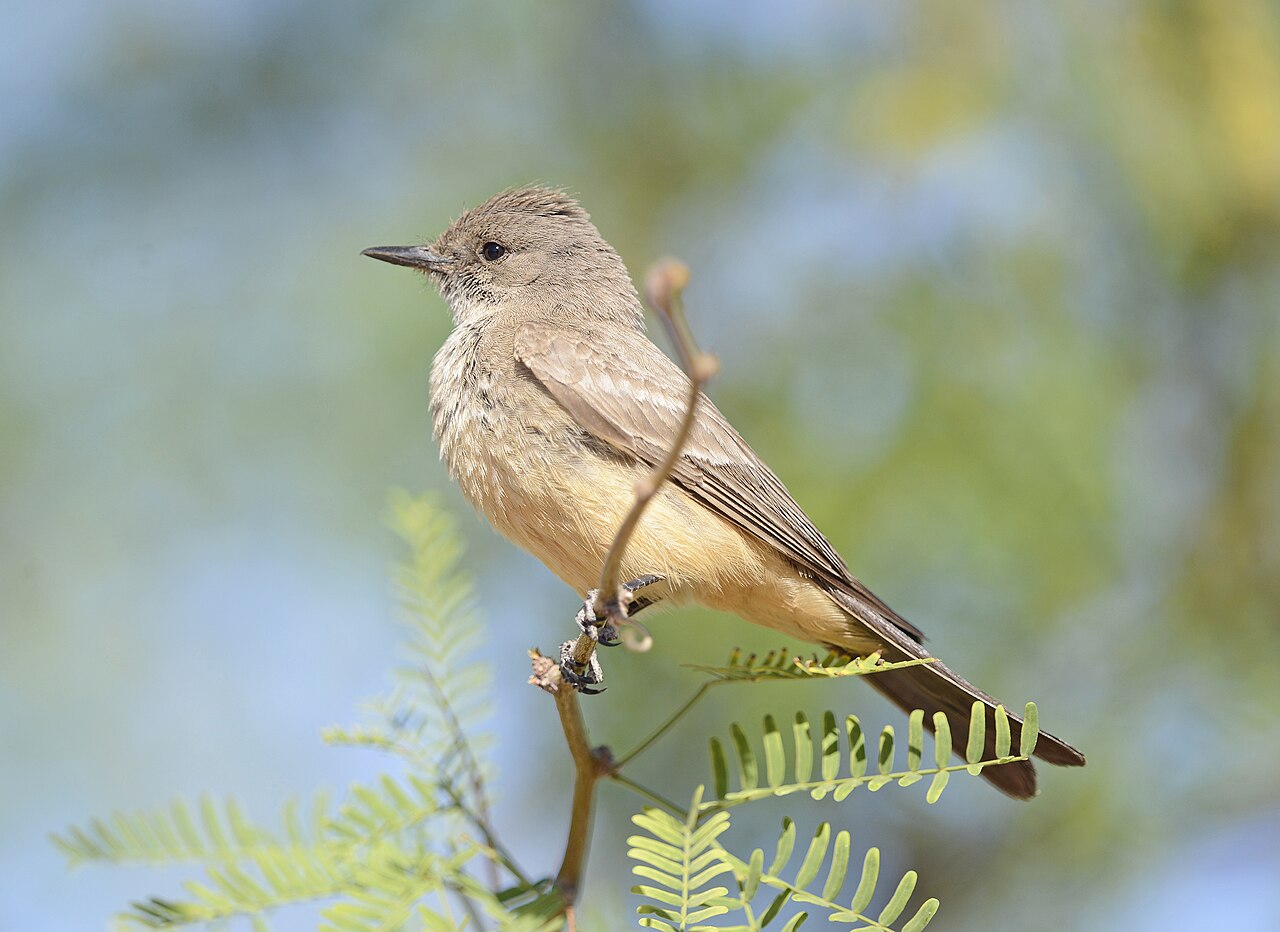
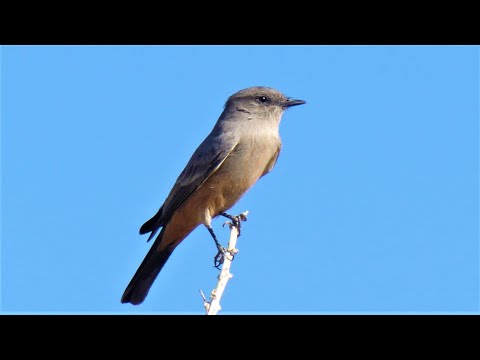
The Say’s Phoebe (Sayornis saya) is the phoebe of the open West — plain gray-brown above, warm cinnamon-buff below, with a dark tail it dips without pause. It hunts insects from low exposed perches — fence posts, rocks, stalks — and nests on ledges, bridges, and building eaves. The song is a soft, whistled fee-bee with a falling second note. Ranch and prairie yards attract them with open perches, sheltered nest ledges, and spray-free insect life. They share the open country with the Ash-throated Flycatcher and the Scissor-tailed Flycatcher.
Species Physical Profile & Morphometrics
Say’s Phoebe belongs to the tyrant flycatcher family (Tyrannidae) and is the phoebe of western open country — prairie, ranchland, sagebrush, and desert edge from the Great Plains to the Pacific, with northern birds wintering in the Southwest and Mexico.
The identification formula: plain gray-brown upperparts + cinnamon-buff belly + dark tail in constant motion. The Eastern Phoebe is white-bellied and eastern; the Black Phoebe wears a sharp black-and-white tuxedo near western water. Say’s is the rusty-bellied one of dry open ground.
Essential Morphometric Field Marks:
- Body Length & Mass: 7.5 inches (19 cm) and 0.7 to 0.8 ounces (21–24 grams) — the largest of the three phoebes, slim and long-tailed.
- Wingspan: 13 inches (33 cm); flight is low and direct between perches, with quick sallies after insects.
- Bill Structure & Color: A slim all-black bill, wide-based for snatching insects, backed by fine rictal bristles.
- Color Pattern: Gray-brown head, back, and chest; cinnamon-buff belly and undertail; dark wings and tail — subtle, clean, and unmistakable at range.
- Male vs. Female: The sexes look alike — both sing the soft fee-bee, and both share the two-brood summer in sheltered nest sites.
The fence-post hunter: sitting low and still, tail dipping, then darting out to snap a grasshopper inches above the grass.
Identical in plumage — she builds the mud-and-weed nest cup on a sheltered ledge and raises two broods while he guards the territory’s airspace.
Say’s Phoebe Vocalization Guide (0 Field Recordings)
Say’s Phoebe’s song is a soft, whistled fee-bee with a falling second phrase, plus a liquid whit contact call. All recordings below are real field audio via Wikimedia Commons — no simulations. For a deeper library, browse xeno-canto: Say’s Phoebe.
1. The Fee-Bee Song
2. The Liquid Whit
3. The Dawn Sequence
Habitat, Range & the Open West
Say’s Phoebe lives in open country: shortgrass prairie, ranchland, sagebrush, badlands, and desert edge — anywhere with low perches, flying insects, and a sheltered ledge for the nest. It is one of the earliest spring migrants, arriving while snow still lingers.

The Prairie’s Patient Percher
Breeding range spans the western half of the continent from Alaska and Canada south through the Great Plains and Intermountain West; winter pulls the northern population into the Southwest and Mexico, while southern birds stay put.
For backyard birders: rural and ranch-edge yards with open ground, low perches, and a barn or porch ledge can host a nesting pair — one of the few flycatchers that adopts human structures.
Backyard Behavioral Patterns & Social Dynamics
Say’s Phoebe is a low-perch sally hunter with a taste for human architecture. Four behaviors explain most of what you will observe:
🎯 The Low Sally
It hunts from low exposed perches — fence posts, rocks, stalks — darting out to snatch insects near the ground and returning to the same lookout.
🏠 The Ledge Nester
It nests on ledges of buildings, bridges, and cliffs — a mud-and-grass cup under a roof, reusing the same site for years.
🌡️ The Early Migrant
It is among the earliest spring arrivals in the West — hawking midges over thawing fields while winter still holds the hills.
🦗 The Grasshopper Harvest
The diet runs heavy to grasshoppers and beetles — a nesting pair clears remarkable numbers from pasture and garden.
Problem: “How Do I Tell Say’s Phoebe from Other Phoebes? What Should I Do?”
The three most common Say’s Phoebe puzzles all have proven answers:
First, the phoebe triangle: compare belly color and habitat — Say’s is cinnamon-bellied in dry open country; Eastern is white-bellied in the East near water and woods; Black is black-and-white and glued to western water. Second, the quiet hours: phoebes sing most at dawn and in cool hours — a silent midday bird on a fence post is normal scheduling, not absence. Third, the unwanted nest: a nest over a doorway is temporary — wait out the five-to-six week cycle from eggs to fledged young, then block the ledge after the family leaves; evicting an active nest is both illegal and unnecessary.
Method 1: Set the Table — Hunting Perches & Nest Ledges
Design for a low-hunting, ledge-nesting insect eater:
-
Keep Low Exposed Perches
Fence posts, rocks, and bare stalks scattered across open ground — the hunting stations of a working phoebe territory.
-
Offer a Sheltered Ledge
An eave, beam, or simple wooden platform under cover — the nest substrate this species has used since the first barn went up.
-
Keep Insects Plentiful
No broad insecticides — grasshoppers, beetles, and flies are the whole menu; a spray-free pasture is a stocked pantry.
-
Leave Old Nests Standing
Old mud cups are reused and repaired — last year’s nest is this year’s head start.
Method 2: Build the Habitat — Open Space & a Drink
Keep the country open and the insects flying, and the pair returns each spring:
-
Keep Sightlines Open
Short grass and scattered shrubs — phoebes hunt where they can see the ground between perches.
-
Provide a Shallow Water Source
A ground-level bath or stock-tank edge — phoebes drink and bathe low, and water concentrates the insects they eat.
-
Grow the Insect Crop
Unsprayed native grassland or meadow — grasshopper country is phoebe country.
-
Watch the Shoulder Seasons
March and October are peak passage — migrating phoebes appear on fence lines far from any breeding ledge.
Tool Solution: Recommended Hardware for Say’s Phoebe
Equipment matched to a low-perching western phoebe:
Open Hunting Perches
Fence posts, snag tops, and bare stalks over open ground — the offices from which a phoebe works your acreage.
- • Height: 2–6 feet
- • Spacing: Open sightlines
- • Bonus: Bluebirds & kingbirds too
Sheltered Ledge or Platform
A covered beam or simple nesting shelf under an eave — the structure that turns a passing phoebe into a resident pair.
- • Placement: Under a roof
- • Surface: Rough wood
- • Bonus: Barn swallows too
Ground-Level Water
A shallow bath or dripping stock-tank edge — water for the birds and bait for the flying insects they harvest.
- • Depth: 1–2 inches
- • Placement: Open ground
- • Bonus: Meadowlarks & sparrows
Frequently Asked Questions
- Species Profile: Say’s Phoebe (Sayornis saya) is a 7.5-inch, 0.7–0.8 ounce flycatcher (Tyrannidae), band code SAPH — the cinnamon-bellied phoebe of the open West.
- ID in One Look: Gray-brown above, cinnamon-buff below, dark tail forever dipping.
- The Sound: A soft whistled fee-bee at dawn; liquid whit contact notes; real field recordings above.
- Range & Habit: Western open country; nests on ledges of buildings and cliffs; earliest spring flycatcher.
- Feeder Formula: Perches, a ledge, and live insects — seed is irrelevant to a phoebe.
- The Grasshopper Dividend: A nesting pair harvests hundreds of pest insects daily — free pest control on wings.
Bird Watching Log
Species: Say’s Phoebe (Sayornis saya)
| Say’s Phoebe (Cinnamon Belly Seen: Yes / No — Tail Dipping: Yes / No — Fee-Bee Heard: Yes / No — Ledge Nest Active: Yes / No — Date & Time: ___) | |