
Vermilion Flycatcher


Vermilion Flycatcher (Pyrocephalus rubinus): Complete Identification, Habitat Guide & Sound Library
Quick Answer: How to Attract & Identify the Vermilion Flycatcher
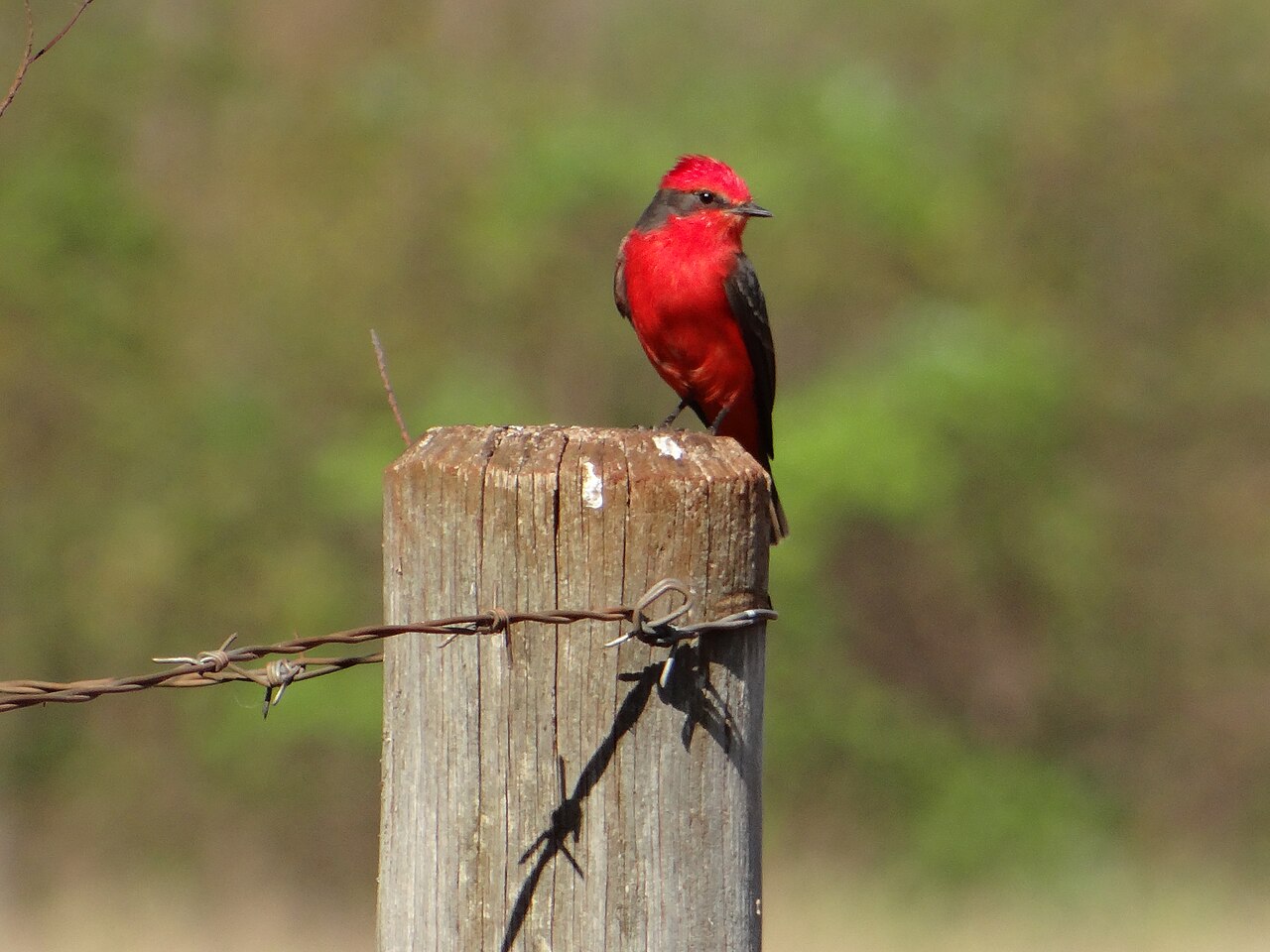
The Vermilion Flycatcher (Pyrocephalus rubinus) is the scarlet jewel of the Southwest — the male fire-red below and on the crown, masked and backed in dark brown; the female soft gray with a peach-salmon blush on the belly. It hunts insects from low perches near water and open grass, and courts with a fluttering display flight. The song is a twittering pit-a-see, pit-a-see. Desert and riverside yards attract them with open lawns, scattered trees, water, and spray-free insect life. They share the bosque with the Say’s Phoebe and the Gila Woodpecker.
Species Physical Profile & Morphometrics
The Vermilion Flycatcher belongs to the tyrant flycatcher family (Tyrannidae) and is the signature flycatcher of the desert Southwest — riverside groves, mesquite grassland, park ponds, and ranch country from Arizona and Texas south deep into Latin America.
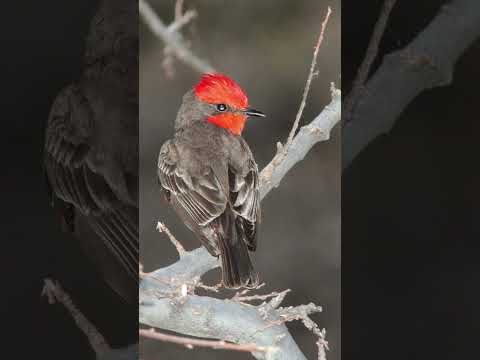
The identification formula: male — scarlet crown and underparts with a dark brown mask and back; female — gray-brown above, whitish below with peach on the belly and a pale eyebrow. The male is unmistakable; the female’s salmon blush and neat dark tail separate her from any phoebe.
Essential Morphometric Field Marks:
- Body Length & Mass: 5.1 to 5.5 inches (13–14 cm) and 0.4 to 0.5 ounces (11–14 grams) — a small, compact flycatcher that punches far above its weight in color.
- Wingspan: 9.8 to 10.2 inches (25–26 cm); flight is quick sallies from a perch and, in spring, a fluttering song-flight above the treetops.
- Bill Structure & Color: A short, slim black bill with a fine point — a precision instrument for snatching small flying insects.
- Color Pattern: Male — brilliant scarlet crown and underparts, dark brown mask, back, wings, and tail. Female — gray-brown above, whitish below, salmon-peach wash on the belly and vent.
- Male vs. Female: Strongly dimorphic — he is the ember; she is the smoke with a peach glow. Both perch low and sally for insects all day.
The struck match: a coal-brown bird set alight — scarlet crown to belly — sitting on a fence wire over the grass, then darting out and returning in a flash of fire.
The subtle half — gray-brown and white with a salmon blush low on the belly; she builds the neat cup nest in a horizontal mesquite fork.
Vermilion Flycatcher Vocalization Guide (3 Field Recordings)
The Vermilion Flycatcher’s song is a twittering pit-a-see, pit-a-see — often given in a fluttering display flight — plus a sharp peek call. All recordings below are real field audio via Wikimedia Commons — no simulations. For a deeper library, browse xeno-canto: Vermilion Flycatcher.
1. The Pit-A-See
2. The Sharp Peek
3. The Song Flight
Habitat, Range & the Desert Oasis
The Vermilion Flycatcher lives where open ground meets scattered trees and water: riverside cottonwood groves, mesquite grassland, desert parks, golf courses, and ranch ponds across the Southwest. It is the rare desert bird that thrives in green suburban oases.

The Oasis Ember
Breeding range centers on the Southwest — Arizona, New Mexico, and Texas — south through Mexico; northern birds withdraw to Mexico in winter, while a growing population now winters in southern Arizona and along the Gulf Coast to Florida.
For backyard birders: Southwest yards with open lawn, scattered trees, and a pond or dripper can host a hunting male from spring through fall — and a lucky few, all winter.
Backyard Behavioral Patterns & Social Dynamics
The Vermilion Flycatcher is a low-perch sally hunter with a flair for display. Four behaviors explain most of what you will observe:
🎯 The Wire Hunter
It hunts from low exposed perches — wires, fence posts, branch tips — darting out for insects and flashing back to the same station.
🎈 The Song Flight
In spring the male performs a fluttering display flight — climbing with rapid wingbeats, twittering nonstop, then dropping back — a scarlet balloon on strings.
🪹 The Fork Nest
The nest is a small neat cup in a horizontal tree fork — mesquite, cottonwood, or willow — usually within ten feet of the ground.
🌅 The Dawn Perch
Males claim the same exposed perch each dawn — find the morning lookout and the ember will be on it tomorrow too.
Problem: “How Do I Find and Keep a Vermilion Flycatcher? What Should I Do?”
The three most common Vermilion Flycatcher puzzles all have proven answers:
First, the missing male: males go quiet and still in midday heat and can vanish from a lawn for hours — watch at dawn and late afternoon when sallying resumes on the same wire. Second, the drab bird confusion: the female is often overlooked or misnamed — check for the salmon-peach blush on the belly, the neat dark tail, and the pale eyebrow; she is usually hunting the same lawn as the male. Third, the vanished pair: territories collapse when lawns are sprayed or trees over-trimmed — stop insecticide, leave horizontal forks untrimmed in nesting season, and keep a water feature running; the embers return to a yard that feeds their insects.
Method 1: Set the Table — Open Grass & Low Perches
Design for a low-hunting desert flycatcher:
-
Keep Open Short Grass
A lawn or short meadow patch — the hunting floor where insects rise and the flycatcher works.
-
Provide Low Exposed Perches
Wires, fence posts, and bare branch tips over the grass — the stations of a Vermilion territory.
-
Keep the Insect Crop
No broad insecticides on the lawn — flies, beetles, and grasshoppers are the entire diet.
-
Run a Water Feature
A pond, dripper, or fountain nearby — water draws insects and gives the birds a drink and bath.
Method 2: Build the Habitat — Scattered Trees & Nest Season Care
Keep the right trees standing and the calendar clear, and the pair returns each spring:
-
Keep Scattered Trees
Mesquite, cottonwood, and willow with horizontal forks — perch, nest site, and shade in one structure.
-
Delay Spring Trimming
No limb work March through July — nests sit low in forks and vanish with a single cut.
-
Plant Native Grass Edges
Unsprayed grass and wildflower margins raise the beetles and flies nestlings need.
-
Watch the Dawn Window
Dawn is display time — the song flight and the loudest twittering happen in the first hour of light.
Tool Solution: Recommended Hardware for Vermilion Flycatcher
Equipment matched to a desert-oasis flycatcher:
Water Feature with Open Rim
A pond, dripper, or fountain beside open grass — the insect magnet and drinking station that anchors a Vermilion territory.
- • Flow: Moving water
- • Edge: Perchable rim
- • Bonus: Phoebes & warblers too
Low Perch Stakes
Bare stakes or snags over lawn — the launchpads for the sally-and-return hunting style.
- • Height: 2–6 feet
- • Placement: Over open grass
- • Bonus: Say’s phoebes & kingbirds
Unsprayed Lawn & Meadow
Chemical-free grass — the insect farm that feeds a flycatcher family through the whole nesting season.
- • Rule: No insecticides
- • Mowing: After nesting
- • Bonus: Sparrows & towhees too
Frequently Asked Questions
- Species Profile: The Vermilion Flycatcher (Pyrocephalus rubinus) is a 5.1–5.5 inch, 0.4–0.5 ounce flycatcher (Tyrannidae), band code VEFL — the scarlet ember of the Southwest.
- ID in One Look: Male — scarlet crown and breast, brown mask; female — peach-blushed belly and pale eyebrow.
- The Sound: Twittering pit-a-see song and fluttering song-flight; real field recordings above.
- Range & Habit: Southwest riversides, parks, and ranch ponds; nests low in tree forks; northern birds winter south.
- Feeder Formula: Open unsprayed lawn, low perches, and moving water — seed is irrelevant.
- The Display Flight: The male’s fluttering, twittering climb is spring’s finest free show in desert country.
Bird Watching Log
Species: Vermilion Flycatcher (Pyrocephalus rubinus)
| Vermilion Flycatcher (Scarlet Male Seen: Yes / No — Peach Female Seen: Yes / No — Pit-A-See Heard: Yes / No — Song Flight Watched: Yes / No — Date & Time: ___) | |