
Violet-green Swallow




Violet-green Swallow (Tachycineta thalassina): Complete Identification, Habitat Guide & Sound Library
Quick Answer: How to Attract & Identify the Violet-green Swallow
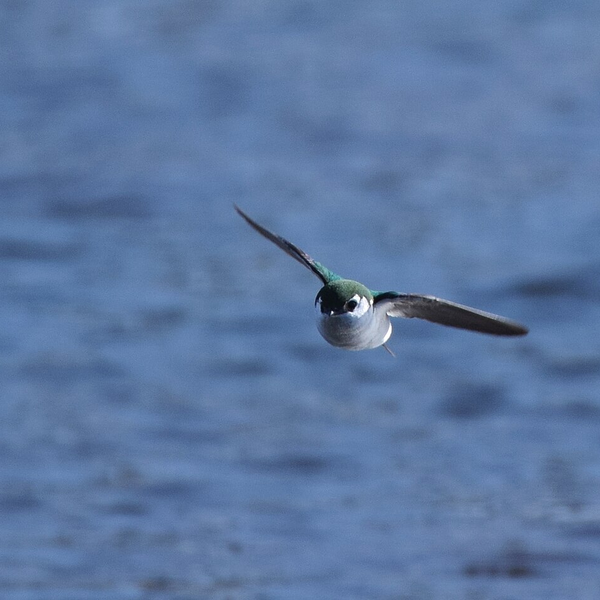
The Violet-green Swallow (Tachycineta thalassina) is the jewel-toned swallow of the West — emerald-green back shading to violet on the crown and rump, white below, with white patches flanking the rump and white wrapping above the eye. It hawks insects over mountain meadows and nests in cavities and nest boxes. The voice is a soft, sweet chee-chee twitter. Western yards attract them with nest boxes facing open airspace. They share the mountain sky with the Tree Swallow and the Barn Swallow.
Species Physical Profile & Morphometrics
The Violet-green Swallow belongs to the swallow family (Hirundinidae) and is the Tree Swallow’s western counterpart — breeding from Alaska to Mexico through the mountain West, the Pacific states, and open pine and aspen country.
The identification formula: white wraps ABOVE the eye + white rump patches + violet-green gloss. The Tree Swallow’s eye sits in dark plumage and its rump is plain; the Violet-green’s face pattern is visible at remarkable distance.
Essential Morphometric Field Marks:
- Body Length & Mass: 4.7 to 5.5 inches (12–14 cm) and 0.5 to 0.6 ounces (14–17 grams) — slightly smaller than the Tree Swallow.
- Wingspan: 10.6 inches (27 cm); flight is quick and flickering, hawking insects over meadows and canyon airspace.
- Bill Structure & Color: A tiny black bill with a wide gape — the standard aerial-insect net of the swallow family.
- Color Pattern: Green back, violet crown and rump, white underparts — with white rising above the eye and white patches on each side of the rump.
- Male vs. Female: He is the brighter, glossier bird; she is duller with more gray in the crown — both share the same face and rump pattern.
The two-tone jewel: green back and violet crown catching the sun as he twitter-sings from the snag above the nest box.
Duller but same-marked — she builds the grass-and-feather cup inside the cavity while he patrols the airspace.
Violet-green Swallow Vocalization Guide (1 Field Recording)
The Violet-green Swallow’s voice is a soft, sweet twittering — dry chee-chee notes and gentle trills. All recordings below are real field audio via Wikimedia Commons — no simulations. For a deeper library, browse xeno-canto: Violet-green Swallow.
1. The Chee-Chee
2. The Sweet Twitter
3. The Nest Chatter
Habitat, Range & the Mountain West
The Violet-green Swallow lives in open western country with cavities: mountain meadows, aspen groves, pine forest edge, canyon rims, and suburban parks — from sea level on the coast to above treeline in the Rockies.

The High Country’s Box Nester
Breeding range runs from Alaska through the Pacific states and the Rockies into Mexico’s highlands; winter takes the population to Mexico and Central America, where they gather in flocks over open country.
For backyard birders: western yards with a nest box facing open sky — especially near meadows, ponds, or forest edge — can host a pair from spring through summer.
Backyard Behavioral Patterns & Social Dynamics
The Violet-green Swallow is a cavity-nesting aerialist of open western airspace. Four behaviors explain most of what you will observe:
🏠 The Cavity Claimer
It nests in old woodpecker holes, natural cavities, and nest boxes — claiming sites early and defending them with aerial chases.
🎯 The Meadow Hawk
It feeds on the wing over open ground — flies, beetles, and winged ants taken in flickering pursuit.
🪶 The Feather Cup
Like its Tree Swallow cousin, it lines the nest with feathers — a soft white lining in the cavity dark.
🏔️ The Elevation Range
It breeds from sea level to above 10,000 feet — one of the most altitude-tolerant songbirds in the West.
Problem: “How Do I Tell Violet-green from Tree Swallow? What Should I Do?”
The three most common Violet-green Swallow puzzles all have proven answers:
First, the face test: look where the white goes — on a Violet-green it wraps up over the eye; on a Tree Swallow the eye stays dark. Second, the rump test: Violet-greens show bold white patches on each side of the rump, visible in flight; Tree Swallow rumps are plain. Third, the box competition: both species claim the same boxes — pair boxes 10–15 feet apart, monitor for House Sparrows weekly, and expect the Violet-green to hunt the higher airspace while Tree Swallows work lower over water and grass.
Method 1: Set the Table — Nest Boxes Facing Open Sky
Design for a cavity-nesting mountain swallow:
-
Mount Boxes on Poles
1.5-inch entrance, 5–8 feet high, guard below — the proven configuration for western cavity nesters.
-
Face the Open Lane
Entrance toward meadow, pond, or canyon air — the hunting runway matters more than the box itself.
-
Pair Where Bluebirds Live
Two boxes 10–15 feet apart — swallows and bluebirds settle as neighbors instead of fighting.
-
Monitor for Sparrows
Weekly checks in season — remove House Sparrow nests promptly; they are unprotected and deadly to native cavity nesters.
Method 2: Build the Habitat — Open Hunting & Natural Cavities
Keep the air full and the snags standing, and the pairs return each spring:
-
Keep Meadow Margins
Unmowed grass near the box — the flying-insect farm of a swallow territory.
-
Leave Safe Snags
Standing dead trees are the original nest sites — a safe snag is a swallow duplex.
-
Skip the Insecticide
The whole diet flies — sprayed airspace is empty airspace.
-
Keep Water Nearby
Ponds and drippers concentrate midges — the densest swallow foraging at dawn and dusk.
Tool Solution: Recommended Hardware for Violet-green Swallow
Equipment matched to a mountain box-nesting swallow:
Pole-Mounted Nest Box
A 1.5-inch-entrance box on a guarded pole facing open sky — the Violet-green homestead.
- • Entrance: 1.5 inches
- • Height: 5–8 feet
- • Facing: Open airspace
Meadow & Pond Airspace
Open grass and water margins — the aerial cafeteria this swallow works all day.
- • Feature: Open + wet
- • Rule: No insecticide
- • Bonus: Tree swallows overlap
Standing Snag
A safe dead tree with woodpecker holes — the original Violet-green nest site.
- • Structure: Stable snag
- • Feature: Old cavities
- • Bonus: Bluebirds & nuthatches
Frequently Asked Questions
- Species Profile: The Violet-green Swallow (Tachycineta thalassina) is a 4.7–5.5 inch, 0.5–0.6 ounce swallow (Hirundinidae), band code VGSW — the jewel of the western sky.
- ID in One Look: White over the eye, white rump patches, violet-green gloss.
- The Sound: Soft chee-chee calls and a gentle twitter; real field recordings above.
- Range & Habit: Western breeder from sea level to treeline; winters in Mexico; nests in cavities and boxes.
- Feeder Formula: A pole box facing open sky — seed never enters the equation.
- The Face Test: White wraps the eye on this species; the Tree Swallow’s eye stays dark.
Bird Watching Log
Species: Violet-green Swallow (Tachycineta thalassina)
| Violet-green Swallow (White Face Seen: Yes / No — Rump Patches Seen: Yes / No — Twitter Heard: Yes / No — Box Claimed: Yes / No — Date & Time: ___) | |