
Chukar


Chukar (Alectoris chukar): Complete Identification, Habitat Guide & Sound Library
Quick Answer: How to Attract & Identify the Chukar
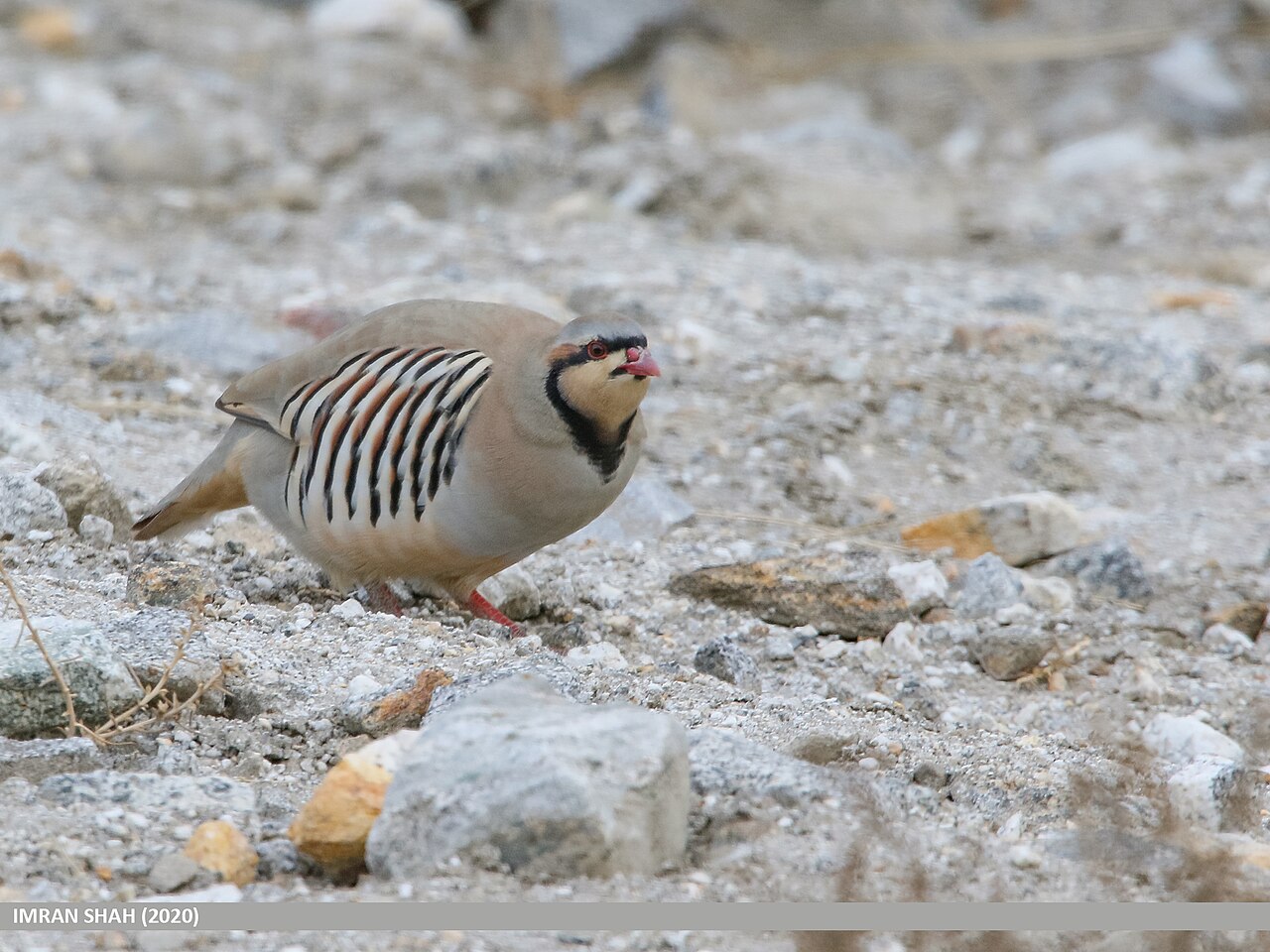
The Chukar (Alectoris chukar) is the clown-faced partridge of the western rimrock — an introduced Eurasian gamebird with a black throat band, bright red bill and legs, and bold black-and-chestnut barred flanks. Its rhythmic chuck-chuck-chukar call rolls down the canyon slopes. It lives year-round on steep arid slopes of cheatgrass and sage and runs uphill from danger rather than flying. Desert-edge yards draw coveys with dependable ground-level water, scattered millet, and rocky brushy cover. They share the dry country with the Scaled Quail and the Sage Thrasher.
Species Physical Profile & Morphometrics
The Chukar belongs to the pheasant and partridge family (Phasianidae) — introduced from Eurasia in the twentieth century and now fully established on arid slopes across the intermountain West, from Washington to Arizona.
The identification formula: gray breast + black throat band + red bill + barred flanks. The Gray Partridge has a rusty face and no throat band and lives on flat farmland; the Chukar owns the steep rocky slopes. The rolling chuck-chuck-chukar call names the bird as clearly as its stripes.
Essential Morphometric Field Marks:
- Body Length & Mass: 12.6 to 15.4 inches (32–39 cm) and 19.1 to 28.6 ounces (541–810 grams) — a plump, big-headed partridge, noticeably heftier than any quail.
- Wingspan: Wings are short and rounded, built for a whirring downhill escape flight — uphill travel is done on those red legs.
- Bill Structure & Color: A stout, bright coral-red bill with matching red legs — the flash of color that picks a Chukar out of gray talus.
- Color Pattern: Pearl-gray breast and back, a bold black band through the eye encircling the cream throat, and flanks striped in black, white, and chestnut bars.
- Male vs. Female: Sexes are nearly identical; the male averages slightly larger with small blunt leg spurs — pairs and coveys are usually identified by behavior, not plumage.
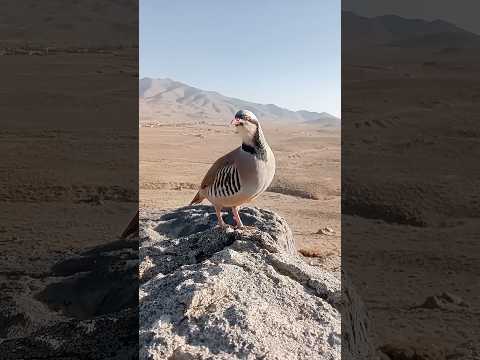
The banded sentinel: red-billed and gray-breasted, calling chuck-chuck-chukar from a boulder above the covey, the black throat band framing his face like a carnival mask.
The near-identical partner — same stripes in a slightly smaller frame — she scrapes a hidden nest under a sage bush and leads a dozen striped chicks down the slope to the water seep.
Chukar Vocalization Guide (0 Field Recordings)
The Chukar’s voice is the rhythmic, rolling call that names it: chuck… chuck-chuck… chukar-chukar-chukar, accelerating like a car engine turning over — plus covey rally calls and sharp alarms. All recordings below are real field audio via Wikimedia Commons — no simulations. For a deeper library, browse xeno-canto: Chukar.
1. The Namesake Chuck
2. The Covey Rally
3. The Alarm Wit
Habitat, Range & the Rimrock Country
The Chukar lives on steep, rocky, arid slopes — rimrock, canyon walls, talus, and cheatgrass hillsides from near-desert valley floors to high ridgelines. It needs three things in a day’s walk: grass and forb seeds to eat, rocky cover to escape into, and — critically — water within reach, which is where desert-edge yards come in.

The Partridge of the Steep Country
Introduced from Eurasia beginning in the 1930s, the Chukar is now established across the Great Basin and interior West — Washington and Oregon east to Montana and Wyoming, south through Nevada, Utah, Idaho, and Colorado to Arizona and New Mexico.
For desert-edge and foothill properties: a yard below rocky slopes with a dependable ground water dish sits on a covey’s daily route. In drought summer, your water pan may be the most visited spot on the hillside.
Backyard Behavioral Patterns & Social Dynamics
The Chukar is a slope-loving, covey-living partridge ruled by water and gravity. Four behaviors explain most of what you will observe:
⛰️ The Uphill Runner
Chukars run uphill from danger and fly downhill — the covey sprints upslope faster than a person can follow, then sails down on stiff wings when pressed.
💧 The Water Route
In dry months the covey visits the same water source every morning and evening — learn the schedule and you can set a chair beside the approach path.
🧱 The Rock Lover
They feed and loaf among rocks, never far from talus or rimrock — open flat ground far from escape cover is not Chukar country.
🗣️ The Constant Caller
Coveys keep up rolling chuck calls all day, loudest at dawn — a calling hillside in June can be located a quarter mile away by ear.
Problem: “Chukars Walk Past My Yard to Water Elsewhere. What Should I Do?”
The three most common Chukar puzzles all have proven answers:
First, the bypassed yard: coveys follow fixed daily routes tied to escape cover — if your water dish sits in the open far from rocks or brush, they will pass it by. Move the dish beside boulders or dense shrubs, directly on their existing route. Second, the dry-dish problem: a dish that runs dry even once in summer teaches the covey to skip it — dependability is the entire attraction; top it up daily or install a dripper. Third, the which-partridge question: on flat farmland you may be seeing Gray Partridge — check the face; a black throat band and red bill say Chukar, a rusty plain face says Gray Partridge.
Method 1: Set the Desert Table — Water First, Seed Second
Design for a slope-walking covey:
-
Provide Ground-Level Water
A shallow pan or dripping ground dish, never dry — the strongest Chukar attractant that exists in arid country.
-
Scatter Millet Near Cover
Millet and cracked grain on bare ground beside rocks or brush — seed keeps the covey lingering after they drink.
-
Feed at the Same Hours
Refresh seed at dawn or just before dusk, the covey’s natural movement hours — they will learn the schedule within days.
-
Keep a Dusting Patch
A bare patch of fine dusty soil near the water completes the station — dust bathing is a daily covey ritual.
Method 2: Build the Slope Refuge — Rocks, Brush & Quiet
Cover close to the table is what makes a yard a stop, not a pass-through:
-
Place Stations Beside Rocks
Feed and water within a few strides of boulders, talus, or dense brush — Chukars will not linger in the open.
-
Add a Rock Pile
A stacked rock pile is instant Chukar architecture — escape cover, loafing shade, and a calling platform for the sentinel.
-
Keep Dogs in at Dawn
Coveys water at first light — loose dogs at that hour push birds off your route for good.
-
Watch From Cover
Glass the station from a window or a seated blind — Chukars accept a motionless watcher at remarkable distance but flush from a moving one.
Tool Solution: Recommended Hardware for Chukar
Equipment matched to a rimrock partridge:
Ground Water Pan with Dripper
A shallow pan kept full — ideally dripping — beside rocky cover, on the covey’s existing route between slope and feeding ground.
- • Depth: 1–2 inches
- • Rule: Never dry
- • Placement: Beside rocks
Millet Scatter at the Cover Edge
A daily handful of millet on bare ground at the brush line — the food that turns a drinking visit into a half-hour show.
- • Food: Millet, grain
- • Timing: Dawn & dusk
- • Bonus: Quail & doves too
Rock Pile & Brush Cover
A stacked rock pile beside native brush — the escape architecture that makes a covey trust your yard with its mornings.
- • Structure: Stacked rocks
- • Location: By the water
- • Bonus: Wrens & lizards
Frequently Asked Questions
- Species Profile: The Chukar (Alectoris chukar) is a 12.6–15.4 inch, 19.1–28.6 ounce introduced partridge (Phasianidae), band code CHUK — the striped bird of the western rimrock.
- ID in One Look: Gray breast, black throat band, red bill, black-and-chestnut barred flanks.
- The Sound: The rolling, accelerating chuck-chuck-chukar that names the bird; real field recordings above.
- Range & Habit: Year-round resident of steep arid slopes across the intermountain West; runs uphill, flies downhill.
- Attraction Formula: Never-dry ground water beside rocks, millet at dawn, and a rock pile for cover.
- The Desert Covenant: In canyon country, dependable water is the promise that holds a covey to your yard.
Bird Watching Log
Species: Chukar (Alectoris chukar)
| Chukar (Covey Size: ___ — At Water: Yes / No — Calling: Yes / No — Ran Uphill / Flew Down: Run / Flew — Date & Time: ___) | |