
Sage Thrasher


Sage Thrasher (Oreoscoptes montanus): Complete Identification, Habitat Guide & Sound Library
Quick Answer: How to Attract & Identify the Sage Thrasher
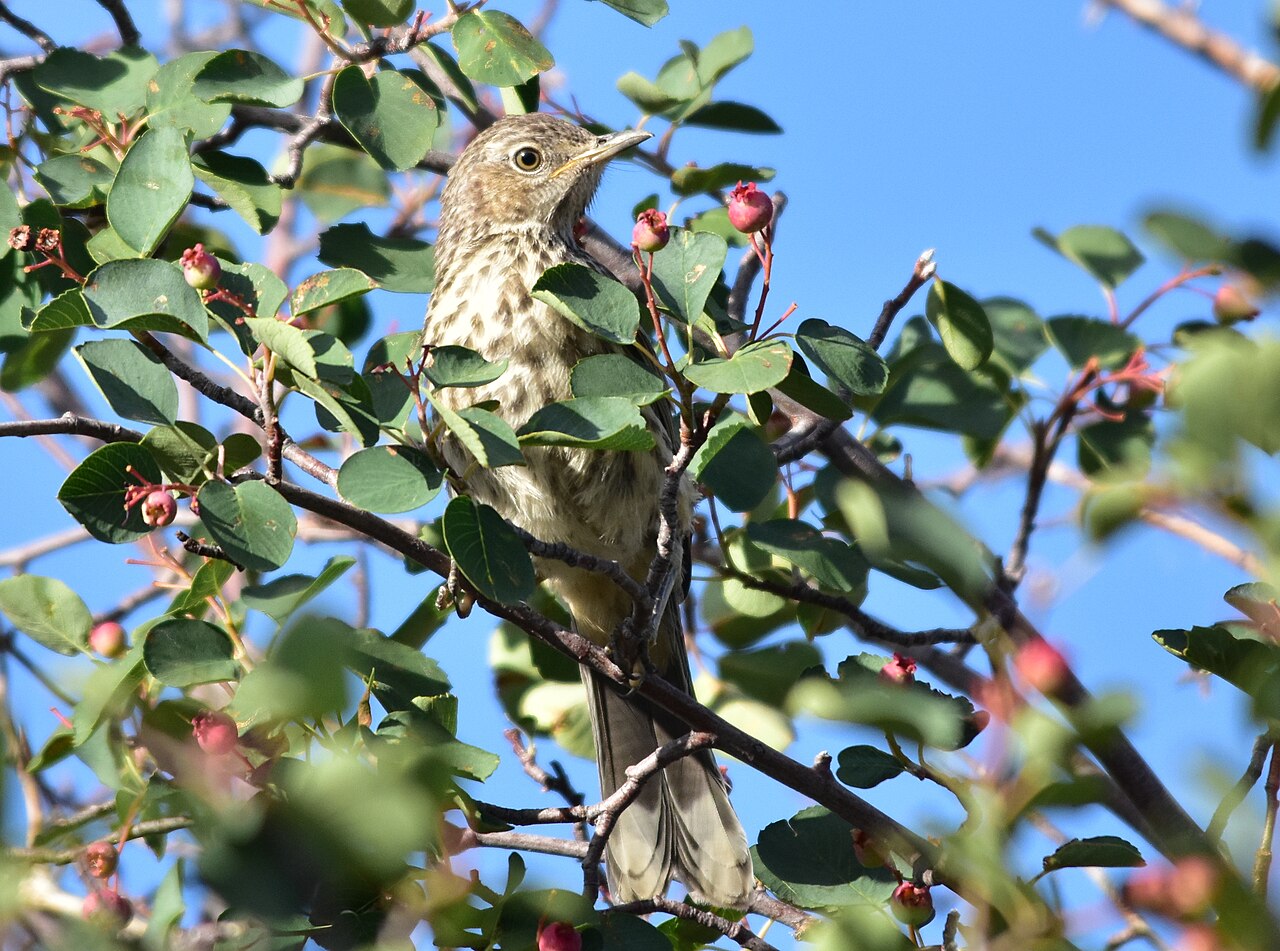
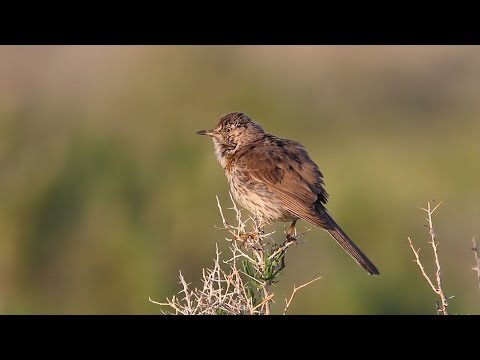
The Sage Thrasher (Oreoscoptes montanus) is the smallest thrasher and the voice of the sagebrush sea — gray-brown above, heavily streaked below, with white tail corners and a relatively short bill. Its song is a long, sustained mimic medley delivered from sage tops at dawn. It breeds only in big sagebrush country and winters in the Southwest and Mexico. Yards adjoining sagebrush attract them with native sage, open ground, and insect habitat. They share the steppe with the Say’s Phoebe and the Lark Sparrow.
Species Physical Profile & Morphometrics
The Sage Thrasher belongs to the mockingbird family (Mimidae) and is an obligate of western sagebrush steppe — breeding from the interior Northwest through the Great Basin and Rockies foothills, wintering in the Southwest.
The identification formula: small thrasher + heavy streaking + white tail corners + sagebrush. Sagebrush Sparrows are smaller and plain-faced; mockingbirds are larger, grayer, and unstreaked; Bendire’s Thrasher has arrowhead spots and desert habitat. In big sage, a streaked bird singing a marathon is this one.
Essential Morphometric Field Marks:
- Body Length & Mass: 8 to 9.1 inches (20–23 cm) and 1.4 to 1.9 ounces (39–54 grams) — the smallest thrasher, noticeably compact.
- Wingspan: 11.4 to 12.6 inches (29–32 cm); flight is a low undulating dash between sage plants, white corners flashing.
- Bill Structure & Color: A short, only slightly curved dark bill — thrasher-shaped but scaled down.
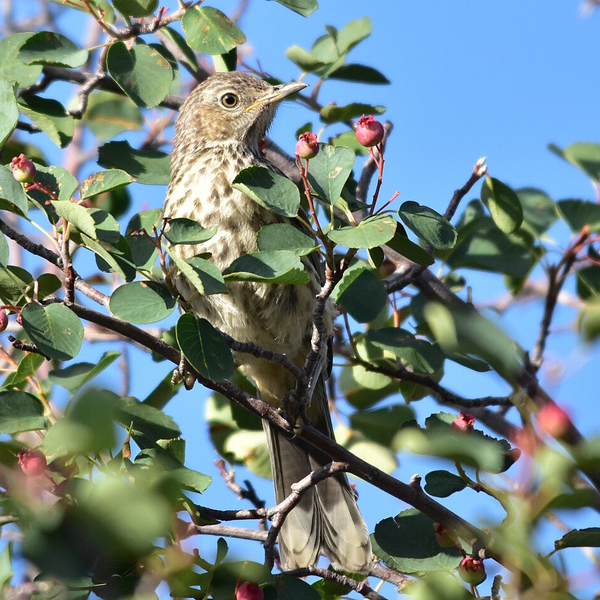
- Color Pattern: Gray-brown above, white below with heavy dark streaks, yellowish eye, and white tail corners — crisp and businesslike.
- Male vs. Female: The sexes look alike — he sings the marathons; she incubates low in the sage and both forage the open ground between plants.
The sage-top marathoner: singing for minutes without pause from the highest sage at dawn, a medley borrowed from every bird on the steppe.
Identical in plumage — she builds the cup on the ground or low in the sage and incubates while he guards and sings.
Sage Thrasher Vocalization Guide (0 Field Recordings)
The Sage Thrasher’s song is a long, sustained mimic medley — phrases flowing for minutes — one of the great voices of the West. All recordings below are real field audio via Wikimedia Commons — no simulations. For a deeper library, browse xeno-canto: Sage Thrasher.
1. The Marathon Medley
2. The Dawn Roll
3. The Chuck Call
Habitat, Range & the Sagebrush Sea
The Sage Thrasher lives only where big sagebrush grows — the steppe of the interior West, from valleys to mountain foothills — a habitat shrinking under development, fire, and invasive grasses.

The Obligate of the Big Sage
Breeding range spans the interior West from Washington and Montana to California and Colorado; winter takes the population to the Southwest deserts and Mexico.
For backyard birders: rural yards adjoining intact sagebrush steppe can host a singing male each spring — the bird arrives with the first warm days and sings until the sage blooms fade.
Backyard Behavioral Patterns & Social Dynamics
The Sage Thrasher is a sage-obligate ground forager with a marathon voice. Four behaviors explain most of what you will observe:
🎶 The Marathon Singer
The male sings continuously for minutes — a flowing mimic medley from the sage top, among the longest song bouts of any western bird.
🌿 The Sage Obligate
It breeds only in big sagebrush — nesting low in or under the shrubs and foraging the bare ground between them.
🏃 The Open-Ground Runner
It forages by running between sage plants — snatching insects from bare soil in quick dashes.
✈️ The Seasonal Shift
It migrates to the Southwest deserts for winter — trading sage for mesquite and saltbush until spring.
Problem: “How Do I Find a Sage Thrasher? What Should I Do?”
The three most common Sage Thrasher puzzles all have proven answers:
First, the identity check: in big sagebrush, a heavily streaked bird with white tail corners is the Sage Thrasher — Sagebrush Sparrows are smaller, plain-breasted, and short-songed; mockingbirds are larger and unstreaked. Second, the vanishing act: the bird dives into sage and disappears — do not chase; sit, and it remounts the sage top to sing within minutes. Third, the empty sage: where cheatgrass and fire have thinned the sage, the birds are gone — restoration with native sage and bunchgrass is the only fix, and it works.
Method 1: Set the Table — Big Sage & Bare Soil
Design for a sagebrush obligate:
-
Protect Big Sagebrush
Mature sage stands are the habitat — never burn, clear, or thin them.
-
Keep Bare Ground Between Plants
Open soil gaps between shrubs — the running-foraging lanes this species needs.
-
Control Cheatgrass
Invasive annual grass fuels fires — the single biggest threat to sage country.
-
Skip Insecticide
Ground insects are the diet — beetles, ants, and grasshoppers from the open steppe.
Method 2: Build the Habitat — Ground Nest Safety & Spring Song
Keep the sage intact and the ground safe, and the singer returns each spring:
-
Keep Cats Indoors
Nests sit on or near the ground — outdoor cats are catastrophic in sage country.
-
Delay Any Ground Work
No clearing or tilling April through July — nests are invisible until the young fledge.
-
Expect the Spring Arrival
Males arrive with warm days — the marathon medley from the sage top announces them.
-
Watch the Migration Windows
April–May and September — passage birds appear in unexpected patches of sage and shrub.
Tool Solution: Recommended Hardware for Sage Thrasher
Equipment matched to a sagebrush steppe songbird:
Intact Sagebrush Stand
Mature big sage with open ground between plants — the complete Sage Thrasher territory.
- • Plants: Big sagebrush
- • Rule: Never burn or clear
- • Bonus: Sage sparrows too
Open Bare Ground
Bare soil gaps between shrubs — the running lanes where the bird hunts its insects.
- • Feature: Open soil
- • Rule: No gravel cover
- • Bonus: Horned larks & phoebes
Ground Water Dish
Shallow water near sage cover — used in the dry months when the steppe bakes.
- • Depth: 1–2 inches
- • Placement: Beside sage
- • Bonus: Doves & sparrows too
Frequently Asked Questions
- Species Profile: The Sage Thrasher (Oreoscoptes montanus) is an 8–9.1 inch, 1.4–1.9 ounce mimid (Mimidae), band code SATH — the songster of the sagebrush sea.
- ID in One Look: Small streaked thrasher, white tail corners, big sage.
- The Sound: A minutes-long mimic marathon from the sage top; real field recordings above.
- Range & Habit: Interior West sagebrush breeder; winters in the Southwest; sage obligate.
- Feeder Formula: Sagebrush and open ground — feeders do not apply.
- The Habitat Warning: Cheatgrass and fire erase the sage, and the thrasher vanishes with it.
Bird Watching Log
Species: Sage Thrasher (Oreoscoptes montanus)
| Sage Thrasher (Streaked Breast Seen: Yes / No — Tail Corners Seen: Yes / No — Marathon Song Heard: Yes / No — Sage Intact: Yes / No — Date & Time: ___) | |